
1.5 x 1600 Thermal Transfer Ribbons and Labels: A Technical Specification Guide
Is your industrial printing setup truly optimized for high-volume output, or are you losing hours every week to avoidable roll changes? Choosing a 1.5 x 1600 ribbon specification is the efficiency sweet spot for narrow-format printing, yet many facilities still struggle with mismatched supplies that compromise scannability. You likely understand that constant downtime for media swaps is a direct drain on your operations. It's frustrating when a ribbon fails to transfer ink properly because the formulation wasn't matched to your specific label media.
This guide helps you master the technical requirements of 1.5 x 1600 industrial printing supplies to ensure maximum uptime and print quality for your Canadian facility. We'll clarify the differences between wax and resin ribbons, confirm compatibility with your hardware, and help you organize a reliable supply chain. You'll learn how to select the right materials to keep your production lines moving without interruption.
Key Takeaways
- Understand why the 1.5 x 1600 specification is the industry standard for high-volume, narrow-format industrial printing.
- Learn to match ribbon formulations like wax, wax-resin, or full resin to your specific label media to ensure scannability and durability.
- Identify critical hardware compatibility factors, including core sizes and maximum outer diameter, before placing your order.
- Discover how to optimize printhead pressure for narrow media to prevent uneven wear and extend the life of your equipment.
- Find out why sourcing from a specialized Canadian distributor ensures supply chain stability and technical support for your facility.
Understanding the 1.5 x 1600 Specification in Industrial Printing
The 1.5 x 1600 specification defines a thermal transfer ribbon that is 1.5 inches wide and 1600 feet long. This specific size is a mainstay in industrial environments across Canada. While consumer-grade printers often use much shorter rolls, the 1600-foot length is designed specifically for heavy-duty Thermal-transfer printing hardware. It serves as a specialized tool for high-volume tracking where precision and uptime are non-negotiable. You'll find this format provides a perfect balance between high-speed output and physical roll size.
Selecting the 1.5 x 1600 format allows facilities to target narrow media without wasting expensive ribbon material. If you're printing 1-inch or 1.25-inch labels, using a standard 4-inch ribbon results in significant ink waste. Matching the ribbon width to the media width ensures you only pay for the ink you actually use. This technical alignment is a key part of how efficient warehouses organize their consumables to protect their bottom line.
Width vs. Length: Why the 1.5-Inch Standard Matters
A 1.5-inch width is ideal for specialized labeling tasks. These often include:
- Laboratory vials and diagnostic tubes.
- Electrical cable wraps and wire markers.
- Small electronics components and PCB tracking.
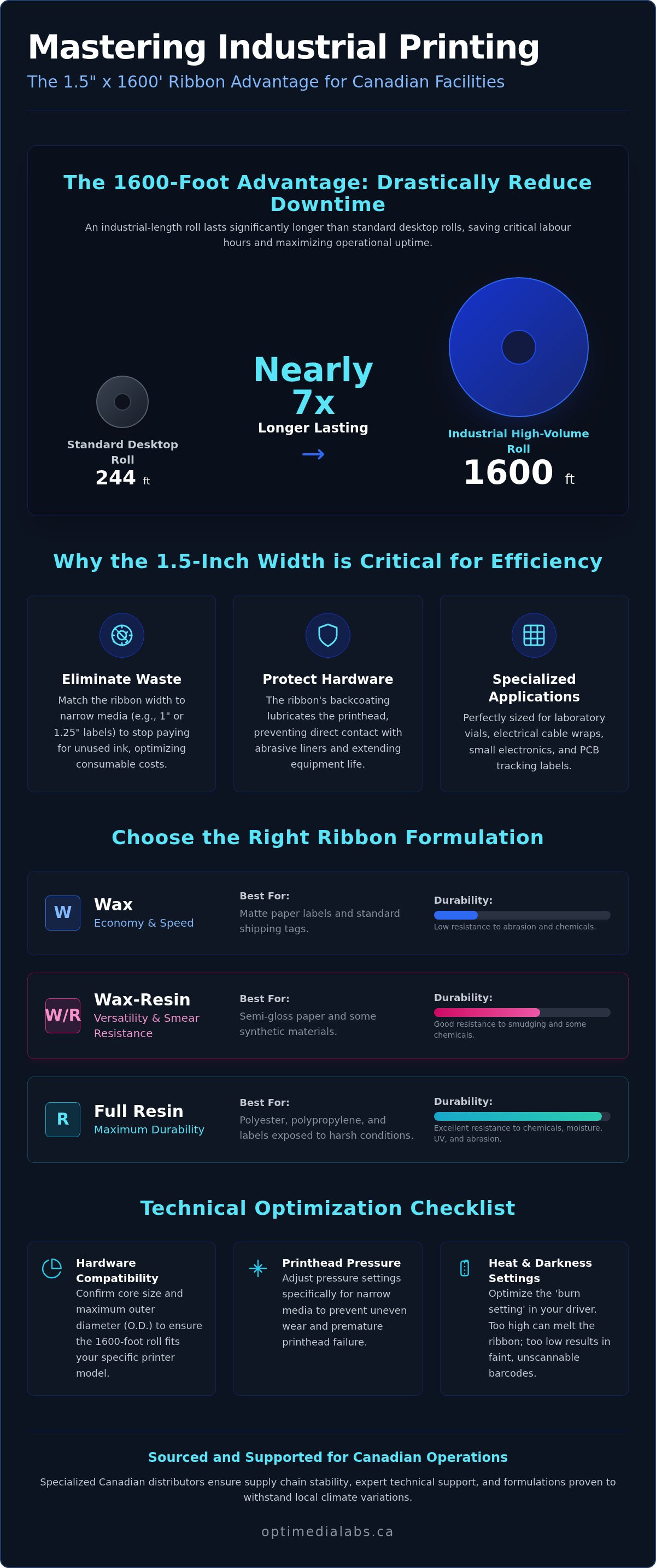
Using the correct width also preserves your hardware. When a ribbon is too wide, the unused portions can lead to uneven tension. Conversely, if the ribbon is narrower than the labels, the printhead may come into direct contact with the abrasive label liner. Using a 1.5-inch ribbon with matching media ensures the printhead is always lubricated by the ribbon's backcoating, which maximizes the life of your equipment.
The 1600-Foot Advantage for Canadian Facilities
The primary benefit of a 1600-foot roll is the drastic reduction in downtime. A standard desktop printer roll is often only 244 feet long. In contrast, the 1600-foot industrial rolls found in Zebra ribbons last nearly seven times longer. This means your team spends less time opening printer bays and more time processing shipments. For a high-volume facility, this shift can save dozens of hours of labour over a single quarter.
Storage and logistics also become more efficient with this format. While the rolls are physically larger, their high capacity means you need fewer individual units in stock to maintain your production levels. It's a streamlined approach that simplifies inventory management for busy Canadian procurement teams.
Ribbon Formulations: Choosing the Right 1.5 x 1600 Material
Selecting the correct 1.5 x 1600 ribbon involves more than just verifying the physical dimensions. The ink formulation determines how well the image survives the Canadian climate, from humid summers to freezing warehouse conditions. You must match the ribbon to your label material to avoid smudging or complete ink failure. While the 1600-foot length provides the quantity you need, the chemical makeup provides the quality your customers expect.
Narrow ribbons like the 1.5-inch format require precise heat management. Because the thermal printhead is concentrated on a smaller surface area, you should optimize your "burn setting" or darkness level in your printer driver. High heat can cause the ribbon to melt and tear. Conversely, insufficient heat results in faint, unscannable barcodes. In Canada, labels often transition from warm production floors to cold transport trucks. This temperature swing can cause condensation, which makes standard wax ink prone to smudging if the formulation isn't durable enough for the journey.
Wax Ribbons for Economy and Speed
Wax is the most cost-effective choice for 1.5 x 1600 rolls. It's ideally suited for matte paper labels and standard shipping tags. These ribbons use a lower melting point, which allows for high print speeds during long production runs. If your labels don't face heavy abrasion or chemical exposure, wax provides the best return on investment. It's the standard for high-volume logistics where labels are typically discarded after a single trip.
Resin and Wax-Resin for Industrial Durability
For synthetic materials like polyester or polypropylene, you need the staying power of resin. Wax-resin is a versatile middle ground that offers smear resistance on semi-gloss stocks. If your facility handles hazardous materials, full resin ribbons are essential for maintaining legibility under the OSHA Hazard Communication Standard. This ensures that safety warnings remain readable even when exposed to harsh solvents or outdoor elements. Resin formulations are designed to "lock" into the synthetic fibres of the label, creating a permanent bond that resists moisture and UV exposure.
Choosing between these materials depends entirely on your specific application and the life cycle of your product. If you're unsure which material fits your substrate, you can speak with our technical team for a media compatibility test.
Printer Compatibility: Will a 1600-Foot Roll Fit Your Equipment?
Before you invest in 1.5 x 1600 consumables, you must verify your hardware's physical capacity. These high-capacity rolls are significantly larger and heavier than standard desktop supplies. Industrial printers feature a rugged metal chassis designed to handle the weight and torque of a 1600-foot ribbon. If you try to force these rolls into a compact desktop unit, you risk motor burnout or mechanical jams. The maximum Outer Diameter (OD) for a ribbon of this length usually exceeds 80mm, which requires the spacious internal compartments found in high-performance machines.
Leading brands in the Canadian market, such as Zebra printers, Afinia, and Toshiba, offer dedicated industrial lines built specifically for this specification. These machines utilize heavy-duty drive systems that maintain precise tension even as the roll diameter shrinks during a long shift. You should realize that using industrial-grade ribbons on underpowered hardware leads to inconsistent print darkness and premature printhead failure. Organizing your facility around the correct hardware ensures that your 1.5 x 1600 supplies deliver the efficiency they promise.
Core Size and Spindle Requirements
The most common compatibility hurdle is the core size. A 1.5 x 1600 ribbon almost always comes on a 3-inch (76mm) industrial core. Most desktop printers are limited to a 1-inch core spindle. If your facility currently uses desktop hardware, you'll need an external roll stand or a spindle adapter to accommodate the larger diameter. However, native industrial hardware remains the superior choice for maintaining consistent back-tension. Managing these high-volume printing tasks also requires robust digital infrastructure. You can learn more about coordinating your hardware and data in our Professional Guide to Barcode Labeling Software.
Verifying Ink-In vs. Ink-Out Configurations
Another critical technical detail is the ribbon's winding direction. Thermal ribbons are either Coated Side Out (CSO) or Coated Side In (CSI). This refers to which side of the polyester film carries the ink. Using the wrong configuration will result in zero ink transfer and may leave a sticky residue on your printhead. Consider these brand-specific standards:
- CSO (Coated Side Out): The standard for Zebra and Afinia industrial printers.
- CSI (Coated Side In): Common for brands like Sato or older Datamax systems.
If you're unsure which version you have, perform a simple "tape test." Press a piece of adhesive tape against the outer surface of the ribbon. If the ink pulls off onto the tape, it's a CSO ribbon. If the ink stays on the film, it's likely a CSI ribbon. Checking this before ordering your 1.5 x 1600 supplies prevents unnecessary downtime and return shipping costs.
Optimizing Print Quality with 1.5-Inch Narrow Media
Printing on 1.5-inch media presents unique mechanical challenges for industrial hardware. Most high-performance printers are built to accommodate 4-inch wide supplies. When you run a 1.5 x 1600 ribbon, the pressure across the printhead becomes unbalanced. You must adjust the tension toggles on the printhead assembly to centre the pressure directly over the narrow ribbon. This prevents the "walking" effect where the ribbon slides toward one side, causing vertical wrinkles or ink smearing. Correct calibration ensures that high-density barcodes remain crisp and scannable throughout the entire 1600-foot roll.
Modern industrial printers often include ribbon-saving features that are highly effective with narrow formats. These mechanisms lift the printhead during non-print areas, which reduces friction and extends the life of your hardware. If you notice "ghosting" or a faint double image, it's often a sign of static buildup or incorrect tension. Ensure your printer is properly grounded and that the ribbon take-up spindle provides enough resistance to keep the 1.5-inch film taut. Uneven tension across such a narrow strip can cause the film to fold, creating white voids in your printed images.
Printhead Maintenance for 1600-Foot Cycles
Because a 1.5 x 1600 roll lasts significantly longer than standard desktop supplies, it's easy for operators to forget routine cleaning. You should clean the printhead every time you replace the ribbon roll. Use isopropyl alcohol pens to remove the microscopic adhesive buildup that accumulates along the edges of narrow media. This buildup is often more pronounced on narrow rolls because the mechanical pressure is concentrated on a smaller surface area. Failure to clean the head leads to "dead pixels" that can render barcodes unreadable. For more information on maintaining your fleet, consult our Industrial Labeling Solutions Canada guide.
Software Calibration for Narrow Formats
Your software settings must match your physical media exactly to avoid registration errors. In programs like BarTender or NiceLabel, set your page width to 1.5 inches and ensure the margins are zeroed out. You also need to select the correct sensor type. Gap sensors are standard for die-cut labels, but 1.5-inch rolls often use black mark sensors for more precise registration in high-speed environments. If your printer skips labels or feeds blank stock, it's likely a calibration error in the driver. You can find detailed setup instructions in our guide to Mastering Barcode Labeling Software.
If you're experiencing persistent quality issues or scannability failures with your narrow-format printing, contact our support specialists for a technical consultation.
Sourcing 1.5 x 1600 Consumables from OptiMediaLabs Canada
Reliable supply chains are the backbone of any Canadian manufacturing or logistics operation. When you rely on high-capacity consumables, a stockout can halt your entire production line. OptiMediaLabs Canada serves as a specialized national distributor, providing consistent access to 1.5 x 1600 ribbons and labels. We understand the technical nuances of industrial printing; we focus on matching ribbon formulations to your hardware to ensure your facility maintains maximum uptime. This prevents the risk of using sub-standard, third-party materials that could void your equipment warranties. Our inventory is specifically curated to support the rugged demands of high-volume labelling environments.
National Distribution and Reliable Inventory
Shipping heavy industrial rolls across the country requires a logistics partner that understands the urgency of your operations. We maintain a robust inventory of 1.5 x 1600 supplies to reduce lead times and shipping costs for our clients from coast to coast. Whether you need a single case or bulk procurement for multiple facilities, our distribution network is organized to handle high-volume demands with precision. We also offer custom slit ribbon services. If your application requires a width slightly different from the standard 1.5-inch spec, we can provide precision-cut ribbons that match your unique requirements. This level of customization helps you eliminate ink waste and protects your printheads from abrasive edges.
Consult with Our Labeling Specialists
Choosing the wrong ribbon formulation leads to expensive rework and equipment damage. Our team provides technical assessments of your current printer and ribbon configuration to ensure perfect compatibility. We don't just sell boxes; we act as a dependable facilitator for your labelling needs. You can request samples for testing on your specific industrial substrates, whether you're using synthetic polyester or standard matte paper. This testing phase is critical for verifying ink transfer and durability before you commit to a high-volume order. Our specialists help you navigate core size requirements and winding directions, ensuring a frictionless setup process once your supplies arrive. Our goal is to ensure your barcodes remain scannable and your labels stay legible throughout their entire life cycle.
Contact OptiMediaLabs Canada for a personalized quote on 1.5 x 1600 supplies
Optimizing Your High-Volume Labelling Operations
Mastering the 1.5 x 1600 specification is a critical step toward maximizing the efficiency of your facility's printing workflows. By matching the correct wax or resin formulation to your substrate and ensuring your industrial hardware is properly calibrated, you eliminate common scannability issues and reduce mechanical wear. The transition to 1600-foot rolls represents a strategic shift from frequent maintenance to sustained production uptime, allowing your team to focus on output rather than constant media swaps.
As an authorized Canadian distributor for Zebra and Afinia, OptiMediaLabs Canada provides the specialized technical support required to keep your industrial systems running at peak performance. We offer national shipping across Canada to ensure your high-volume supplies arrive exactly when they are needed most. Our specialists understand the rigorous technical demands of industrial environments and are ready to help you organize a more reliable, durable supply chain for your labelling tasks.
Contact our team for expert advice on 1.5 x 1600 consumables and find the perfect match for your specific printing requirements. We look forward to supporting your facility's growth.
Frequently Asked Questions
Does 1.5 x 1600 refer to inches or feet?
This specification refers to a width of 1.5 inches and a length of 1600 feet. In the industrial printing industry, width is measured in inches, while roll length is measured in feet or metres. A 1.5 x 1600 roll provides a high-capacity solution for narrow-format labelling, which reduces the frequency of media changes compared to shorter desktop rolls. This length is a standard for high-volume production environments across Canada.
Can I use a 1600-foot ribbon in a desktop thermal printer?
Generally, you cannot use a 1600-foot ribbon in a standard desktop printer. These rolls have a large outer diameter that exceeds the physical space inside a compact desktop chassis. Additionally, desktop printers typically use a 0.5-inch or 1-inch core, whereas 1600-foot ribbons require a 3-inch industrial core spindle. Attempting to force a larger roll can damage the printer's motor or cause severe mechanical jams that lead to expensive equipment repairs.
What is the difference between wax and resin for a 1.5-inch ribbon?
Wax ribbons are the most economical choice and work best on matte paper labels for general shipping and tracking. Resin ribbons are designed for synthetic materials like polyester, providing superior resistance to chemicals, heat, and abrasion. For a 1.5-inch ribbon, choosing resin is essential if the labels will face harsh Canadian industrial environments. This formulation ensures that your barcodes remain scannable even when exposed to moisture or extreme temperature fluctuations.
Will a 1.5 x 1600 ribbon work with my Zebra industrial printer?
Yes, a 1.5 x 1600 ribbon is compatible with most Zebra industrial printers, such as the ZT series, provided they support a 3-inch core. You must verify that the ribbon is wound in a Coated Side Out (CSO) configuration, which is the standard for Zebra hardware. These high-capacity rolls are specifically engineered to match the heavy-duty drive systems and spacious internal compartments found in high-performance industrial chassis used across Canada.
How do I know if my printer requires ink-in or ink-out ribbons?
You can determine the required configuration by checking your printer's documentation or performing a tape test. Zebra and Afinia printers typically use Coated Side Out (CSO), while brands like Sato often require Coated Side In (CSI). To test, press a piece of adhesive tape against the outer layer of the ribbon. If the ink sticks to the tape, the ribbon is CSO. If it doesn't, the ink is on the inner side. Knowing this prevents you from ordering incompatible supplies.
Is a 3-inch core standard for 1600-foot thermal ribbons?
A 3-inch (76mm) core is the industry standard for 1600-foot thermal ribbons. This larger core size is necessary to support the weight and tension of the high-capacity roll during high-speed printing. Industrial printers are equipped with spindles designed specifically for this size to ensure stable ink transfer. Desktop printers, by contrast, usually utilize smaller 1-inch cores, which are incompatible with the physical dimensions and weight of these high-volume industrial supplies.
Why is my 1.5-inch ribbon wrinkling during high-speed printing?
Ribbon wrinkling on narrow 1.5-inch widths is usually caused by uneven printhead pressure or incorrect ribbon tension. Because the ribbon is much narrower than the printhead, you must adjust the pressure toggles to centre the force directly over the media. If the pressure is unbalanced, the ribbon can "walk" or fold, creating vertical voids. Ensuring the take-up spindle provides consistent resistance will also help prevent these artifacts during high-speed production cycles.
How many labels can I print with one 1600-foot ribbon?
The total number of labels depends on the height of your individual labels plus the gap between them. Since there are 19,200 inches in a 1600-foot roll, a 1-inch high label would yield approximately 18,000 to 19,000 labels after accounting for the gaps. Using high-capacity rolls significantly reduces the number of changeovers required during a shift, which helps Canadian facilities maintain a more efficient and consistent output for high-volume tracking.