
1650*2.5 Thermal Transfer Ribbons: A Technical Guide for Canadian Industry

The Canadian thermal transfer ribbon market is projected to reach USD 760 million by 2031, growing at a rate of 10.2% annually. This surge reflects a nationwide push towards industrial automation and high-capacity logistics. You likely realize that even a minor mismatch in consumables can stall an entire production line. It's frustrating to purchase a 1650*2.5 ribbon only to find it doesn't fit your printer housing or that the ink formulation smudges on your GHS-compliant labels. These technical errors waste time and increase your operational costs.
This guide helps you master the technical specifications of 1650*2.5 thermal transfer ribbons to optimize your industrial labelling workflow. You'll learn how to confirm printer compatibility and select between wax, resin, or wax-resin formulations to ensure durable, clear barcodes. We also provide a roadmap for securing a reliable Canadian supplier to help you avoid high shipping fees and stabilize your supply chain. This information gives you the technical authority to manage your consumables with total confidence.
Key Takeaways
- Identify why the 1650-foot length is the preferred industrial standard for reducing roll change frequency and maximizing uptime.
- Confirm hardware compatibility for 1650*2.5 ribbons with leading industrial printers from Zebra, TSC, and Datamax.
- Evaluate wax, resin, and wax-resin formulations to ensure your labels withstand abrasion and meet strict Canadian regulatory requirements.
- Strengthen your supply chain by sourcing high-capacity consumables from a national distributor to avoid unpredictable customs fees and currency risks.
- Calculate the cost-per-foot advantages of high-capacity rolls compared to standard desktop alternatives to optimize your procurement budget.
Understanding the 1650*2.5 Specification: Length and Width
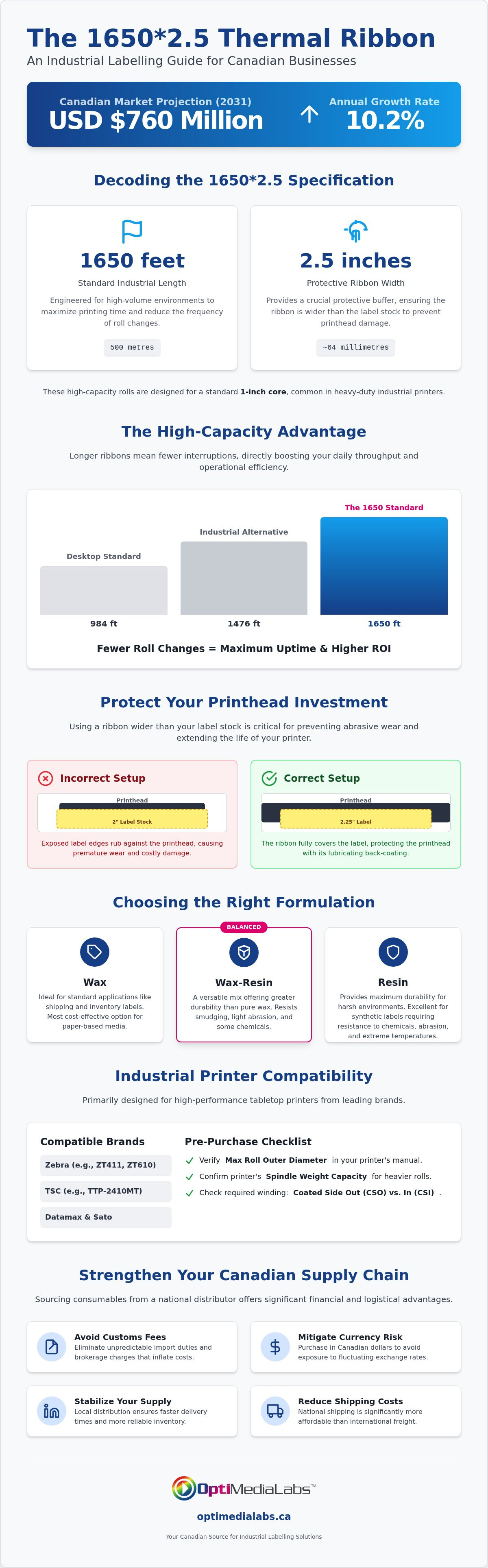
The 1650*2.5 specification is a high-capacity industrial standard. It consists of 1650 feet of ribbon length wound onto a 2.5-inch wide roll. This format is specifically engineered for high-volume environments where efficiency is paramount. Most industrial printers utilize a standard 1-inch core to accommodate these larger rolls. By utilizing Thermal-transfer printing technology, manufacturers can achieve high-speed output without frequent interruptions. You'll find these specifications common in heavy-duty shipping and manufacturing hubs across Canada.
High-volume industrial printing requires consistent uptime. A 1650-foot ribbon lasts significantly longer than standard 984-foot or 1476-foot alternatives. This reduces the frequency of ribbon changes, which directly impacts your daily throughput. When your operators spend less time reloading consumables, your overall production efficiency improves. It's a practical choice for facilities running multi-shift operations where every minute of downtime counts toward the bottom line. Sourcing these high-capacity rolls from Zebra ribbons or TSC ribbons ensures you maintain this momentum.
Metric vs Imperial Conversions for Canadian Buyers
Canadian buyers often encounter mixed units in technical documentation. While 1650*2.5 is an imperial designation, many technical sheets list 500 metres in length and approximately 64 millimetres in width. You must verify the outer roll diameter before purchasing. Industrial housings have specific clearances. If the roll diameter exceeds your printer's internal capacity, you'll face mechanical jams or be unable to close the printer cover. Always cross-reference the manufacturer's maximum roll outer diameter with the ribbon's technical data sheet to ensure a seamless fit.
The Role of Ribbon Width in Printhead Longevity
The 2.5-inch width serves a critical mechanical purpose. It provides a protective buffer for your printhead. In thermal transfer printing, the ribbon should always be slightly wider than the label stock. If you use a 2-inch ribbon for 2-inch labels, the edges of the label stock can rub directly against the printhead. This abrasive contact leads to premature wear and expensive replacement costs. Using a 2.5-inch ribbon for 2-inch or 2.25-inch labels ensures the printhead is fully lubricated by the ribbon's back-coating. This simple alignment protects your investment and extends the life of your hardware.
Compatibility: Which Industrial Printers Use 1650-Foot Ribbons?
Industrial printers are designed for heavy workloads. Unlike desktop models that support short ribbon lengths, industrial tabletop models have the internal chassis clearance for 1650-foot rolls. Confirming your 1650*2.5 ribbon is compatible requires checking both the physical roll diameter and the spindle's weight capacity. Most high-performance units from Zebra, TSC, and Datamax are built for these larger consumables. Following industrial printer compatibility standards ensures your hardware and supplies work together to produce scannable, compliant barcodes for the global supply chain.
Zebra Industrial Series Compatibility
Zebra's high-end models are the most common hosts for this format. The Zebra ZT411 and ZT610 series are specifically engineered to accept high-capacity rolls. Older workhorses like the 110Xi4 also support this length. When selecting Zebra Ribbons, ensure your printer's supply spindle is adjusted for the added weight. A full 1650-foot roll is significantly heavier than standard rolls; improper tensioning can lead to ribbon wrinkle or motor strain.
TSC and Other Industrial Brands
TSC printers offer robust support for high-capacity consumables. The TSC TTP-2410MT and the MB240 series are primary examples of hardware that utilizes the 1650-foot standard. You should always consult your hardware manual to verify the maximum ribbon length capacity. While many Datamax models also support this size, the internal clearance varies by model year. Using TSC Ribbons in these machines helps maintain high uptime by reducing the need for manual intervention during long print runs.
Technical compatibility extends beyond physical size. You must verify if your printer requires "Coated Side Out" (CSO) or "Coated Side In" (CSI) ribbon winding. Zebra typically uses CSO, while some older Datamax or Sato models may require CSI. If the ink side faces the wrong direction, the ribbon will not transfer to the label. Additionally, check the outer roll diameter. A 1650-foot ribbon usually results in a larger roll that may rub against the printer's internal casing if the clearance is too tight. If you are unsure about your specific hardware requirements, you can request a technical compatibility check from a specialist.
Formulation Guide: Wax, Resin, or Wax-Resin for 2.5" Ribbons?
Selecting the right ink formulation for your 1650*2.5 ribbon is just as critical as hardware compatibility. The high-capacity 1650-foot length is standard in industrial environments, but the ink type determines whether your labels survive the supply chain. You must match the ribbon to your specific label material and the final environment. This includes considering whether the product stays in a temperature-controlled warehouse or moves through an outdoor storage yard.
Full wax ribbons are the most economical choice. They are ideal for standard paper labels used in general shipping and logistics. While they offer excellent print density, they lack the durability needed for long-term exposure. If your labels will be handled frequently or subjected to friction, a wax ribbon may smudge. This potentially renders barcodes unreadable and disrupts your inventory tracking.
When to Choose Resin for 1650*2.5 Applications
Full resin ribbons are essential for high-stress applications involving chemical drums, medical supplies, or outdoor assets. These ribbons pair best with synthetic materials like polyester or polypropylene. Full resin ribbons provide the maximum level of thermal and chemical resistance required to maintain barcode legibility during extreme Canadian winter temperature fluctuations. This durability ensures compliance with GHS standards for hazardous materials in industrial workplaces.
When using resin, you must ensure your thermal transfer label printers are set to the correct heat and speed. Resin requires higher energy settings to fuse properly with synthetic stocks. Failure to adjust these settings can result in poor ink transfer or "ghosting" on the label surface.
Wax-Resin: The Versatile Middle Ground
Wax-resin ribbons, often called hybrids, offer a balance of cost and performance. They provide enhanced smudge and scratch resistance compared to full wax. This makes them ideal for semi-gloss paper and some poly-based stocks. This formulation supports high-speed printing without sacrificing barcode clarity. It's a reliable choice for high-volume manufacturing lines that require both speed and precision.
Using a wax-resin 1650*2.5 ribbon allows for professional-grade results across a wide variety of substrates. It is a cost-effective solution for retail labelling and distribution centres where durability is required but full resin is unnecessary. You get the benefit of sharp, crisp edges on small fonts and complex barcodes. This ensures high first-scan rates in automated sorting systems, which helps maintain your operational efficiency.
Performance Benefits: Why 1650-Foot Rolls Increase ROI
Investing in the 1650*2.5 ribbon format provides a measurable boost to your operational return on investment. While technical compatibility and ink formulation are vital for print quality, the physical length of the roll drives your bottom line. High-capacity consumables allow your facility to maintain momentum during peak production cycles. By transitioning to these larger rolls, you reduce the total cost of ownership for your labelling infrastructure. This shift impacts everything from direct labour costs to your environmental footprint.
One of the primary financial advantages is the lower cost-per-foot. Industrial rolls are more economical than shorter desktop-sized alternatives because they require less packaging and fewer plastic cores per kilometre of material. Additionally, long production runs benefit from consistent print quality. Frequent roll changes introduce opportunities for mechanical misalignment or tensioning errors. A single 1650-foot run ensures uniform ink transfer from the first label to the last, which minimizes the risk of rejected batches due to unreadable barcodes.
Calculating Downtime Savings
Downtime is a significant hidden cost in Canadian manufacturing. Moving from standard 300-metre rolls to 500-metre (1650ft) rolls represents a 66% increase in capacity per roll. If your operators spend five minutes changing a ribbon and recalibrating the printer, reducing those interruptions by over half creates substantial annual labour savings. For a facility running multiple shifts, this extra uptime translates into hundreds of additional production hours. You can explore more ways to streamline your facility in our Industrial Labeling Solutions Canada guide. These cumulative efficiencies allow your team to focus on high-value tasks rather than routine maintenance.
Storage and Handling of High-Capacity Consumables
Maintaining the integrity of your 1650*2.5 ribbons requires proper storage and handling. Thermal ribbons are sensitive to heat and humidity, which can cause the ink layers to stick or degrade. Store your rolls in a climate-controlled centre at temperatures between 5°C and 35°C. Proper inventory management ensures you rotate stock effectively, using older rolls first to maintain optimal performance levels.
Handling wider 2.5-inch formats requires attention to detail to avoid ribbon wrinkle. Wrinkling occurs when the ribbon is not perfectly parallel to the printhead, leading to unsightly streaks across your barcodes. Ensure your supply and take-up spindles are correctly tensioned for the weight of a high-capacity roll. If you notice consistent tracking issues, it may be time to inspect your printer's alignment. If you need help selecting the right supplies for your specific environment, you can contact our technical team for a personalized consultation.
Sourcing 1650*2.5 Thermal Ribbons in Canada
Sourcing your 1650*2.5 ribbons from a domestic distributor eliminates the complexities of international trade. With the 50% ad valorem tariff on U.S. printing and paper products effective as of August 22, 2026, importing consumables across the border carries a heavy financial burden. Sourcing nationally allows you to bypass these significant costs and avoid the unpredictability of currency fluctuations. You gain a stable price point and a predictable supply chain for your high-volume operations. This stability is essential for maintaining consistent production schedules without unexpected overhead spikes.
Domestic sourcing also provides access to localized technical expertise. Matching a 1650*2.5 ribbon to your specific hardware requires precise knowledge of Canadian industrial standards and environmental conditions. You can find more detailed insights in our Professional Guide to Label Printer Consumables. Working with a specialist ensures that your wax, resin, or hybrid formulations are perfectly suited to your specific label stock. This technical alignment prevents costly errors and ensures your barcodes remain scannable throughout their lifecycle.
The OptiMediaLabs Canada Advantage for National Procurement
OptiMediaLabs Canada maintains a broad inventory of Zebra and TSC compatible 1650-foot ribbons. We understand that industrial facilities require rapid replenishment to maintain uptime. Our direct-to-warehouse shipping covers all Canadian provinces, ensuring that your consumables arrive without the delays associated with cross-border logistics. We focus on industrial-grade durability and performance, providing the reliability you need for professional environments. This national coverage supports the federal "Buy Canadian" procurement policy framework, which prioritizes domestic goods and suppliers.
Our team at OptiMediaLabs Canada offers professional support to help you select the correct formulation for your application. Whether you need full resin for chemical resistance or a versatile wax-resin hybrid, we provide the technical clarity required for a successful implementation. This partnership approach helps you organize your labelling workflow and reduce long-term operational costs. We prioritize transparency and ease of use to ensure your procurement process remains frictionless.
How to Order Your Industrial Consumables
Before you finalize your order, verify your printer model and label material compatibility. As discussed in previous sections, ensuring the correct "Ink Out" or "Ink In" winding is essential for proper ink transfer. High-volume manufacturing facilities should also consider bulk purchasing options. Ordering in larger quantities reduces your cost-per-unit and simplifies your inventory management. It also ensures you have a buffer against sudden shifts in market demand or logistical disruptions.
Check your printer manual for the maximum roll outer diameter one last time. This simple step prevents mechanical fitment issues at the point of installation. When you're ready to secure your supply, you can Shop Industrial Thermal Transfer Ribbons at OptiMediaLabs Canada. Our streamlined ordering process is designed for the busy professional who values precision and efficiency. We are here to support your long-term success with reliable, high-performance consumables.
Optimizing Your Industrial Labelling Strategy
Mastering your consumable strategy ensures your production lines remain operational and efficient. Selecting the correct 1650*2.5 ribbon helps you protect your hardware and reduce the frequency of manual interventions. You now understand how to match wax, resin, or hybrid formulations to your specific substrate while maintaining compatibility with your Zebra or TSC industrial printers. These technical choices directly impact your facility's daily throughput and long-term hardware health.
As a national Canadian distributor, OptiMediaLabs Canada provides the stability and specialized expertise your business requires. We are specialists in Zebra and TSC hardware, offering expert technical support for all industrial consumables. Sourcing nationally helps you avoid customs delays and provides a reliable path to high-performance results. When you're ready to optimize your procurement process, Browse our selection of High-Capacity Industrial Ribbons or speak with our specialists. We look forward to supporting your industrial labelling goals with precision and reliability.
Frequently Asked Questions
What does the 1650*2.5 specification mean for thermal ribbons?
The 1650*2.5 specification identifies a thermal transfer ribbon with a total length of 1650 feet and a width of 2.5 inches. In metric units, this translates to approximately 500 metres by 64 millimetres. This high-capacity format is specifically engineered for industrial-class tabletop printers. It's a standard choice for high-volume manufacturing environments in Canada where reducing the frequency of roll changes is a priority for maintaining consistent operational uptime.
Can I use a 1650-foot ribbon in a desktop thermal printer?
No, you cannot typically use a 1650-foot ribbon in a compact desktop printer. Desktop models are designed for smaller footprints and usually only support ribbon lengths between 74 and 300 metres. The physical outer diameter of a 1650-foot roll is far too large for the internal housing of desktop units. Attempting to force a larger roll can damage the printer's spindle or motor assembly due to the excessive weight and size.
Why should I use a 2.5-inch ribbon for 2-inch wide labels?
You should use a slightly wider ribbon to protect your printhead from premature wear and physical damage. A 2.5-inch ribbon provides a protective buffer that prevents the edges of 2-inch labels from rubbing directly against the printhead elements. This lubrication from the ribbon's back-coating extends the life of your hardware. It's a professional strategy to avoid the high replacement costs associated with abrasive contact between label stock and the delicate printhead surface.
What is the difference between Wax and Resin for 1650-foot rolls?
Wax is the most economical ink formulation for standard paper labels and general shipping applications. Resin is a high-durability alternative designed for synthetic materials like polyester or polypropylene. While wax can smudge under friction, resin offers superior resistance to chemicals, moisture, and extreme temperatures. For many Canadian industrial applications, a wax-resin hybrid provides a versatile middle ground, offering better durability than full wax without the higher energy requirements of full resin formulations.
How do I know if my Zebra printer needs Ink-In or Ink-Out ribbons?
Most Zebra industrial printers utilize "Ink-Out" (CSO) ribbons, where the ink side faces away from the core. You can verify your specific requirements by performing a simple tape test. Press a piece of adhesive tape against the outer surface of the ribbon roll. If the ink pulls off onto the tape, it is an Ink-Out roll. If the ink only transfers from the inner side, you have an Ink-In (CSI) roll. Consult your manual for confirmation.
Is 1650 feet the longest ribbon available for industrial printers?
While 1650 feet is a common high-capacity standard, some specialized industrial printers can support rolls up to 600 or 900 metres in length. However, 1650 feet is widely considered the "sweet spot" for compatibility across major brands like Zebra and TSC. It balances maximum uptime with the physical weight limits of standard industrial spindles. Always check your printer's maximum roll diameter and length specifications before upgrading to larger capacities to ensure mechanical clearance.
Will using a 2.5-inch ribbon damage my 4-inch printhead?
No, using a 2.5-inch ribbon on a 4-inch printhead is perfectly safe as long as the ribbon is wider than your label stock. The ribbon protects the specific area of the printhead it covers during the printing process. However, if you consistently print narrow labels on a wide printhead, the uncovered sections may accumulate dust or adhesive residue. It's best practice to periodically clean the entire printhead surface to maintain consistent heat transfer and prevent uneven wear.
How should I store 1650-foot thermal ribbons to prevent degradation?
Store your 1650*2.5 ribbons in a cool, dry centre away from direct sunlight and heat sources. Ideal temperatures range between 5°C and 35°C with relative humidity between 20% and 80%. Exposure to high temperatures can cause the ink layers to bond together, which is a condition known as "blocking" that makes the ribbon unusable. Keep the rolls in their original packaging until needed to protect them from dust and physical damage during long-term storage.