
1.7" x 300m Thermal Transfer Ribbons: The 2026 Canadian Buying Guide
Could a ribbon width of just 1.7 inches be the single point of failure in your entire 2026 production schedule? It's a frustrating reality for many Canadian logistics managers; selecting the wrong 1.7 x 300 thermal transfer ribbon often leads to snapped rolls, smudged barcodes, and significant printer downtime. You likely already realize that narrow labels require precise tensioning and a specific material bond to survive the rigours of industrial handling. If the ribbon doesn't match the substrate, your high-speed Zebra or TSC printer becomes a bottleneck rather than an asset.
We'll help you master the technical specifications and material requirements for 1.7-inch industrial ribbons to ensure peak printer performance and label durability. You'll learn how to identify exact hardware compatibility, select a ribbon material that resists chemicals, and navigate the shifting trade landscape to secure a stable supply chain within Canada. This guide covers everything from the latest GHS compliance standards to choosing between wax and resin formulations for the Canadian climate. We provide the technical clarity you need to keep your labelling operations running at maximum efficiency.
Key Takeaways
- Understand how the 1.7 x 300 specification integrates with 1-inch industrial cores to prevent ribbon snapping and maintain optimal tension.
- Identify the ideal ink formulation for your substrate, ensuring your labels resist smudging and chemicals in various Canadian climates.
- Verify hardware alignment with Zebra and TSC systems to maximize printhead longevity and protect your equipment warranty.
- Master cost-per-label calculations to improve ROI by matching ribbon width precisely to narrow-web label requirements.
- Establish a reliable Canadian supply chain for specialized consumables to avoid production delays and minimize inventory downtime.
Understanding the 1.7 x 300 Specification for Industrial Printing
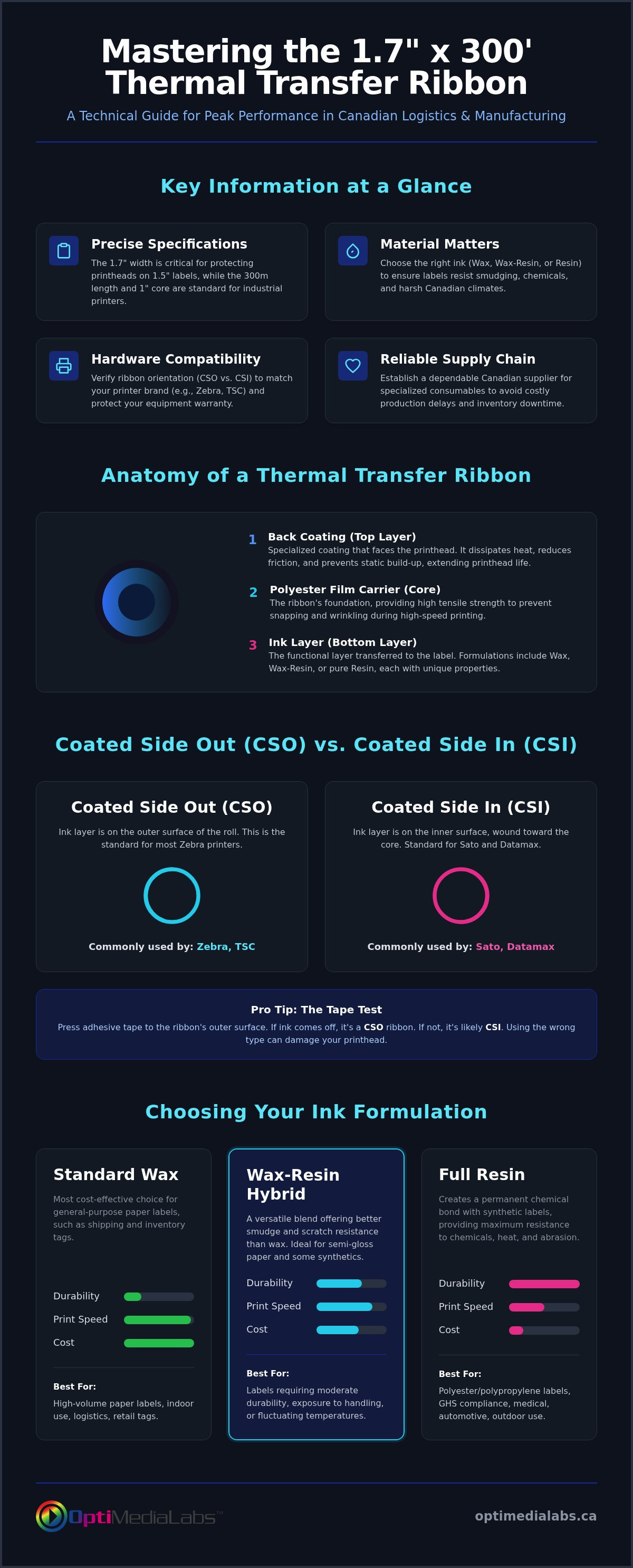
The 1.7 x 300 specification refers to a thermal transfer ribbon that measures 1.7 inches (43mm) in width and 300 metres (984 feet) in length. These rolls are engineered for a standard 1-inch core, which is the universal requirement for mid-range and high-volume industrial printers. Selecting a 1.7-inch width is a deliberate choice for operators running 1.5-inch labels. This slight over-width provides a critical buffer that ensures full edge-to-edge ink coverage. It also protects the printhead from direct contact with the abrasive label substrate, extending the life of your hardware. The 300m length serves as the ideal middle ground for busy production lines. It provides enough capacity for high-volume throughput without exceeding the physical diameter limits of standard printer housings.
The Anatomy of a Thermal Transfer Ribbon
Every 1.7 x 300 ribbon utilizes a sophisticated three-layer architecture designed for precision. The core foundation is a polyester film carrier that provides the necessary tensile strength to prevent snapping. Above this sits the ink layer, while the underside features a specialized back coating. This Thermal-transfer printing technology depends on that back coating to dissipate heat and reduce friction during the printing process. Without a high-quality back coating, the printhead would suffer from premature wear and static build-up. In narrow media applications, the 1.7-inch width is especially effective at preventing "ribbon wrinkle." It maintains consistent tension across the narrow print path, which helps eliminate the diagonal streaks that often occur when using wider ribbons for small labels.
Coated Side Out (CSO) vs Coated Side In (CSI)
Ink orientation determines whether a ribbon is compatible with your specific printer brand. Most Zebra printers are designed for Coated Side Out (CSO) ribbons, meaning the ink layer faces away from the roll's centre. In contrast, brands like Sato or Datamax often require Coated Side In (CSI) configurations. Loading the incorrect orientation will result in the ink facing the wrong way, which can lead to ink melting directly onto the printhead. This causes immediate downtime and requires extensive cleaning. You can verify your orientation with a simple tape test. Press a piece of adhesive tape against the outer layer of the ribbon roll. If the ink pulls off onto the tape, you have a CSO ribbon. Ensuring this match is vital for the health of your thermal transfer label printers and the clarity of your barcodes.
Material Selection: Wax vs Resin for 1.7-Inch Applications
Selecting the correct ink formulation is just as vital as the physical dimensions of the 1.7 x 300 roll. You must match the ribbon's thermal properties to your label substrate to ensure long-term legibility and scan accuracy. In Canada, extreme temperature fluctuations in unheated warehouses or transit hubs can compromise ink adhesion. Lower-quality ribbons often become brittle during cold winters or smudge under high humidity. Adhering to GS1 General Specifications ensures that your barcodes remain compliant and scannable throughout their lifecycle, regardless of these environmental rigours.
Standard Wax Ribbons for General Purpose
Standard wax is the most cost-effective solution for high-volume paper labelling. These ribbons are ideal for shipping labels, retail tags, and indoor inventory management. Because wax melts at a lower temperature, you can use lower energy settings on your printer. This protects the printhead and allows for faster throughput. However, wax offers limited resistance to smudging and chemicals. If your labels are handled frequently or exposed to moisture, the print quality may degrade quickly. For basic logistics where cost-per-label is the primary driver, wax remains the standard choice.
High-Performance Resin and Wax-Resin Hybrids
When your application involves synthetic materials like polypropylene or polyester, a resin thermal transfer ribbon is mandatory. Resin-based inks create a chemical bond with the substrate, providing maximum resistance to heat, abrasion, and solvents. Wax-resin hybrids offer a versatile middle ground, delivering sharp images on semi-gloss paper and some synthetics. These hybrids provide better smudge resistance than pure wax while maintaining a higher print speed than pure resin. Industrial sectors like food processing or chemical manufacturing must meet strict environmental resistance standards where pure resin is often the only formulation that survives wash-down cycles. Near-edge technology requires specific 1.7 x 300 ribbons designed for floating printheads that operate at significantly higher speeds than traditional flat-head models. If you're struggling to find the right balance between durability and speed, you can get expert advice on material compatibility for your specific industry.
Compatibility Guide: Zebra, TSC, and Industrial Printer Alignment
Confirming hardware compatibility is the most critical step in your procurement process. While many industrial printers feature a standard 4-inch printhead, using a 1.7 x 300 ribbon is a common and efficient practice for narrow-web applications like component marking or vial labelling. You must ensure the ribbon width exceeds the label width to prevent the abrasive edges of the label from scoring the delicate printhead. For businesses complying with OSHA's Hazard Communication Standard, maintaining this hardware alignment is vital. It ensures that safety warnings remain crisp and legible even after exposure to industrial friction or chemicals. Using a ribbon that's too narrow for your media will cause uneven wear patterns, eventually leading to costly printhead replacements.
Zebra Industrial Series Requirements
Zebra's ZT series, specifically the ZT230 and ZT411 models, are the workhorses of the Canadian pharmaceutical and electronics sectors. These machines are designed to handle 300m ribbon lengths effortlessly within their internal housings. When you standardize on Zebra 300m ribbons, you reduce the frequency of roll changes and maintain consistent tension across the print path. You'll need to adjust your printer's darkness settings when switching between wax and resin formulations to achieve the best contrast. Because the 1.7-inch width concentrates heat in a smaller area of the printhead, start with a lower darkness setting and increase it incrementally until the barcode edges are sharp and well-defined.
TSC and Godex Hardware Synchronization
TSC and Godex printers offer excellent versatility for mid-range production volumes. Many of these models utilize a 1-inch core adapter that must be properly seated to keep the 1.7-inch ribbon centred. If the ribbon isn't perfectly aligned with the media, you'll experience tracking issues or "ribbon walk," where the ribbon slides toward the edges of the spindle. Selecting high-quality TSC ribbons ensures that the leader tape and trailer are compatible with the printer's sensors, preventing false "ribbon out" errors. You should also optimize your tension controls. A 300m roll has significant mass; if the take-up tension is too high, the ribbon may snap during high-speed print jobs. Regularly cleaning the platen roller will help maintain the friction necessary to pull the ribbon through the assembly without slippage.
Maximizing ROI and Print Quality in Canadian Manufacturing
Operational efficiency in Canadian manufacturing often hinges on the small details of consumable management. To calculate your exact cost-per-label, divide the total cost of a 1.7 x 300 roll by the number of labels yielded. A 300-metre roll offers 300,000mm of linear ink. If you're printing 50mm high labels, a single roll provides roughly 6,000 units. By matching your ribbon width closely to your label width, you eliminate the expense of unused ink and prevent the printhead from overheating on exposed sections. Many industrial printers now feature a "ribbon save" mechanism. This function lifts the printhead during non-print areas, which significantly extends the life of the 1.7 x 300 ribbon and reduces mechanical wear. Adopting a strict preventative maintenance schedule is equally critical. Clean the printhead with isopropyl alcohol every time you replace a ribbon roll to prevent debris build-up and maintain crisp barcode edges.
Managing High-Volume Print Runs
Reducing downtime during ribbon changeovers is essential for maintaining high-speed production lines. Standardizing on 300m lengths across your facility allows for predictable maintenance intervals. Regional distribution centres in Canada benefit from bulk procurement, which ensures a steady supply and lower shipping costs per unit. You can further optimize your workflow by integrating barcode labeling software Canada to track consumable usage in real-time. This data-driven approach allows you to anticipate reorder points and avoid the "ribbon out" errors that halt shipping departments during peak seasons.
Durability Testing for Harsh Environments
Canadian manufacturing environments demand consumables that withstand more than just standard friction. Your 1.7" resin ribbons must survive extreme temperature swings, especially for products shipped in unheated trailers during winter months. Smudge and scratch resistance benchmarks are non-negotiable for industrial barcodes that face heavy handling. To ensure GHS compliance, you must pair the correct resin formulation with a compatible synthetic label. This pairing ensures that chemical warnings and tracking data remain legible even if exposed to solvents or moisture. If you aren't sure which material combination meets your regulatory requirements, request a technical consultation to verify your setup.
Sourcing 1.7 x 300 Ribbons in Canada: Why OptiMediaLabs?
Sourcing specialized consumables in the Canadian market requires more than just a vendor; it requires a technical partner who understands the nuances of narrow-web printing. As a dedicated label printer distributor Canada, OptiMediaLabs prioritizes the availability of 1.7 x 300 ribbons to meet the specific demands of the pharmaceutical and component manufacturing sectors. We maintain a central Canadian supply point to ensure national shipping logistics remain fast and reliable, even as trade patterns and tariffs on imported paper products shift. Our team provides expert consultation to help you match the correct ribbon formulation to your thermal transfer label printers, ensuring every barcode meets the highest scan-quality benchmarks. This technical authority allows us to troubleshoot ribbon snapping or tension issues before they cause significant downtime on your production floor.
Reliability and Brand Protection
Using genuine ribbons is a fundamental requirement for protecting your industrial printer warranty. While generic, low-quality imported ribbons might seem cost-effective initially, they often carry hidden costs. These include premature printhead wear and inconsistent ink release that leads to label rejection. OptiMediaLabs is an authorized distributor for Zebra and TSC hardware, and our consumables are tested to meet high-performance industrial standards. We help you avoid the friction and static build-up associated with sub-par materials, preserving your hardware investment and ensuring long-term operational stability. Our commitment to quality means we only stock ribbons that provide consistent back-coating protection, which is essential for maintaining the integrity of your 4-inch printheads when running narrow 1.7-inch media.
Streamlined Procurement for 2026
Managing a complex supply chain in 2026 requires a proactive approach to inventory. We help you set up recurring supply orders for 1.7 x 300 ribbon stocks, which eliminates the risk of stockouts during high-demand periods. Our clients have direct access to technical data sheets and compliance certifications, which are essential for industries governed by strict regulatory frameworks like the Federal Plastics Registry or GHS standards. Whether you're a regional distribution centre or a high-volume manufacturing plant, we can provide custom quotes tailored to your specific throughput requirements. This methodical approach to procurement allows your team to focus on production rather than troubleshooting consumable failures. You can rely on our national shipping coverage to keep your operations running smoothly from coast to coast.
Optimizing Your Narrow-Web Labelling Strategy for 2026
Precision is the foundation of high-performance industrial printing. Choosing the correct 1.7 x 300 ribbon ensures that your Zebra or TSC hardware operates at peak efficiency while protecting your printhead from premature wear. You've learned how to match ink formulations to your substrate and why a dedicated Canadian supply point is vital for avoiding trade-related delays. Standardizing on these technical specifications reduces downtime and guarantees that your barcodes remain scannable in the harshest environments.
As an authorized Zebra and TSC supply partner, OptiMediaLabs provides national Canadian distribution and specialized technical support for every industrial application. We help you navigate complex material requirements and regulatory compliance with ease. Our expertise ensures that your labelling operations remain stable, secure, and cost-effective throughout the year. Browse our full selection of 1.7" x 300m ribbons at OptiMediaLabs to secure your 2026 supply chain today. We look forward to supporting your manufacturing success with reliable, high-quality consumables.
Frequently Asked Questions
What does the 1.7 x 300 specification mean for thermal ribbons?
The 1.7 x 300 specification indicates a ribbon width of 1.7 inches (43mm) and a total length of 300 metres (984 feet). This size is engineered for industrial printers with a 1-inch core. The 300m length is a standard capacity for mid-range hardware, providing a balance between roll diameter and high-volume output. It's a specialized width often used in pharmaceutical and electrical component labelling where narrow media is common.
Will a 1.7-inch ribbon work in a 4-inch wide Zebra printer?
A 1.7-inch ribbon is fully compatible with 4-inch Zebra industrial printers like the ZT series. You don't need to use a full-width ribbon for narrow labels. However, you must ensure the ribbon is wider than your label stock. This prevents the abrasive edges of the paper from coming into direct contact with the printhead. Using this narrow ribbon on a wide printer helps reduce consumable waste and lowers your overall cost-per-label.
How do I know if I need a wax, resin, or wax-resin 1.7-inch ribbon?
Your choice depends entirely on your label material and environmental requirements. Use wax ribbons for standard paper shipping labels and indoor storage. Opt for wax-resin hybrids if you're using semi-gloss or synthetic materials that require smudge resistance. If your labels face harsh chemicals or extreme Canadian winters, a pure resin formulation is necessary. We recommend resin for any application requiring GHS compliance or long-term outdoor durability to ensure barcodes remain scannable.
What is the difference between CSO and CSI ribbons for 300m rolls?
CSO and CSI refer to the side of the polyester film that holds the ink. Coated Side Out (CSO) is the standard for Zebra and TSC printers, meaning the ink faces away from the core. Coated Side In (CSI) is typically required for Sato or Datamax hardware. Loading the wrong orientation can melt ink onto your printhead, causing immediate failure. Always perform a tape test to verify the ink side before installation on your 300m rolls.
Can I use a 1.7-inch ribbon for 1.7-inch wide labels?
It's best to use a ribbon that is slightly wider than your label. If you have 1.7-inch labels, a 1.7-inch ribbon might leave the edges of your printhead exposed to the label's abrasive surface. This exposure leads to premature wear and scoring of the heating elements. We generally suggest using a 1.7-inch ribbon for labels that are 1.5 inches wide or smaller. This provides a safe buffer for edge-to-edge coverage and hardware protection.
How many labels can I print with a single 300m ribbon roll?
You can calculate your yield by dividing the 300,000mm of ribbon by the height of your label plus the gap. For a standard 2-inch (50mm) high label with a 3mm gap, a single 300m roll will produce approximately 5,660 labels. This high capacity reduces the frequency of roll changes, which minimizes downtime in busy production environments. Tracking these metrics helps you maintain a lean inventory and accurately forecast your annual consumable expenditures.
Why is my 1.7-inch ribbon wrinkling during high-speed printing?
Wrinkling usually happens due to uneven tension or poor alignment on the ribbon spindles. Because a 1.7-inch ribbon is narrow, it's more sensitive to centring errors on a 4-inch wide spindle. Ensure the roll is perfectly centred and that the take-up tension isn't set too high for the ribbon's thickness. High-speed printing also generates significant heat; if your darkness setting is too high, the ribbon may stretch and cause diagonal streaks or ghosting on your labels.
Does OptiMediaLabs ship 1.7 x 300 thermal ribbons across Canada?
OptiMediaLabs provides national shipping coverage for 1.7 x 300 thermal ribbons across all Canadian provinces. We operate as a specialized distributor with a central supply point to ensure consistent inventory availability for industrial clients. Our logistics network is designed for speed and reliability, helping you avoid production halts caused by stockouts. We also offer technical support to help you synchronize your ribbons with your specific hardware for optimal print quality and durability.