
170Xi4 Ribbons: A Canadian Buyer’s Guide to Thermal Transfer Supplies
Your high-speed Zebra 170Xi4 is only as reliable as the consumables you feed it. Selecting the wrong 170xi4 ribbons often leads to premature printhead failure or unreadable barcodes that stall your entire supply chain. It's a costly mistake that many industrial operators don't realize they're making until the downtime starts piling up and maintenance costs spike.
You likely agree that consistency is everything in a high-volume warehouse. It's frustrating when labels smudge in cold storage or when high shipping duties from US suppliers eat into your operational budget. With new Health Canada front-of-package regulations and Quebec's Bill 96 language requirements, your labels must be more durable and legible than ever before. This guide allows you to master the technical specifications and material compatibility required to select the perfect thermal transfer ribbon for your specific application. We will examine the chemistry behind wax, wax-resin, and resin formulations. You'll also learn how sourcing from a reliable Canadian partner reduces ribbon breaks and protects your hardware investment for the long term.
Key Takeaways
- Understand how ribbon quality affects the 12 ips print speed of your Zebra 170Xi4 to ensure maximum uptime during high-volume production cycles.
- Identify the specific technical differences between wax, wax-resin, and resin formulations to select the most durable 170xi4 ribbons for your application.
- Master the "ink-to-substrate" bond by matching your matte or gloss label stock with the correct chemical formulation and printer heat settings.
- Eliminate cross-border shipping delays and unexpected customs duties by sourcing your industrial thermal transfer supplies from a national Canadian distributor.
- Protect your hardware investment and reduce printhead replacement frequency by choosing premium ribbons designed for industrial-grade performance.
Optimizing High-Volume Production with Zebra 170Xi4 Ribbons
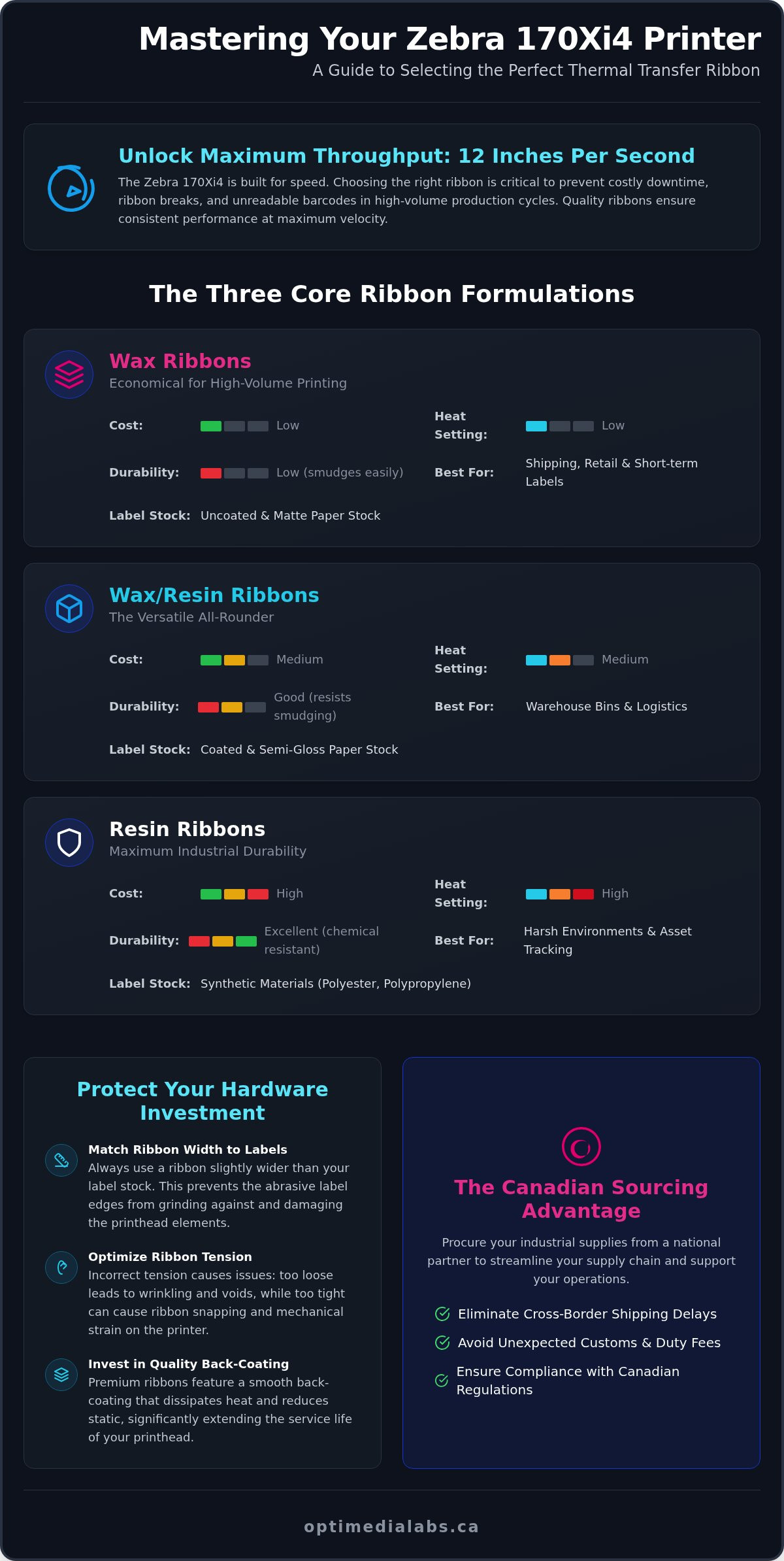
The Zebra 170Xi4 is a heavy-duty industrial workhorse designed for the most demanding 24/7 manufacturing environments. It achieves a maximum print speed of 12 inches per second (ips), which is essential for high-volume logistics and distribution centres. However, maintaining this velocity requires high-performance 170xi4 ribbons that can keep pace with the mechanical demands of the printer. Poor quality supplies often fail at these speeds, leading to ribbon snaps or inconsistent ink transfer that results in unscannable barcodes.
The efficiency of thermal transfer printing technology depends on the ribbon’s ability to handle intense heat. High-speed printing generates significant friction between the printhead and the ribbon. Quality back-coating is vital here; it dissipates heat and acts as a lubricant to prevent the printhead from wearing down prematurely. Without this protective layer, you'll face frequent hardware failures and expensive repairs.
Common signs of ribbon-related downtime include:
- Frequent ribbon breaks during high-speed runs.
- Barcode voids or streaks caused by ribbon wrinkling.
- Build-up of "ribbon dust" or tacky residue inside the printer mechanism.
- Unreadable, light print despite using high heat settings.
The Impact of Ribbon Tension and Width
The 170Xi4 supports a maximum ribbon width of 170mm (6.7 inches). Always ensure your ribbon is slightly wider than your label stock. This practice ensures that the ribbon’s back-coating covers the entire printhead, preventing the abrasive label edges from grinding against the delicate heating elements. Proper tensioning is equally critical. If the tension is too loose, you'll see diagonal wrinkles across your labels. If it's too tight, you risk mechanical strain and sudden ribbon snapping during a print job.
Protecting Your Industrial Investment
Choosing bargain 170xi4 ribbons often leads to false savings. While the initial roll price might be lower, the long-term cost of frequent printhead replacements quickly erodes any perceived benefit. Zebra Certified Supplies are engineered specifically to minimize friction and dissipate static, significantly extending the service life of your 170Xi4 printhead. High-quality back-coating prevents the static build-up that can fry sensitive electronic components. By sourcing premium supplies from a reliable Canadian partner, you reduce roll change frequency and maintain the crisp, scannable quality required for national compliance.
The Big Three: Wax, Wax/Resin, and Resin Formulations
Thermal transfer ribbons aren't interchangeable. The chemical composition of the ink layer dictates how well the image bonds to your label under the intense heat of the 170Xi4 printhead. To maintain compliance with Canadian labeling regulations, you must select a formulation that matches your durability requirements. Choosing the correct Zebra Ribbons ensures your barcodes remain crisp and scannable even at maximum production speeds. Each formulation requires specific energy settings on the 170Xi4 to optimize print quality and printhead life.
Wax Ribbons: Economical High-Volume Printing
Wax ribbons are the standard choice for high-volume shipping and retail applications. These 170xi4 ribbons use a high percentage of wax-based components that melt at relatively low temperatures. This allows the 170Xi4 to operate at lower energy settings, which preserves the life of your printhead heating elements. While they're highly cost-effective, wax ribbons have limited durability. They smudge easily under friction and don't hold up well in high-moisture or high-friction environments. Use these for short-term labels that won't face harsh handling.
Wax/Resin Ribbons: The Versatile All-Rounder
This formulation offers a versatile middle ground for most industrial users. By blending wax and resin, these ribbons create a significantly stronger bond on semi-gloss or coated paper stocks. They're excellent for warehouse bin labels and logistics where labels might face rough handling or outdoor exposure. You get enhanced resistance to smudging and mild chemical exposure compared to pure wax. They require slightly higher heat settings but provide the scratch resistance needed for long-term tracking in a busy warehouse.
Resin Ribbons: Maximum Industrial Durability
Resin ribbons provide the highest level of durability for synthetic materials like polyester and polypropylene. They're engineered to withstand harsh chemicals, solvents, and extreme temperatures. Because resin has a much higher melting point than wax, these 170xi4 ribbons require higher printhead energy settings on the 170Xi4 to achieve a permanent bond. This ensures that critical safety or identification labels remain legible for the life of the product. They're the gold standard for manufacturing environments where labels face oils, cleaners, or extreme cold storage conditions.
If you need help determining the right durability level for your specific facility, reach out to our technical support team for a material compatibility recommendation.
Material Compatibility: Matching Ribbons to Your Label Stock
Achieving a perfect "ink-to-substrate" bond is the cornerstone of any reliable industrial labelling system. On a high-performance machine like the Zebra 170Xi4, which handles media up to 6.6 inches wide, this bond must form almost instantaneously at speeds reaching 12 ips. If the ribbon chemistry doesn't physically fuse with the label surface, the resulting print will be vulnerable to flaking, smudging, or complete erasure during transit. Mastering this relationship is vital for implementing Industrial Labeling Solutions Canada that remain durable throughout the entire national supply chain.
Coated vs. Uncoated Paper Stocks
Uncoated paper stocks possess a porous texture that naturally allows wax-based 170xi4 ribbons to penetrate and anchor into the fibres. This absorption creates a deep, matte finish with the high contrast required for achieving 100% scan rates in automated sorting centres. However, many Canadian manufacturers prefer flood-coated or gloss paper for its professional appearance or mild moisture resistance. These smooth, non-porous surfaces don't absorb ink; instead, the ribbon must "bite" into the coating through a chemical bond. For these applications, a wax-resin blend is the minimum requirement to ensure barcodes don't smear when the label passes through high-speed automated applicators or high-friction conveyor systems.
Synthetics and Harsh Environments
Synthetic substrates are the only viable option when your application moves into harsh environments where paper fails. Polypropylene (BOPP) is a staple in Canadian food processing and cold storage facilities due to its moisture resistance. These labels require specialized wax-resin or resin 170xi4 ribbons to maintain legibility in freezing temperatures. Without the correct resin content, the ink can become brittle and crack as the material contracts in sub-zero conditions. In more extreme industrial cases, such as chemical drum marking or aerospace components, polyester labels are mandatory. These must be paired with full resin ribbons to meet strict UL/CSA compliance standards. This combination provides the chemical and solvent resistance needed for safety labels that must remain legible for years. Testing your specific ribbon and label combination on the 170Xi4 prevents costly compliance failures and ensures your tracking data remains secure from the factory floor to the end user.
Procurement Strategies for Canadian Industrial Operations
Procurement for high-volume systems requires a focus on supply chain stability. Many Canadian operations face hidden costs when ordering from US suppliers. These include customs duties, brokerage fees, and unpredictable border delays that can stall a manufacturing line. By sourcing from a national distributor, you eliminate these variables and ensure price transparency. This strategic approach is detailed in our Professional Guide to Label Printer Consumables. Calculating the Total Cost of Ownership (TCO) means looking beyond the price per roll. You must account for administrative overhead, shipping expenses, and the potential cost of production halts.
Standardizing Roll Lengths for Efficiency
The Zebra 170Xi4 is built for speed and high-duty cycles. Using shorter 300m rolls increases the frequency of changeover downtime, which reduces your overall efficiency. Standardizing on Zebra 450m Ribbons reduces the number of times an operator must stop the line to reload the printer. This 50 percent increase in length directly translates to higher daily throughput and less mechanical wear from frequent starts and stops. Always store your 170xi4 ribbons in a climate-controlled centre. Canadian warehouses often experience extreme temperature swings that can cause ink layers to block or stick if they are not properly managed.
Bulk Purchasing and Stock Management
Ordering 170xi4 ribbons in case quantities is the most effective way to prevent sudden stock-outs. A production halt due to a missing ribbon is far more expensive than carrying a small amount of safety stock. Thermal ribbons generally have a shelf life of approximately one year when kept in cool, dry conditions away from direct sunlight. Working with a Canadian partner allows you to implement a Just-In-Time (JIT) supply chain strategy. You can maintain leaner inventory levels without the risk of a two-week delay at the border. This reliability is essential for facilities running 24/7 shifts where consumables must be available on demand.
If you are looking to streamline your consumables inventory, contact our experts for a bulk supply consultation to ensure your facility never faces a ribbon-related shutdown.
Sourcing 170Xi4 Ribbons from OptiMediaLabs
OptiMediaLabs serves as a dependable facilitator for Canadian manufacturers requiring consistent industrial supplies. We prioritize high-performance consumables that safeguard your hardware investment while maintaining peak output. Selecting the correct 170xi4 ribbons is a technical requirement that directly impacts the reliability of your production line. Our ordering process is designed for speed and transparency, allowing your procurement team to focus on core operations rather than managing logistics hurdles. We offer a streamlined path for procurement, ensuring that logistics firms and industrial facilities receive their supplies without the typical cross-border friction associated with international vendors. Our commitment to quality ensures that every roll meets the rigorous standards of high-volume manufacturing centres.
Technical Support and Expert Advice
Access to specialized knowledge is vital when managing high-speed equipment like the Zebra 170Xi4. Our specialists possess a deep understanding of the 170Xi4’s unique mechanical specifications and thermal requirements. This printer requires precision. We provide the technical authority needed to match ribbon chemistry to complex or synthetic substrates. We provide detailed guidance on heat settings and tensioning to ensure your 170Xi4 operates at its maximum 12 ips capability without compromising print quality. If you're transitioning from legacy systems or looking to optimize your current Thermal Transfer Label Printers, we offer the clarity and reassurance needed for a smooth integration. We help you eliminate the costly trial-and-error process by recommending formulations that guarantee crisp, scannable barcodes during every shift. Our team acts as a knowledgeable partner, focusing on the technical success of your labelling operations.
Your National Source for Industrial Labelling
We maintain a comprehensive inventory that includes premium supplies for Zebra, Afinia, and Epson systems. Our business model focuses on performance-driven consumables that reduce mechanical downtime and lower your frequency of printhead replacements. By positioning ourselves as a stable Canadian partner, we ensure your facility has a secure and predictable supply of 170xi4 ribbons for long-term operational needs. Our inventory management system tracks your usage patterns to help you anticipate your next bulk order, preventing the risk of a complete production halt. We value precision and customer satisfaction, providing the stability your business requires to meet evolving Canadian regulatory standards. Our national distribution network ensures that your bulk supplies arrive when needed, allowing you to maintain a lean and efficient inventory. We understand that manufacturing environments in Canada face unique logistical challenges, and we are here to provide the support necessary to keep your printers running 24/7.
Reliability in your supply chain starts with choosing a partner that understands the industrial environment. Browse our full selection of Zebra 170Xi4 Ribbons today to secure your industrial consumables from a trusted Canadian distributor.
Securing Your Industrial Labelling Supply Chain
Selecting high-performance 170xi4 ribbons is a critical technical decision that dictates your facility's daily throughput and long-term hardware health. By matching the correct chemical formulation to your specific label substrate, you ensure that barcodes remain crisp and scannable even at the 170Xi4’s maximum speed of 12 ips. This precision protects your hardware investment and minimizes the frequency of expensive printhead replacements. Using the right consumables prevents the smudging and legibility issues that can lead to costly compliance failures.
Sourcing your supplies from a national partner eliminates the logistical friction of cross-border shipping and unexpected customs duties. OptiMediaLabs provides the industrial-grade stock and expert technical support required to keep your high-volume production lines moving without interruption. Our national Canadian distribution ensures that your bulk supplies are always available when your operations demand them. We prioritize stability and efficiency to help you maintain a resilient and predictable supply chain.
Contact our technical team today to optimize your thermal transfer supplies and secure a stable partner for your manufacturing needs. We look forward to helping you achieve a more efficient and reliable labelling process.
Frequently Asked Questions
What is the maximum ribbon width for the Zebra 170Xi4?
The maximum ribbon width for the Zebra 170Xi4 is 170mm, which is approximately 6.7 inches. This wide-format capability allows the printer to handle large-scale industrial labels for chemical drums and shipping pallets. Always ensure your 170xi4 ribbons are slightly wider than your label stock. This practice prevents the abrasive edges of the labels from grinding against the printhead, which significantly extends the life of your equipment heating elements.
Can I use direct thermal labels in a Zebra 170Xi4 without a ribbon?
Yes, you can use direct thermal labels in a Zebra 170Xi4 without a ribbon. The printer is designed to support both thermal transfer and direct thermal printing methods. You must adjust the printer settings in your software or via the front panel to "Direct Thermal" mode. This setting disables the ribbon sensor and adjusts the printhead temperature. While convenient, direct thermal labels are more sensitive to heat and light compared to thermal transfer solutions.
Why are my 170Xi4 ribbons wrinkling during high-speed printing?
Ribbon wrinkling at high speeds is usually caused by incorrect ribbon tension or an unbalanced printhead. On the 170Xi4, ensure the ribbon supply and take-up spindles are properly tensioned. If the tension is too loose, the ribbon will drift and fold. Additionally, check that your 170xi4 ribbons are loaded straight and that the printhead pressure is even across the entire width. Using a ribbon that is too narrow for the printer settings can also cause diagonal wrinkles.
How do I know if I need a wax/resin or a full resin ribbon?
Your choice depends on the label material and the environmental conditions the label will face. Wax/resin ribbons are the standard for semi-gloss paper and some synthetic materials, offering good smudge resistance for warehouse logistics. Full resin ribbons are mandatory for polyester or polypropylene labels used in harsh environments. If your labels will encounter chemicals, extreme temperatures, or heavy abrasion in a Canadian manufacturing centre, full resin provides the necessary permanent bond.
Will using non-Zebra brand ribbons damage my 170Xi4 printhead?
Using high-quality compatible ribbons will not damage your 170Xi4 printhead. The key is ensuring the ribbon has a premium back-coating to dissipate heat and reduce friction. While Zebra Certified Supplies are tested for performance, many industrial-grade compatible 170xi4 ribbons provide identical protection. However, poor-quality ribbons often lack adequate back-coating, leading to static build-up and premature printhead failure. Always source from a reliable Canadian distributor to guarantee the technical quality of your consumables.
What is the difference between ink-in and ink-out ribbons for Zebra printers?
The terms "ink-in" and "ink-out" refer to which side of the ribbon carries the ink coating. Zebra industrial printers, including the 170Xi4, require "ink-out" ribbons, also known as Coated Side Out or CSO. This means the ink faces the label during the printing process. Using an "ink-in" ribbon will result in the ink transferring onto the printhead rather than the label, which can cause immediate hardware damage and require extensive cleaning or replacement.
How long is a standard 170Xi4 ribbon roll and how many labels will it print?
Standard 170Xi4 ribbon rolls are typically available in lengths of 300 metres or 450 metres. A 450-metre roll is generally preferred for high-volume operations to reduce changeover downtime. The number of labels you can print depends on the height of your label. For example, a 450-metre roll will print approximately 2,950 labels that are 6 inches high, assuming a small gap between labels. Always calculate your usage to maintain an efficient supply chain.
Does the 170Xi4 require a specific core size for its ribbons?
Yes, the Zebra 170Xi4 requires ribbons wound on a standard 1-inch (25.4mm) internal diameter core. This is the industrial standard for high-capacity thermal transfer printers. Using the correct core size ensures the ribbon fits securely on the supply and take-up spindles, preventing slippage during high-speed 12 ips printing. Ensure your cores are not crushed or damaged before loading, as this can cause uneven tension and lead to barcode voids or sudden ribbon breaks.