
Afinia Digital Label Finisher Review: 2026 Canadian Guide
What if the most expensive part of your label production wasn't the ink or the substrate, but the physical shape itself? For many Canadian manufacturers, the high cost of custom metal dies and the weeks of waiting for tooling delivery create a significant bottleneck that drains capital. This Afinia digital label finisher review addresses the frustration of these fixed costs and the waste associated with pre-die-cut rolls that simply don't align with modern production speeds.
You'll discover how to bring professional finishing in-house to achieve full creative freedom and eliminate minimum order quantities. We will evaluate technical specifications across the DLF and DLP series, providing a clear breakdown of the ROI for your specific facility. OptiMediaLabs Canada provides the technical expertise and hardware necessary to streamline your roll-to-roll workflow. This guide offers a comprehensive path to reducing inventory costs and stabilizing your domestic supply chain through precision digital cutting technology.
Key Takeaways
- Eliminate the high cost and long lead times of custom metal dies by utilizing digital blade cutting technology for any label shape.
- Compare the technical capabilities of the DLF-140S, DLF-220S, and DLP-2200 to find the right footprint and speed for your specific production volume.
- This Afinia digital label finisher review details how transitioning to continuous blank rolls can significantly lower per-label costs and remove minimum order quantities.
- Streamline your finishing process by combining lamination, contour cutting, and slitting into one automated, seamless in-house workflow.
- Identify the logistics advantages of partnering with a national Canadian distributor for duty-free procurement and accessible technical expertise across the provinces.
What is an Afinia Digital Label Finisher and Why Does It Matter?
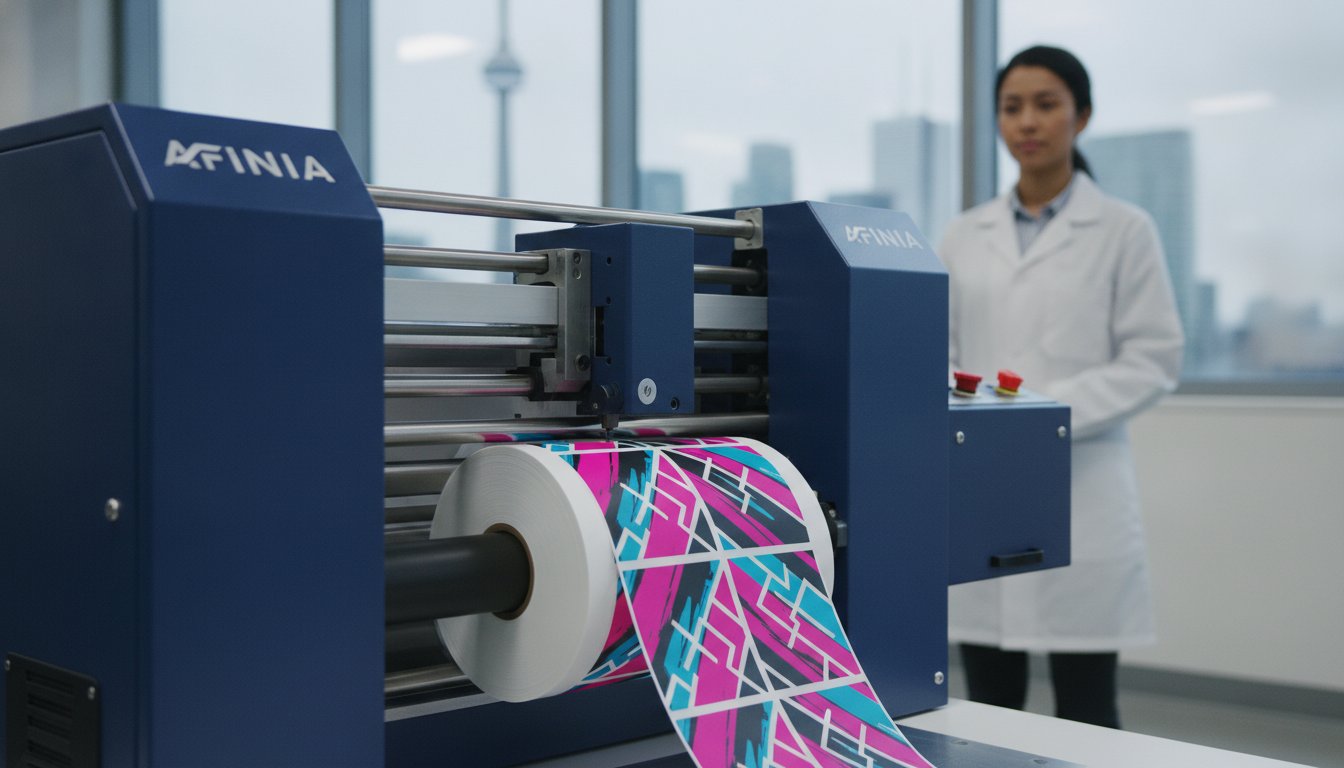
A digital label finisher is a high-performance roll-to-roll system designed to convert printed media into professional, shelf-ready products. It integrates multiple industrial processes, including lamination, contour cutting, waste matrix removal, slitting, and rewinding, into a single automated sequence. This Afinia digital label finisher review highlights how these systems provide a critical bridge between raw inkjet printing and final application. By consolidating these steps, businesses can move from a printed roll to a finished product in one pass.
The primary advantage lies in the digital nature of the system. Traditional finishing relies on rotary or flatbed dies, which are physical metal tools tailored to one specific shape. In contrast, Afinia label finishers utilize precision plotters guided by software. This shift allows for instantaneous shape changes without the need for physical tooling. It is an ideal solution for Canadian manufacturers managing multiple SKUs or those who frequently update their packaging designs.
The Problem with Traditional Die-Cutting
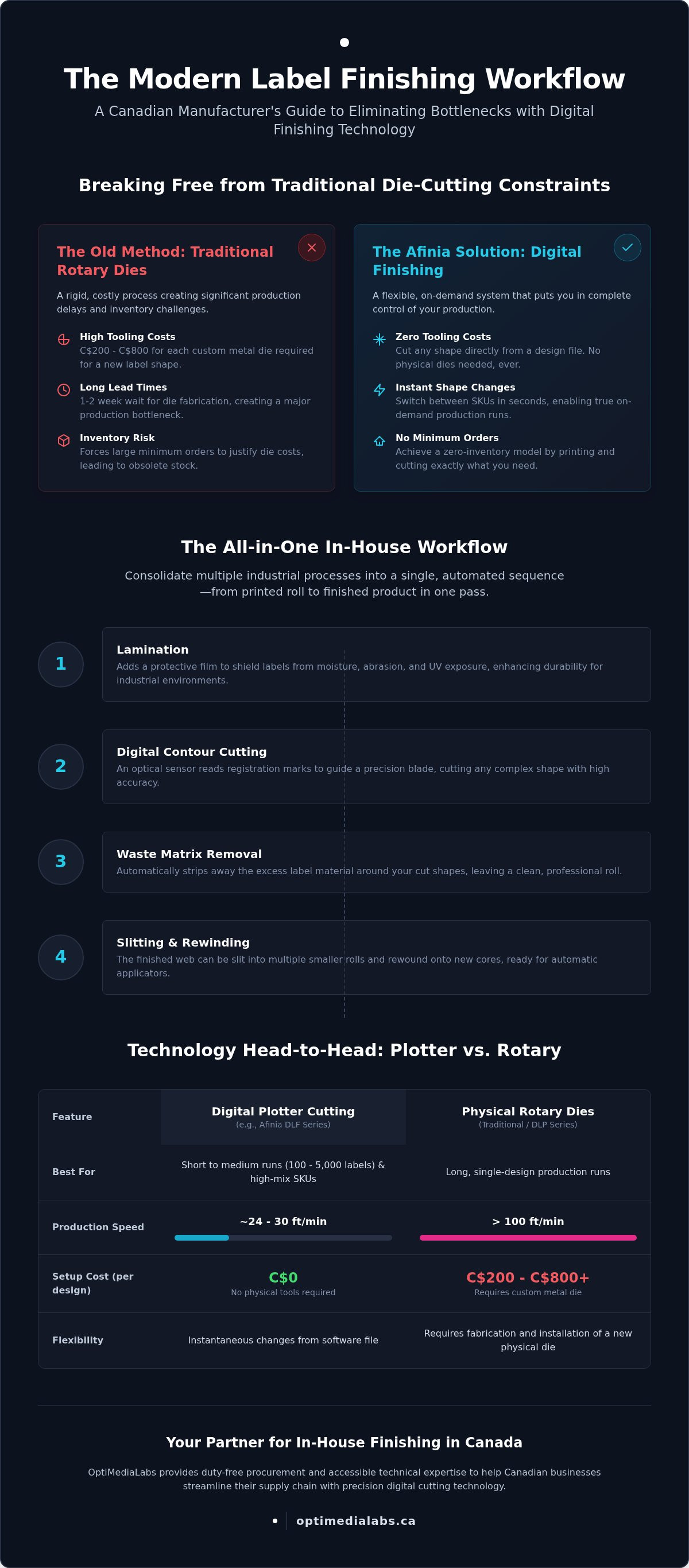
Traditional die-cutting creates a rigid production environment. Custom metal dies typically cost between C$200 and C$800 per design. Beyond the direct expense, the 1-2 week lead time for tool fabrication creates a significant production delay. This often leads to an inventory trap. Businesses feel forced to order thousands of labels at once to justify the initial die investment. Digital finishing enables a zero-inventory model. You can print and cut exactly what you need for today's production run, which eliminates the risk of obsolete stock.
Key Features of the Afinia Finishing Ecosystem
The Afinia ecosystem is built for durability and precision. It handles the heavy lifting of post-print production through three core functions:
- Lamination: This process adds a protective film layer over the print. It's vital for labels used in high-moisture environments or industrial settings where abrasion is a risk.
- Contour Cutting: Advanced optical sensors track registration marks to cut complex shapes. Whether it's a simple circle or a jagged custom logo, the plotter maintains high accuracy.
- Waste Removal: Also known as matrix removal, this feature strips away the excess material around the cut labels. It leaves clean, finished rolls on the rewind spindle that are ready for automatic applicators.
This all-in-one workflow ensures that your in-house production is as professional as any outsourced service. It provides the technical precision required for modern retail standards while maintaining the flexibility that Canadian small-to-medium enterprises need to stay competitive.
Technical Breakdown: Plotter Cutting vs. Physical Rotary Dies
Choosing between plotter technology and rotary dies depends entirely on your production volume and shape complexity. This Afinia digital label finisher review explores how these two distinct mechanisms serve different operational needs. The DLF series utilizes digital plotter technology; essentially precision knives guided by software. To maximize throughput, the DLF-220S employs dual-cutting heads that work in tandem to process the web faster than single-head systems. This allows you to cut any shape, from standard circles to complex brand logos, directly from a PDF file without waiting for a tool manufacturer.
The DLP series takes a different approach by utilizing magnetic cylinders and flexible dies. This rotary technology allows for significantly higher speeds during long-run production. While it requires a physical die, the magnetic cylinder makes the setup much faster than traditional heavy-duty presses. Both systems rely on black-mark registration to maintain precision. This optical sensor detects printed marks on the web to ensure every cut remains perfectly centred, even if the print shifted slightly during the initial roll-to-roll process.
Speed Considerations for Canadian Manufacturers
Speed is a variable factor in digital finishing. The DLF-220S typically operates at a linear speed between 24 and 30 feet per minute, but complex shapes with intricate corners will naturally slow the plotter heads down as they change direction. Industrial rotary presses can exceed 100 feet per minute, yet they lack the "instant change" capability of a plotter. Digital finishing finds its sweet spot for runs between 100 and 5,000 labels. For businesses managing dozens of SKUs, the time saved on setup often outweighs raw linear speed.
Lamination and Durability for Industrial Labels
In-line lamination is a standard feature that transforms standard paper into a rugged industrial product. This is particularly important for producing GHS compliant labels that must withstand harsh chemical exposure. Afinia finishers apply the laminate film before the cutting stage, which seals the ink and protects the substrate from UV degradation and moisture. This process ensures your labelling remains legible throughout the product's lifecycle.
Beyond protection, lamination allows you to realize better aesthetic results. You can apply gloss or matte finishes to standard inkjet paper stocks, which avoids the need to stock multiple types of specialized media. If you're unsure which technology fits your current workflow, you can request a technical consultation to review your specific label designs and volume requirements.
Comparing the Models: DLF-140S, DLF-220S, and the DLP-2200
Choosing the right hardware requires a clear understanding of your web width requirements and production volume. This Afinia digital label finisher review breaks down the three primary models in the ecosystem to help you identify the best fit for your facility. The DLF-140S is the entry-level solution, specifically designed for narrower 5.5-inch webs. It provides the same digital precision as larger units but with a smaller footprint, making it ideal for boutiques or labs with limited space. If you mainly produce small health and beauty labels or vape juice wraps, this compact unit offers the most efficient path to in-house finishing.
The DLF-220S serves as the workhorse for the majority of Canadian manufacturers. It expands your capabilities with an 8.6-inch width capacity and utilizes the dual-plotter heads mentioned previously to maximize throughput. For those requiring a complete end-to-end production line, the DLP-2200 is the industrial-scale "Digital Label Press." It often pairs the Afinia L901 directly with rotary finishing components. These finishers are highly compatible across various digital label presses, which allows you to upgrade your finishing capabilities without necessarily replacing your existing print fleet.
Tabletop vs. Full-Scale Production
The DLF-220S is a tabletop model that fits comfortably into a standard office or warehouse setting. It runs on standard 110V power, which simplifies installation in most Canadian commercial spaces. In contrast, the DLP-2200 is a floor-standing unit designed for 24/7 industrial environments. While it requires more floor space and sometimes specialized power drops, it handles massive rolls and higher tensions that tabletop units cannot manage. Transitioning to the DLP series is usually justified when your monthly volume consistently exceeds 25,000 labels.
Software and Ease of Use
Efficient finishing relies on intuitive software. Afinia's control software manages cut paths by reading the PDF data and coordinating the plotter movements. It works in tandem with industry-standard tools like BarTender or NiceLabel software. To minimize setup time, you can save specific cut profiles for recurring jobs. When you switch from a circular honey label to a rectangular chemical drum label, you simply load the preset. This digital workflow ensures that you spend more time producing and less time calibrating the equipment.
Calculating ROI: When Does In-House Finishing Make Sense?
Moving your label production in-house represents a strategic shift from operational expense to capital investment. This Afinia digital label finisher review focuses on the financial logic of eliminating third-party dependencies. The most immediate saving comes from the price difference between media types. Continuous blank rolls are significantly less expensive than pre-die-cut rolls. By switching to continuous media, you eliminate the premium paid for converted rolls and the risk of alignment errors that lead to scrapped material. Precise slitting and rewinding further reduce waste by ensuring every roll is perfectly wound for your automatic applicators.
Time-to-market is another critical factor in the ROI equation. Outsourcing often involves waiting weeks for a production slot and shipping. With an in-house finisher, you can ship product labels the same day they are designed. This agility allows you to respond to market trends or urgent orders without paying rush fees. You also eliminate the Minimum Order Quantities (MOQs) typically required by external print houses. Instead of buying 5,000 labels to get a better unit price, you can finish exactly 150 for a specific batch.
The Cost of Outsourcing vs. In-House Ownership
Calculating the true cost of a label requires looking beyond the substrate. You must factor in the cost of Afinia ink cartridges and lamination film. Even with these consumables, the per-label cost is usually a fraction of the price charged by a service bureau. For Canadian brands with more than 10 SKUs, the ROI on a digital finisher often realizes itself within 12 to 18 months. This timeline accounts for the hardware cost, maintenance, and operator time. Once the equipment is paid off, your labelling costs drop to just the price of raw materials.
Reducing Inventory and Storage Costs
Inventory is dead capital. Storing thousands of pre-printed labels ties up cash flow and takes up valuable warehouse space. This is a particular concern for health and wellness brands that must deal with frequent regulatory changes. If Health Canada mandates a font size change or a new warning symbol, your existing stock becomes obsolete overnight. A "print-and-finish-on-demand" workflow ensures you never have more than a few days of stock on hand. This flexibility protects your bottom line from regulatory shifts and design updates. To see how these savings apply to your specific production volume, you can request a custom ROI breakdown from our technical team.
Implementing Your Afinia Solution with OptiMediaLabs Canada
Procuring industrial hardware in Canada often presents logistical hurdles, from customs clearance to unpredictable shipping timelines. Partnering with a national distributor like OptiMediaLabs Canada simplifies this process through duty-free procurement and established shipping lanes across all provinces. This Afinia digital label finisher review highlights that the value of the equipment is tied to the reliability of local support. OptiMediaLabs Canada provides the necessary technical authority to ensure your system is calibrated for your specific environmental conditions, which prevents material waste during the initial setup phase. Having a domestic partner means you don't have to navigate cross-border delays for parts or technical expertise.
Consumable security is vital for maintaining a zero-downtime production environment. You need a stable supply of Afinia labels and thermal transfer ribbons to keep your finisher operational. OptiMediaLabs Canada maintains a comprehensive inventory of brand-specific media and ink, allowing for rapid replenishment without the delays of international shipping. This localized supply chain ensures that your in-house production remains consistent even during global market fluctuations. We focus on creating a secure path to obtaining the resources your business needs to stay competitive and responsive to customer demands.
The Full Production Workflow
Building a complete labelling centre involves more than just a cutter. Pairing a DLF-220S with an Afinia L801 or L901 printer creates a high-performance production line capable of handling thousands of labels per day. For secondary applications, such as shipping or logistics tracking, OptiMediaLabs Canada can help you integrate Zebra hardware into your facility. Our specialists help organize your production floor layout to maximize efficiency and minimize the physical footprint of your equipment. This holistic approach ensures that every piece of hardware, from the primary printer to the final rewinder, works in perfect sync.
Contacting a Canadian Specialist Today
A professional consultation is a prerequisite for any industrial hardware investment. OptiMediaLabs Canada offers virtual demonstrations and material testing to confirm that the Afinia digital label finisher review process meets your specific quality standards. We can process your artwork files on various substrates to show the precision of the digital blades before you commit to a purchase. This technical verification process ensures the hardware integrates perfectly with your current software and production goals. It's about building a long-term partnership that supports your growth and operational stability.
Contact OptiMediaLabs Canada to discuss your Afinia digital label finishing needs and secure a technical consultation with our national support team.
Modernize Your In-House Labelling Workflow
The transition to in-house finishing is more than a hardware upgrade; it is a move toward total operational independence. This Afinia digital label finisher review has outlined how removing the physical die from the equation transforms your production from a rigid, external process into a flexible, on-demand asset. By consolidating lamination, cutting, and waste removal into a single pass, you gain the agility needed to respond to Canadian market shifts without the burden of obsolete inventory or high tooling fees.
OptiMediaLabs Canada serves as your dedicated partner in this transition, providing the technical authority and hardware support required to maintain a high-performing facility. We ensure you have access to a stable supply of brand-specific ink and media, backed by national distribution that understands the unique logistics of the Canadian landscape. This partnership allows you to focus on your core business while we provide the infrastructure for professional, retail-grade labelling.
Request an Afinia Finisher Quote from OptiMediaLabs Canada to begin your transition toward a more efficient and profitable production model. We look forward to providing the technical resources and support your team needs to achieve long-term labelling success.
Frequently Asked Questions
Do I need a special computer to run an Afinia label finisher?
You don't need a specialized workstation, as a standard Windows PC with a USB port is sufficient to run the Afinia control software. The system processes PDF cut paths and coordinates with the finisher in real-time. It's best to ensure your computer meets the minimum RAM requirements specified in the technical manual to prevent lag during complex shape processing. This setup allows you to manage the entire finishing process from a single office or warehouse terminal.
Can the Afinia DLF-220S cut any shape, or am I limited to standard rectangles?
The DLF-220S can cut any shape imaginable, including circles, stars, and intricate custom brand logos, directly from your digital files. Since it uses a plotter knife rather than a physical die, you aren't restricted to standard rectangles or squares. This flexibility is a core focus of this Afinia digital label finisher review, as it allows Canadian brands to experiment with creative packaging without incurring additional tooling costs for every new design.
How long does it take to set up a new cutting job on a digital finisher?
Setting up a new cutting job typically takes less than five minutes once your artwork is ready. You simply load the PDF cut path into the software and align the roll with the optical sensors. The machine then automatically identifies the registration marks to begin the process. This rapid transition is much faster than the hours required to swap and calibrate physical rotary dies on traditional equipment, which maximizes your daily uptime.
Is lamination required for all labels finished on an Afinia machine?
Lamination is entirely optional and depends on your specific product requirements. While the finisher includes a lamination station, you can choose to bypass it if your labels don't require extra protection against moisture or chemicals. Many food and beverage producers use lamination to enhance the shelf appeal with gloss or matte finishes; however, it isn't a technical requirement for the cutting and slitting functions of the machine to operate correctly.
Can I use an Afinia finisher with my existing Epson or Primera label printer?
You can absolutely use an Afinia finisher with rolls printed on Epson ColorWorks or Primera equipment. These systems are designed to be brand-agnostic as long as the roll width and diameter fall within the finisher's technical specifications. This compatibility makes it a versatile investment for businesses that already own a digital printer but want to bring their finishing in-house to reduce costs and eliminate the need for pre-die-cut media.
What is the maximum roll diameter and width for the DLF-220S?
The DLF-220S supports a maximum roll width of 8.6 inches (220 mm) and an outside diameter of up to 11 inches (280 mm). These specifications allow you to process standard industrial-sized rolls used in most professional labelling environments. It accommodates a wide range of media types, provided the web width is at least 3.9 inches. This capacity ensures compatibility with the majority of high-output digital printers currently available on the Canadian market.
What kind of maintenance is required for the cutting knives and plotter heads?
Maintenance is straightforward and primarily involves periodically replacing the tungsten carbide cutting blades and keeping the plotter heads free of adhesive buildup. You should inspect the blade tip daily for wear, especially when cutting abrasive or thick materials like heavy vinyl. Most operators can swap a blade in under a minute without specialized tools. Regular cleaning of the drive rollers ensures consistent tracking and prevents registration errors during long production runs.
Is on-site training available for Canadian businesses purchasing an Afinia finisher?
On-site training and remote technical support are available for Canadian businesses to ensure a smooth implementation of their new equipment. Our specialists guide your team through the software configuration, blade calibration, and roll alignment processes. This Afinia digital label finisher review emphasizes that professional support is vital for maximizing ROI. We provide localized expertise across the provinces to help you troubleshoot any workflow challenges and maintain a stable production environment from the start.