
Afinia DLF-140S Digital Label Finisher: The Complete 2026 Guide for Canadian Businesses
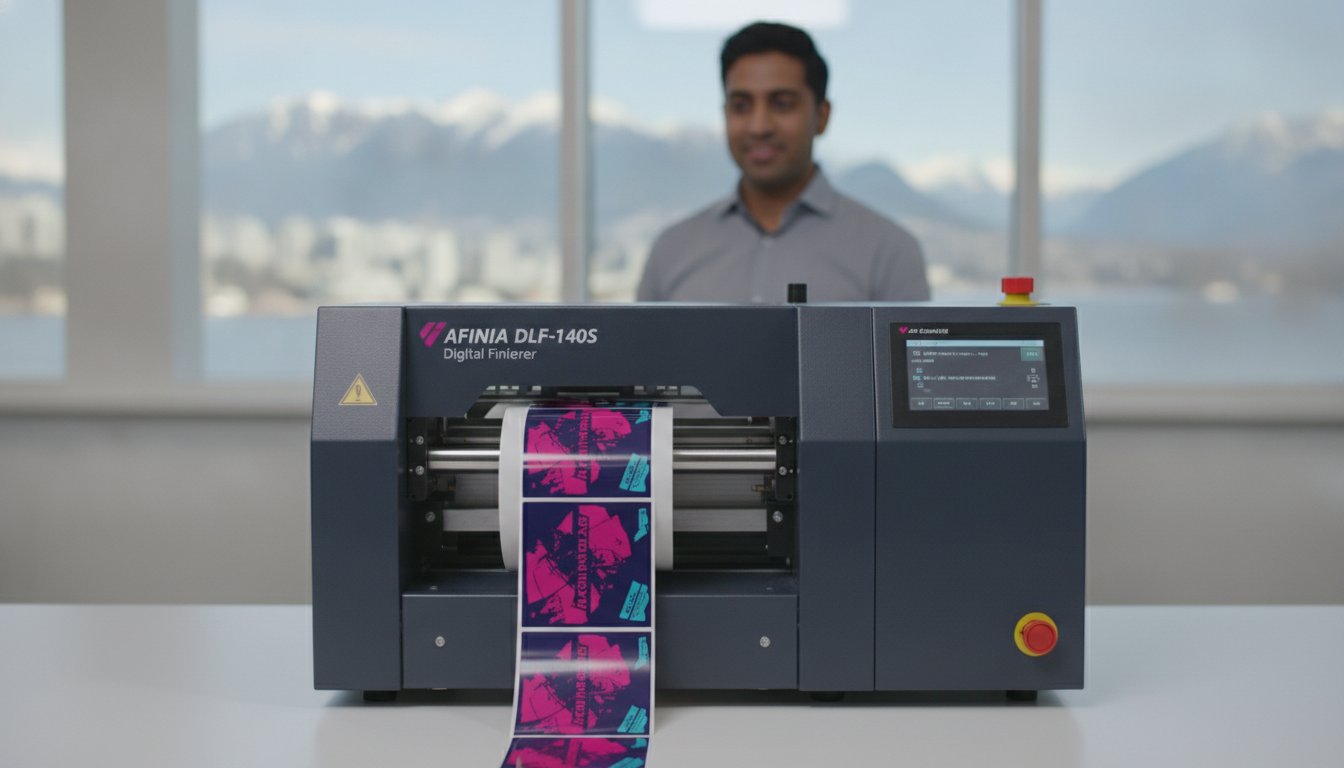
How much capital is your business losing to custom metal dies that only serve a single product run? For many Canadian brands, the high cost of physical tooling and the excessive waste generated during traditional setup are significant barriers to growth. You likely recognize that waiting weeks for a new die or maintaining a massive inventory of pre-printed labels is no longer a sustainable strategy. This is where the afinia dlf140 changes the equation. It is a compact, digital solution designed to bring professional finishing directly to your production floor without requiring the space of an industrial facility.
We understand the pressure to maintain high quality standards while simultaneously reducing operational overhead. This guide promises to show you how to eliminate die costs entirely and produce laminated, custom-shaped labels on demand. You will learn how to reduce your label inventory by finishing only what you need, when you need it. We will examine the technical capabilities of the Afinia DLF-140S, its seamless compatibility with digital label printers, and the specific ways it streamlines the labelling process for Canadian businesses looking to scale in 2026.
Key Takeaways
- Learn how the afinia dlf140 eliminates the need for expensive physical dies by using digital plotter-style cutting for any label shape.
- Discover how to optimize your production workflow by synchronizing finishing speeds and preparing artwork with precise digital cut lines.
- Compare the efficiency of on-demand digital finishing against traditional die-cutting to reduce lead times from weeks to minutes.
- Understand the benefits of the 140mm web width for producing professional, laminated labels across various product packaging sizes.
- Identify the advantages of sourcing hardware through a national distributor to avoid customs delays and maintain a reliable stock of genuine Afinia consumables.
Understanding the Afinia DLF-140S: A Tabletop Finishing Powerhouse
The Afinia DLF-140S isn't just a simple label cutter. It's a comprehensive finishing station that automates the transition from raw, printed rolls to professionally finished products ready for the shelf. By combining several industrial processes into a single tabletop unit, this system allows businesses to maintain full control over their production quality. It functions as a specialized partner for brands that need to move fast and stay lean.
Digital finishing represents a significant shift in how labels are produced. Unlike the traditional die-cutting process which requires custom-made metal tools for every new shape, the afinia dlf140 uses a digital plotter-style blade. This blade follows a digital path created in your design software. You can switch from a circular honey jar label to a complex, contoured craft beer label in seconds. There's no waiting for a tool manufacturer and no physical die inventory to manage.
This machine is the ideal choice for Canadian businesses managing short to medium production runs. It's particularly effective for private-label manufacturers, boutique food producers, and chemical companies that require frequent regulatory text updates. If your workflow involves printing on demand, the afinia dlf140 ensures your finishing speed matches your printing capabilities.
The All-in-One Finishing Process
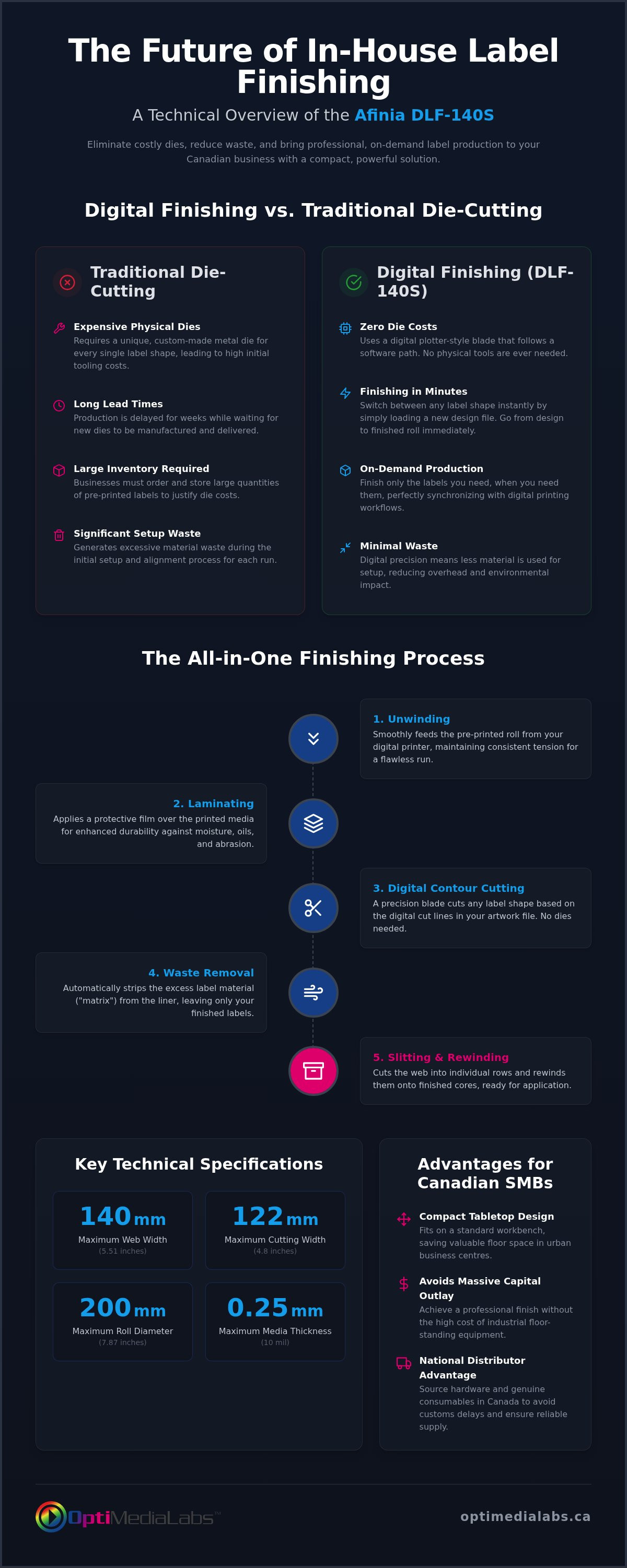
This system manages the entire post-print workflow in one continuous pass. It eliminates the need for multiple machines or manual intervention between steps. The process includes:
- Unwinding: Smoothly handles pre-printed rolls from your digital label printer to ensure consistent tension.
- Laminating: Applies a protective film to the web, providing essential durability against moisture, oils, and abrasion.
- Digital Contour Cutting: Uses a precision blade to cut any shape based on your artwork's cut line.
- Waste Removal: Automatically strips the "matrix" or excess material from the liner, leaving only the finished labels.
- Slitting and Rewinding: Cuts the wide web into individual rows and rolls them onto finished cores for easy application.
Why Compact Design Matters for Canadian SMBs
Space is a premium resource in urban Canadian business centres. Many Afinia label cutters & finishers are designed with this reality in mind. The DLF-140S features a compact tabletop form factor that fits onto a standard workbench. You don't need a dedicated industrial floor or specialized power drops to get started. Its small footprint allows for easy integration into existing packaging lines or small-scale warehouse environments. This accessibility enables smaller brands to achieve the same professional finish as large-scale manufacturers without the massive capital outlay for floor-standing equipment.
Key Technical Specifications and Performance Metrics
The Afinia DLF-140S provides a technical foundation designed for high precision in small-scale environments. Understanding its metrics helps you determine if it fits your specific packaging requirements. The 140mm (5.51") maximum web width is optimized for standard product labelling, such as wine bottles, cosmetic jars, or specialty food containers. While the web is 140mm, the machine offers a maximum cutting width of 122mm (4.8"), giving you sufficient room for bleed and registration marks.
Media compatibility is another strong point. The system handles substrates up to 0.25mm (10 mil) in thickness. This capability is vital for Canadian businesses that need durable, heavy-duty Afinia labels for industrial or outdoor applications. The slitting module further enhances productivity by allowing you to create multiple narrow rolls from a single wider web. This means you can finish several rows of labels simultaneously, significantly increasing your hourly output.
Width and Length Capabilities
The DLF-140S manages roll diameters up to 200mm (7.87"), which supports long, continuous production runs without frequent roll changes. For businesses producing varied packaging types, the minimum and maximum label length constraints are flexible enough to accommodate everything from small vape cartridges to tall beverage cans. By using a plotter-style blade, the system maintains a consistent cutting speed. However, throughput naturally varies based on artwork complexity. Simple rectangles finish faster than intricate, jagged shapes with multiple nodes.
Digital Precision and Blade Technology
Precision is maintained through an advanced optical black-mark sensor. This sensor reads registration marks printed on the media to ensure the blade aligns perfectly with your artwork. If your print shifts slightly on the roll, the afinia dlf140 adjusts its cutting path in real-time to compensate. This prevents the waste often associated with traditional mechanical alignment.
Users can fine-tune the blade exposure and cut force directly through the software. This level of control prevents the blade from cutting through the liner, which is a common issue with lower-quality finishers. Preparing these cut paths is simplified by the CM Barcode Generator. This tool automates the creation of registration marks and cut lines within your design software. If you're unsure which substrate thickness is best for your application, you can consult with a technical specialist to review your media samples.
Digital Plotter-Style Cutting vs. Traditional Die-Cutting
Traditional die-cutting creates a financial wall for every new SKU. For a Canadian business, ordering a custom metal die often involves significant costs and waiting periods of several business days or even weeks. The afinia dlf140 removes this friction by utilizing a software-driven cutting path. This digital approach transforms a rigid mechanical process into a flexible, on-demand workflow.
Digital cutting is essentially zero-cost per shape change. If you decide to change a square label to a hexagon, you simply update the digital file. Traditional dies, by contrast, are fixed assets that become obsolete the moment a design changes. This shift significantly reduces setup waste. You don't need to run metres of material through the machine just to align a mechanical die. This efficiency makes digital finishing the superior choice for seasonal products and market-testing new labels where volumes are unpredictable.
Eliminating the "Die-Tax" on Innovation
Innovation thrives when the cost of failure is low. With digital finishing, you can test five different label shapes in a single afternoon without spending a cent on tooling. This flexibility removes the primary financial barrier for small Canadian batches and boutique releases. Digital finishing empowers rapid product iteration by transforming physical hardware constraints into flexible software parameters. You can respond to market trends in hours rather than waiting for a tool manufacturer to ship a new die across the border.
Inventory Reduction and On-Demand Production
Many businesses fall into the trap of stockpiling thousands of pre-cut labels to justify the initial die cost. This practice carries a high risk. If a health regulation changes or your branding evolves, that pre-printed stock becomes expensive waste. By pairing the afinia dlf140 with Afinia Color Label Printers, you switch to a finish-on-demand model. You print and cut only the exact quantity needed for your immediate orders. This synergy ensures your capital is not tied up in vulnerable physical inventory. It creates a leaner, more responsive supply chain that can adapt to the specific requirements of the Canadian market without the burden of obsolete stock.
Optimizing Your In-House Labelling Workflow
Establishing a professional production line requires more than just high-end hardware. It demands a structured workflow that maximizes the efficiency of the afinia dlf140. To achieve consistent results, your team must master the transition from a digital printer to a finished, shelf-ready roll. This optimization process involves five critical stages:
- Step 1: Artwork Preparation. Define vector cut lines and registration marks in your design software to guide the digital blade.
- Step 2: Speed Synchronization. Match the output of your primary printer with the finisher's throughput to avoid production bottlenecks.
- Step 3: Lamination Application. Apply protective films for labels destined for refrigerated transport or chemical exposure.
- Step 4: Slitting. Use the adjustable slitting blades to divide the wide web into multiple narrow rolls for final application.
- Step 5: Matrix Stripping. Ensure the waste material is removed cleanly to prevent adhesive bleeding on the finished rolls.
Artwork Preparation and Software Integration
Precision begins at the design stage. The afinia dlf140 relies on an optical sensor to read registration marks. If these marks are placed incorrectly, the sensor may fail to sync, leading to wasted media. Use the dedicated DLF software to organize your cut paths efficiently. This software allows you to nest shapes tightly, which reduces material waste. For complex variable data or barcode requirements, integrating the finisher's workflow with BarTender ensures that every cut aligns perfectly with the printed data. Always double-check your cut line layers before sending the file to the plotter to maintain a frictionless setup.
Lamination and Durability for Harsh Environments
Canadian logistics often involve extreme temperature shifts, particularly for food and beverage brands using cold storage. Lamination is not just for aesthetics; it provides a vital barrier against frost, moisture, and abrasion. When selecting a lamination film, ensure it matches the chemical properties of your base media. Using mismatched materials can lead to curling or delamination over time. For industrial applications, pairing the DLF-140S with durable label materials ensures your branding remains legible from the warehouse to the end customer. If you need help selecting the right film for your specific environmental conditions, you can speak with our technical support team for a media compatibility review.
Clean rolls are the final indicator of a successful workflow. Proper matrix stripping prevents the "sticky edge" problem that can jam automatic label applicators. By maintaining correct tension during the rewinding phase, you produce tight, professional rolls that are ready for immediate use on your packaging line.
Procuring Your Afinia DLF-140S in Canada
Procuring industrial equipment like the afinia dlf140 requires a strategic approach to logistics. For Canadian manufacturers, importing directly from international suppliers often results in unpredictable customs delays and additional brokerage fees. These interruptions can stall production lines and inflate your total cost of ownership. By partnering with a national distributor, you bypass these cross-border complexities and ensure your equipment arrives ready for immediate integration.
OptiMediaLabs Canada specializes in navigating the specific requirements of the Canadian manufacturing landscape. We focus on providing a secure and efficient path to obtaining high-performance hardware. This partnership extends beyond the initial purchase. It ensures you have a reliable source for the technical guidance necessary to maintain a professional in-house labelling operation. Our expertise helps you avoid common integration pitfalls that can occur when setting up digital finishing for the first time.
The Benefit of National Distribution
A consolidated supply chain is essential for maintaining production uptime. When you source through a Canadian distributor, shipping is streamlined across the country. This eliminates the risk of your hardware being held at a port of entry for an indefinite period. Beyond the machine itself, you gain consistent access to genuine Afinia consumables, including specialized lamination films and plotter blades. Having these items stocked domestically means you don't have to worry about international shipping times for routine supplies. OptiMediaLabs Canada positions itself as your long-term facilitation partner, ensuring your inventory of labels and ink remains stable.
Next Steps: Samples and Consultations
Before finalizing your investment, it is vital to confirm that the DLF-140S meets your specific quality standards. We recommend requesting a finished label sample. This allows you to verify the precision of the digital plotter-style cut on your chosen substrate. Additionally, our specialists can help you ensure full compatibility with your existing Afinia printers, such as the L801 or L901 models. We will analyze your typical production volumes and artwork complexity to confirm that this finisher is the right match for your workflow. To begin this process, contact OptiMediaLabs Canada for an Afinia DLF-140S consultation and take the first step toward die-free finishing.
Future-Proof Your Label Production for 2026
Adopting an in-house finishing strategy is a decisive step toward operational independence. By integrating the afinia dlf140 into your facility, you remove the financial and logistical barriers created by traditional tooling. This transition allows your brand to respond to market shifts with unprecedented speed, producing high-quality, custom-shaped labels without the burden of physical die inventories. You can now focus on product development rather than managing the limitations of outsourced finishing schedules.
OptiMediaLabs Canada serves as your dedicated partner in this transition, offering the specialized expertise required to maintain a professional production environment. As a national Canadian distributor, we provide direct access to genuine Afinia parts and consumables, ensuring your equipment performs at peak efficiency. Our team delivers expert technical guidance tailored to your specific industry needs, from food and beverage to industrial manufacturing. Take the final step toward a streamlined, cost-effective labelling process today. View the Afinia DLF-140S and Request a Quote to secure your competitive advantage. We are ready to help you achieve professional finishing results on your own terms.
Frequently Asked Questions
What is the difference between the Afinia DLF-140S and the DLF-220S?
The primary difference is the maximum web width. The DLF-140S supports up to 140mm (5.5"), while the DLF-220S handles up to 220mm (8.6"). Choose the 140S for standard product labels and the 220S for larger items like chemical drums or gallon jugs. This ensures that smaller Canadian manufacturing facilities supported by OptiMediaLabs Canada can achieve industrial-grade results without requiring excessive floor space.
Do I need special software to run the Afinia DLF-140S?
Every unit includes dedicated DLF software for managing your cut files and registration marks. While it integrates with design tools like Adobe Illustrator, you don't need to purchase third-party software just to operate the cutter. The included package handles the communication between your computer and the plotter blade to ensure accurate execution. This software ensures that your production remains efficient and your registration remains perfectly synchronized during every run.
Can the DLF-140S cut any label shape?
It can cut virtually any shape imaginable because it uses a digital plotter blade rather than a fixed die. This includes complex contours, sharp angles, and intricate internal cutouts. You aren't restricted to standard circles or rectangles. If you can design the shape in your software, the afinia dlf140 can execute the cut with high precision on your chosen media. This flexibility allows your brand to innovate without additional tooling costs.
Does the Afinia DLF-140S require a specific type of label printer?
It is designed to work with any roll-to-roll digital label printer. It is particularly optimized for compatibility with the Afinia L801 and L901 printers sold by OptiMediaLabs Canada. The key requirement is that your printer must be able to add the necessary black-mark registration points that the finisher's optical sensor uses to align the cutting blade correctly. This synchronization ensures that your printed artwork and cut lines stay perfectly registered throughout the entire roll.
Is lamination mandatory when using the DLF-140S?
Lamination is optional but highly recommended for labels exposed to moisture, oils, or abrasion. The DLF-140S features a built-in lamination station that applies a protective film during the finishing process. If your products don't require this extra durability, you can bypass the lamination module and move directly to cutting and slitting. This flexibility allows you to customize the finish for every SKU based on the specific environmental conditions your packaging will face.
How fast can the DLF-140S finish a roll of labels?
The finishing speed depends on the complexity of your label shapes and the size of the roll. Simple shapes finish much faster than intricate contours with many nodes. The machine maintains a consistent pace that typically matches the output of medium-volume digital printers. By slitting the web into multiple narrow rolls, you can significantly increase your total hourly production. This ensures your labelling workflow remains productive even during high-volume seasonal shifts.
Where can I buy replacement blades and consumables for the DLF-140S in Canada?
You can buy replacement blades and consumables directly from OptiMediaLabs Canada. As a national distributor, we maintain a steady stock of these items to ensure your production line never stalls due to supply chain delays. Ordering domestically avoids the customs complexity and brokerage fees often associated with importing parts from international suppliers. This provides your business with a reliable, local supply chain for all your finishing needs.
Can the DLF-140S handle clear or transparent label media?
Yes, it handles clear media effectively, provided there is a high-contrast registration mark for the sensor to read. Most printers can apply a black mark on the clear liner or the media itself to facilitate this. Once the sensor reads the mark, the afinia dlf140 will execute the cut path with high precision. This capability is perfect for the "no-label look" often used in the premium beverage and cosmetic industries.