
Avoiding Retail Compliance Chargebacks for Barcodes
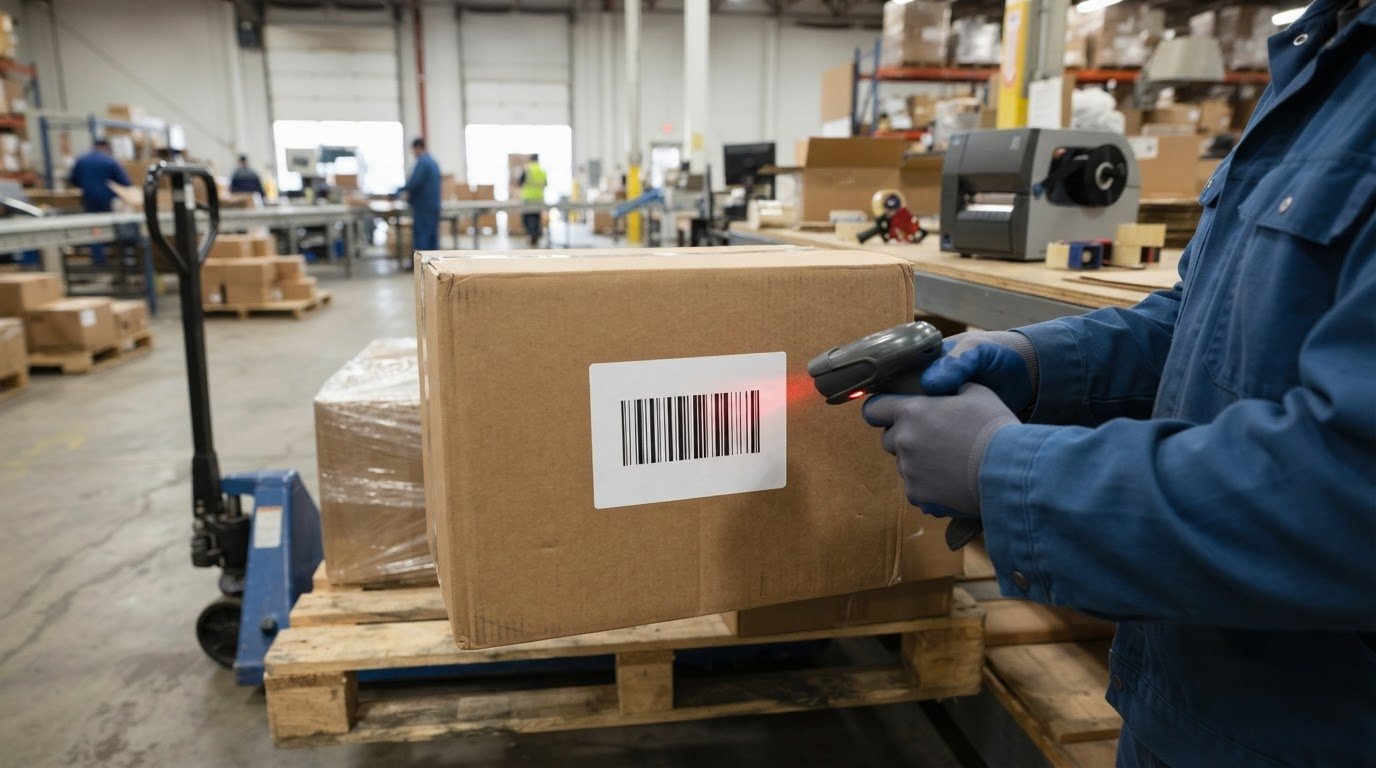
A barcode can scan and still trigger a retail chargeback if it fails the retailer’s requirements for content, placement or print quality. Chargebacks are deductions from supplier payments for shipments that do not meet those requirements. Avoiding retail compliance chargebacks for barcodes means matching each label to the retailer’s specifications and catching defects before the shipment leaves your facility.
It’s easy to focus on whether a barcode is readable and overlook the details that vary by retailer. This guide explains how chargebacks work, why barcode quality and retailer-specific rules matter, and how label checks can help reduce barcode-related deductions. You’ll also learn what to look for in GS1-128 labels, including required data, placement, quiet zones and print quality, so you can build a more reliable compliance process.
Key Takeaways
- Match shipping-label fields and placement to each retailer’s current requirements, including department, store and distribution-centre details.
- Check more than whether a barcode scans: symbology, quiet zones, contrast and print quality can all affect compliance.
- Understand how barcode errors, missing labels and shipment mismatches can lead to deductions or receiving delays.
- Use retailer routing guides to align label specifications, shipment documentation and warehouse processes before dispatch.
- See how retailer-specific rules differ, and why a label that works for one account may not meet another’s requirements.
What Is Vendor Compliance in Retail?
Vendor compliance means meeting a retailer’s requirements for shipping labels, packaging, routing and shipment data. For barcode labelling, check that each identifier and label matches the shipment level and the retailer’s instructions.
Required Label Fields
A shipping label’s required fields identify where a carton or pallet belongs, such as its department, store or distribution centre (DC).
Fields can link a shipment to a purchase order, destination and handling process. A label with the correct product identifier but the wrong department or destination information may still be unusable at receiving. Retailers can flag these defects when a shipment reaches a distribution centre, delaying identification and handling.
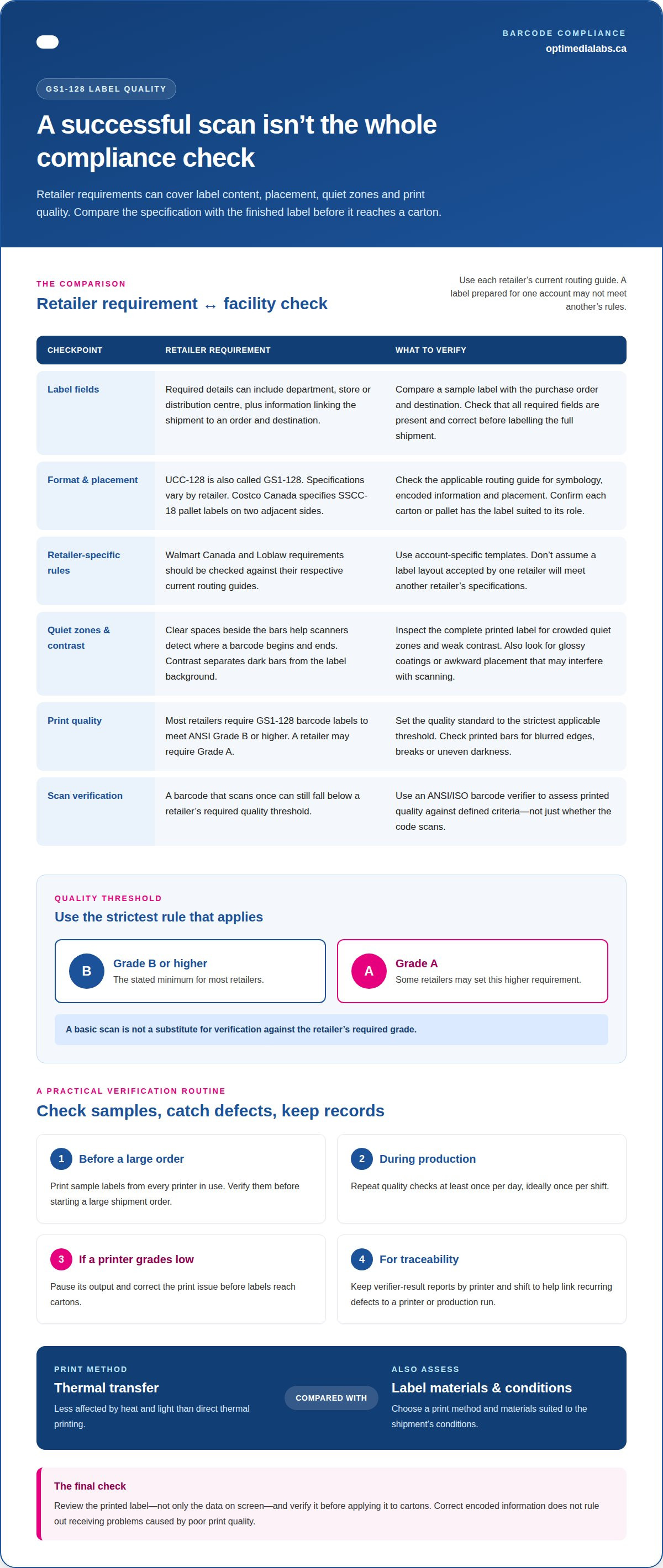
Build account-specific templates from each retailer’s current routing-guide specifications. Populate them with order data instead of retyping details for each carton, then compare a sample label with the purchase order and destination before dispatch. This helps catch missing fields before you label the whole shipment.
Retailer Barcode Specifications
Retailer barcode specifications define the format, encoded information and placement accepted for shipping containers. UCC-128 is also referred to as GS1-128; major retailers require these labels on shipping containers, but specifications vary by retailer.
Costco Canada’s vendor requirements specify SSCC-18 pallet labels on two adjacent sides, supporting scans from different approaches at receiving. Walmart Canada and Loblaw requirements should be checked against their respective current routing guides; don’t assume that a label prepared for Costco meets either retailer’s specifications.
GS1-128 labels need to follow retailer rules for content, placement and quiet zones. A retailer-specific template should include the fields its guide requires, while the application process should check the printed label before it is attached. Account-specific templates reduce the risk of applying one retailer’s label layout to another retailer’s carton.
GTINs, UPCs and Chargeback Prevention
A GTIN identifies a trade item, while a UPC barcode is a familiar way to encode a GTIN for scanning at the item level. GS1 Canada GTINs help retailers connect a scanned product with its item record, supporting accurate identification during receiving and sale.
Retail item setup uses a GS1-issued GTIN alongside case configuration, dimensions and weights. If the barcode points to the wrong item record, or the item data conflicts with the shipment, scanning can expose the mismatch. Accurate identifiers and item data help prevent that kind of avoidable exception.
Keep the hierarchy clear: an individual unit can carry its item-level UPC, while a case-pack or inner-pack may need an identifier suited to that packaging level. A pallet label can identify the shipping unit, with SSCC-18 used to connect the pallet or carton to its contents. Retail packaging may require different barcodes at item, case and pallet levels, so rarely is one barcode suitable for every level.
Before a large shipment leaves, validate the account template, generate labels from live order data and inspect a printed sample. Confirm that each carton and pallet carries the label required for its role. This makes label verification part of the shipment process, rather than a correction after receiving.
Barcode symbology, quiet zones, contrast, and print quality
Prevent barcode errors by matching each label’s symbology and content to retailer requirements, then checking print quality before shipment. Test samples from every printer and confirm that labels scan before applying them to cartons.
Symbology, Quiet Zones and Contrast
Symbology defines how barcode data is encoded. Quiet zones are clear spaces beside the bars that help scanners detect where the code begins and ends. Contrast separates dark bars from the label background, making the pattern easier to read.
For a GS1-128 label, an incorrect format, crowded quiet zone or weak contrast can interfere with scanning. Glossy coatings, awkward placement and low-resolution printing can also make a barcode difficult to read at a distribution centre. Review the complete printed label, not just the data shown on screen.
Print Quality and Scan Verification
Print quality describes how clearly a barcode’s bars and spaces appear on the finished label. Scan verification assesses whether the code meets quality criteria beyond a basic scan. The distinction matters because a barcode that scans once can still fall below a retailer’s required threshold.
Most retailers require GS1-128 barcode labels to meet ANSI Grade B or higher. A retailer may require Grade A, so use the strictest applicable threshold when setting a quality-control standard. Poor print quality can lead to receiving problems and penalties even when encoded information is correct.
Thermal transfer printing is less affected by heat and light than direct thermal printing. Choose a print method and label materials suited to the shipment’s conditions, then inspect for blurred edges, broken bars or uneven darkness. These visible defects can signal that a label needs attention.
Scan-Quality Testing
Scan-quality testing uses an ANSI/ISO barcode verifier to assess printed barcode quality against defined criteria. A verifier can help assess whether a barcode is likely to scan reliably in different conditions.
Print sample labels from every printer in use and test them before starting a large shipment order. Repeat quality checks at least once per day, ideally once per shift. If a printer produces a low grade, pause its output and correct the print issue before labels reach cartons.
Keep verifier-result reports by printer and shift. These records help warehouse teams link recurring defects to a particular printer or production run, rather than treating each rejected label as an isolated error.
Preventing Barcode Errors
An effective prevention process combines accurate label data, controlled printing and pre-dispatch verification. Generate barcode data from purchase-order and item-master information instead of entering it manually, and check the case-pack quantity when printing the label.
Before applying labels, compare a printed sample with the order and retailer specifications. Confirm the symbology, encoded content, quiet zones, contrast and placement. Then verify a sample from each printer and check that labels remain readable after application to the carton.
Make the inspection part of warehouse pick, pack and ship workflows. If a barcode is incorrect or fails its quality threshold, stop that batch, identify the cause, and reprint and retest affected labels before dispatch. For help discussing barcode workflow requirements, contact the team.
What Is a Retail Chargeback?
A retail chargeback is a deduction from supplier payment that allows a retailer to recover costs or apply a penalty for a non-compliant shipment. It differs from a physical shipment rejection: a retailer may receive the goods, then deduct an amount from the supplier’s payment. In other cases, a shipment or pallet problem may require extra handling before the goods reach their intended destination.
The financial basis depends on the retailer’s program and the type of failure. Retail chargeback penalties for non-compliant shipments are described as ranging from 1% to 5% of a supplier’s gross invoice amount. NielsenIQ notes that a supplier can be charged upward of 20% of an invoice when products fail retailer standards. These figures illustrate why the deduction terms matter alongside the operational cost of correcting a shipment.
Barcode and labelling issues are one part of a wider compliance picture. A retailer may identify an error involving product identification, shipping-unit information or the link between a label and the goods it represents. Other issues can include shipment shortages, overages, late delivery or a load that fails receiving requirements. The applicable program determines whether a problem leads to a deduction, extra handling or another consequence.
Consider a pallet that arrives with poor load quality. The retailer may need to spend labour correcting the load, so a chargeback can include labour costs as well as a penalty. A barcode defect is different: the central issue is whether the label correctly identifies the product or shipping unit. Separating these impacts helps suppliers pinpoint which part of compliance needs attention.
- Data or identification issue: The label does not represent the item or shipping unit accurately.
- Physical shipment issue: The quantity, load or delivery does not meet the order requirements.
- Receiving issue: The retailer must correct or handle the shipment before processing it.
When avoiding retail compliance chargebacks for barcodes, distinguish barcode-related deductions from broader shipment penalties. This keeps product-identification problems separate from delivery or load-quality failures. It also helps teams assess whether an incident concerns a particular label, the physical shipment or the retailer’s handling process.
Chargebacks can affect more than one payment. Retailers can pass the costs of non-compliant shipments back to brands through deductions or penalties, and repeated issues can strain retailer relationships or reduce order volumes. Treat each deduction as a signal about how the retailer assessed the transaction, then focus corrective work on the process involved. This helps keep barcode controls distinct from other compliance responsibilities.
Retailer supplier and routing guide requirements
A retailer’s routing guide connects shipment preparation with delivery, receiving and compliance expectations. For suppliers, the correct barcode is only one part of a shipment that must also meet account-specific packaging, documentation and timing rules.
Barcode Rules in Routing Guides
A routing guide sets out how a vendor must prepare and deliver orders, including retailer-specific barcode and label requirements. It can specify packaging, palletizing, carrier selection, delivery windows and shipping documents.
Use the guide as the operating reference for each account. Compare its label rules with the shipment’s carton and pallet setup, then align routing and documentation before dispatch. A label can be readable yet still fail if it is placed incorrectly or lacks information required by that retailer’s guide.
Turn each account’s instructions into clear warehouse checks. For example, the dispatch process can confirm the correct carrier, delivery appointment, pallet configuration, labels and paperwork for that purchase order. Keep the relevant guide version accessible to the teams preparing and releasing shipments.
Retailer-Specific Compliance
Retailer-specific compliance means meeting each account’s own performance targets and shipment procedures. Requirements differ, so do not assume one vendor checklist will fit every retailer.
Walmart’s stated OTIF targets are 98% on-time and 95% in-full, tracked at purchase-order line level. Kroger expects at least 98% on-time performance against the Original Requested Arrival Date and a 95% case fill rate. These measures make accurate order quantities and delivery timing operational priorities.
Target’s Perfect Order Program has a 100% target. Its requirements include advance shipping notices, or ASNs, and timely shipment information. A vendor should align each ASN with the physical shipment and follow the applicable retailer process for transmission and acceptance.
Keep account rules separate in your compliance records. A practical guide can map each retailer to its label format, required shipment documents, delivery window, pallet rules and performance measures. Assign a process owner to keep the information current and communicate revisions to warehouse and transportation teams.
- Before picking: Confirm the purchase order, item data and case quantities.
- Before dispatch: Check labels, pallet preparation, carrier routing, documents and delivery timing.
- After delivery: Compare receiving exceptions and retailer scorecards with shipment records.
Walmart’s OTIF measures show why line-level accuracy matters: a purchase order can include both compliant and non-compliant lines. A missing case, incorrect quantity or late arrival may affect the retailer’s assessment even when other lines arrive correctly. Review exceptions by purchase order and cause, then update the warehouse or routing step responsible.
Keep barcode controls connected to transportation workflows. A correct label supports receiving, while accurate routing and complete documentation help the shipment meet the retailer’s broader requirements. Review each account’s current guide before changing templates, carrier instructions or dispatch procedures.
Retailer-specific barcode chargebacks
Retailer-specific barcode chargebacks depend on the account’s defect definitions, deduction basis and receiving process. A label that meets one retailer’s specifications may fail another’s, so suppliers need controls mapped to each vendor account.
Walmart charges 3% of the cost of goods on non-compliant items. That makes the affected item value important when assessing an issue. Target’s barcode and ASN defect deductions use a per-carton structure, subject to a minimum. The difference matters: a defect may be measured against item value at one retailer and affected cartons at another.
These program rules make the retailer’s stated reason code essential. A broad description such as “barcode defect” does not show whether the cause was missing information, an unreadable symbol, incorrect placement or a mismatch between the label and shipment data. Match the reason code to the retailer’s criteria, then identify which cartons, items or purchase orders it covers.
For a useful account-level review, record the retailer, purchase order, deduction reason, affected units and supporting receiving evidence. Compare the deduction with label files, shipment records and scan results. A missing required field on a GS1-128 label, for example, points to a different corrective action than a barcode that fails print-quality grading.
Measure the issue at the level the retailer uses. If the deduction applies per carton, count the affected cartons and compare them with the packing record. If the rule applies to the value of non-compliant items, reconcile those items against the invoice. This helps establish whether one label defect affected a small part of the shipment or spread across multiple cases.
Manual re-entry can create mismatches between order data, labels and shipping documents. Use purchase-order and item-master information as the source for label data, then compare the final shipment with its ASN. Keep carrier and delivery records with the same order file so a barcode exception is not confused with a routing or arrival issue.
Retailer-specific templates and checks help prevent the same generic label from being used across accounts. Set up a separate approval step for each retailer’s required fields, barcode format, placement and carton-level rules. Before distribution, test a sample label and confirm that it matches the order and the correct account template.
When a deduction occurs, group similar reason codes and look for recurring patterns by retailer, printer, template or warehouse process. Repeated missing fields suggest a template problem; recurring scan failures point to print or placement controls. Update the relevant procedure and track later receiving results to assess whether the correction worked.
For help aligning barcode workflows with retailer requirements, discuss your barcode compliance needs.
Walmart assesses non-compliant items at 3% of their cost of goods. The section provides no comparable barcode-chargeback details for Costco Canada or Loblaw.
OptiMediaLabs Canada
OptiMediaLabs Canada offers printing equipment and consumables for businesses producing labels in-house. If barcode checks reveal inconsistent output or your current setup needs review, its range includes Afinia Color Label Printers, RFID Label Printers, Afinia Label Cutters & Finishers, and Thermal Transfer Ribbons.
The right combination depends on your label workflow, printer requirements and production environment. Review these factors to select equipment and supplies suited to producing clear, consistent labels for shipment preparation. The retailer’s barcode rules and verification process remain essential to compliance.
For a practical discussion about your label-printing setup, contact OptiMediaLabs Canada.
Make barcode compliance part of your next improvement
Use your next shipment cycle to make barcode checks a repeatable operational control. Review the retailer requirements for each account, then connect them to label production, verification and dispatch procedures. When a chargeback appears, record its reason and trace it to the process that needs attention.
A focused review can show whether the next improvement belongs in data handling, printer output or staff procedures. Keep the response practical: address the cause, document the change and monitor subsequent shipments. A consistent process for avoiding retail compliance chargebacks for barcodes helps teams meet retailer requirements with greater control.
If you're assessing barcode printing equipment or supplies for your workflow, OptiMediaLabs Canada can help you explore relevant options, including reliable ink cartridges. Discuss your barcode printing requirements with OptiMediaLabs Canada and take a clear next step towards a more consistent process.
Frequently Asked Questions
Do small suppliers need a compliance program?
Yes, small suppliers benefit from a documented process scaled to their order volume. Assign responsibility for reviewing retailer instructions, approving label changes and recording shipment exceptions. For example, one person can maintain an account-by-account requirements file and a simple log of rejected cartons. These records help distinguish an isolated handling mistake from a recurring data or template issue as sales grow.
What barcode standards do Canadian retailers require from suppliers?
Requirements vary by retailer and shipment level. GS1-128 is a baseline format for shipping-container labels, while product-level identification commonly uses a GTIN encoded in a UPC barcode. Retailer routing guides determine the accepted label content and application rules for each account. Suppliers should map each product, case and pallet identifier to its role, rather than assuming one barcode standard covers every shipping unit.
What barcode placement, size, contrast, and print-quality rules do major Canadian retailers require?
Retailer instructions determine the required placement and dimensions; there is no single size that applies across every label and shipment. Labels need adequate contrast, clear quiet zones and print quality that meets the retailer’s threshold. Most retailers require GS1-128 labels to meet ANSI Grade B or higher. Check the specific account guide for placement and size, then verify the printed label against its stated quality grade.
How can suppliers verify barcode readability before shipping products to retailers?
Use an ANSI/ISO barcode verifier to assess print quality instead of relying only on a handheld scan. Test a sample from each printer and retain the result alongside the printer identification, production details and shipment reference. A scan test confirms basic readability; verification provides a quality grade. If a sample falls below the retailer’s threshold, hold the affected labels and correct the print issue before applying them.
What barcode and labelling violations commonly trigger retail compliance chargebacks in Canada?
Common triggers include missing carton or pallet labels, incorrect encoded data, an unacceptable GS1-128 format, poor print quality and placement that prevents receiving scans. A label can also create an exception if its information conflicts with the product or shipment record. Separate these causes during review: a missing label calls for an application-process fix, while incorrect data points to item or order information.
What are typical Canadian retail chargeback fees for barcode or labelling errors?
There is no single standard fee across Canadian retail accounts. A retailer may calculate a deduction per carton, per shipment or as a share of the affected goods’ value. The amount depends on the retailer’s program, the defect category and the number of affected units. Check the applicable vendor terms and deduction reason code; do not use one retailer’s charge to estimate another account’s.
How can suppliers dispute a barcode-related retail chargeback, and what evidence is needed?
Submit a dispute through the retailer’s designated process within its filing window, with evidence linked to the affected purchase order. Useful records include the deduction notice, label image, verifier results, shipment and packing records, ASN, and receiving or delivery documentation. Explain how the records address the stated reason code. Keep the dispute record separate from corrective-action notes so claim review and process improvement remain traceable.
Do Canadian retail barcode requirements differ for cartons, pallets, and individual products?
Yes. An individual product, a case and a pallet represent different packaging levels, and each may need its own identifier. A UPC can identify a consumer unit, while shipping labels can identify cases or pallet loads for distribution and receiving. Retailer instructions determine which labels to apply and where. For example, a pallet label does not replace the product barcode used to identify individual items.