
BarTender vs NiceLabel: Which Labeling Software Is Best for Your Canadian Operation in 2026?
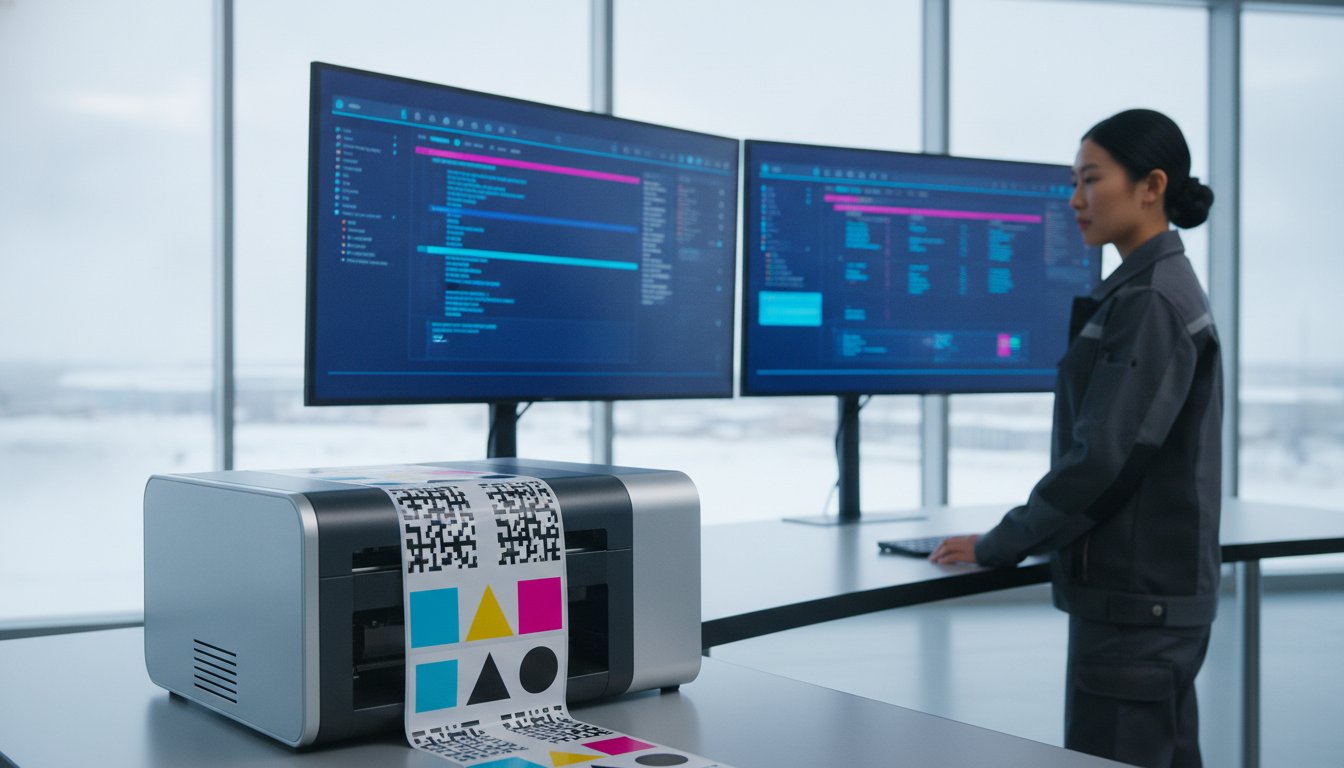
Did you know that 79% of consumers are now more likely to buy products with scannable 2D codes, driving a massive shift in how Canadian warehouses operate? As the GS1 Sunrise 2027 deadline approaches, the choice between BarTender vs NiceLabel has never been more critical for your production efficiency. You've likely experienced the frustration of manual data entry errors leading to shipping delays or the difficulty of integrating software with your existing ERP. Managing disparate printer drivers across brands like Zebra and Afinia shouldn't be a daily struggle. You need a system that just works.
We agree that your operation deserves a centralised, automated labelling system that reduces design time and ensures full compliance with industry standards. This guide provides the definitive comparison between these two industry leaders to help you determine which platform aligns with your production goals and hardware. We'll explore the latest 2026 subscription models, hybrid cloud architectures, and the essential tools needed to meet bilingual mandates across Canada. You'll gain the clarity needed to choose a solution that offers long-term stability for your Canadian operation.
Key Takeaways
- Analyze the shift from perpetual licenses to the 2026 subscription-first model to accurately calculate your long-term operational costs in C$.
- Compare the design interfaces of BarTender vs NiceLabel to determine which platform provides the most intuitive user experience for your production staff.
- Evaluate the benefits of a cloud-native SaaS architecture against hybrid resilience to ensure maximum uptime for your specific Canadian facility.
- Learn how to automate the bridge between your ERP and hardware to eliminate manual data entry and streamline your labeling workflow.
- Identify the essential software features required to organize dynamic text for bilingual mandates and upcoming GS1 2D barcode transitions.
Understanding the BarTender vs NiceLabel Landscape for 2026
The labeling industry has undergone a radical transformation. What began as simple design tools has evolved into sophisticated enterprise platforms. In the current market, the BarTender vs NiceLabel debate centres on how your operation handles data and hardware. BarTender 12 and NiceLabel (now rebranded as NiceLabel Cloud) dominate the Canadian landscape. Both provide the architecture needed to modernize your production line.
BarTender maintains a reputation for robust on-premises resilience through its hybrid architecture. It excels in complex manufacturing environments where edge printing is vital. Conversely, NiceLabel focuses on a cloud-native experience. It prioritizes ease of use and rapid scalability across multiple sites. Choosing between them requires a clear understanding of your current printer fleet and your long-term automation goals.
The Evolution of Industrial Labeling Systems
Standalone workstations are becoming obsolete. Modern Canadian facilities now utilize centralized label management to maintain control over thousands of templates. This shift allows for the seamless integration of RFID and IoT sensors directly into the production line. Centralization ensures that a change made at your headquarters is instantly reflected at every satellite warehouse.
Reliable data flow is essential. These platforms act as a bridge between your hardware and your enterprise resource planning (ERP) systems. This connectivity ensures that every label printed is backed by real-time data. It also simplifies compliance with global standards like GS1 and GHS. With the GS1 Sunrise 2027 deadline approaching, your software must handle 2D barcodes like GS1 DataMatrix and QR codes with absolute precision.
Why Software Choice Dictates Production Efficiency
Software isn't just about design; it's about uptime. Centralized driver management reduces technical friction across your facility. If you use a mix of Zebra printers and high-resolution colour label printers, your software must support them natively. This prevents the "driver hell" that often leads to unexpected printing pauses.
Efficiency gains come from:
- Locked Templates: Prevent unauthorized changes and reduce human error during print jobs.
- Data Validation: Ensure that dynamic fields meet specific criteria before the printer starts.
- Colour Consistency: Maintain brand integrity on Afinia printers and other supported colour label devices by using optimized ICC profiles.
Poorly integrated software leads to shipping delays and wasted media. By selecting a platform that aligns with your hardware, you minimize downtime and maximize throughput. Whether you choose BarTender software or NiceLabel software, the goal remains the same: a secure, automated path to production excellence.
Comparative Analysis: Core Design and Printing Capabilities
The choice between BarTender vs NiceLabel often begins at the design interface. Your production staff needs a tool that balances power with simplicity. While both platforms offer professional-grade design environments, they approach user experience differently. Selecting the right one ensures that your team spends less time troubleshooting templates and more time moving product.
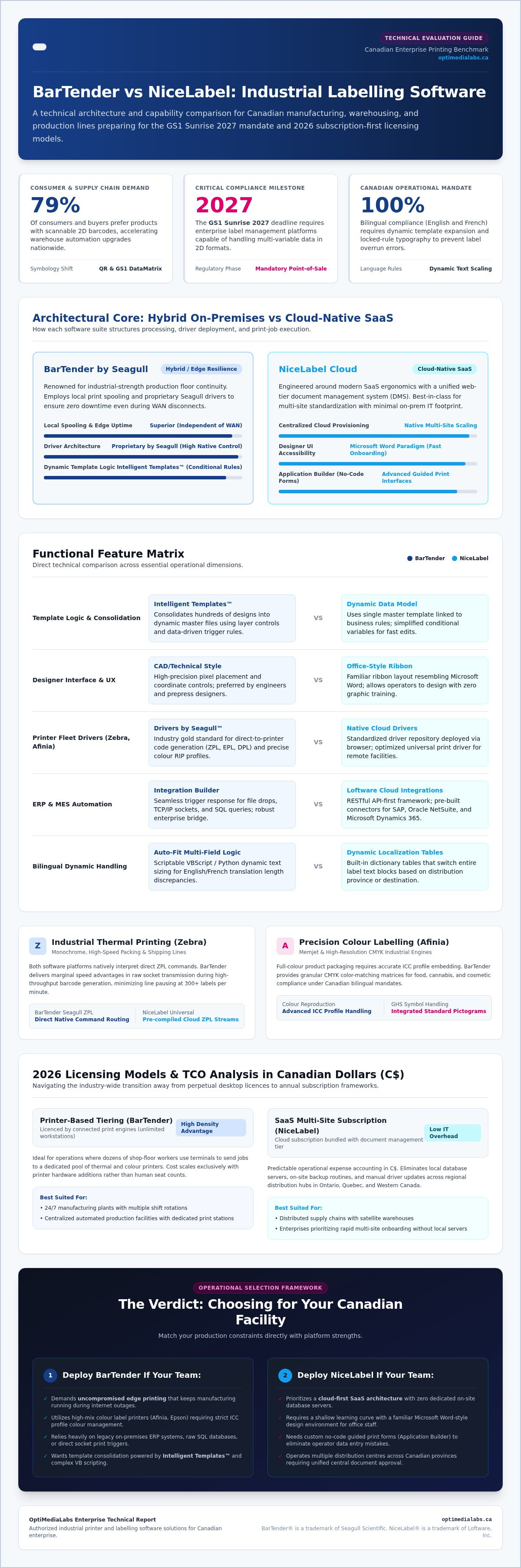
Intelligent Templates™ serve as a core BarTender differentiator by enabling a single label file to automatically adjust its layout and content based on variable data conditions. This capability is essential for Canadian manufacturers who must manage hundreds of product variations without creating hundreds of individual files. Both suites provide the precision required to meet GS1 barcode standards, ensuring your 1D and 2D symbologies are compliant for global retail and medical supply chains.
BarTender’s Intelligent Templates™ vs NiceLabel’s Designer
NiceLabel Designer utilizes a Microsoft Word-like interface. This familiar layout allows for rapid onboarding; even employees with minimal design experience can create professional labels in minutes. It's an excellent choice for operations that prioritize speed and a shallow learning curve. The software handles complex graphics and precise colour matching with ease, which is vital for maintaining brand consistency on high-end Afinia printers.
BarTender excels in environments where conditional logic is a daily requirement. Its Intelligent Templates™ allow you to hide or show specific layers and objects based on the data coming from your database. This reduces human error by locking down the design and only allowing variable fields to change. If you are unsure which interface fits your team's specific workflow, reach out to our specialists for a technical demonstration.
Driver Management and Print Performance
Print performance is dictated by how efficiently the software communicates with your hardware. Seagull Scientific, the developer of BarTender, is the industry leader in "True Windows Drivers". These drivers are specifically engineered to unlock the full potential of your hardware, ensuring that features like RFID encoding and high-speed thermal transfer function perfectly. This native support minimizes spooling delays and prevents the common "printer paused" errors that plague generic drivers.
NiceLabel utilizes a modern 64-bit print engine designed for high-throughput environments. This architecture is particularly effective at processing large print jobs without taxing your local network resources. When optimizing output for Epson ColorWorks systems, NiceLabel’s engine ensures that high-resolution colour images are rendered quickly. This prevents the printer from "hunting" or pausing between labels, which extends the life of your printhead and maintains maximum production speeds.
Integration and Automation: Connecting to Your ERP
Modern labelling software acts as a "headless" microservice. It bridges the gap between your ERP and your hardware fleet. The BarTender vs NiceLabel debate often shifts to integration. Your software must trigger print jobs automatically based on data changes in your system. This eliminates the need for manual data entry and prevents shipping delays. Choosing the right integration method depends on your IT infrastructure and the number of facilities you manage.
NiceLabel’s Cloud-First Approach vs BarTender’s On-Premise Strength
NiceLabel has positioned itself as the SaaS leader through Loftware Cloud solutions. This model is ideal for multi-site Canadian operations. It allows you to manage label governance centrally while printing locally. This architecture significantly reduces IT overhead. You don't need to manage local servers or complex driver deployments at every warehouse. Web-based print clients allow workers to trigger jobs from any browser. It ensures every user follows the same approval workflow.
BarTender 12 remains a powerful choice for high-security, on-premise environments. Its Integration Builder provides robust data triggering for local systems. If your internet connectivity is inconsistent, BarTender’s hybrid model ensures production never stops. It uses local edge printing to maintain uptime. This resilience is critical for meeting CFIA traceability and labelling requirements. Missing data or downtime can lead to significant regulatory hurdles in the food and medical sectors.
Handling Complex Variable Data and RFID
Automation eliminates the risk of manual entry errors. Both platforms connect seamlessly to SQL, Excel, and Oracle databases. This connectivity is vital for handling complex variable data without writing custom code. For Canadian logistics providers, RFID label production is now a standard requirement. Your software must encode RFID chips while simultaneously printing the human-readable barcode. It must do this at production speed without slowing down the printer.
Automating GHS safety data sheets is another area where BarTender vs NiceLabel capabilities shine. These systems pull dynamic chemical data and pictograms directly from your safety database. This ensures every container is labelled accurately according to WHMIS standards. By removing the human element from data selection, you ensure compliance and speed up the shipping process. The software handles the logic; your team simply handles the product.
Licensing Models and Total Cost of Ownership (TCO)
The financial landscape for barcode software has changed. By 2026, the industry has largely transitioned to "Labeling as a Service." When comparing BarTender vs NiceLabel, you must look beyond the initial purchase price. Total Cost of Ownership (TCO) now includes recurring subscription fees, mandatory maintenance agreements, and the cost of scaling your printer network. Understanding these recurring costs is vital for long-term budgeting in any Canadian manufacturing environment.
Subscription vs Perpetual Licensing in 2026
Seagull Software shifted to a subscription-first model on July 1, 2025. This means renewals for legacy perpetual licenses are now quoted under the BarTender License Flex Program. This shift moves your labeling costs from capital expenditure (CapEx) to operating expense (OpEx). While this provides lower entry costs, it requires consistent annual budgeting to maintain access. It's a model that rewards operations looking for flexibility over fixed assets.
Loftware has followed a similar path. Since late 2024, they've strictly required an active Software Maintenance Agreement (SMA) for technical support on all on-premises installations. Subscriptions for NiceLabel automatically bundle this SMA. This ensures your national Canadian operation always has access to the latest security patches and driver updates without unexpected fees. It simplifies the administrative burden of managing multiple license keys across different sites.
Scalability for Growing Canadian Manufacturers
Both platforms scale primarily by the number of active printers. BarTender allows for unlimited workstation users on its Professional and Automation tiers, charging only for the printers you use. This is cost-effective for facilities with many designers but few output devices. As you grow, moving from a Starter edition to an Enterprise tier allows you to manage global standards from a single Canadian headquarters. This centralized control prevents "template drift" as you add new production lines.
High-volume printing also brings material costs into the TCO equation. If your facility runs multiple shifts using Zebra ribbons, your software must be efficient. Inefficient spooling or template errors lead to wasted media and higher OpEx. We recommend calculating your three-year costs to see which model fits your growth trajectory. If you need a detailed cost breakdown for your specific printer fleet, contact our team for a custom quote.
The Verdict: Choosing the Right Software for Your Operation
Choosing between BarTender vs NiceLabel isn't about which software is better in a vacuum. It's about which architecture supports your specific production environment. BarTender 12 remains the industry standard for facilities requiring deep, on-premise integration and edge printing resilience. NiceLabel, now Loftware Cloud, is the superior choice for organizations prioritizing rapid deployment and centralized cloud governance. Both platforms provide the professional tools needed to maintain compliance and eliminate shipping errors.
Use-Case Recommendations: Which Software Wins?
Your business size and geographic footprint dictate the best fit. For a small business with a single workstation, NiceLabel Designer or BarTender Starter provides an affordable entry point. Enterprise manufacturing lines with complex data triggers often require BarTender Automation to handle high-speed demands. If you manage multi-site logistics across multiple provinces, NiceLabel Cloud offers the most streamlined path to centralized label management. This cloud-native approach ensures that every facility uses the same approved templates without local server maintenance.
Hardware synergy is the final piece of the puzzle. Your software must communicate perfectly with your Afinia printers and Epson printers to ensure colour accuracy and printhead longevity. Generic drivers often fail to utilize the specialized features of these high-resolution systems. By matching your software to your hardware, you ensure that high-quality colour labels are produced at maximum speed without media waste. It's about creating a frictionless path from design to the finished label.
Why OptiMediaLabs Canada Is Your Strategic Labeling Partner
We provide more than just license keys. OptiMediaLabs Canada is a national distributor of both software and specialized label consumables. Our expertise allows us to recommend the ideal pairing of software and hardware, specifically for Afinia Color Label Printers. We focus on your production uptime by offering a stable, professional service that Canadian manufacturers can depend on. Our team understands the technical requirements of high-volume operations.
Your next step is a workflow audit. Evaluate your current template count, data sources, and printer brands. This clarity allows for a precise recommendation that avoids over-licensing and reduces design time. If you're ready to modernize your labeling system, our technical team is available to assist with a comprehensive evaluation of your production goals. We provide a secure, streamlined path to obtaining the resources your operation needs to thrive.
Future-Proofing Your Canadian Labeling Infrastructure
The decision between BarTender vs NiceLabel ultimately rests on your infrastructure's specific demands. We've analyzed how BarTender 12 provides on-premise stability for complex production lines, while Loftware Cloud offers the agility needed for multi-site Canadian expansion. Preparing for the 2027 GS1 Sunrise deadline requires this level of foresight. Your software must handle the transition to 2D barcodes and bilingual compliance without slowing down your production or creating data silos.
OptiMediaLabs Canada provides the necessary resources to implement these complex systems. As an authorized distributor and specialist in Afinia and Epson industrial solutions, we ensure your software is perfectly matched to your hardware for maximum efficiency. Our national Canadian shipping and support services prioritize your production uptime and regulatory compliance. Contact our labeling experts to find the right software for your Canadian facility and establish a reliable, automated foundation for your operation. Success starts with a system that's built to last.
Frequently Asked Questions
Is BarTender better than NiceLabel for RFID printing?
Both platforms offer robust support for RFID encoding. BarTender Enterprise is often preferred for complex, on-premise manufacturing where high-speed RFID encoding must sync with local PLC data. NiceLabel (Loftware Cloud) is ideal for multi-site operations that need to manage RFID standards centrally. Your choice depends on whether your RFID hardware is localized or distributed across several facilities. We recommend pairing either software with specialized RFID label printers for maximum encoding accuracy.
Can I use NiceLabel with my existing Zebra printers?
Yes, NiceLabel is fully compatible with your existing Zebra printers. It utilizes specialized 64-bit print engines to optimize performance on Zebra hardware. This ensures high-speed throughput and accurate barcode rendering without the need for generic Windows drivers. By using native drivers, you reduce spooling delays and maintain better control over thermal transfer settings. This compatibility extends to various thermal transfer ribbons and label stocks, ensuring a seamless transition from your current software.
Does BarTender software require a monthly subscription in 2026?
As of 2026, Seagull Software has transitioned to a subscription-first model under the BarTender License Flex Program. While perpetual licenses were common in the past, new installations and renewals now typically utilize an annual subscription. When comparing BarTender vs NiceLabel, it is important to note that both have moved toward recurring models. This shift ensures you always have access to the latest security updates and technical support for your national operation.
Which labeling software is easier for beginners to learn?
NiceLabel is generally considered easier for beginners because it uses a Microsoft Word-like interface. This familiar layout allows non-designers to create professional labels with minimal training. It features intuitive drag-and-drop tools for adding barcodes, text, and graphics. While the BarTender vs NiceLabel debate often focuses on power, BarTender is also user-friendly; however, its deeper conditional logic features can have a slightly steeper learning curve for advanced automation users.
How do I integrate BarTender with my ERP system?
You can integrate BarTender with your ERP system using the Integration Builder tool. This allows the software to act as a bridge, triggering print jobs automatically when data changes in systems like SAP, Oracle, or Microsoft Dynamics. It supports various methods including web services, database triggers, and file drops. This automation eliminates manual data entry errors and streamlines your production workflow. For a successful setup, ensure your ERP data is structured to map directly to your templates.
Can NiceLabel Cloud manage printers across multiple Canadian locations?
Yes, NiceLabel Cloud (Loftware Cloud) is specifically designed to manage printers across multiple Canadian locations from a single interface. It provides centralized governance, allowing you to deploy approved templates to satellite warehouses instantly. This ensures brand consistency and regulatory compliance nationwide without requiring local IT servers at every site. Workers at any facility can access the system via a secure web-based print client, ensuring a uniform labeling process across your entire organization.
What are the system requirements for BarTender 2026?
BarTender 12 requires a 64-bit version of Windows 10 or 11, or Windows Server 2019/2022. You should have at least 8 GB of RAM and a modern multi-core processor to handle high-volume printing and automation tasks. A stable internet connection is necessary for license activation and cloud-based governance features. Because BarTender utilizes a hybrid architecture, local edge printing resilience is maintained even if your primary network connection experiences temporary downtime.
Is there a free version of BarTender or NiceLabel available?
Both vendors offer limited versions or trial periods to help you evaluate the software. BarTender provides a Free Edition that allows for basic label design and printing, though advanced automation and database features are locked. NiceLabel offers a 30-day free trial of its Cloud and Designer tiers, giving you full access to its capabilities before committing to a subscription. These trials are excellent for testing compatibility with your Afinia or Epson colour label printers before purchasing.