
Best 2.8 x 0.75 Labels for Your Canadian Business
What if your precision labelling process is being held back by a single millimetre of error? For many Canadian businesses, finding niche sizes in stock is a persistent challenge that leads to costly production delays. Relying on standard stock for specialized 2800 * 0.75 applications often results in adhesive failure in cold storage or frustrating compatibility issues with your inkjet and thermal transfer hardware.
We realize that you need reliable label stock that arrives quickly without the burden of international shipping fees. This expert guide from OptiMediaLabs Canada helps you find the ideal 2.8 x 0.75 labels for your specific printer and application. We'll examine the technical differences between matte and gloss materials, analyze adhesive performance for curved surfaces, and show you how to reduce per-label costs through bulk Canadian distribution. By the end of this guide, you'll have a clear path to sourcing high-performance media that protects your brand's professional image.
Key Takeaways
- Identify how specialized 2.8 x 0.75 labels serve narrow-profile products like medical vials and lip balm tubes to ensure professional branding.
- Select the right substrate and adhesive for your environment, ensuring your 2800 * 0.75 stock withstands moisture or cold storage requirements.
- Verify printer compatibility with Afinia and Epson systems by adjusting media guides for narrow 2.8-inch wide rolls.
- Optimize production efficiency by calculating cost-per-label and maximizing labels-per-roll to reduce operational downtime.
- Source reliable blank stock from a dedicated Canadian distributor to benefit from faster national shipping and expert technical support.
Understanding the Versatility of 2.8 x 0.75 Labels
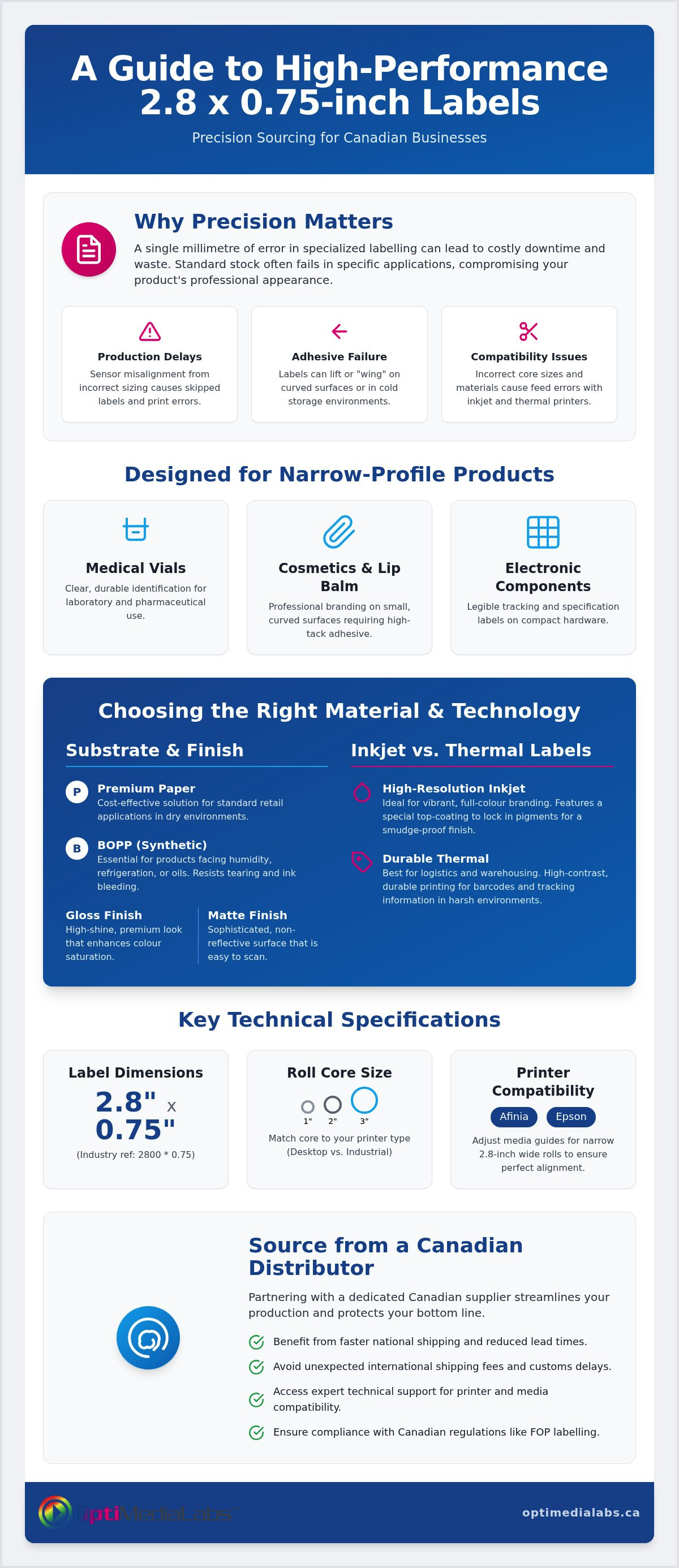
The 2.8 x 0.75-inch label is a specialized size designed for narrow-profile products. In many industrial catalogues, you'll see this referred to by the technical specification 2800 * 0.75. Achieving a professional finish on such a small canvas requires extreme precision. Even a minor error in the millimetre-to-inch conversion can lead to sensor misalignment during the print cycle. This causes the printer to skip labels or print over the die-cut edges, resulting in avoidable waste.
When understanding the purpose of labels for small format items, you'll see they are essential for products like lip balm tubes, medical vials, and small electronic components. These applications often require the label to wrap around a tight circumference. Because of this, the material's flexibility and the roll's core size become critical factors. Industrial printers usually require a 3-inch core to handle high-volume rolls, while smaller desktop units might use a 1-inch or 2-inch core. Using the wrong core size can lead to improper tension and feed errors.
Why Sizing Accuracy Matters for Automated Finishing
If your production workflow involves high-speed application, sizing accuracy is paramount. Afinia label cutters and finishers use sophisticated sensors to detect either a "gap" between labels or a "black mark" on the liner. For a 0.75-inch height, the margin for error is slim. Inconsistent spacing leads to "drift," where the cut line gradually shifts across the design. This drift ruins the visual symmetry of your packaging and can stop an entire production line. High-quality blank stock ensures that every label in the 2800 * 0.75 format stays perfectly registered from the first inch of the roll to the last.
Common Industry Standards for Small Format Labels
Small labels don't exempt you from regulatory compliance. For instance, GHS requirements for small chemical containers still demand legible pictograms and safety text. In the retail sector, barcode clarity is a major hurdle on a 0.75-inch vertical space. Scanners require specific quiet zones and high contrast to function. As of January 1, 2026, Canadian food businesses must also comply with new Front-of-Package (FOP) nutrition labelling regulations. These rules require a specific black-and-white magnifying glass symbol on products high in sodium, sugars, or saturated fat. Fitting these mandatory symbols onto a 2.8-inch wide label requires careful layout to ensure you meet Health Canada standards without sacrificing your brand's aesthetic.
Choosing the Right Material for Your 2.8 x 0.75 Labels
Choosing the right substrate for your 2.8 x 0.75 labels is a technical decision that dictates the success of your packaging. For standard retail applications where moisture isn't a factor, premium paper stock provides a cost-effective solution. However, if your products face humidity or refrigeration, synthetic materials like BOPP (Biaxially Oriented Polypropylene) are essential. These 2800 * 0.75 synthetic labels resist tearing and prevent ink bleeding when exposed to oils or water.
The aesthetic choice between matte and gloss finishes also impacts brand perception. Gloss finishes offer a high-shine, premium look that enhances colour saturation. Matte finishes provide a sophisticated, non-reflective surface that is easier to scan under industrial lighting. Beyond the finish, you must consider the adhesive. Small-format labels applied to curved surfaces, such as narrow tubes, require high-tack adhesives to prevent "winging," where the edges lift over time. Permanent adhesives are standard, but removable options are available for temporary tracking.
When selecting materials, adherence to Canadian labelling regulations ensures your choice meets safety and legibility standards for your specific industry. Selecting the correct 2800 * 0.75 media is a technical requirement that ensures long-term performance. If you are unsure which substrate fits your environment, you can speak with our media specialists for a compatibility assessment.
Inkjet Labels: Achieving Vibrant Colour
High-resolution inkjet printing requires specialized Epson labels designed for rapid ink absorption. These labels feature a technical top-coating that locks in pigments instantly. Top-coating is the key to ink durability. Without it, ink remains on the surface, leading to smudging. For high-end cosmetics, smudge-proof performance is non-negotiable to maintain brand integrity during customer handling.
Thermal Labels: Durability in Harsh Environments
For logistics and warehouse tracking, you must choose between direct thermal and thermal transfer technology. Direct thermal is efficient for short-term shipping labels but remains sensitive to heat and light. Thermal transfer printing utilizes thermal transfer ribbons to create a permanent bond. This method is necessary for long-term legibility in industrial environments where labels face abrasion or chemical exposure.
Printer Compatibility for 2.8-Inch Wide Label Rolls
Technical compatibility ensures your 2800 * 0.75 labels feed correctly without jamming. Narrow media requires specific hardware features to maintain alignment during high-volume runs. Most industrial systems are designed for 4-inch or 8-inch widths; therefore, printing on a 2.8-inch roll requires precision adjustments to the physical feed path. If your hardware isn't properly configured, you'll face frequent downtime and wasted stock.
Adjustable media guides are the most critical hardware component for this size. In Afinia and Epson systems, these guides must be locked firmly against the edges of the roll. If the guides are even slightly loose, the media will skew. This results in misaligned text that bleeds off the edge of the 0.75-inch height. Additionally, using brand-matched ink cartridges prevents nozzle clogs. Small labels require high-density printing for legibility. Generic inks often lack the pigment quality needed for micro-text, leading to blurred characters and failed barcode scans.
Afinia and Epson: The Leaders in Small Format Printing
Afinia printers are engineered to handle the 2800 * 0.75 format with minimal waste. The L502 model is particularly effective for these narrow runs because of its versatile media handling and durable construction. For businesses requiring high-resolution micro-text, Epson printers like the ColorWorks series offer superior clarity. You should optimize your print speed settings for these short labels. Reducing the speed helps the printer maintain perfect registration and prevents the media from slipping during the high-frequency start-stop cycles of small label production.
Software Integration: Designing for 2.8 x 0.75
Designing for a small footprint requires specialized tools to ensure every millimetre is utilized. BarTender software provides the granular control needed to create 2.8 x 0.75 templates. It allows you to set precise margins and gap tolerances that match your physical roll. If your application involves serial numbers or medical tracking, NiceLabel manages variable data without slowing down the print queue. When placing barcodes on a 0.75-inch height, centring is paramount. Always maintain a minimum quiet zone of 1.6 mm at the top and bottom. This prevents the scanner from picking up the label edge instead of the barcode data.
Optimizing Your Production: Cost and Efficiency
Transitioning from outsourced printing to an in-house solution significantly alters your operational budget. When ordering 2.8 x 0.75 labels from external providers, you often face high minimum order quantities and setup fees for non-standard sizes. In-house production eliminates these barriers. It allows Canadian SMEs to print only what they need, reducing the capital tied up in sitting inventory. This "on-demand" model is particularly effective for businesses with multiple SKUs or seasonal product lines that utilize the 2800 * 0.75 format.
Efficiency depends on minimizing waste during initial calibration. Narrow rolls are sensitive; even a slight misalignment during the first few feet can ruin the tracking for the entire roll. To reduce waste, always perform sensor calibration with the media guides locked. This ensures the printer recognizes the 0.75-inch height immediately. By refining this process, you preserve your 2800 * 0.75 stock and ensure every label on the roll is usable, directly impacting your bottom line.
Calculating Your Label ROI in 2026
Your return on investment involves more than just the price of the blank stock. You must account for labour costs. Manual application is time-consuming and prone to human error. Investing in automated application or high-speed finishers reduces these labour hours significantly. Additionally, sourcing bulk label printer consumables through a Canadian distributor lowers your per-unit cost. For industrial sectors, ensuring your labels are GHS compliant within your standard workflow prevents costly regulatory fines and re-labelling projects.
Reducing Downtime with High-Capacity Rolls
Downtime is the hidden enemy of production efficiency. To combat this, select the largest Outer Diameter (OD) your printer can accommodate. High-capacity rolls mean fewer changeovers and more continuous uptime. Always verify if your printer requires a 1-inch or 3-inch core before ordering. Using standard core sizes allows for quick changeovers between different materials. Additionally, running narrow media continuously can cause uneven wear on the printhead. Periodically cleaning the printhead helps maintain hardware health. If you need assistance calculating the ideal roll capacity for your specific hardware, you can request a production efficiency audit from our team.
Why Source Your 2.8 x 0.75 Labels from OptiMediaLabs Canada?
Procuring specialized 2800 * 0.75 media requires a vendor that understands the intersection of material science and hardware performance. At OptiMediaLabs Canada, we prioritize the availability of high-performance blank stock that aligns with your specific production requirements. We maintain a robust inventory of Afinia labels and Primera labels to ensure your operations remain uninterrupted by stock shortages. Because every industrial environment presents different challenges, we encourage you to request a sample roll for testing. Validating the adhesive bond and print durability on your specific containers is the most effective way to guarantee success before scaling to full production.
National Distribution Across Canada
Supply chain stability is essential for maintaining your 2026 production schedules. As a dedicated national distributor, we ship all orders directly from our Canadian centre to every province. This domestic logistics model allows your business to bypass the complexities of cross-border trade, such as unpredictable customs delays and additional duty fees. By sourcing your 2800 * 0.75 labels within Canada, you gain a transparent lead time and a more predictable cost structure. We manage our stock levels proactively to support the growth of Canadian SMEs, ensuring that the specialized sizes you need are ready for immediate dispatch. Similarly, for healthcare organizations seeking a dependable domestic source for medical equipment, you can discover M.D. Surgical & Healthcare Supplies to ensure your facility remains fully equipped.
Our role extends beyond simple order fulfilment; we provide the technical expertise necessary to optimize your labelling workflow. Our team offers specialized guidance on matching thermal transfer label printers to the most durable substrates. If your application involves synthetic media for chemical or medical use, we'll help you select the appropriate zebra ribbons to achieve a permanent, smear-resistant finish. This technical alignment prevents hardware damage and ensures your barcodes remain legible throughout the product lifecycle. We provide the stability and expertise required for long-term operational success. Explore our full range of 2.8 x 0.75 labels today.
Scaling Your Production with Precision Labelling
Selecting the right media for your 2.8 x 0.75 application is a technical requirement that directly impacts your brand's professional image. By matching high-quality 2800 * 0.75 stock with authorized hardware, you eliminate common risks like sensor drift and adhesive failure. We've explored how choosing the correct finish and substrate ensures your packaging withstands demanding environments while reducing your overall per-label costs through efficient in-house printing.
OptiMediaLabs Canada stands as a trusted partner for Canadian businesses, offering an extensive industrial-grade material selection and authorized distribution for leading brands like Afinia and Epson. Our national shipping coverage provides a stable supply chain, allowing you to avoid the complexities of cross-border procurement. We're committed to helping you realize a more efficient and cost-effective production cycle in 2026. Shop 2.8 x 0.75 labels at OptiMediaLabs Canada today to find the perfect media for your specific printer and application. We look forward to helping you achieve precision in every print run.
Frequently Asked Questions
Are 2.8 x 0.75 labels compatible with all desktop label printers?
Compatibility is not universal. Most desktop printers require a specific minimum width or adjustable guides to handle the 2.8-inch roll width. Hardware like the Afinia L502 or Epson ColorWorks series is ideal because they feature robust media handling for narrow formats. Without these adjustable guides, the 2800 * 0.75 rolls will skew during production. Always verify your printer's minimum media width specifications before purchasing blank stock to avoid feed errors.
What is the best material for 2.8 x 0.75 labels used on frozen products?
Synthetic polypropylene (BOPP) is the superior choice for frozen environments. Unlike standard paper, BOPP resists moisture, frost, and condensation without tearing or losing legibility. You must pair this material with a high-tack, freezer-grade permanent adhesive. This ensures the labels remain securely bonded to the packaging at sub-zero temperatures. We recommend gloss or matte synthetic stock for any application involving cold storage or high humidity.
How many 2.8 x 0.75 labels typically fit on a standard 3-inch core roll?
The total label count depends on the roll's outer diameter and the gap between labels. High-capacity rolls on a 3-inch core typically provide several thousand labels, which helps reduce the frequency of roll changes. This improves your production uptime by allowing for longer continuous print runs. You should always verify the maximum roll diameter your printer can accommodate before ordering to ensure the stock fits within the hardware's internal media bay.
Do I need a special ribbon for 2.8 x 0.75 thermal transfer labels?
You must match your thermal transfer ribbon to the specific label material. For 2.8 x 0.75 synthetic labels, a resin or wax-resin ribbon is required to ensure the print doesn't smudge or fade. The ribbon should be slightly wider than the 2.8-inch label roll to provide full coverage and protect the printhead from abrasion. Using a brand-matched ribbon, such as a Zebra resin ribbon, ensures long-term legibility for barcodes and serial numbers.
Can I print high-resolution barcodes on a label only 0.75 inches high?
High-resolution barcodes are achievable on a 0.75-inch height if you use 300 DPI or 600 DPI hardware. Software like BarTender or NiceLabel allows you to scale barcodes precisely while maintaining the necessary quiet zones. You should focus on high-contrast 1D barcodes or compact Data Matrix codes for these dimensions. This ensures your 2800 * 0.75 labels remain scannable across all industrial and retail hardware while utilizing every millimetre of the vertical space.
Is it cheaper to buy pre-die-cut 2.8 x 0.75 labels or use a label finisher?
Pre-die-cut labels are generally more cost-effective for consistent, high-volume production runs. They eliminate the need for secondary finishing steps and reduce the initial hardware investment. However, if your business requires frequent size changes or custom shapes, an Afinia label finisher provides more flexibility. For most Canadian businesses using standard dimensions, purchasing high-quality blank die-cut stock is the most efficient path to reducing your per-label costs and production time.
What is the difference between matte and gloss polypropylene for this label size?
The primary difference lies in light reflection and colour vibrancy. Gloss polypropylene enhances colour saturation and provides a high-shine finish that stands out on retail shelves. Matte polypropylene offers a sophisticated, non-reflective surface that is often preferred for industrial applications. Matte finishes are particularly effective for barcode scanning in environments with harsh overhead lighting, as they prevent glare that can interfere with scanner performance during high-speed logistics tracking.
How do I avoid "drift" when printing long runs of these narrow labels?
Avoiding drift requires precise hardware calibration and high-quality media. You must ensure the printer's media guides are locked firmly against the 2.8-inch roll to prevent horizontal movement. Additionally, your software must be configured to recognize either the gap or the black mark on the liner. Using premium stock with consistent die-cutting reduces the risk of the sensor losing its position. Regular printhead cleaning also prevents the buildup of adhesive residue that causes media slippage.