
Best Commercial Colour Label Printer for Small Business in Canada (2026)
Relying on third-party print shops for your product packaging is a strategic risk your margins can't afford in 2026. You've likely felt the sting of rising outsourcing costs for small runs and the frustration of waiting weeks for labels that need to hit the shelves today. With Health Canada’s mandatory front-of-package nutrition symbols now in full effect, investing in a commercial label printer is the most efficient way to ensure your labelling remains compliant and agile. It's difficult to stay competitive when you're tied to someone else's production schedule and minimum order quantities.
Discover how the right hardware can reduce your long-term overhead and give you total control over your brand’s output. By bringing production in-house, you'll meet bilingual requirements and seasonal demands with ease while maintaining professional colour and store-shelf quality. This guide reviews the top-performing hardware to help you find the perfect balance of speed, cost, and precision for your specific volume needs.
Key Takeaways
- Eliminate high minimum order quantities and regain production control by transitioning to on-demand in-house printing.
- Match your ink chemistry to your environment, choosing dye-based for retail vibrancy or pigment-based for GHS compliance and durability.
- Identify the best commercial label printer for your specific volume needs, from the versatile Afinia L502 to the high-speed L901 colour systems.
- Analyze the total cost of ownership beyond the initial purchase price to understand long-term ROI and per-label expenses.
- Simplify your operations by sourcing hardware, ink, and media from a single, reliable Canadian specialist.
The Shift to In-House Production: Why Your Small Business Needs a Commercial Label Printer
A professional label printer is no longer just a piece of warehouse equipment; it's a high-speed, professional-grade engine for on-demand production. Unlike standard office printers, a true commercial label printer is designed to handle the rigours of industrial output while maintaining the aesthetic precision required for retail shelves. Canadian small businesses are increasingly adopting this technology to reclaim control over their supply chains and eliminate the friction caused by external vendors.
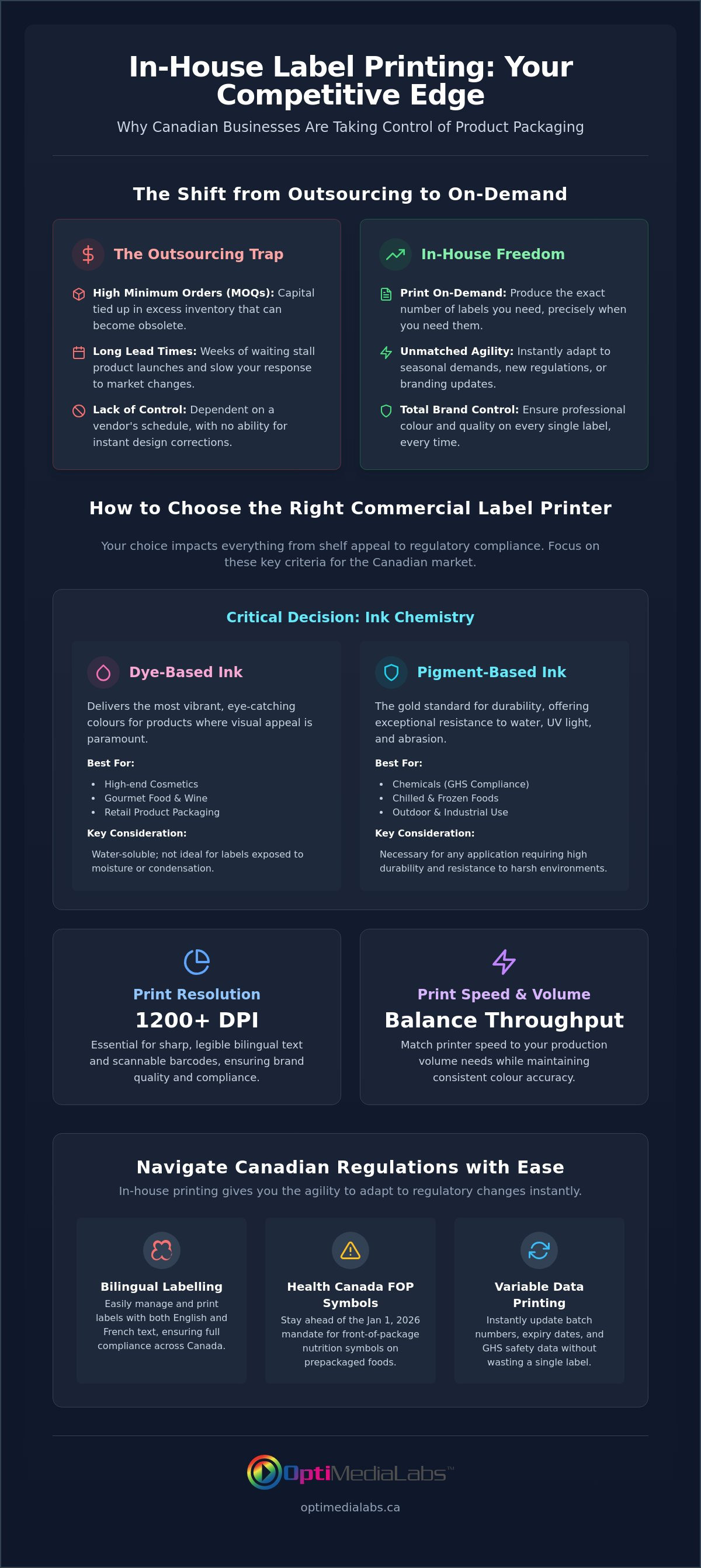
The primary driver for this shift is the avoidance of high minimum order quantities (MOQs). Third-party print shops often require orders of thousands of units to justify their setup costs. For a small business, this results in capital tied up in inventory and a high risk of waste if branding or regulations change. In-house production allows for "Just-in-Time" labelling. You print exactly what you need, when you need it. This agility is vital for seasonal products, limited-edition releases, or testing new market segments without a massive upfront investment. It's a direct path to better margins through reduced inventory overhead and the total elimination of obsolete stock.
Eliminating the "Outsourcing Tax"
Outsourcing carries hidden costs that go beyond the price per label. Shipping fees, customs duties for international orders, and lengthy lead times can stall your product launches. When you own the production process, you can make immediate design corrections or iterations without waiting for a new proof from a vendor. If you're comparing different brands to find the right fit for your workflow, our Afinia Color Label Printers Guide provides deep context on how specific hardware can streamline these operations. Reducing these external dependencies ensures your products reach the market faster and your cash flow remains fluid.
Flexibility for Variable Data and Compliance
Regulatory compliance in Canada is becoming more complex. As of January 1, 2026, Health Canada requires mandatory front-of-package (FOP) nutrition symbols on many prepackaged foods. Meeting these requirements alongside bilingual labelling laws demands high precision and the ability to update data instantly. A commercial label printer integrated with professional software allows you to update batch numbers, expiry dates, or GHS safety data in seconds. This level of control ensures you don't get stuck with thousands of non-compliant labels because of a sudden legislative shift or a simple typo in a nutritional panel. Digital printing provides the accuracy needed for the sharp, small fonts required by 2026 standards while maintaining "store-shelf" vibrancy.
Critical Evaluation Criteria: How to Judge the Best Colour Label Printers
Selecting a commercial label printer requires looking beyond the initial sticker price. You must evaluate how the hardware handles specific Canadian environmental factors and market expectations. A printer that performs well in a climate-controlled office might fail when labels are subjected to the humidity of a commercial kitchen or the UV exposure of a retail window. Technical specifications like ink chemistry, resolution, and media compatibility determine whether your labels remain professional from the warehouse to the customer's hands.
Adhering to Canadian labeling regulations often requires printing high volumes of small, bilingual text. To maintain legibility at these scales, a print resolution of 1200 dpi or higher is essential. Lower resolutions can result in "fuzzy" edges on characters, which undermines your brand's perceived quality and may lead to compliance issues. You should also consider print speed. High throughput is vital for growing businesses, but it must be balanced with the ability to maintain consistent colour accuracy across thousands of units.
Dye vs. Pigment Ink: The Small Business Dilemma
Dye-based inks offer the most vibrant "pop" for retail packaging, making them ideal for high-end cosmetics or gourmet food items where visual appeal is paramount. However, dye ink is susceptible to smudging when exposed to liquids. Pigment ink is the gold standard for moisture and UV resistance. It's the necessary choice for chemical products, chilled foods, or items stored outdoors. Always match your ink chemistry to the specific environment where your product will be used or stored to avoid faded or illegible branding.
Understanding Total Width and Roll Capacity
The physical dimensions of your packaging dictate your hardware requirements. Most small businesses choose between 4-inch and 8-inch print widths depending on their bottle or box sizes. Utilizing Afinia printers provides the versatility to scale across different packaging formats without sacrificing speed. Larger roll capacities are equally important; they significantly reduce downtime during long production runs by minimizing the frequency of media changes. This efficiency allows your team to focus on fulfillment rather than printer maintenance.
Workflow efficiency also depends on software integration. Using professional barcode labeling software Canada ensures that your designs remain consistent and your data stays accurate across different product batches. If you're unsure which technical specifications match your specific product line, speak with one of our specialists for a tailored technical assessment.
2026 Roundup: The Best Commercial Label Printers for Every Small Business Sector
Selecting the right commercial label printer depends on your specific industry requirements and production volume. While the Afinia L502 serves as a versatile all-rounder with its dual-ink technology, other models offer specialized advantages for niche applications. For example, businesses in the chemical or logistics sectors often rely on Epson ColorWorks systems. These industrial workhorses provide the durability needed for GHS-compliant labelling while maintaining consistent uptime in demanding warehouse environments. Matching your hardware to your sector's specific stressors ensures your investment remains productive for years.
Best for Retail and Boutique Branding
Visual impact is the primary goal for artisanal food, craft beverage, and cosmetic brands. Primera label printers, particularly the LX-series, are the preferred choice for these high-detail applications. These systems excel at producing vibrant, photographic-quality results that make products stand out on a crowded shelf. They are designed for ease of use, allowing staff members without extensive technical training to produce professional results. Maintaining compliance with Canadian packaging and labelling regulations is straightforward with these systems, as they handle small, bilingual font requirements with exceptional clarity.
Best for High-Volume Manufacturing
Manufacturing and large-scale distribution centres require throughput that standard desktop units cannot match. The Afinia L801 and L901 systems utilize Memjet technology to achieve massive print speeds without sacrificing resolution. These machines are built for long-run efficiency and integrate seamlessly into existing conveyor or finishing lines. Long-term operational costs are kept low through the use of high-capacity Afinia ink cartridges, which provide a significantly lower cost-per-label than entry-level cartridges. This makes them the most economical choice for businesses printing tens of thousands of labels monthly.
The Role of Finishing: Beyond the Printer
The commercial label printer is only one half of a complete in-house production solution. Professional presentation also requires precise cutting, especially for uniquely shaped bottles or jars. Afinia label cutters & finishers allow you to create custom shapes digitally without the high cost of physical dies. Digital finishing enables you to produce unlimited label shapes on a single roll of media. This flexibility is essential for businesses that frequently update their packaging or offer a wide variety of product sizes. It eliminates the lead times associated with ordering pre-die-cut labels and ensures every package has a perfect, tailored fit.
Maximizing Your Investment: Total Cost of Ownership and ROI Analysis
A commercial label printer is a capital investment that requires a thorough Total Cost of Ownership (TCO) analysis. While the purchase price is the most visible figure, your long-term return on investment is determined by the cost of ink, media, and maintenance. Calculating the cost per label is a vital first step. This involves dividing the total cost of a full ink set and a roll of media by the estimated yield. For businesses printing high-coverage designs, ink becomes the primary variable cost. Precision in these calculations helps you understand exactly how much you save on every unit compared to third-party rates.
Hidden costs often reside in maintenance and printhead replacement. Unlike consumer-grade hardware, professional systems often utilize user-replaceable printheads. This design reduces service downtime but requires you to factor the cost of these components into your operational budget. Automated systems also provide significant labour savings. By reducing the time spent on manual labelling processes or managing vendor communications, your team can focus on higher-value tasks. Additionally, capital equipment purchases for Canadian businesses may offer depreciation benefits through the Capital Cost Allowance (CCA) program. Consult with a tax professional to realize how these benefits apply to your specific business structure.
The "Break-Even" Point
Knowing when to jump from a desktop unit to a commercial label printer depends on your monthly volume. Outsourcing a 1,000-label run often involves high unit costs and setup fees. Printing that same run in-house significantly reduces the per-label expense. To keep media costs low, utilize high-quality blank inkjet labels designed for your specific ink chemistry. Most businesses find the break-even point occurs much faster than expected when factoring in the elimination of shipping fees and minimum order penalties.
Scalability: Planning for 2027 and Beyond
Buy for the business you intend to be next year, not just the one you are today. Choose a system that handles your current volume while providing the overhead for growth. Modern systems are often modular; you can start with the printer and add digital finishers as your production needs evolve. Longevity is also tied to the quality of your supplies. Using brand-specific Epson ink cartridges ensures your printheads remain in peak condition and prevents premature hardware failure. Planning for scalability ensures your equipment remains a technical asset rather than an operational bottleneck.
If you need a detailed cost-per-label analysis for your specific artwork, contact our technical team for a custom ROI report.
Streamlining Your Supply Chain with OptiMediaLabs Canada
OptiMediaLabs Canada serves as a dedicated partner for businesses transitioning to in-house production. Managing multiple vendors for hardware, ink, and media creates unnecessary friction in your supply chain. By consolidating your procurement, you gain a single, reliable point of contact for both thermal label printers and high-resolution colour systems. Our national distribution network ensures that your commercial label printer never sits idle due to supply shortages. We prioritize speed and reliability. We deliver the essential components of your packaging line directly to your facility. This eliminates the delays often associated with international shipping or complex customs clearances.
Our commitment is to professional-grade hardware. We don't offer design services or adjacent marketing support. This specialization allows us to maintain a deep technical expertise in the equipment we sell. While we handle your hardware needs, for high-end custom design and printing of photobooks, calendars, or wall art, Photobook Press is an excellent resource for professional brand assets. You receive clear, transactional advice on how to optimize your output and reduce your per-unit costs. It's about providing the tools you need for a stable, long-term production environment. We focus on the technical requirements of your business so you can focus on growth.
Comprehensive Consumable Support
Maintaining an industrial production schedule requires a consistent supply of high-quality materials. We carry a vast inventory of Zebra ribbons and specialty synthetic media to suit any environment. Production downtime is expensive. Our stock levels are managed to prevent interruptions in your workflow. For businesses requiring complex system integration, we provide high-end software solutions like NiceLabel. This software bridges the gap between your internal database and your hardware. It ensures data integrity across every print job, from simple barcodes to complex GHS safety labels.
Your Next Steps for In-House Success
Transitioning to a commercial label printer is a strategic move for any Canadian small business. We recommend verifying the quality on your specific substrates before making a final decision. Organize a sample print with us to see exactly how your artwork performs on different materials. This step ensures that your aesthetics meet professional standards. Consult with one of our specialists to determine which model matches your projected production volume. They'll help you realize the most efficient path to full production control. Visit our primary shop page to view current 2026 hardware availability and secure your production future.
Scaling Your Production with In-House Precision
Transitioning to an in-house commercial label printer isn't just about reducing costs; it's about gaining the agility needed to thrive in the 2026 Canadian market. You've seen how matching ink chemistry to your environment and calculating the total cost of ownership can transform your margins. By eliminating outsourcing delays and high minimum order quantities, you position your brand for sustainable growth and full regulatory compliance. Professional packaging is now within your direct control.
OptiMediaLabs Canada is an authorized distributor for Afinia, Epson, and Primera, providing the technical infrastructure for your success. We offer national Canadian shipping and support, backed by a comprehensive stock of brand-specific inks and blank media. This ensures your production line remains consistent and efficient as you scale. Our technical expertise helps you avoid the common pitfalls of industrial printing, keeping your focus on your product rather than maintenance hurdles.
Browse our full range of Commercial Colour Label Printers to find the ideal solution for your workflow. We're ready to help you take full control of your brand's production future and realize your long-term efficiency goals.
Frequently Asked Questions
What is the best color label printer for a small business starting out in 2026?
The Afinia L502 is the best commercial label printer for a small business starting in 2026 due to its dual-ink capability. It allows you to switch between dye and pigment inks depending on whether you need retail vibrancy or industrial durability. This flexibility ensures your hardware remains useful as your product line expands into different market segments. It's a secure investment that grows alongside your production needs.
How much does it cost to print labels in-house versus outsourcing in Canada?
In-house printing typically reduces the per-label cost by eliminating setup fees and minimum order quantities required by external shops. While the initial capital investment is higher, the absence of shipping fees and inventory waste leads to a lower total cost per unit. Most Canadian businesses realize that printing in-house becomes more economical once they exceed a few thousand labels per month, especially when handling multiple product variations.
Can I print GHS-compliant chemical labels with a standard commercial printer?
You can print GHS-compliant labels provided your commercial label printer utilizes pigment-based ink and compatible synthetic media. Pigment ink is essential because it offers the chemical and moisture resistance required by international safety standards. Using a standard dye-based inkjet system won't meet these regulations. The ink will smudge or fade when exposed to harsh substances, which compromises safety and legal compliance.
What is the difference between inkjet and thermal transfer label printers?
Inkjet printers produce high-resolution, full-colour labels suitable for retail branding, while thermal transfer printers are better for high-speed monochrome barcodes. Thermal transfer technology uses a heated ribbon to create durable, high-contrast images that withstand extreme temperatures and abrasion. Choose inkjet for aesthetic appeal and shelf-ready packaging. Select thermal transfer for logistics, shipping, and long-term warehouse tracking where durability is more important than colour.
Do I need special software to run a commercial label printer?
Yes, professional barcode software is necessary to manage variable data and ensure your labels meet Canadian retail standards. While most printers include basic drivers, specialized programs like NiceLabel or BarTender allow for database integration and precise placement of bilingual text. This software streamlines the production of batch numbers, expiry dates, and nutritional panels. It eliminates the need for manual design adjustments for every product run.
How long do the ink cartridges last in a high-volume commercial printer?
Ink cartridge longevity depends on your specific artwork coverage and the millilitre capacity of the tanks used in your system. High-volume models like the Afinia L801 utilize large 250ml tanks that produce significantly more labels per set than entry-level desktop units. You should calculate your expected yield based on your specific ink coverage to maintain an accurate operational budget. High-capacity systems offer a much lower cost-per-label over time.
Are Afinia printers better than Epson for small business use?
Afinia printers often provide higher print speeds and specialized finishing options, while Epson is recognized for its rugged industrial reliability and GHS compliance. Your choice should depend on whether you prioritize throughput and custom shapes or long-term durability in harsh environments. Both brands offer professional-grade quality. Afinia typically caters to businesses focused on high-volume branding, whereas Epson excels in logistics and safety labelling.