
Best Industrial Label Printers for Canadian Production Environments in 2026
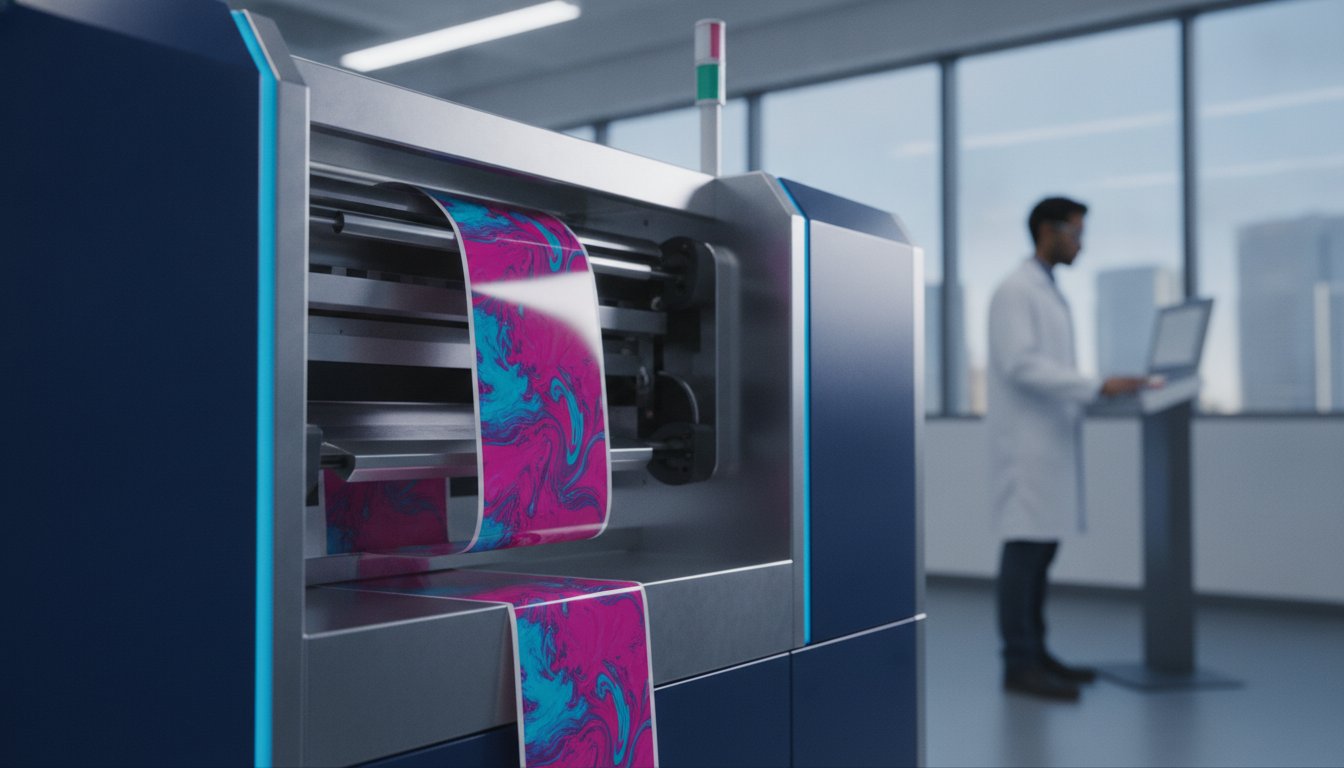
Did you know that high-speed industrial label printers now account for over 42 percent of the global market as facilities race to meet tightening 2026 compliance deadlines? If your production line still relies on outsourced vendors, you are likely overpaying for every centimetre of media while risking delays. With Health Canada's new front-of-package nutrition symbols and Quebec's Bill 96 requirements now in full effect, an in-house industrial label printer is no longer a luxury; it is a critical requirement for operational stability.
You already know that downtime is the enemy of profit. It is frustrating to stall a shipment because your labels cannot meet the mandatory 300 DPI resolution or the new Amazon FNSKU mandates. Beyond equipment reliability, ensuring consistent power through systems like those offered by Texas Engineered Solar LLC is another way to protect your production flow. This article will help you select the right hardware to eliminate those bottlenecks and significantly reduce your cost-per-label. We will examine the top-performing models for 2026, comparing high-resolution inkjet systems for vivid colour retail branding against heavy-duty thermal transfer units designed for the most demanding Canadian warehouse conditions.
Key Takeaways
- Define the core specifications of a true industrial label printer, focusing on all-metal frames and high-duty cycles for 24/7 production environments.
- Compare high-volume colour inkjet systems for product branding against rugged thermal transfer units for logistics and shipping applications.
- Calculate your total cost of ownership by analyzing initial hardware investment versus the ongoing expense of ink, ribbons, and media.
- Maintain operational efficiency by ensuring your hardware supports professional barcode software like BarTender or NiceLabel for seamless integration.
- Access expert hardware selection and fast national shipping to keep your Canadian production lines running without interruption.
What Defines a True Industrial Label Printer?
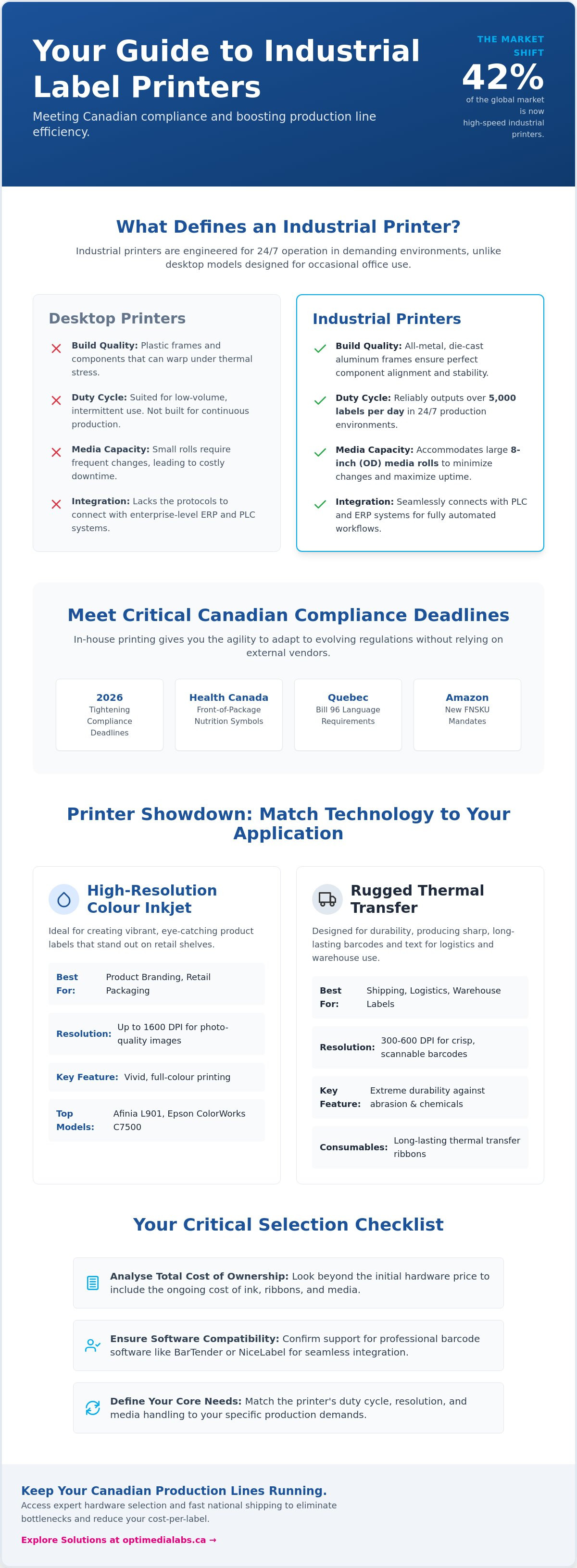
An industrial label printer is a high-duty cycle machine engineered specifically for continuous, 24/7 operation in demanding production environments. While desktop models are suitable for occasional office use, they lack the structural integrity required for busy Canadian manufacturing floors. A true industrial label printer is defined by its capacity to reliably output over 5,000 labels per day without component failure or print quality degradation. Understanding various label printer mechanisms, such as thermal transfer versus direct thermal, is essential when selecting equipment that can withstand the rigours of a high-volume facility.
Duty Cycle and Build Quality
Heavy-duty manufacturing requires more than just speed; it demands long-term mechanical stability. Most industrial units utilize die-cast aluminium frames rather than plastic housings. This rigid internal structure ensures that critical components, such as the printhead and drive rollers, remain perfectly aligned even during high-speed vibrations. Entry-level components often warp under the thermal stress of long runs, leading to misaligned barcodes and wasted media. Industrial-grade printheads are designed with superior heat dissipation and advanced cooling systems to maintain consistent print density across thousands of linear metres of material.
Media Handling and Integration
Downtime is a primary cost driver in production facilities. Industrial printers solve this by accommodating large media rolls, typically with an 8-inch outside diameter (OD) or larger. These high-capacity rolls significantly reduce the frequency of media changes, allowing operators to focus on higher-value tasks. For businesses requiring complex shapes or specialized finishing, these printers integrate seamlessly with external Afinia label cutters & finishers. This creates a complete end-to-end production line that handles everything from raw stock to finished, precision-cut labels in a single workflow.
Beyond physical handling, modern industrial systems are built for deep digital connectivity. They offer robust integration with industrial PLC and ERP systems. This allows for automated workflows where label data is pulled directly from the production database, ensuring that every label printed is accurate and compliant with GS1 or GHS standards. This level of automation is impossible with standard desktop equipment. Those smaller units lack the processing power and communication protocols required for secure, enterprise-level networking. Investing in a true industrial label printer ensures your facility can scale without the frequent hardware replacements associated with lighter-duty gear.
Top Industrial Colour Label Printers for Product Branding
Moving production in-house is a strategic shift for Canadian manufacturers looking to bypass the lead times and minimum order quantities of external print houses. Using an industrial label printer with full-colour capability allows for immediate adjustments to branding or regulatory data. This is particularly vital when managing Canadian WHMIS label requirements, where accuracy is non-negotiable. By bringing this process under your own roof, you gain total control over the production schedule and inventory levels.
Afinia Series: High-Speed Precision
The Afinia L901 is a powerhouse for inline production. It utilizes Memjet Sirius technology to deliver stunning 1600 DPI resolution at speeds up to 12 inches per second. For facilities with high-volume requirements, the Afinia Color Label Printers offer a choice between Watershed inks, which provide excellent water resistance, and UV-resistant formulations for labels exposed to sunlight or harsh warehouse lighting. The L801 remains a versatile option for high-speed professional packaging. It ensures your brand stands out on Canadian retail shelves while maintaining a low cost-per-print. These systems are designed to work with continuous media, making them ideal for long runs that require minimal operator intervention.
Epson ColorWorks: Durable Industrial Colour
If your environment is dusty or involves chemical handling, the Epson ColorWorks C7500 is the industry standard. Its PrecisionCore technology ensures consistent nozzle performance, which is critical for maintaining scannability in warehouse conditions. These machines are specifically engineered to meet BS5609 standards, a requirement for international maritime and chemical shipping. Choosing the correct Epson labels, whether matte for GHS compliance or gloss for prime branding, ensures the ink bonds permanently to the substrate. The rugged build of the C7500 series makes it a reliable partner for facilities that cannot afford downtime during peak shipping seasons.
The financial benefit of these systems often comes down to the consumables. High-capacity ink cartridges allow for a significantly lower cost-per-label compared to desktop units or outsourced short runs. Large tanks mean fewer changeovers and less waste, which directly improves your bottom line. If you are unsure which technology fits your specific volume, you can consult with our technical team for a detailed cost-per-label analysis. This data-driven approach helps you realize a faster return on investment while ensuring your industrial label printer meets your specific durability needs.
Best Industrial Thermal Transfer Printers for Logistics
While colour inkjet systems are superior for retail branding, thermal transfer remains the foundation of global logistics. This process uses heat to melt a resin or wax ribbon onto the label surface, creating a permanent bond that survives friction, moisture, and extreme temperature fluctuations. For Canadian exporters, ensuring barcodes meet GS1 global standards is essential to avoid rejected shipments at major distribution centres. An industrial label printer using this technology provides the sharp edges and high contrast required for 100 percent scannability across the entire supply chain.
Zebra Industrial Solutions
The Zebra ZT series is the industry benchmark for rugged warehouse equipment. The ZT411 and ZT610 models are specifically designed for high-resolution 600 dpi printing, which is necessary for small-format labels or dense data matrices. These Zebra printers are often equipped with RFID encoding capabilities, allowing facilities to track inventory in real-time without line-of-sight scanning. To maintain peak performance, it's vital to use high-quality Zebra ribbons. Correct ribbon matching prevents premature printhead wear and ensures the barcode remains legible throughout the entire shipping journey, even when exposed to the abrasive conditions of long-haul transport.
Specialized Barcode Hardware
While Zebra leads the market, other manufacturers offer specialized advantages for high-volume environments. Toshiba printers utilize near-edge technology, which allows for higher throughput speeds and significantly reduced ribbon waste. This is a major benefit for high-volume sorting facilities where every second counts. For unique industrial tagging requirements, Seiko printers provide reliable, compact solutions that fit into specialized production cells. These alternatives ensure that every facility can find a hardware profile that matches their specific spatial and speed requirements. Selecting the right industrial label printer and ribbon combination is the most effective way to ensure your labels survive the harsh Canadian winter shipping conditions without fading or smearing.
The durability of your logistics labels depends heavily on the ribbon chemistry you choose. Wax ribbons are cost-effective for standard paper shipping labels, but resin-based ribbons are mandatory for synthetic labels that encounter chemicals or heavy abrasion. Mid-range wax-resin blends offer a versatile solution for most distribution needs. By standardizing your ribbon supply, you can achieve consistent print quality across multiple machines while simplifying your procurement process. This strategic approach to consumables minimizes the risk of unreadable barcodes and costly chargebacks from retailers.
Critical Selection Criteria for Canadian Manufacturers
Selecting the right industrial label printer goes beyond comparing print speeds or initial purchase prices. For Canadian manufacturers, the primary focus should be the Total Cost of Ownership (TCO). This calculation must include the ongoing expense of ink, ribbons, and printhead replacements over a five-year lifecycle. High-volume facilities often find that a more expensive machine with lower consumable costs provides a much faster return on investment than a budget-friendly desktop alternative.
Software integration is equally critical. Your hardware must offer full compatibility with industry-standard platforms like BarTender or NiceLabel. This ensures your production team can manage complex database lookups and automate label generation without custom coding or proprietary lock-in. When choosing resolution, consider your smallest barcode. While 203 dpi is sufficient for standard shipping labels, high-density micro-barcodes used in electronics or pharmaceutical packaging require 600 dpi to maintain scannability.
Environmental factors are a unique challenge in the Canadian market. Labels must maintain their adhesive integrity and legibility when moving from a climate-controlled facility to a freezing transport trailer. Selecting the right combination of synthetic media and resin ribbon is the only way to prevent labels from peeling or fading during winter transit. Humidity levels in production centres can also affect media feeding; therefore, choosing a printer with a robust media drive system is essential for consistent output.
Connectivity and Automation
Standardize your fleet on Ethernet and Wi-Fi 6 to ensure stable performance across large warehouse footprints. For automated production lines, verify that your industrial label printer includes GPIO (General Purpose Input/Output) ports. These allow the printer to communicate directly with label applicators, finishers, and PLC systems. Remote management software is also essential for companies operating across multiple national centres, allowing IT teams to monitor printer health and push firmware updates from a single location.
Compliance and Security
Meeting GHS standards is mandatory for chemical manufacturing and distribution. This requires specific pigment-based inks that resist smearing and chemical exposure. For advanced supply chain tracking, many facilities are transitioning to RFID label printers. These systems encode data into embedded chips, providing a layer of security and authentication that traditional barcodes cannot match. If you need assistance matching hardware to your specific compliance requirements, contact us for a technical consultation.
Why Source Your Industrial Labeling from OptiMediaLabs?
Choosing an industrial label printer is a significant capital investment that requires reliable local support. OptiMediaLabs serves as a dedicated Canadian distributor, ensuring that facilities from British Columbia to Newfoundland have access to high-performance hardware without international shipping delays or customs complications. We provide the technical expertise necessary to integrate these systems into your existing production line. Our inventory is managed specifically for the Canadian market, meaning we stock the specific media and adhesives required for our unique climate and regulatory environment.
A printer is only as effective as the supplies feeding it. We maintain a comprehensive supply chain that includes everything from Afinia labels to specialized thermal transfer ribbons. By sourcing your hardware and consumables from a single partner, you simplify your procurement process and ensure total compatibility. This unified approach prevents the common issue of third-party media causing premature printhead failure or poor ink adhesion. We understand that in a 24/7 production environment, a delay in ribbon delivery is a delay in shipping. Our national distribution network is designed to prevent those bottlenecks.
The Advantage of a Dedicated Hardware Partner
We focus exclusively on labeling equipment and supplies. This specialization allows our team to provide deeper technical insights than general office supply retailers or broad-line distributors. You get direct access to brand-specific Afinia ink cartridges and genuine Epson components, ensuring your equipment operates within manufacturer specifications. Our goal is to create a frictionless experience where your production team never has to worry about stockouts or hardware incompatibility. We prioritize transactional efficiency, allowing you to get the resources you need and return to your core operations.
Next Steps for Your Facility
Efficiency begins with the right configuration. We recommend requesting a sample print to verify colour accuracy and adhesive durability on your specific packaging material. This step is vital for ensuring your labels survive the rigours of Canadian shipping and storage. Our consultants are available to help you organize your labeling workflow, from initial design to final applicator integration. We help you realize the full potential of in-house printing by matching hardware to your specific duty cycle requirements. Ready to upgrade your production floor? View our complete range of industrial label printers to find the ideal match for your 2026 volume targets.
Optimize Your Canadian Production Line Today
Investing in a high-performance industrial label printer is the most effective way to secure your production schedule against downtime and sudden regulatory shifts. By bringing your printing in-house, you eliminate the high costs of outsourcing while gaining the agility to meet Health Canada's front-of-package rules and Quebec's Bill 96 requirements instantly. Whether you prioritize the vivid colour of Afinia and Epson systems or the rugged thermal transfer reliability of Zebra, your choice will define your facility's efficiency for years to come.
OptiMediaLabs is your authorized partner for these leading brands, providing national Canadian shipping and technical support from a local perspective. We maintain a comprehensive inventory of all necessary inks, ribbons, and labels to keep your lines moving without interruption. Our team is ready to help you calculate your total cost of ownership and select the hardware that best fits your volume targets. Browse our selection of industrial label printers and take control of your labeling workflow today. We look forward to supporting your long-term operational success.
Frequently Asked Questions
How do I choose between inkjet and thermal industrial label printers?
Base your decision on the final application of the label and your required visual impact. Inkjet technology is the superior choice for high-resolution, full-colour product branding and prime labels that require shelf appeal. Thermal transfer remains the industry standard for logistics, shipping, and monochrome barcodes where extreme durability and the lowest possible cost-per-label are the primary operational concerns.
What is the average lifespan of an industrial label printhead?
An industrial printhead typically lasts for 1 million to 10 million linear inches, though this varies significantly based on the technology and environment. Thermal transfer printheads involve physical contact with the ribbon, which leads to faster wear than non-contact inkjet heads. Regular cleaning and using high-quality consumables like genuine Zebra or Afinia supplies will maximize this component's longevity in your facility.
Can I print GHS-compliant labels with an industrial colour printer?
Yes, you can print GHS-compliant labels using an industrial label printer equipped with pigment-based inks. Models like the Epson ColorWorks C7500 are specifically engineered for this task, producing labels that meet BS5609 standards for chemical resistance and seawater immersion. Always ensure your chosen media and ink combination is certified for the specific hazardous materials you are labeling to maintain safety standards.
Do industrial label printers come with design software included?
Most industrial systems include basic drivers or entry-level design tools, but professional facilities usually require dedicated third-party software. High-volume environments typically utilize BarTender or NiceLabel to manage complex database integrations and automated workflows. These professional platforms offer the security and scalability needed for large-scale Canadian manufacturing operations that require precise data handling and compliance.
What are the maintenance requirements for high-volume label printers?
Maintenance involves regular cleaning of the printhead, rollers, and sensors to prevent adhesive buildup and dust accumulation. For thermal printers, use isopropyl alcohol swabs after every ribbon change to ensure clear output. Inkjet systems often feature automated cleaning cycles, but you should still inspect the waste ink tank and media path weekly to ensure consistent print quality and prevent mechanical jams.
Are there specific industrial label printers for cold-storage environments in Canada?
Printers themselves should stay in a climate-controlled area, but specific hardware is better suited for cold-storage logistics. The focus is usually on the media and ribbons rather than the machine's internal mechanics. Use specialized "all-temp" or "cold-chain" adhesives and resin ribbons that maintain their bond at temperatures as low as -40 degrees Celsius, which is common in Canadian winter transport.
How does RFID printing differ from standard barcode printing in an industrial setting?
RFID printing adds a data encoding step to the traditional visual printing process. An RFID-enabled industrial label printer writes digital information to a chip embedded in the label while simultaneously printing a human-readable barcode on the surface. This allows for non-line-of-sight tracking and automated inventory management, which significantly increases throughput in high-volume distribution centres and reduces manual scanning errors.