
Best Label Printer for Cannabis Products in Canada: 2026 Roundup
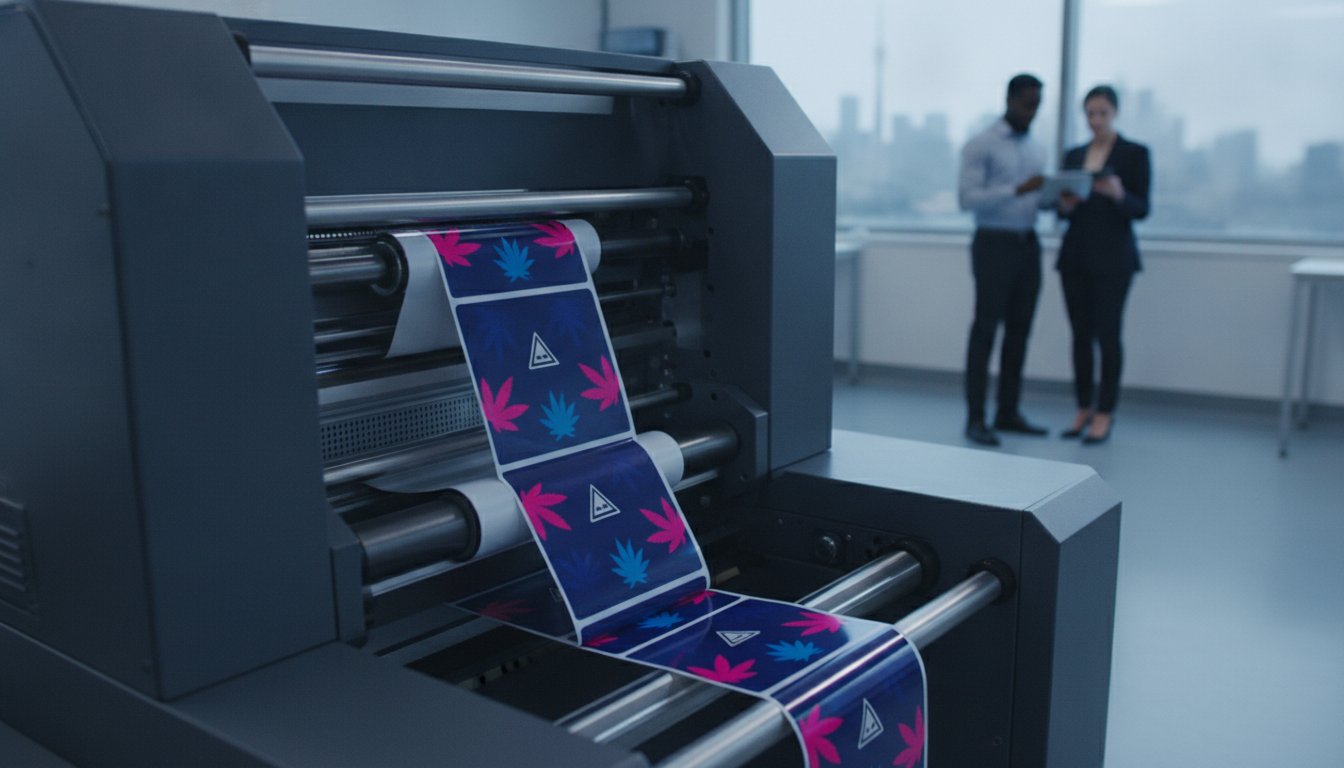
With the March 12, 2026, transition period now officially closed, any cannabis label that hasn't adapted to the updated Health Canada font and warning requirements is a liability. You likely realize that choosing the right label printer for cannabis products Canada is no longer just about aesthetics; it's about operational survival. Outsourcing small batches is expensive. Waiting weeks for a simple regulatory text change is even worse. Labels that peel off oil bottles or fade on flower containers can damage your brand reputation before the customer even opens the seal.
Investing in reliable in-house hardware allows you to take total control of your production timeline. You'll ensure every SKU meets strict federal standards, from new Total THC calculations to non-bold font requirements, without sacrificing colour accuracy. This 2026 roundup evaluates the top industrial systems from brands like Afinia, Epson, and Primera. We'll show you how to reduce your cost-per-label while utilizing new flexibility for QR codes and transparent windows to make your products stand out on crowded retail shelves across the country.
Key Takeaways
- Navigate the 2026 Health Canada packaging updates with precision by understanding the hardware requirements for mandatory warning symbols and non-bold font standards.
- Discover the most reliable label printer for cannabis products Canada to achieve professional-grade colour consistency and branding across your entire product line.
- Compare high-performance models from Afinia and Epson to find the right balance between speed, resolution, and cost-per-label for your facility.
- Select the ideal blank label stock and finishes, such as durable BOPP, to prevent peeling and fading on oil-based products and flower containers.
- Analyze the financial advantages of transitioning from outsourced printing to an in-house model to increase operational agility and reduce batch waste.
Navigating Cannabis Labeling Requirements in Canada
The regulatory environment for Canadian cannabis producers reached a critical milestone on March 12, 2026. This date marked the final end of the transition period for updated packaging and labelling rules under the Cannabis Act. Producers must now adhere to strict guidelines regarding health warning placement, THC/CBD font styles, and multi-pack configurations. Relying on pre-printed labels often leads to massive inventory waste when these regulations shift. An in-house label printer for cannabis products Canada provides the agility needed to update designs instantly, ensuring every container that leaves your facility is fully compliant.
Compliance and Small Text Legibility
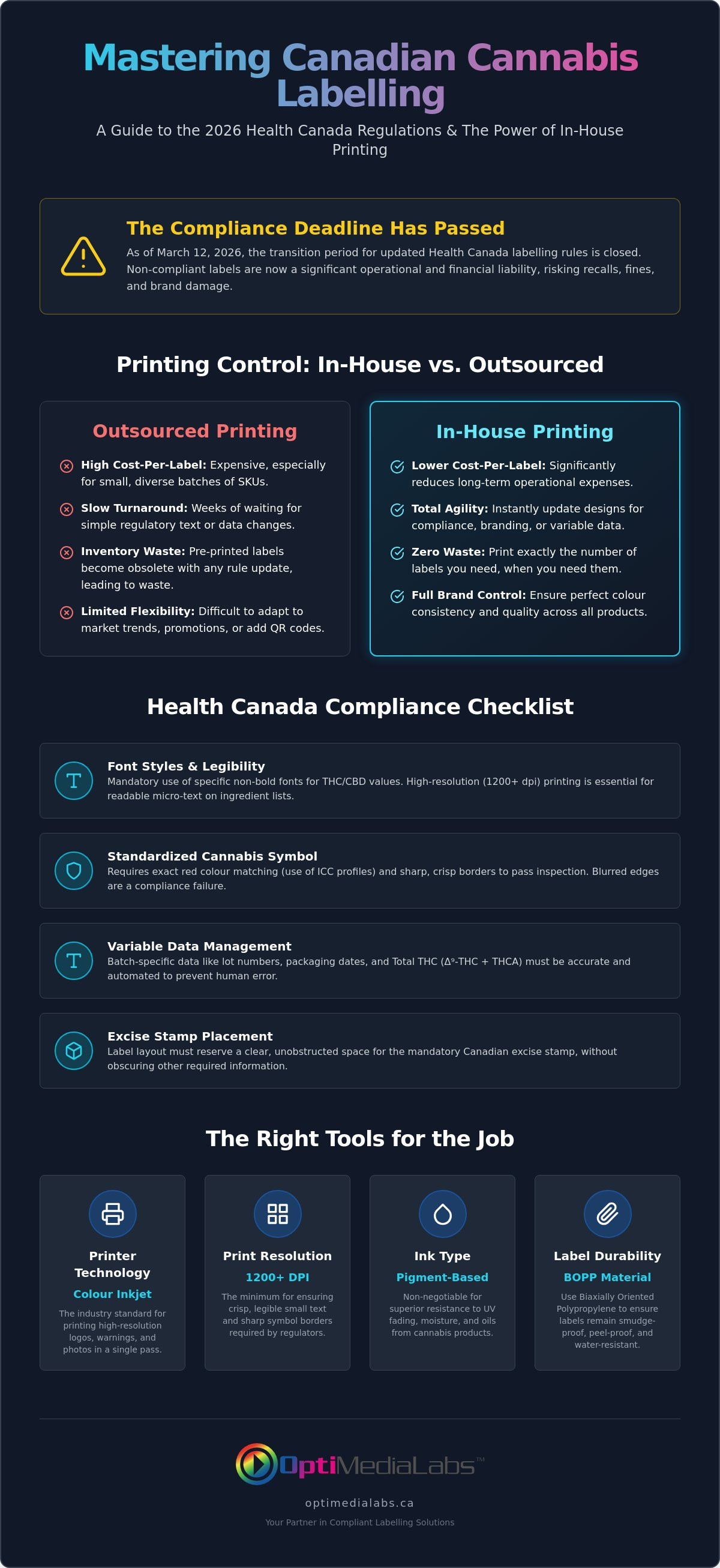
Health Canada's requirements for mandatory information are technically demanding. Small font sizes for ingredient lists and producer details can become illegible if printed on low-resolution hardware. Most standard desktop printers lack the clarity required for these microscopic characters. Industrial inkjet systems offering 1200 dpi resolution are the standard for maintaining crisp, readable text. This resolution is also vital for the Standardized Cannabis Symbol. The red colour must be exact, and the borders must remain sharp to pass regulatory inspections. Blurred edges or off-colour symbols can lead to costly product recalls or distribution delays.
Managing Variable Data and Excise Stamps
Beyond static branding, cannabis labels require batch-specific variable data. This includes lot numbers, packaging dates, and the specific Total THC calculation, which is now calculated as Delta-9 THC plus THCA. Manually entering this data for every SKU is prone to human error and slows down production. Professional label design tools like BarTender allow licensed producers to automate this process. The software pulls data directly from your seed-to-sale system to populate the label accurately. You must also coordinate your layout to leave clear space for the mandatory Canadian excise stamp. Precise placement ensures the stamp doesn't obscure the health warning or the QR codes now permitted for additional consumer information.
Physical durability is the final compliance hurdle. Cannabis oils and topicals can easily degrade standard paper labels. If a label becomes unreadable due to oil saturation or moisture, it no longer meets federal standards. We recommend utilizing BOPP (Biaxially Oriented Polypropylene) materials paired with pigment-based inks. This combination ensures labels remain smudge-proof and moisture-resistant throughout the product's entire shelf life, regardless of storage conditions.
Key Features for Cannabis Product Labeling Hardware
Selecting a label printer for cannabis products Canada requires a balance between regulatory precision and brand impact. While basic thermal printers handle simple shipping labels, they often fall short for consumer-facing packaging. Colour inkjet technology has become the industry standard because it allows producers to print high-resolution logos, product photography, and mandatory warning symbols in a single pass. This capability eliminates the need for expensive pre-printed label inventory that often becomes obsolete when regulations change.
Total cost of ownership is a critical metric for any facility. You must evaluate more than just the initial hardware price. High-capacity ink tanks and efficient media handling significantly reduce your long-term operational expenses. If you're unsure which system fits your specific volume, you can speak with our technical specialists to run a cost-per-label analysis for your most popular SKUs.
Print Quality and Colour Accuracy
Consistent branding across different product lines is essential for consumer trust. Achieving this requires the use of ICC profiles, which ensure that your brand's specific colours look identical whether they're printed on a matte flower container or a glossy edible box. Pigment-based inks are non-negotiable for this sector. They provide superior resistance to UV fading, moisture, and the oils found in many cannabis topicals. This ensures your high-vibrancy labels maintain their luxury look from the production floor to the retail shelf, fully adhering to Health Canada's official labelling guide.
Reliability in Production Centres
Industrial duty cycles are designed to prevent bottlenecks during peak packaging runs. A printer's duty cycle refers to the maximum number of labels it can reliably produce within a given timeframe without experiencing mechanical failure or requiring maintenance. Mid-to-high volume facilities should prioritize hardware with easy-to-replace ink cartridges and robust internal components. This reliability minimizes downtime and keeps your production lines moving efficiently. Consider the following hardware features when comparing models:
- Ink Capacity: Larger tanks mean fewer interruptions during high-volume runs.
- Media Sensors: Adjustable sensors allow for use with various label shapes and sizes.
- Connectivity: Ethernet and USB options ensure seamless integration with your local network.
- Resolution: Higher dpi settings ensure small regulatory text remains crisp and compliant.
Top-Rated Label Printers for Canadian Cannabis Producers
Selecting the ideal label printer for cannabis products Canada involves matching specific technology to your facility's weekly throughput. High-volume producers require different hardware than boutique craft startups focused on limited-run cultivars. The models reviewed below represent the most reliable industrial solutions currently available for the Canadian market, each offering distinct advantages in speed, resolution, and ink chemistry.
The Afinia Advantage for High-Volume LPs
The Afinia L801 is a powerhouse for large-scale operations. It utilizes Memjet Waterfall technology to achieve print speeds of up to 12 inches per second while maintaining 1600 dpi resolution. This speed is essential for facilities processing thousands of pre-rolls or flower containers daily. For even more demanding environments, the Afinia L901 is designed for inline integration. It features a printhead that can be serviced without breaking the web, allowing it to work seamlessly with Afinia label cutters and finishers. This creates a complete roll-to-label solution that eliminates manual rewinding and accelerates your packaging timeline.
Epson ColorWorks: Versatility and Durability
The Epson C6000 series has earned its reputation as a reliable workhorse for mid-sized licensed producers. These printers utilize PrecisionCore technology and pigment-based inks, which are vital for meeting the durability standards discussed in previous sections. The C6500 and C6000 models are particularly effective when paired with matte label stock to create oil-resistant labels for tinctures and topicals. Many producers prefer this series because of the built-in peeler and auto-cutter. These features allow for the immediate application of individual labels to units as they move down the line, reducing the labour costs associated with manual application from a roll.
Primera LX-Series for Craft Cannabis
Boutique producers and craft startups often find their perfect fit with the Primera LX-series. Models like the LX610 or LX910 offer a lower entry price point while still delivering professional-grade colour accuracy. While these units have smaller ink tanks compared to the Afinia systems, they're ideal for short-run seasonal drops or specialized extracts where label variety is high but volume per SKU is low. They provide the same 1200 dpi clarity required for Health Canada compliance without the footprint of a full industrial press.
Analysis of Cost-per-Print
Operational efficiency is driven by your long-term ink and media expenses. High-volume systems like the Afinia L801 utilize 250ml ink tanks, which significantly lowers the cost-per-label for large batches. Epson systems offer a balanced mid-range cost, while Primera systems are best suited for producers who prioritize low upfront hardware costs over high-volume ink savings. We recommend choosing a system that allows your brand to scale without forcing a hardware replacement within the first 18 months of operation.
Finishing and Consumables: Ensuring Label Durability
High-quality hardware is only half the equation for compliant packaging. The substrate and finish you choose determine if your label survives the Canadian supply chain. For most cannabis applications, BOPP (Biaxially Oriented Polypropylene) is the superior choice over standard paper. It's resistant to water, oils, and tearing. This is vital for topicals or tinctures where leakage can dissolve standard adhesives. When selecting a label printer for cannabis products Canada, ensure your chosen media is technically compatible with the printer's ink type to prevent smudging or poor adhesion.
Matte vs Gloss: A Branding Decision
The finish you select heavily influences how consumers perceive your brand on the shelf. Matte finishes are currently popular for 'craft' or 'natural' aesthetics. They offer a practical benefit by reducing glare, which makes it easier for staff and customers to read mandatory regulatory text under bright retail lights. Gloss finishes provide high-impact vibrancy and a premium feel that stands out in crowded dispensary cabinets. To achieve professional results for unique packaging, utilize Afinia label cutters. These finishers allow you to create custom-contoured labels for tapered jars or specialized edible boxes without the long lead times associated with ordering custom dies.
Adhesive selection is particularly critical for vape cartridges and other small-diameter containers. Standard adhesives often 'flag' or peel at the edges when applied to tight curves. You need high-tack, aggressive adhesives specifically designed for glass or low-surface-energy plastics. This ensures your legal information remains permanently attached for the entire life of the product, regardless of how often it's handled.
Consumables Management
Maintaining a consistent supply of consumables prevents costly production halts during peak packaging windows. It's best practice to stock a surplus of Epson ink cartridges or Afinia supplies to match your forecasted production runs. Using brand-certified media is equally important for your label printer for cannabis products Canada. These materials are engineered for optimal ink absorption and fast-drying performance, which is essential for high-speed industrial printing.
Proper storage of blank labels is essential in the Canadian climate. Significant fluctuations in humidity and temperature in warehouses can cause label rolls to curl or the adhesive to degrade prematurely. Keep your media in a climate-controlled environment, ideally between 15°C and 25°C. This prevents feeding issues and ensures every print run remains crisp and professional. If you need help selecting the right material for a specific container type, contact our team for a media compatibility consultation.
Scaling Your Cannabis Brand with In-House Printing
The transition from outsourcing to in-house production is a defining moment for growing licensed producers. While third-party print shops offer convenience for initial launches, they often impose rigid Minimum Order Quantities (MOQs) that don't align with the agility needed for craft cannabis or seasonal drops. Choosing the right label printer for cannabis products Canada allows you to reclaim your production schedule. You can print exactly what you need, when you need it, ensuring that your speed-to-market for new strains is limited only by your packaging capacity, not a printer's lead time.
ROI of In-House Hardware
Calculating the return on investment for industrial labelling equipment involves more than just comparing the cost-per-label. You must account for the secondary savings found in waste reduction and inventory management. When you control the print process, you no longer have to order surplus labels to meet a vendor's minimum requirements. In-house printing allows you to update regulatory text or branding on the fly, effectively eliminating the financial risk of carrying thousands of obsolete labels when Health Canada requirements change. Most facilities find their break-even point within the first year by simply removing the premium charged by external print services on short-run SKUs.
Partnering with a National Distributor
Success in the Canadian cannabis market requires a stable supply chain for both hardware and consumables. OptiMediaLabs Canada supports producers across all provinces by providing a single source for Afinia, Epson, and Primera systems. This centralized approach ensures that your inks, blank media, and barcode software are always technically compatible and available for immediate shipping. Our role as a technical authority means we don't just ship boxes; we provide the expertise needed to integrate these systems into your existing facility workflow.
Maintaining a high-performing production line requires more than just a printer. It requires reliable access to specialized inks and durable label stock that can withstand the rigours of retail distribution. Whether you're a boutique startup in British Columbia or a large-scale LP in Ontario, having a dependable partner ensures your branding remains consistent and your facility stays compliant with every batch. Contact OptiMediaLabs Canada to find the right cannabis label printer for your facility.
Future-Proof Your Cannabis Packaging Operations
Maintaining compliance in Canada's evolving regulatory environment requires more than just high-quality graphics. It demands the technical precision to reproduce microscopic text and mandatory symbols with absolute clarity. Transitioning to an in-house label printer for cannabis products Canada empowers your brand to adapt instantly to Health Canada's 2026 standards. You don't have to wait for external print shop lead times or manage high minimum order quantities that lead to inventory waste. By selecting durable materials like BOPP and utilizing pigment-based inks, you ensure your branding remains intact from the production floor to the retail shelf.
OptiMediaLabs Canada serves as an authorized Afinia and Epson distributor, providing specialized industrial support to licensed producers across the country. We simplify the transition to in-house production with national Canadian shipping and a complete inventory of certified consumables. Our team helps you calculate the ROI for your specific SKU volume to find a solution that scales with your business. Take total control of your production timeline and branding quality today.
Shop our full range of cannabis-ready label printers to secure your facility's operational agility for years to come.
Frequently Asked Questions
What is the best label printer for small cannabis startups in Canada?
The Primera LX610 or LX910 systems are the most effective entry-level choices for craft producers. These printers offer high resolution and built-in digital die-cutting, allowing startups to produce unique container shapes without the upfront cost of custom dies. While they have smaller ink tanks than industrial models, they deliver the professional finish required for dispensary shelves across the country.
Can I print Health Canada compliant labels on a standard office printer?
Standard office printers typically fail to meet the 1200 dpi resolution needed for crisp regulatory text. Health Canada has strict legibility requirements for ingredient lists and health warnings that microscopic characters must satisfy. Using a dedicated label printer for cannabis products Canada ensures that small text remains sharp and that the Standardized Cannabis Symbol prints in the exact required colour specifications.
Do I need special ink for cannabis oil bottle labels to prevent smudging?
You must use pigment-based inks to ensure durability on oil-resistant containers. Standard dye-based inks often dissolve or smudge when they contact the oils found in tinctures and topicals. Pairing pigment ink with a synthetic BOPP substrate creates a permanent, smudge-proof bond that survives heavy handling and varied storage conditions throughout the product's entire shelf life.
How do I ensure my labels fit the mandatory excise stamps correctly?
Utilize professional design software to create templates with dedicated margins for the Canadian excise stamp. These stamps are mandatory and must not obscure any regulatory information or health warnings. By using software like BarTender, you can lock specific areas of your label design to ensure the stamp is always applied in a compliant, unobstructed location on your packaging.
What is the difference between matte and gloss labels for cannabis packaging?
Matte labels offer a non-reflective finish that improves the readability of small regulatory text under bright retail lighting. This is often preferred for a craft or organic brand aesthetic. Gloss labels provide higher colour vibrancy and a shiny finish that helps products stand out in retail displays. Your choice should balance your brand's visual identity with the technical need for clear legibility.
Is it cheaper to print cannabis labels in-house or outsource them in 2026?
In-house printing is generally more cost-effective for producers managing multiple SKUs or frequent batch changes. Outsourcing often involves high minimum order quantities and long lead times. By using an industrial label printer for cannabis products Canada, you eliminate vendor markups and the risk of carrying obsolete label stock when regulations change. Most facilities realize a return on investment within the first year.
Which software is best for designing cannabis labels with variable THC data?
BarTender is the most reliable software for managing variable data like batch-specific THC and CBD percentages. It integrates directly with your seed-to-sale database to automate the printing of lot numbers and packaging dates. This reduces the risk of manual entry errors and ensures that every label printed matches the specific lab results for that harvest or production run.
How long do the inks last on cannabis labels stored in retail environments?
Pigment-based inks on brand-certified media are designed to last for several years without noticeable fading. Retail environments often use high-UV lighting that can degrade standard dye inks in a matter of weeks. Choosing industrial-grade consumables ensures your branding and mandatory health warnings remain vivid and compliant from the moment they are packaged until they reach the final consumer.