
Best Label Printer for Cosmetics Canada: 2026 Roundup and Buyer's Guide
A single smudge on your luxury serum bottle isn't just a minor packaging flaw; it's a direct hit to your brand's perceived value. You've likely spent months perfecting your formula, yet many Canadian beauty brands still struggle with ink that bleeds when exposed to essential oils or water. Outsourcing often feels like a trap of high minimum orders and slow lead times that stall your seasonal launches.
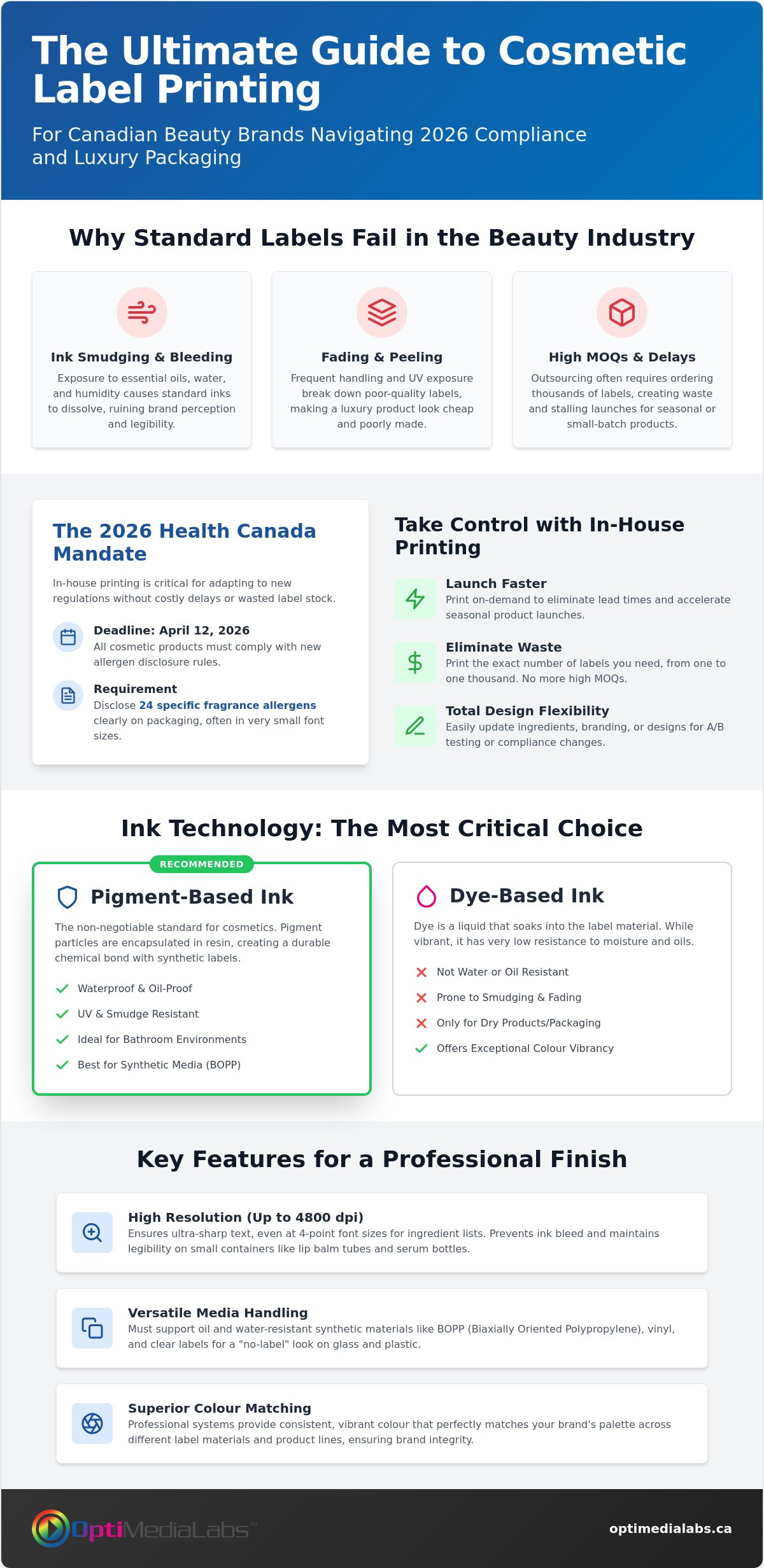
We recognize that professional-grade durability is a necessity for your business growth. Investing in the right label printer for cosmetics Canada allows you to produce vibrant, moisture-resistant labels with luxury colour in-house. This gives you total control over your design and inventory. It's also the most efficient way to comply with Health Canada's 2026 allergen disclosure rules. As of April 12, 2026, you must disclose 24 specific fragrance allergens on your packaging, making in-house flexibility more important than ever.
This guide reviews the top-performing hardware for 2026, including the versatile Afinia L502 and the budget-friendly Primera LX3000. You'll discover how to achieve a premium finish that survives the bathroom shelf while keeping your production costs predictable and your turnaround times fast.
Key Takeaways
- Understand why pigment-based ink technology is the industry standard for creating oil-resistant and water-resistant labels that survive bathroom environments.
- Compare the best label printer for cosmetics Canada options for 2026 to find the right balance of speed, resolution, and ink versatility for your brand.
- Learn to select professional media like BOPP or clear labels to achieve a high-end, moisture-proof finish for glass and plastic containers.
- Discover how high-resolution printing helps you maintain compliance with Health Canada’s detailed allergen disclosure requirements and fine-print ingredient lists.
- Realize the benefits of in-house production to eliminate high minimum order quantities and accelerate your seasonal product launches.
Why Cosmetic Brands Need Specialized Label Printers
Packaging serves as the primary touchpoint for consumer trust in 2026. A label that peels, fades, or smudges suggests a lack of quality control in the formula itself. While a standard office label printer might handle shipping documents, it cannot withstand the unique stressors of the beauty industry. Exposure to essential oils, high humidity, and frequent handling requires specialized hardware and ink chemistry that standard equipment lacks.
Producing labels in-house eliminates the friction of high minimum order quantities (MOQs). Traditional print shops often require orders of 5,000 or more units to be cost-effective. For a small Canadian brand launching a limited edition line, this is a significant barrier. By using a professional color label printer, you gain the agility to print exactly what you need. Selecting a dedicated label printer for cosmetics Canada ensures your ingredient lists remain legible throughout the product's entire lifecycle.
Moisture and Chemical Resistance Requirements
Cosmetic products live in bathrooms and handbags. These environments are high in moisture and subject to chemical interaction with the product's own ingredients. Essential oils are powerful solvents. They can dissolve standard inkjet and laser toners instantly. You must distinguish between water-resistant and truly waterproof materials. We recommend performing a "rub test" on every new batch. Apply your product directly to the label and vigorously rub the surface. This ensures the ink remains anchored and the text stays sharp under real-world conditions.
Achieving a Luxury Aesthetic In-House
A premium brand demands a premium finish. Achieving this requires high-resolution output, often reaching up to 4800 dpi, to ensure that even the smallest font in an ingredient list is crisp. Professional systems offer superior colour matching and vibrancy that office-grade machines simply cannot replicate. This consistency ensures your brand's specific palette looks identical across glass jars, plastic tubes, and cardboard boxes. A specialized label printer for cosmetics Canada provides the precision needed to compete with global luxury brands while maintaining the flexibility of local, small-batch production.
Key Features to Look for in a Cosmetic Label Printer
Selecting a label printer for cosmetics Canada involves more than comparing price points. You must evaluate how the internal technology interacts with synthetic materials and chemical ingredients. The technical specifications of your hardware determine whether your brand maintains its luxury image or looks weathered after a single use in the shower. High-performance cosmetic labelling requires a specific synergy between ink chemistry and substrate compatibility.
Pigment Ink vs. Dye Ink for Beauty Products
The choice between dye and pigment ink is the most critical technical decision for any beauty brand. Dye-based inks are known for exceptional vibrancy and wide colour gamuts, making them suitable for products kept in dry environments like retail shelves. However, they are highly prone to smudging when touched by wet hands or oily fingers. Pigment ink is the non-negotiable standard for products like shampoos, facial oils, and body scrubs. Pigment ink creates a durable chemical bond with synthetic media to ensure the label remains intact and legible even under extreme moisture or UV exposure.
Handling Small Text and Intricate Designs
Legibility is a legal requirement, not just a design choice. According to Canadian cosmetic labelling requirements, all mandatory information must be presented clearly in both English and French. Small cosmetic containers, such as lip balm tubes or 30ml serum bottles, often require font sizes as small as 4-point. High-resolution printers with up to 4800 dpi prevent ink from bleeding into the material fibres, ensuring every letter remains sharp. This precision is vital for maintaining compliance and professional aesthetics on compact packaging.
Beyond resolution, consider media compatibility and production throughput. Your hardware must support synthetic substrates like BOPP (Biaxially Oriented Polypropylene), which provides the oil resistance paper labels lack. While high-speed industrial printers offer massive throughput, smaller boutique brands often prioritize the finishing quality of a desktop color label printer to achieve a "no-label" look on glass jars. Balancing these factors ensures your production line remains efficient without sacrificing the premium feel your customers expect. If you need help determining which hardware handles your specific substrate, you can contact our experts for a technical consultation.
Top Label Printers for Cosmetics in Canada: 2026 Roundup
Selecting the right hardware requires matching your production volume with specific finishing features. The 2026 market offers specialized solutions ranging from compact desktop units to high-speed industrial engines. Finding the ideal label printer for cosmetics Canada involves evaluating ink costs, media flexibility, and integrated cutting capabilities to ensure your packaging remains competitive. Each model highlighted here serves a distinct stage of business growth, from boutique startups to full-scale manufacturing facilities.
Best for Startups: Primera LX610
The LX610 is a breakthrough for boutique beauty brands that utilize non-traditional packaging. Its built-in digital die-cutter allows you to print and cut any label shape in a single, continuous process. You don't need to purchase pre-die-cut labels or invest in separate finishing equipment. This significantly lowers your initial capital investment while providing total creative freedom for unique bottle silhouettes, such as hexagonal jars or custom-shaped tubes. Explore Primera label printers for accessible, entry-level professional quality that doesn't compromise on resolution.
Best for Growing Brands: Afinia L502
Scaling brands require technical flexibility to handle diverse product lines. The Afinia L502 features 'Duo' ink technology, which allows you to switch between dye and pigment inks using the same machine. This versatility is ideal for businesses that produce both high-vibrancy retail display boxes and durable, oil-resistant serum labels. Its rugged, industrial-grade construction is designed for consistent daily production cycles. This ensures your hardware remains a stable asset as your order volumes increase. View the complete lineup of Afinia printers to find a configuration that supports your increasing volume and durability needs.
Best for Industrial Production: Epson C6000A
For large-scale manufacturing, the Epson ColorWorks C6000 series provides unmatched reliability and workflow integration. These units integrate seamlessly into existing automated lines using ZPL II emulation and offer peeler options for immediate application. They deliver precise ink placement for both matte and gloss finishes, ensuring your brand aesthetic remains uniform across thousands of units. Check out Epson printers for high-volume Canadian production environments where speed and consistency are non-negotiable.
If production speed is your primary metric, the VIPColor VP750 utilizes Memjet technology to print at rates up to 12 inches per second. This capacity is essential for brands managing rapid growth or frequent seasonal launches with tight deadlines. Each of these models addresses specific operational gaps, from custom finishing to industrial throughput, ensuring your cosmetic line maintains a premium edge in the Canadian market.
Selecting the Right Media and Finish for Beauty Products
Hardware provides the foundation for your production, but the media you select determines the final durability and consumer perception of your brand. For those using a label printer for cosmetics Canada, the industry standard is BOPP (Biaxially Oriented Polypropylene). This synthetic material is non-porous and resistant to the aggressive oils and chemicals found in modern skincare formulas. Unlike paper, BOPP won't tear, peel, or turn grey when exposed to the high-humidity environment of a bathroom or shower.
Choosing the right substrate involves more than just selecting a material that sticks. You must consider how the light interacts with your packaging and how the texture feels in a customer's hand. High-end cosmetic lines often use a combination of specialized media and finishes to differentiate their products on crowded retail shelves. Whether you're aiming for a minimalist clinical look or a vibrant luxury aesthetic, your media choice must support the technical capabilities of your printer's ink system.
The 'No-Label' Look with Clear Media
Achieving a seamless "no-label" look on glass jars or plastic tubes requires clear synthetic stock. This technique allows the product's natural colour to show through, creating a sophisticated appearance that mimics direct-to-bottle printing. To avoid "silvering," which is the appearance of tiny air bubbles under the label, ensure your containers are perfectly clean and use a high-tack adhesive designed for clear films. Pairing clear media with high-opacity pigment inks is essential. This ensures your text remains legible and doesn't appear translucent when placed against a dark or patterned product background.
Choosing Between Matte and Gloss
Your choice of finish should align directly with your brand's core values and target demographic. Matte finishes are frequently used for organic, natural, or clinical product lines as they communicate a sense of understated sophistication and "clean" beauty. Gloss finishes, conversely, enhance colour vibrancy and create a classic luxury aesthetic that catches the light and draws the eye. For a deeper dive into these options, read our guide on Matte vs Gloss Label Finish: Which Suits Your Brand?.
Beyond these standard choices, you can add high-end flair by using metallic or foil media. Printing on silver or gold synthetic stock allows you to create metallic hues that suggest a premium, boutique origin for your serums and creams. This provides a cost-effective way to achieve a foil-stamped look without the need for expensive external tooling. If you're unsure which material works best for your specific container and formula, contact our team to request media samples and technical guidance for your specific application.
Why OptiMediaLabs is Your Canadian Partner for Cosmetic Labeling
Success in the beauty industry requires more than just a label printer for cosmetics Canada. It requires a stable supply chain and technical expertise to ensure your production line never stops. OptiMediaLabs provides national distribution across Canada. We ensure reliable shipping of hardware and consumables from coast to coast. We position ourselves as a dependable expert and efficient facilitator for brands that value precision. Our goal is to provide clarity and customer reassurance at every stage of your growth.
Our role extends beyond a simple transaction. We understand the specific technical hurdles of the Canadian market, including bilingual labelling and the durability needs of skincare packaging. By providing a secure path to high-performing resources, we help you maintain full control over your brand's aesthetic. We focus on building trust through transparency and ease of use. This grounded approach ensures your labeling system remains a reliable asset for years to come.
Complete System Support: Ink, Labels, and Software
Maintaining uptime is critical for meeting retail deadlines and seasonal launch windows. We supply genuine Afinia ink cartridges and Epson ink cartridges to ensure your hardware performs at peak specification. Using manufacturer-approved inks prevents technical failures. It also guarantees the chemical resistance needed for oil-based products. Our inventory is managed to provide immediate access to the supplies you need to keep your printers running.
Your workflow is further enhanced through professional barcode labeling software Canada. This allows for precise data management and easy updates to ingredient lists as Health Canada regulations evolve. For brands ready to automate their post-print process, Afinia label cutters and finishers provide the professional edge needed to scale. These systems allow you to create custom shapes without the delays of external print shops.
Expert Guidance for Canadian Manufacturers
We focus exclusively on hardware and supplies. This specialization makes us the preferred partner for manufacturers who require technical authority. We ensure your system meets the luxury aesthetic standards of the 2026 beauty market. We also prioritize compliance standards. Our practical approach focuses on building long-term partnerships. We don't use high-pressure tactics. Instead, we offer a helpful and supportive service that simplifies your procurement process.
Selecting the right label printer for cosmetics Canada is the first step toward packaging independence. Our team is available to assist with technical specifications and media compatibility tests. Contact our team today to realize your brand's potential with a tailored labeling solution designed for the unique challenges of the Canadian cosmetic sector.
Elevate Your Cosmetic Packaging Standards
The transition from external printing to in-house production is a strategic move for any growing beauty brand. You've seen how pigment ink technology and synthetic media like BOPP ensure your labels survive the bathroom environment. These tools provide the agility needed to meet Health Canada's 2026 allergen disclosure requirements without the burden of high minimum order quantities.
To further maximize the value of your custom labels, consider integrating digital touchpoints; for instance, using BonusQR allows you to turn every product package into a gateway for customer loyalty and rewards.
As an authorized Canadian distributor for Afinia, Epson, and Primera, OptiMediaLabs provides the technical expertise and hardware required for professional results. We maintain a comprehensive inventory of specialized cosmetic label media and inks to ensure your production remains uninterrupted. Selecting the right label printer for cosmetics Canada is about more than just equipment; it's about securing a reliable partner for your brand's long-term growth. We offer national shipping across Canada to support your manufacturing needs wherever you're located.
Shop our full range of professional colour label printers today. We look forward to helping you achieve the premium packaging your formulas deserve.
Frequently Asked Questions
What is the best label printer for a small cosmetic business in Canada?
The Afinia L502 is the most versatile label printer for cosmetics Canada for small businesses because of its Duo Ink technology. It allows you to switch between pigment ink for extreme durability and dye ink for high-vibrancy retail packaging. This flexibility helps boutique brands manage diverse product lines without investing in multiple machines.
Are inkjet labels waterproof enough for shampoo and soap bottles?
Inkjet labels are completely waterproof when you pair pigment-based inks with synthetic substrates like BOPP. This combination ensures that labels on shampoo or soap bottles won't smudge or peel when exposed to constant moisture and high humidity. Always perform a rub test with your specific formula to ensure maximum ink anchorage.
Can I print metallic or gold foil labels in-house?
You can achieve a metallic or gold foil effect by printing directly onto silver or gold synthetic media. This method allows you to create premium accents in-house without the high cost and lead times of traditional hot foil stamping. It is a cost-effective way to give your serums and creams a luxury, boutique appearance.
What is BOPP and why is it recommended for cosmetic labels?
BOPP stands for Biaxially Oriented Polypropylene; it is a durable synthetic material that resists oils and water. It is the industry standard for cosmetics because it maintains its structural integrity when exposed to the chemicals found in lotions and oils. Unlike paper, it will not tear or discolour during frequent consumer handling.
How do I ensure my ingredient lists are Health Canada compliant?
Compliance requires maintaining perfect legibility for bilingual text and the 2026 fragrance allergen disclosures. High-resolution printing at 1200 dpi or higher ensures that even 4-point fonts remain sharp and readable. This precision is essential for meeting the strict formatting and disclosure standards set by Health Canada.
Do I need special software to design and print cosmetic labels?
Professional barcode software like BarTender or NiceLabel is recommended for managing complex ingredient lists and regulatory data. These programs streamline the process of updating labels to reflect the latest allergen rules. They also provide better control over colour management and alignment than standard graphic design applications.
What is the difference between pigment and dye ink for beauty products?
Pigment ink utilizes solid particles that bond to the surface for superior resistance to UV, water, and oils. Dye ink uses liquid colourants that sink into the media, offering brighter colours but less durability in moisture-heavy environments. Most professional cosmetic printers use pigment ink to ensure labels remain intact throughout the product's life.
How much space does a professional cosmetic label printer require?
A professional label printer for cosmetics Canada typically requires a footprint of approximately 60 cm by 60 cm. You should plan for a dedicated, level workspace that allows for proper ventilation and easy access to the media roll. Ensure there is additional room for a label rewinder or finisher if you plan to automate your production line.