
Best Label Printer for Pharmaceuticals Canada: 2026 Procurement Guide
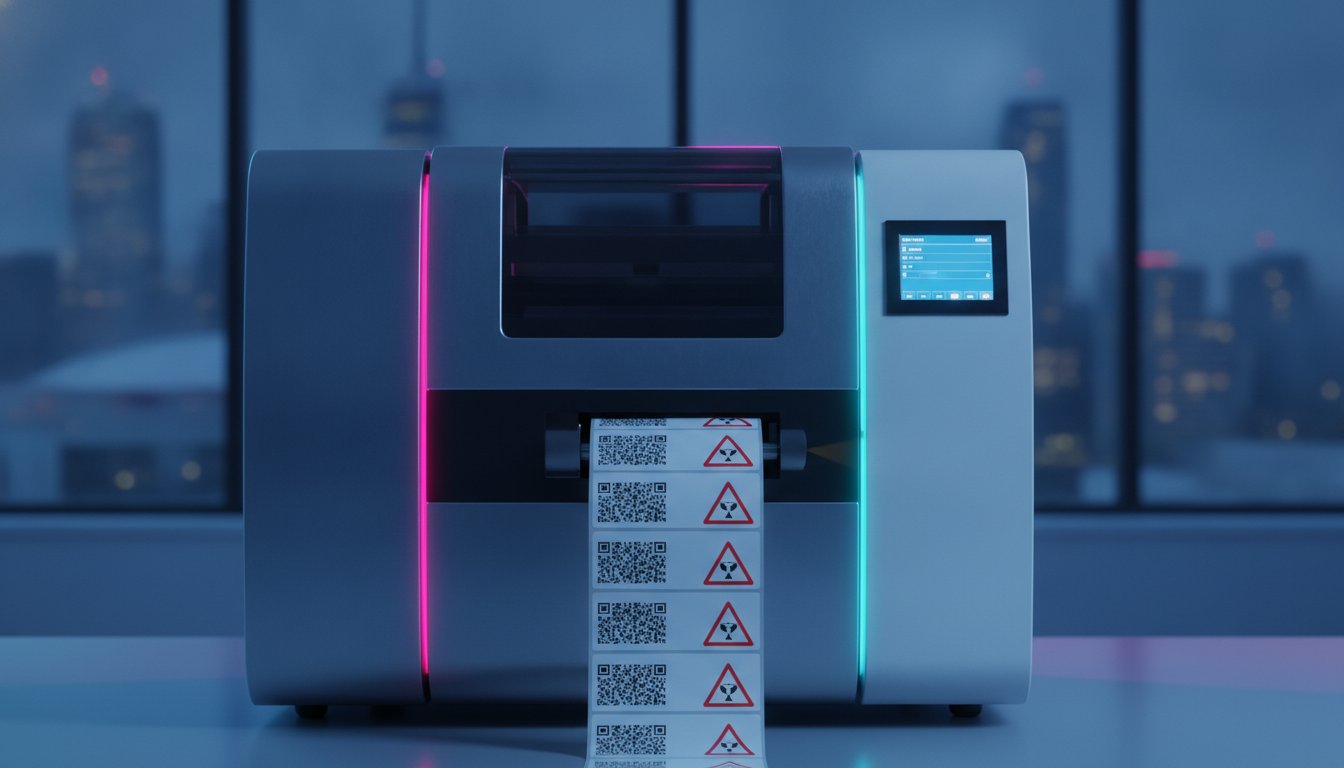
Medical errors are the third leading cause of death in North America. This data highlights why precision in pharmaceutical labelling isn't just a regulatory hurdle but a critical safety requirement. You already know that a single unreadable barcode or a label that peels off in cold storage can trigger a failed Health Canada audit or a costly product recall. It's a high-stakes environment where equipment failure isn't an option and outsourced printing often leads to unacceptable lead times.
Finding the right label printer for pharmaceuticals Canada is the most effective way to regain control over your batch accuracy and operational costs. This guide helps you select an ideal system to ensure Health Canada compliance and durability in harsh lab environments. We'll explore high-resolution thermal transfer technology for crisp 600 dpi serialization, colour inkjet solutions for GHS standards, and the specialized software needed to maintain 100% GS1 DataMatrix accuracy. Discover how to eliminate waste through on-demand printing while securing your supply chain for the 2026 regulatory landscape.
Key Takeaways
- Learn how transitioning to in-house labelling eliminates long lead times and improves supply chain agility for small-batch pharmaceutical runs.
- Understand the technical necessity of 1200 dpi resolution and chemical-resistant media for printing legible 4pt text and high-density micro-barcodes.
- Compare inkjet and thermal transfer technologies to find the right balance between full-colour GHS pictograms and monochrome cryo-vial durability.
- Select specialized resin ribbons and moisture-resistant blank labels to ensure your markings remain permanent in autoclave and cold storage environments.
- Discover why partnering with a dedicated distributor for your label printer for pharmaceuticals Canada is vital for accessing national technical support and rapid consumable shipping.
The Strategic Shift to In-House Labeling for Pharmaceuticals in Canada
Canadian pharmaceutical manufacturers are moving away from outsourced printing to gain total control over their production schedules. Small-batch runs, common in clinical trials and specialized medicine, often suffer from long lead times when relying on third-party vendors. By integrating a dedicated label printer for pharmaceuticals Canada, facilities can produce labels the moment a batch is ready. This agility is vital in the Canadian healthcare sector, where supply chain disruptions can delay patient access to life-saving treatments. It's about speed. It's about reliability.
Security and waste reduction are equally important drivers for this shift. Printing only what you need eliminates the "minimum order" waste associated with external print shops. More importantly, keeping sensitive batch data and expiry information within your own facility reduces the risk of data breaches. It ensures that critical drug labelling principles are followed without exposing proprietary manufacturing schedules to outside parties. You maintain a closed-loop system that protects your intellectual property and your patients.
Meeting Health Canada and GHS Requirements
Compliance in Canada requires absolute precision. On-demand systems allow for the immediate update of variable data, ensuring every lot number and expiry date is 100% accurate. For hazardous materials, Epson printers provide the high-quality colour signaling required for GHS-compliant pictograms. These systems also facilitate the implementation of GS1 DataMatrix barcodes, which are increasingly expected across Canadian pharmacy and hospital networks to improve traceability. Accuracy isn't optional; it's a requirement for staying on the market.
Cost Efficiency for Small and Medium Enterprises
For many Canadian nutraceutical startups and SMEs, the total cost of ownership for an in-house system is significantly lower than repetitive outsourcing fees. You don't have to manage massive inventories of pre-printed labels that might become obsolete if regulations change. Using professional BarTender software allows for rapid template adjustments. This means your capital isn't tied up in static stock. This lean approach supports growth and allows smaller players to compete by maintaining high standards without the overhead of a massive warehouse.
- Eliminate delays: Print labels on-demand for immediate batch release.
- Reduce waste: Stop throwing away obsolete pre-printed stock.
- Enhance security: Keep sensitive batch data behind your own firewall.
- Maintain compliance: Update GHS and GS1 data instantly as regulations evolve.
Technical Requirements for a Pharmaceutical Label Printer
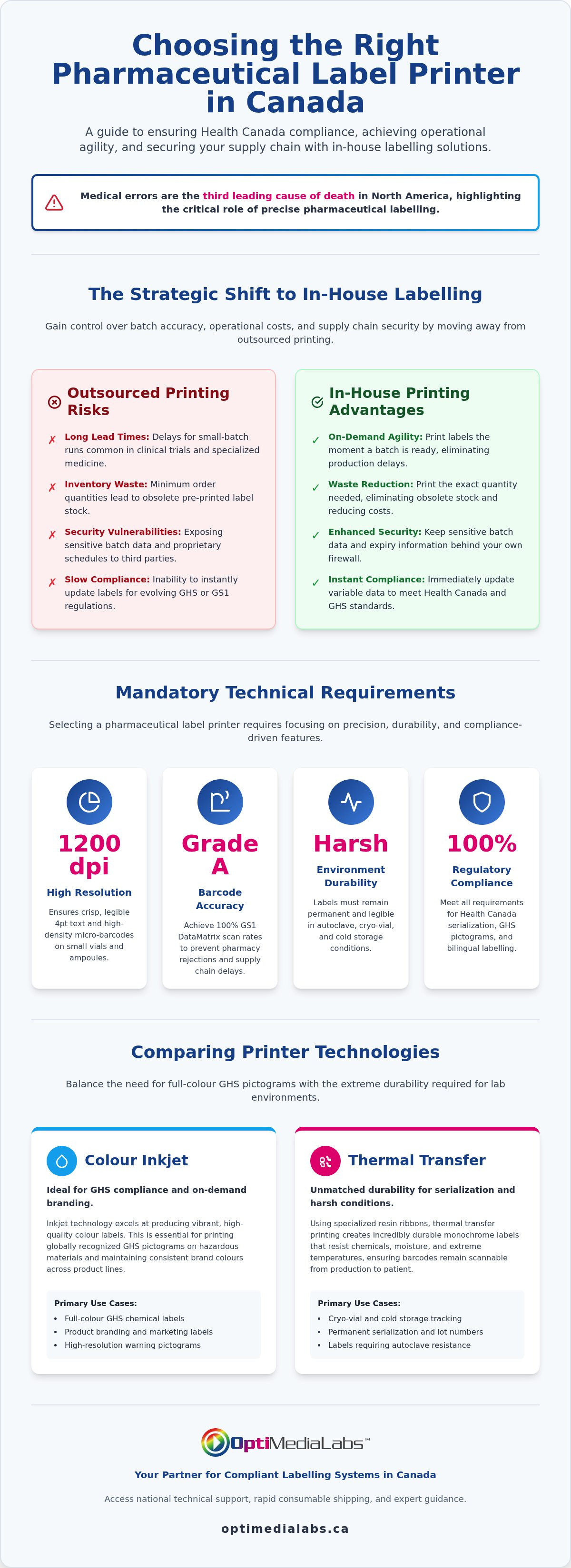
A pharmaceutical label printer is a specialized, high-precision device engineered to produce 1200 dpi resolution and chemically inert output. In the Canadian market, where bilingual requirements and compact packaging often overlap, these technical specifications are mandatory. Selecting a label printer for pharmaceuticals Canada requires looking beyond basic output speed. You need a machine that can handle micro-barcodes and 4pt text without sacrificing legibility or scan rates. Precision is the difference between a compliant batch and a regulatory rejection.
High-resolution printing serves as the backbone of regulatory compliance. As established in the ISPE Good Practice Guide, packaging integrity must be maintained from the manufacturing floor to the patient. 1200 dpi resolution ensures that complex symbols and bilingual French-English instructions remain sharp on small vials or ampoules. This level of precision maintains Grade A barcode quality over high-volume runs. It prevents the scanning failures that lead to pharmacy rejections and supply chain delays. Colour accuracy is also vital. Inconsistent colours on safety warnings can lead to user error, while branding must remain identical across different production lots to maintain consumer trust.
Resolution and Precision for Regulatory Compliance
Maintaining high-resolution output is essential for the serialization requirements coming to the Canadian pharmaceutical sector. 1200 dpi allows for the clear rendering of GS1 DataMatrix codes that contain lot numbers, expiry dates, and GTINs in a space smaller than a fingernail. Printers like those from the Epson ColorWorks line are built to sustain this quality throughout long shifts. They ensure that every label produced at the end of the day is as crisp as the first one off the roll.
Chemical and Environmental Durability
Laboratory environments present unique challenges for label durability. Equipment and containers face constant exposure to isopropyl alcohol, sanitizers, and moisture. Pigment-based inks are the industry standard here because they offer superior long-term stability compared to dye-based alternatives. For labels that must survive harsh conditions, achieving BS5609 standards for adhesive and ink permanence is non-negotiable. This prevents smudging or fading that could render critical safety information unreadable.
Cleanroom and laboratory space is often limited. Modern designs prioritize a small footprint, allowing units to fit on standard lab benches or mobile carts. This ensures that printing happens at the point of application, reducing the risk of batch mix-ups. If you are unsure which hardware fits your specific lab layout, you can request a technical consultation to review your site requirements.
- 1200 dpi resolution: Essential for 4pt font and high-density 2D barcodes.
- Pigment ink systems: Provides smudge resistance against chemicals and solvents.
- Colour accuracy: Critical for safety warnings and brand consistency.
- Compact chassis: Ideal for integration into restricted cleanroom environments.
Comparing Inkjet vs. Thermal Transfer for Lab Applications
Choosing a label printer for pharmaceuticals Canada requires a clear understanding of your specific environment. Inkjet and thermal transfer technologies aren't interchangeable; they serve distinct functions in the supply chain. Inkjet excels where colour is a functional requirement, such as GHS pictograms or branding. Thermal transfer remains the standard for extreme durability in lab conditions. Many facilities now employ a hybrid workflow to maximize efficiency, using colour inkjet for primary packaging and thermal transfer for secondary logistics and cold storage tracking.
When to Choose Afinia or Epson Colour Inkjet
High-speed production environments benefit most from Afinia Color Label Printers. These machines handle full-colour prime labels with the precision needed for complex pharmaceutical branding. If your facility handles hazardous materials, Epson printers are the preferred choice for GHS-certified chemical labelling. They produce pigment-based output that resists smearing and fading when exposed to liquids. For a deeper dive into hardware selection, see our Afinia Color Label Printers Guide. These systems allow you to print high-resolution warnings and brand elements in a single pass, reducing the need for pre-printed stock.
The Role of Thermal Transfer in Cold Storage
For monochrome applications like cryo-vials and autoclave processing, Zebra printers are the industry staple. These machines utilize a thermal transfer ribbon to "bake" ink into the label surface, creating a bond that survives liquid nitrogen and high-heat sterilization. This technology is indispensable for secondary pharmaceutical packaging where legibility in harsh environments is the only priority. You can find more details in our Industrial Labeling Solutions Canada Reference. Unlike inkjet, thermal transfer requires no drying time, making it ideal for high-volume logistical labelling where labels are applied immediately after printing.
Evaluating maintenance costs is the final step in procurement. Inkjet systems involve periodic printhead cleaning and ink cartridge replacement, while thermal transfer costs are driven by the ribbon and label media. While inkjet offers more versatility for colour-coded safety systems, thermal transfer often provides a lower cost-per-label for high-volume, black-and-white serialization. Balancing these two technologies ensures your facility remains compliant while keeping operational expenses under control.
- Inkjet: Best for GHS pictograms, brand consistency, and colour-coded warnings.
- Thermal Transfer: Essential for cryo-storage, autoclaves, and chemical washes.
- Hybrid Approach: Combines the visual clarity of colour inkjet with the durability of resin-based thermal printing.
Essential Consumables and Software for Pharma Accuracy
Achieving pharmaceutical accuracy requires more than just high-resolution hardware. The synergy between your printer, the chosen media, and the management software determines the long-term viability of your labelling system. A professional label printer for pharmaceuticals Canada must be paired with substrates that withstand the rigorous conditions of a clinical environment. From moisture-laden refrigerators to high-heat autoclaves, the material choice is critical. Using the wrong ribbon or label stock leads to unreadable barcodes and regulatory non-compliance.
Media compatibility is the foundation of a reliable system. For thermal transfer printing, resin ribbons are the only choice for permanent marking. Unlike wax or wax-resin blends, pure resin bonds deeply with synthetic face stocks to resist smudging and chemical exposure. If you use inkjet technology, your blank labels must feature a specialized top coat designed to "lock in" pigment ink. This prevents the bleeding or fading that occurs when standard paper labels are exposed to humidity or sanitizers. Precision starts with the right materials.
Specialized Media for Vials, Syringes, and Blister Packs
Small-diameter containers like vials and syringes require high-tack adhesives to prevent "flagging," where label edges peel away from the curved surface. Utilizing Afinia labels ensures superior adhesion on these difficult substrates. For applications involving frequent chemical contact, durable Epson labels provide the necessary resistance to maintain legibility. You can find a comprehensive breakdown of material types in our Professional Guide to Label Printer Consumables. Selecting the correct media ensures your labels remain intact throughout the entire product lifecycle.
Implementing BarTender and NiceLabel for Compliance
Manual data entry is a significant risk factor in pharmaceutical labelling. Specialized software eliminates this vulnerability by pulling data directly from your ERP or LIMS system. Automating GS1-128 barcodes with BarTender software ensures that every lot number and expiry date is formatted correctly every time. If your facility manages multiple production lines, centralizing label management with NiceLabel provides a secure, auditable trail of all print jobs. For more on these tools, see our Professional Guide to Barcode Labeling Software. These platforms are essential for maintaining the 100% accuracy required for Health Canada audits.
Don't risk your compliance on unverified media combinations. To ensure your hardware and consumables are perfectly matched for your specific lab environment, you can request a custom media sample from our technical team.
- Resin Ribbons: Mandatory for permanent, smudge-proof thermal transfer marking.
- High-Tack Adhesives: Prevents label flagging on small-diameter vials and syringes.
- Software Automation: Pulls batch data directly from databases to eliminate manual entry errors.
- GS1 Compliance: Ensures barcodes meet international standards for supply chain traceability.
Procuring Your Pharmaceutical Labelling System in Canada
Procuring a label printer for pharmaceuticals Canada is a long-term commitment to your facility's operational uptime. It's not a simple one-time hardware purchase. Success depends on a reliable supply chain for specialized consumables and immediate access to technical support. Buying from international vendors often introduces customs delays and unpredictable cross-border shipping costs for critical inks and ribbons. A domestic partnership ensures that your production line remains active and compliant without the risk of stockouts.
Healthcare institutions and pharmaceutical manufacturers require turnkey solutions that integrate hardware, software, and media seamlessly. Navigating this process involves evaluating the total cost of ownership beyond the initial sticker price. You must account for national shipping speeds, the availability of specialized media, and the expertise of the distributor. A partner who understands Health Canada requirements can help you avoid the pitfalls of mismatched components that lead to scanning failures or label degradation.
OptiMediaLabs: Your National Partner for Pharma Labelling
OptiMediaLabs serves as a specialized facilitator for Canadian manufacturers. We provide deep expertise in Afinia, Epson, and Zebra hardware, ensuring you receive a system tailored to your specific lab environment. Maintaining a consistent supply of Afinia ink cartridges and Epson ink is our priority. We understand that in the pharmaceutical sector, a delay in consumables is a delay in patient care. Our team provides personalized consultations to help you select the right combination of pigment inks and synthetic substrates for maximum durability.
Next Steps: Consultation and Implementation
Moving your labelling in-house requires careful planning to minimize production downtime. The first step is verifying that your chosen media survives your specific environmental challenges. We recommend requesting a print sample to conduct rigorous chemical resistance and temperature testing in your own facility. Once the media is verified, our team assists with the implementation of BarTender or NiceLabel software to ensure your data remains secure and accurate. It's time to take control of your compliance. Contact OptiMediaLabs today for a specialized pharmaceutical labelling consultation.
- Local Support: Access Canadian technical expertise and national shipping speeds.
- Turnkey Bundles: Combine hardware, software, and ink for a streamlined implementation.
- Supply Security: Ensure a steady flow of specialized cartridges and ribbons.
- Verified Samples: Test labels against your specific chemical and thermal requirements before you buy.
Securing Your Pharmaceutical Supply Chain for 2026
Transitioning to an in-house labelling system provides the control needed to meet evolving Health Canada standards and GS1 serialization deadlines. You've seen how 1200 dpi precision and chemically inert media prevent audit failures and ensure patient safety. By balancing high-speed colour inkjet for GHS compliance with durable thermal transfer for cold storage, your facility can eliminate the delays of third-party printing. It's about maintaining agility in a high-stakes market.
Selecting the ideal label printer for pharmaceuticals Canada is a strategic investment in your operational stability. Success requires a partner who understands the technical nuances of lab environments and maintains a steady supply of specialized consumables. As an authorized Canadian distributor for Afinia and Epson, OptiMediaLabs provides the hardware, resin-based ribbons, and expert technical support your production line demands. We stock pharmaceutical-grade media and offer fast national shipping to keep your facility running at peak efficiency.
Request a Pharmaceutical Labeling Solution Quote to start your technical consultation. We're ready to help you achieve 100% batch accuracy and long-term compliance.
Frequently Asked Questions
What is the best label printer for small pharmaceutical batches in Canada?
The Epson ColorWorks CW-C4000 and Afinia L502 are the top choices for small-batch pharmaceutical production in Canada. These models offer high-resolution output and the flexibility to switch between different label sizes without wasting expensive media. They provide the 1200 dpi precision required for micro-barcodes on small vials. Choosing an on-demand system allows your facility to react quickly to batch changes while maintaining full control over variable data and serialization.
How do I ensure my labels are Health Canada compliant?
Compliance requires meeting Health Canada requirements for bilingual text, Drug Identification Numbers (DIN), and clear expiry dates. You must use a high-resolution printer to ensure all 4pt text remains legible throughout the product's shelf life. Integrating GS1-certified software like BarTender helps automate the creation of DataMatrix barcodes. This reduces the risk of human error and ensures your labels meet the latest industry-led standards for Canadian distribution.
Can inkjet printers produce labels that survive liquid nitrogen storage?
Inkjet printers can produce cryo-vial labels when paired with specialized synthetic media and pigment-based inks. While thermal transfer remains the traditional choice for liquid nitrogen, modern Epson pigment inks bond with specific cryogenic face stocks to resist cracking and fading at extreme temperatures. You must test your specific label and ink combination in your lab environment to verify that the adhesive and print remain intact during deep-freeze storage cycles.
What is the difference between pigment and dye ink for pharma labels?
Pigment ink is the industry standard for pharmaceutical applications because of its superior resistance to chemicals, moisture, and UV light. It uses solid particles that sit on the label surface, making it smudge-proof against isopropyl alcohol. Dye-based inks offer higher colour vibrancy for retail branding but often bleed or fade when exposed to lab sanitizers. For any label printer for pharmaceuticals Canada, pigment ink is essential for maintaining long-term regulatory legibility.
Do I need specialized software to print pharmaceutical barcodes?
Professional labelling software like BarTender or NiceLabel is necessary to manage complex pharmaceutical barcodes and serialization. These platforms allow you to pull variable data directly from your ERP system, which eliminates manual entry mistakes. They support GS1 standards and provide the audit trails required for regulatory compliance. Standard office software lacks the precision and security features needed to generate high-density 2D barcodes that scan reliably across the healthcare supply chain.
How much does it cost to set up an in-house labelling system?
An in-house setup involves the initial hardware cost, a software license, and the first batch of specialized media. While initial capital expenditure is required, the long-term savings come from eliminating minimum order quantities and high unit costs of outsourced printing. Total investment varies based on whether you require 600 dpi thermal transfer or 1200 dpi colour inkjet technology. Contact a Canadian distributor to evaluate the total cost of ownership for your specific production volume.
Are there specific labels required for GHS chemical compliance?
GHS compliance requires labels that meet BS5609 standards for adhesive and ink durability. These materials are tested to survive harsh environments, ensuring that safety pictograms and hazard warnings remain readable even after chemical exposure. Using an Epson ColorWorks printer with certified synthetic media allows you to print the red and black GHS symbols on-demand. This ensures your hazardous material labelling is always accurate and compliant with Canadian workplace safety regulations and WHMIS standards.
Can I print on-demand labels for both primary and secondary packaging?
You can print on-demand labels for both primary vials and secondary shipping cartons using the same software ecosystem. Many Canadian facilities use a high-resolution colour inkjet system for primary packaging to include branding and safety warnings. They then utilize a high-volume thermal transfer printer for secondary packaging and logistics labels. This integrated approach ensures consistent data across all levels of packaging while optimizing the cost and durability of each specific label type throughout your facility.