
Chemical Drum Label Printer Canada: A Guide to GHS and WHMIS Compliance
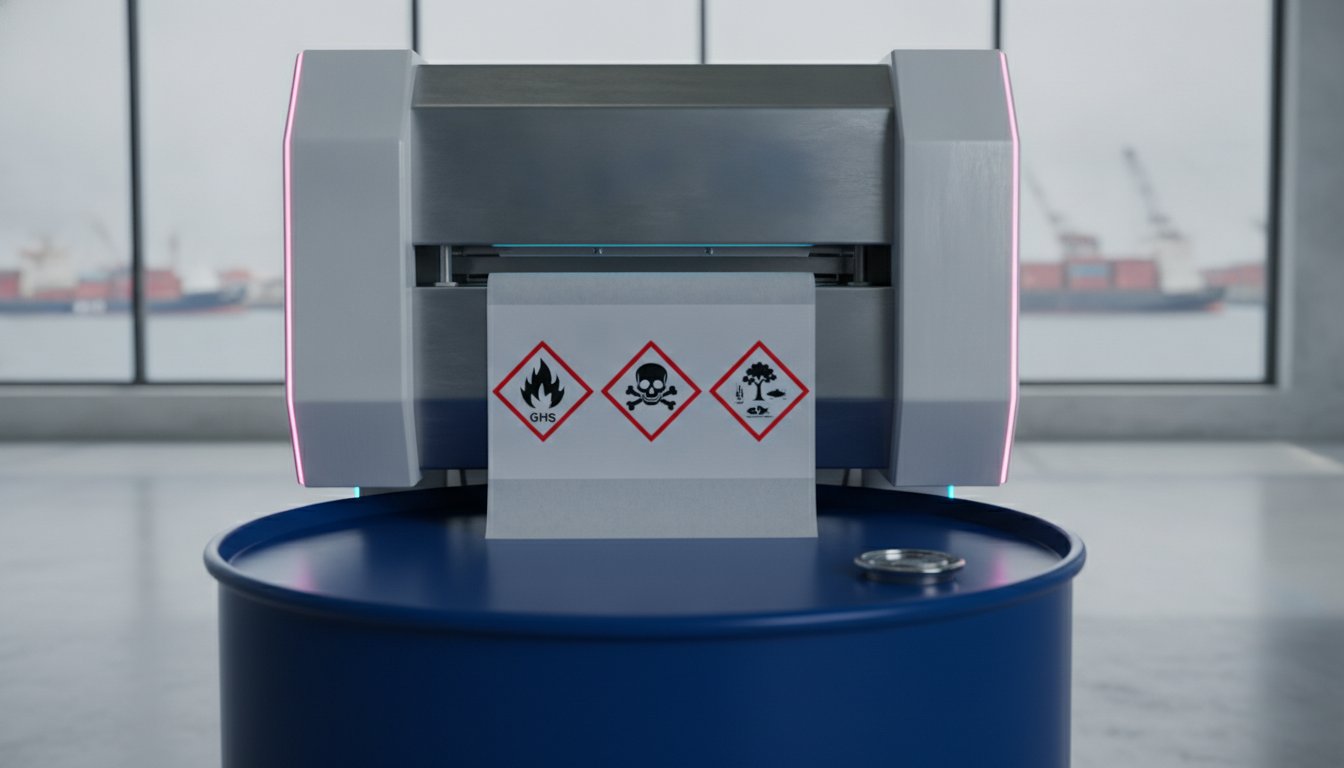
Did you know that by December 15, 2025, every chemical manufacturer and workplace in the country must fully transition to the updated WHMIS standards aligned with GHS Revision 7? It's a critical deadline for an industry that handles over $74 billion in shipments annually. Finding a reliable chemical drum label printer Canada professionals can trust is no longer just about convenience; it's a matter of regulatory survival. You likely already realize that traditional pre-printed labels are too slow for small batches and often fail the durability tests required for international shipping.
We understand the frustration of seeing expensive labels smear or peel before they even reach the customer. This guide provides a clear path to achieving a streamlined, one-step GHS labelling workflow that eliminates inventory waste. You'll learn how to select the right pigment-based hardware and BS 5609:2024 certified materials to ensure your drums remain compliant from the warehouse to the open sea. We'll break down the essential hardware, software, and media requirements to keep your operations running safely and efficiently.
Key Takeaways
- Align your facility with WHMIS 2015 and GHS Revision 7 standards to ensure full compliance with updated Canadian hazardous materials regulations.
- Master the requirements for BS 5609 certification to produce labels that remain legible and attached even during prolonged seawater exposure.
- Compare leading Epson and Afinia models to find the best chemical drum label printer Canada offers for durable, high-resolution hazardous material labelling.
- Automate your production workflow using specialized software that pulls GHS pictograms and hazard data directly from your chemical product codes.
- Reduce procurement complexity by sourcing all printers, pigment inks, and certified media from a single Canadian specialist.
GHS and WHMIS 2015 Compliance for Canadian Chemical Labels
Canada's Workplace Hazardous Materials Information System (WHMIS) underwent a significant transformation to align with the Globally Harmonized System (GHS). This transition, known as WHMIS 2015, replaced the aging 1988 standards to create a universal language for hazard communication. For manufacturers, this means every drum leaving a facility must feature specific, high-visibility elements that are instantly recognizable across borders. Monochrome thermal transfer printing, once the standard for industrial labelling, is no longer sufficient. Modern regulations require red-bordered pictograms that must be printed in vibrant colour. Using a dedicated chemical drum label printer Canada businesses can rely on ensures these red borders are crisp, clear, and legally compliant.
On-demand printing has become essential for handling variable batch data and strict bilingual requirements. Static, pre-printed labels often lead to massive inventory waste. Chemical batches vary; keeping a warehouse full of pre-printed labels for every possible product combination is a logistical nightmare. Modern systems allow you to print exactly what you need, when you need it. This flexibility is vital for maintaining accuracy while reducing overhead costs.
The Role of Health Canada in Labelling Standards
Health Canada enforces the Hazardous Products Act and its associated regulations. While the transition to GHS has been gradual, the final deadline for full compliance with GHS Revision 7 is December 15, 2025. By 2026, every chemical container in a Canadian workplace must meet these updated criteria. A unique challenge for domestic manufacturers is the mandatory bilingual requirement. All safety information must be presented in both English and French. Non-compliance carries heavy legal penalties and risks shipment rejections at the border. Implementing professional NiceLabel software helps automate these bilingual translations and ensures your data remains consistent across all documents.
Anatomy of a Compliant GHS Drum Label
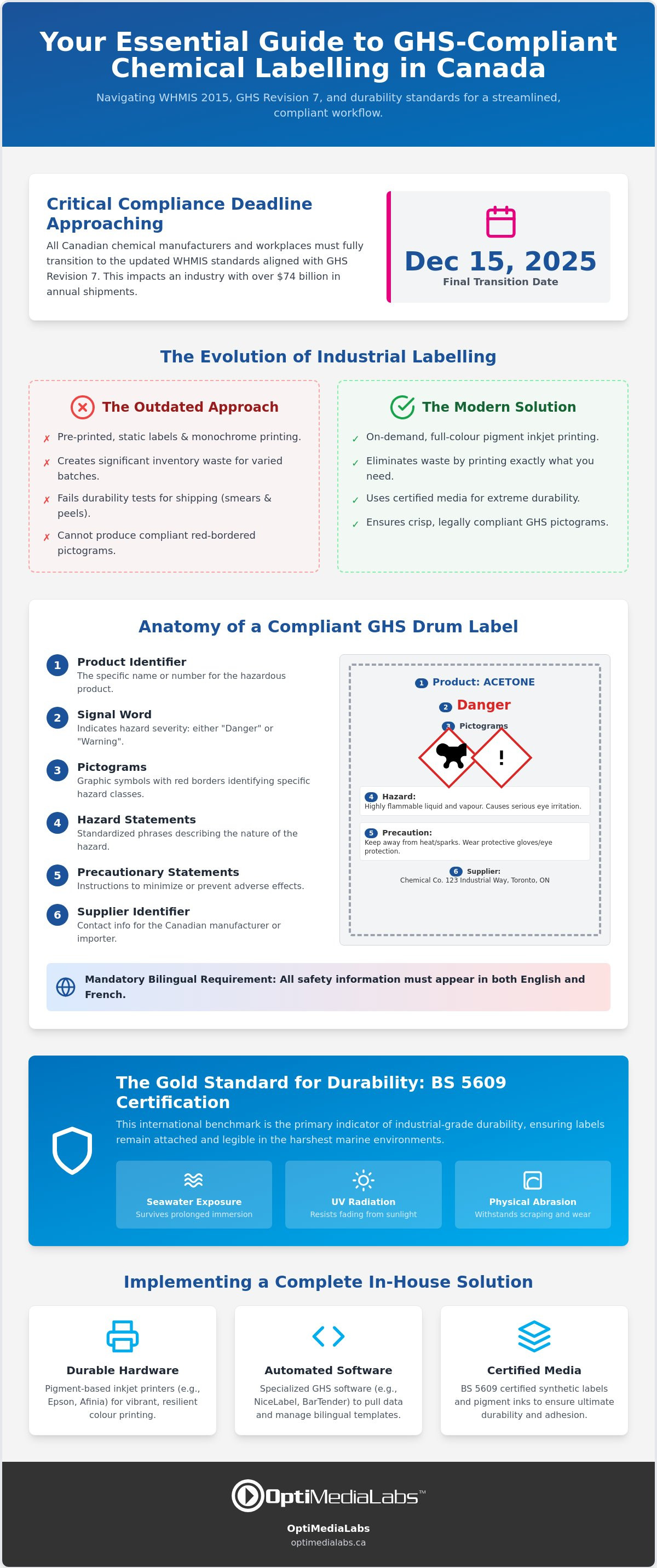
A compliant GHS label is a precise technical document rather than a simple sticker. In 2026, GHS compliance in Canadian chemical manufacturing is defined as the successful integration of standardized hazard classifications with durable, bilingual, and colour-coded visual communication. Every label must include these six mandatory elements:
- Product Identifier: The specific name or number used for the hazardous product.
- Signal Word: Either "Danger" or "Warning" to indicate the severity of the hazard.
- Pictograms: Graphic symbols with red borders identifying specific hazard classes.
- Hazard Statements: Standardized phrases describing the nature of the hazard.
- Precautionary Statements: Instructions on how to minimize or prevent adverse effects.
- Supplier Identifier: Contact information for the Canadian manufacturer or importer.
Label sizes are also strictly regulated based on the capacity of the container. Larger drums require larger labels to ensure legibility from a safe distance. Using BarTender software allows you to scale these elements automatically based on the drum size, ensuring you never fall out of compliance due to a scaling error.
Understanding BS 5609 Certification: The Secret to Durable Drum Labels
The BS 5609 Certification Standard is the international benchmark for pressure-sensitive labels used in marine environments. It ensures that critical hazard information remains attached and readable even under the most extreme conditions. If a chemical drum is lost at sea, the label must survive prolonged exposure to saltwater, UV radiation, and physical abrasion. For any business investing in a chemical drum label printer Canada professionals trust, BS 5609 compliance is the primary indicator of industrial-grade durability. It moves beyond simple "waterproof" claims to provide a verified guarantee of performance in high-stakes logistics.
Achieving this level of durability requires more than just a sturdy sticker. It relies on a specific chemical interaction between pigment-based inks and specialized synthetic media. Unlike dye-based inks that sit on the surface, pigment inks contain solid particles that embed into the pores of synthetic materials. This creates a permanent bond that resists smearing and chemical degradation. When you use a certified system, you're ensuring that your GHS pictograms remain vibrant and your hazard statements remain legible throughout the entire product lifecycle.
BS 5609 Section 2 vs. Section 3
It is vital to understand that BS 5609 certification is divided into two distinct parts. Section 2 focuses on the blank label stock. This involves testing the adhesive and the base material for three months of seawater submersion. The updated BS 5609:2024 standard now includes mandatory testing on High-Density Polyethylene (HDPE) surfaces, reflecting the common use of plastic drums in the industry. Section 3 evaluates the final printed output. It tests the specific combination of a printer, its ink, and the media for colour fastness and resistance to abrasion. You cannot claim Section 3 compliance if you change any part of this "Golden Triangle." The printer, ink, and label must be tested as a unified system.
Choosing the Right Media for Harsh Environments
Selecting the correct base material is the first step toward compliance. While paper labels are unsuitable for chemical drums, synthetic options like Biaxially Oriented Polypropylene (BOPP) and PET offer the necessary resistance to moisture and chemicals. These materials don't tear or degrade when wet. Aggressive, high-tack adhesives are also required to bond with the low-surface-energy plastics used in modern drum manufacturing. You can explore our range of Afinia-compatible labels for industrial use to find media designed specifically for these rigorous standards. If you need help determining which material suits your specific chemical containers, reach out to our specialists for a technical consultation.
Comparing Leading Chemical Drum Label Printers: Afinia vs. Epson
Selecting the right hardware is the most critical decision in your compliance strategy. For many facilities, the search for a reliable chemical drum label printer Canada offers leads directly to two market leaders: Epson and Afinia. Both brands provide the pigment-based ink technology required for BS 5609 Section 3 certification. Pigment ink is non-negotiable for chemical applications. Unlike dye-based alternatives that bleed when exposed to solvents or water, pigment particles physically bond with synthetic media to resist smearing and fading. This ensures your GHS pictograms and hazard warnings remain legible throughout the entire supply chain.
Epson ColorWorks: The Industry Standard
The Epson ColorWorks series, specifically the C6000A and C6500A models, serves as the industry workhorse for hazardous material labelling. These units were built to replace traditional black-and-white thermal transfer printers without disrupting existing workflows. The C6500A is particularly suited for large-scale operations. It handles media up to 8 inches wide, which is the standard size for 200-litre (55-gallon) chemical drums. These printers feature ZPL II emulation, allowing them to integrate seamlessly with legacy systems and automated label applicators on high-volume production lines. You can find the full range of Epson ColorWorks printers and pigment ink cartridges to support your high-capacity needs.
Afinia L502: Versatility for Small to Mid-Sized Batches
Afinia offers unique advantages for businesses requiring more flexibility in their production environment. The Afinia L502 is highly regarded for its rugged industrial construction and its unique "Duo Ink Technology." This feature allows users to switch between dye and pigment print heads. While you'll always use pigment for GHS compliance, the ability to use dye for other warehouse labelling tasks provides excellent versatility. For those prioritizing throughput, the Afinia L701 utilizes advanced print technology to produce high-resolution labels at rapid speeds. This is ideal for mid-sized batches where time is a critical factor. Explore the Afinia L502 and L701 industrial solutions to see which model fits your specific environment.
When comparing these systems, consider these technical factors to determine your total cost of ownership:
- Print Width: Ensure the printer can handle the 8-inch labels required for large drums.
- Resolution: High-resolution output (up to 1200 dpi) ensures that small precautionary text is always readable.
- Ink Efficiency: High-capacity cartridges in the Epson series often provide a lower cost per millilitre for high-volume users.
- Durability: Industrial builds with all-metal covers are better suited for harsh warehouse floors than desktop alternatives.
Integrating GHS Software with Your Production Workflow
Hardware alone cannot solve the complexities of modern safety regulations. To fully leverage a chemical drum label printer Canada professionals need a robust software "brain" to drive the output. Manual data entry is a significant liability in hazardous environments. Integrating professional labelling software allows you to automate the inclusion of red-bordered pictograms and signal words based on specific chemical product codes. This digital connection ensures that the information on the drum matches the Safety Data Sheet (SDS) with 100% accuracy, eliminating the risk of human error during high-pressure production runs.
Software platforms also handle the essential variable data that changes with every batch. Lot numbers, expiry dates, and manufacturing timestamps are pulled directly from your database and formatted instantly. This one-step process reduces label waste and ensures that your facility remains compliant with Health Canada's strict traceability requirements.
BarTender and NiceLabel for GHS
BarTender is widely recognized for its built-in GHS templates. These templates provide the correct layout, font sizes, and signal word hierarchies required for industrial drums. It simplifies the design process so you don't have to be a graphic designer to produce compliant labels. NiceLabel offers similar power with a focus on deep integration. It can pull data directly from your existing ERP or Warehouse Management System (WMS), creating a seamless flow from the front office to the warehouse floor. You can explore our professional barcode and labelling software for Canadian manufacturers to find the best fit for your technical infrastructure.
Centralizing Your Labelling Process
Cloud-based labelling solutions provide a massive advantage for companies with multiple Canadian locations. Centralizing your label library ensures that every facility uses the same approved safety data. You'll realize faster production turnarounds when your staff doesn't have to search for the correct file or wait for head office approval on every print job. Version control is also managed automatically; when a regulation changes, you update the master file once, and every printer in your network is instantly updated. This centralized approach is the most efficient way to maintain compliance across a growing organization. If you're ready to modernize your digital workflow, contact our specialists for a software demonstration.
User permissions add another layer of security to your workflow. By restricting editing rights to qualified safety officers, you prevent unauthorized changes to critical hazard statements. Operators on the floor can be limited to "print-only" access, which further reduces the chance of accidental non-compliance. This methodical organization creates a stable, predictable environment for chemical manufacturing.
Implementing an In-House Labelling Solution with OptiMediaLabs Canada
Transitioning from pre-printed labels to an on-demand system is the most effective way to eliminate inventory waste and ensure total compliance. Many Canadian manufacturers struggle with the high cost of ordering small batches of labels that quickly become obsolete when regulations change. By choosing a chemical drum label printer Canada specialists recommend, you regain control over your production schedule. OptiMediaLabs Canada provides a single-source solution where you can obtain professional-grade hardware, pigment inks, and certified media designed to work together as a unified system. This prevents the compliance gaps that often occur when components are sourced from multiple, unverified vendors.
Our focus remains on industrial reliability. We supply high-performance solutions from market leaders including Epson, Afinia, and VIPColor. These systems are specifically engineered to handle the rigorous demands of chemical environments. Sourcing your entire labelling ecosystem from OptiMediaLabs Canada ensures that your Section 3 BS 5609 certification remains valid and your drums stay compliant through every stage of transport.
National Distribution and Support
Maintaining a consistent supply chain is vital for uninterrupted production. OptiMediaLabs Canada offers national distribution across the country, ensuring that blank labels and ink cartridges are always available when you need them. Our technical team provides the expertise required to help you choose between thermal transfer and inkjet technologies based on your specific chemical resistance needs. For a deeper look at specific hardware options, consult The Ultimate Canadian Buyer’s Guide to Afinia Color Label Printers. We don't just sell equipment; we provide the ongoing support necessary to keep your facility running efficiently.
Next Steps for Your Facility
The first step toward implementation is verifying performance in your specific environment. We encourage facilities to request print samples to test for chemical and abrasion resistance against their unique products. Our team at OptiMediaLabs Canada will consult with you to match a colour label printer to your daily volume requirements, ensuring you don't over-invest in capacity you don't need or under-equip a busy production line. We provide a stable, streamlined path to upgrading your safety protocols.
Implementing an in-house printing system increases workplace safety by ensuring immediate label availability while significantly reducing long-term operational centre costs. You'll no longer be tied to external print schedules or minimum order quantities. This shift allows your team to respond instantly to new GHS requirements or batch changes, keeping your facility at the forefront of Canadian safety standards.
Future-Proof Your Chemical Labelling Strategy
Achieving full GHS and WHMIS compliance doesn't have to be a logistical burden. By moving your production in-house, you eliminate the delays of third-party vendors and ensure your drums are ready for the December 2025 regulatory deadline. You've seen that the right chemical drum label printer Canada manufacturers select must utilize pigment-based inks and BS 5609 certified media to withstand the harshest maritime conditions. Integrating this hardware with centralized software creates a fail-safe environment where human error is minimized and safety is prioritized.
OptiMediaLabs is your dedicated partner in this transition. As an authorized distributor for Afinia, Epson, and VIPColor, we provide the technical expertise needed to navigate complex GHS and BS 5609 standards. We offer national Canadian shipping on all printers and consumables to keep your facility running without interruption. Our team is ready to help you realize a more efficient, cost-effective workflow that protects your workers and your bottom line. Contact OptiMediaLabs to find the right chemical drum label printer for your facility today. We look forward to supporting your long-term success.
Frequently Asked Questions
What is the difference between GHS and WHMIS 2015 labels in Canada?
WHMIS 2015 is the specific Canadian regulation that implements the international Globally Harmonized System (GHS). While GHS provides the global framework for hazard classification, WHMIS 2015 includes unique Canadian requirements such as mandatory bilingual safety information in both English and French. Every chemical drum sold or used in a Canadian workplace must adhere to these localized standards to remain compliant with Health Canada regulations.
Do I really need a colour printer for GHS drum labels?
Yes, a colour printer is mandatory because GHS pictograms must feature a specific red diamond border. Traditional monochrome thermal printers can only produce black and white images, which fails the legal requirement for hazard visibility. Using a dedicated chemical drum label printer Canada businesses trust ensures that these red borders and black symbols are printed with the precision required by safety inspectors.
What does BS 5609 certification mean for my chemical labels?
BS 5609 is a technical standard that guarantees a label will remain attached and legible after three months of submersion in seawater. It's the gold standard for durability in the chemical industry, particularly for products shipped by sea. This certification ensures that even if a drum is lost overboard or exposed to extreme weather, the hazard information stays intact to protect emergency responders and the environment.
Can I use a standard office inkjet printer for chemical drum labelling?
No, standard office printers are unsuitable for this application because they typically use dye-based inks and paper media. Dye-based inks smear instantly when exposed to moisture or chemicals, and paper labels will disintegrate in harsh warehouse environments. Professional GHS systems use pigment-based inks that chemically bond with synthetic materials like BOPP or Polypropylene to provide permanent, smudge-proof results.
How do I ensure my drum labels are bilingual for the Canadian market?
The most efficient way to manage bilingual requirements is through professional labelling software like BarTender or NiceLabel. These programs allow you to link your label templates to a central database containing both English and French hazard statements. When you select a product code, the software automatically populates the correct text in both languages, ensuring you meet Health Canada's strict communication standards without manual translation errors.
Which is better for drum labels: Afinia or Epson?
Both brands are excellent, but the choice depends on your specific production volume and environment. Epson ColorWorks printers are often considered the industry workhorse for high-volume, automated production lines due to their speed and large ink capacity. Afinia models, such as the L502, offer exceptional versatility for small to mid-sized batches and feature rugged industrial builds that thrive on busy warehouse floors.
What software is best for designing GHS-compliant labels?
BarTender and NiceLabel are the premier choices for designing GHS-compliant labels. These platforms include specialized GHS wizards and pre-formatted templates that already meet the layout requirements for signal words and pictograms. They also provide robust integration capabilities, allowing you to pull variable data like batch numbers and expiry dates directly from your existing ERP or warehouse management system.
How much can I save by printing chemical labels in-house?
In-house printing generates savings by eliminating the high markups and minimum order quantities associated with pre-printed labels. You'll also reduce significant waste; when regulations or product formulas change, you can update your digital files instantly instead of discarding thousands of obsolete pre-printed stickers. This on-demand approach allows you to organize your inventory more effectively and realize lower overall procurement costs.