
Chemical Label Printer Canada: The 2026 Guide to GHS and BS 5609 Compliance
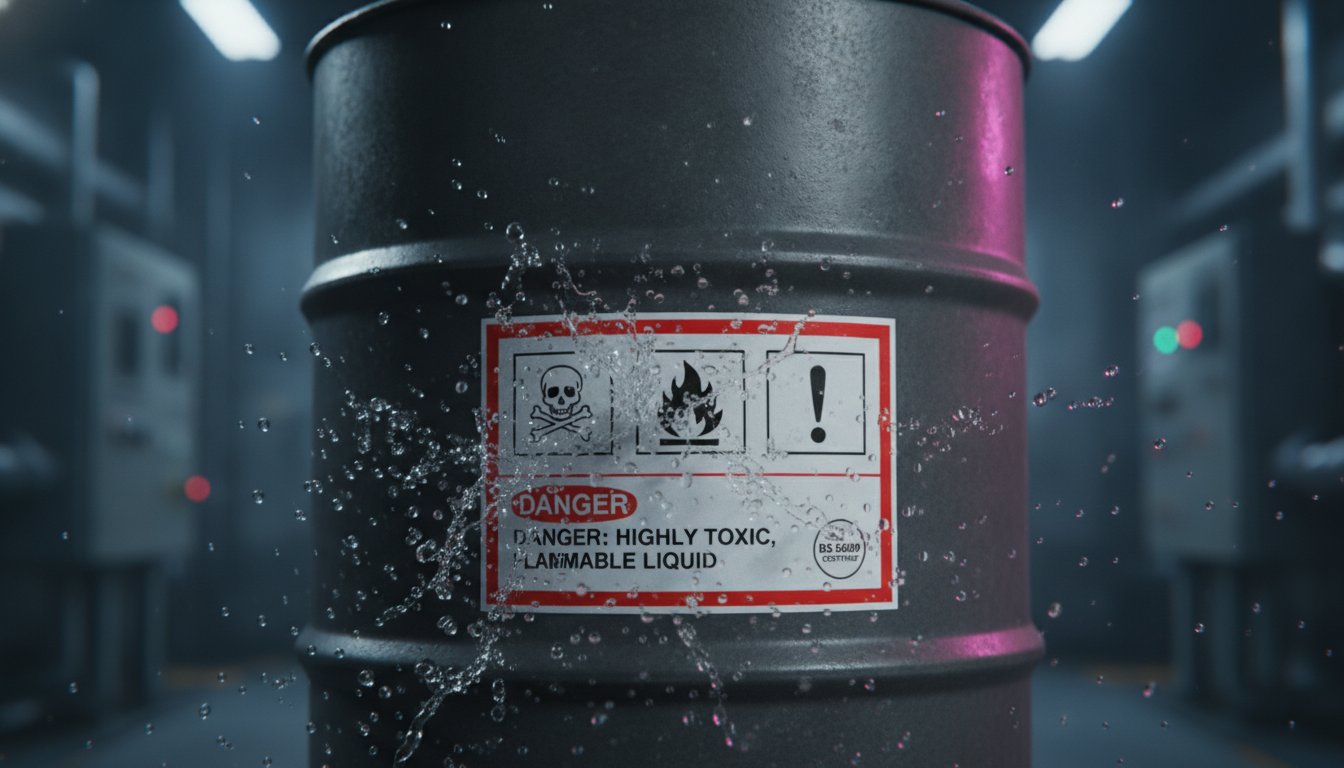
Could a single peeling label result in a massive compliance fine for your business in 2026? With the transition period for Canada's amended Hazardous Products Regulations now over, the margin for error has disappeared. You've likely felt the frustration of outsourcing small-batch labels that arrive late or fail to withstand the abrasive conditions of your facility. It's a common pain point for Canadian manufacturers who need durability without the high markup of external print shops.
Finding the right chemical label printer Canada provides is the first step toward reclaiming control over your supply chain. We'll show you how to produce GHS-compliant, bilingual labels that stay legible even after saltwater immersion or chemical exposure. This guide explores the essential pigment-based hardware, BS 5609-certified media, and specialized software required to eliminate lead times and ensure your facility meets every safety standard. You'll learn how to integrate these tools into a seamless, in-house workflow that prioritizes both precision and efficiency. Our focus remains on providing the technical clarity you need to maintain a stable, compliant, and cost-effective labelling process.
Key Takeaways
- Understand how the 2025 WHMIS amendments and GHS Revision 7 standards impact your regulatory obligations for hazardous material identification across Canada.
- Compare the durability and technical efficiency of pigment-based inkjet versus thermal transfer systems for harsh-environment applications.
- Identify the most reliable chemical label printer Canada offers, such as the Afinia L502 or Epson ColorWorks series, to meet your specific production volume.
- Learn the technical requirements for BS 5609 certification to ensure your drum labels remain legible and adhered after prolonged saltwater immersion.
- Calculate the operational savings of moving to an on-demand, in-house printing model to eliminate outsourcing delays and reduce inventory waste.
Understanding Chemical Labeling Standards in Canada
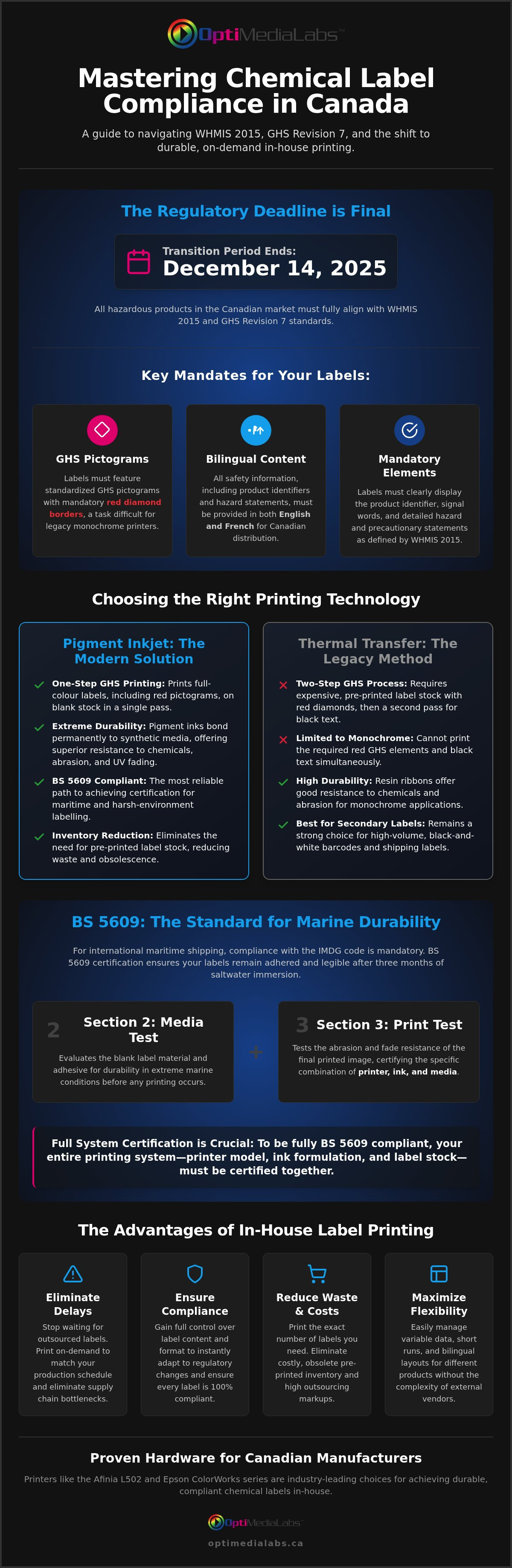
Compliance isn't optional. As of December 14, 2025, the transition to the amended Hazardous Products Regulations is complete. Every hazardous product in the Canadian market must now align with the Globally Harmonized System (GHS) Revision 7. This international standard simplifies trade but adds technical pressure to the production floor. It replaces older, fragmented systems with a unified approach to hazard communication.
The most visible change is the requirement for red diamond borders on the nine standard GHS pictograms. Legacy monochrome thermal printers often fail here. While they are reliable for black and white barcodes, they cannot produce the mandatory red elements in a single pass. This limitation forces manufacturers to use expensive pre-printed stock or upgrade to a modern chemical label printer Canada businesses use to maintain operational flexibility. Using a color label printer allows you to print the entire label, including the red pictograms, on blank stock in one step.
The WHMIS 2015 Connection
WHMIS 2015 governs how these standards apply within Canadian borders. Labels must include specific mandatory elements: the product identifier, signal words, and detailed hazard statements. Crucially, Canadian distribution requires full bilingualism. Every piece of safety information must appear in both English and French. This requirement often leads to crowded label designs. Utilizing a digital printing system helps you manage these layouts efficiently, ensuring every batch meets strict linguistic and safety requirements without wasting pre-printed inventory.
BS 5609 Certification Explained
For companies shipping dangerous goods by sea, BS 5609 is the non-negotiable benchmark for durability. This international standard ensures labels remain legible and adhered after three months of saltwater immersion. It's a critical requirement for meeting the International Maritime Dangerous Goods (IMDG) Code. The certification is divided into two distinct parts:
- Section 2: Evaluates the durability of the base plastic film and the adhesive under extreme marine conditions.
- Section 3: Tests the printed image itself. This certifies the specific combination of the printer, the ink set, and the label material.
To be fully compliant, your entire system must be certified together. Using a high-performance chemical label printer Canada provides, especially those utilizing pigment-based inks, is the most reliable path to achieving Section 3 certification. This ensures your products remain safe and compliant from the Great Lakes to international waters.
Inkjet vs. Thermal Transfer: Choosing the Right Technology
Selecting the right technology depends on your specific volume and durability requirements. For decades, thermal transfer was the only viable option for industrial environments. However, the rise of pigment-based inkjet has fundamentally changed how manufacturers approach a chemical label printer Canada project. The primary driver for this shift is the "One-Step" advantage. Modern inkjet systems print the mandatory red GHS pictograms and black hazard text simultaneously on blank synthetic stock. This eliminates the need for large inventories of pre-printed labels with empty red diamonds, which are prone to obsolescence when regulations change.
The Power of Pigment Ink
Success in chemical labelling hinges on ink chemistry. Dye-based inks, while vibrant, often bleed or fade when exposed to moisture or harsh solvents. Pigment-based inks are the industry standard for Canadian GHS implementation because they contain solid particles that bond permanently to synthetic media. These inks offer superior UV stability and abrasion resistance. When you use high-quality Afinia ink cartridges, the resulting output can meet the rigorous BS 5609 maritime standards. The pigment particles anchor into the specialized topcoat of polyester or BOPP materials, creating a label that won't smudge even under extreme mechanical stress.
Thermal Transfer for High-Volume Basics
While inkjet offers maximum flexibility, thermal transfer label printers remain a staple for high-volume, secondary labelling. This technology uses a heated printhead to melt a resin ribbon onto the label surface. It is exceptionally durable for black-and-white applications, such as shipping barcodes or warehouse tracking. If your facility already uses Zebra or Toshiba hardware for logistics, integrating these for secondary chemical containers is a logical step. However, remember that thermal transfer typically requires pre-printed red diamonds for GHS compliance. This adds complexity to your inventory management and can increase lead times for new product launches.
Cost-per-label analysis shows that inkjet is often more economical for small to medium production runs. It removes the setup costs and minimum order quantities associated with custom pre-printed stock. For large, static runs of thousands of identical labels, thermal transfer with pre-printed stock might offer a lower per-unit cost. If you're unsure which technology fits your current production volume, you can speak with a technical specialist to compare specific hardware specifications and ribbon types.
Top Chemical Label Printers for Canadian Manufacturers in 2026
Selecting a chemical label printer Canada industrial leaders can rely on requires more than just checking resolution specs. You need hardware that withstands the dust and vibrations of a production floor while maintaining strict compliance with the Globally Harmonized System (GHS) in Canada. For 2026, a few specific models have emerged as the gold standard for durability and ease of use. These machines allow you to move away from the high costs of outsourcing and the delays of pre-printed stock.
Afinia L502: Industrial Versatility
The Afinia L502 is often called the "Duo-Ink" workhorse because it supports both dye and pigment inks. For chemical applications, the pigment ink set is mandatory. Its rugged metal construction makes it a standout for chemical plants where equipment takes a beating. The L502 is specifically engineered to produce BS 5609-compliant labels when paired with certified synthetic media. This printer handles mid-range volumes with ease, providing a secure path for businesses transitioning away from outsourced labels. You can explore the full range of Afinia printers to see which configuration fits your facility’s footprint.
Epson ColorWorks C6000/C6500
Epson has designed the ColorWorks series to bridge the gap between traditional thermal transfer and modern colour inkjet. The C6000 and C6500 models are particularly effective because they offer seamless integration with existing ZPL II workflows. This means you can replace older monochrome units without a total software overhaul. These Epson printers also feature peel-and-present capabilities. This is a game-changer for automated labelling lines where speed and precision are paramount. The C6500, with its 8-inch print width, is ideal for large chemical drums that require expansive safety information.
For larger-scale distribution, the VIPColor VP750 offers high-speed pigment printing that keeps pace with rapid bottling lines. When evaluating these options, prioritize industrial media handling. Chemical labels are often heavy and thick; your printer must have the torque and sensor precision to manage these rolls without constant jamming. Reliability on the production floor translates directly to maintained uptime and guaranteed compliance. It's about finding a balance between speed, cost-per-label, and the physical durability of the hardware itself.
Essential Media and Software for Compliance
A high-performance chemical label printer Canada provides is only as effective as the media it feeds. In chemical environments, standard paper labels are a liability. They absorb moisture, tear easily, and the adhesive often fails when exposed to temperature fluctuations or chemical seepage. To maintain compliance, you must utilize synthetic substrates designed for industrial use. These materials form the foundation of a durable labelling system that survives the rigours of transport and storage.
BOPP (Biaxially Oriented Polypropylene) is a popular, cost-effective choice for many secondary containers. However, for large-scale drums or outdoor storage, Polyester or Vinyl offer superior UV stability and tear resistance. The adhesive is equally critical. Chemical containers often have textured or low-surface-energy surfaces; your labels need high-tack adhesives that won't peel or "flag" over time. Using the wrong combination can lead to non-compliance fines if the safety information becomes detached or unreadable.
BS 5609-Certified Blank Labels
Achieving marine-grade durability requires more than just pigment ink. You must match your printer with the correct Afinia labels or Epson-qualified media. Section 2 of the BS 5609 standard focuses entirely on the base material and adhesive performance. We recommend conducting splash and immersion tests specific to your facility's chemicals. This ensures that the bond between the ink and the media remains intact even after accidental exposure to corrosive substances or long-term outdoor storage in harsh Canadian winters.
Software: BarTender and NiceLabel
Automating the complex requirements of GHS is nearly impossible without professional labelling software. Tools like BarTender software Canada and NiceLabel allow you to pull data directly from your Safety Data Sheets (SDS) or ERP system. This integration ensures that the hazard statements and pictograms on your label always match the latest regulatory updates. It removes the risk of manual data entry errors that could compromise safety.
Using pre-designed GHS templates significantly reduces design time. Instead of manually placing red diamonds, the software dynamically selects the correct pictograms based on your product's classification. This guarantees that your bilingual English and French text fits perfectly within the layout without overlapping critical safety symbols. The software manages the complex logic required for Canadian distribution, allowing your team to focus on production rather than design.
Choosing the right combination of media and software is a technical decision that impacts your long-term ROI. If you need assistance selecting a media type that is compatible with your specific chemical label printer Canada setup, contact our technical support team for a detailed media audit.
Transitioning to In-House Chemical Labeling
Transitioning from outsourced printing to an in-house model is a strategic move that pays dividends in both agility and cost control. For many Canadian manufacturers, the decision to invest in a chemical label printer Canada setup is driven by the need to eliminate the "minimum order quantity" hurdle. When you outsource, you're often forced to buy thousands of labels to get a reasonable price. If a regulation changes or a product formulation is updated, that inventory becomes expensive waste. In-house printing allows you to print ten labels or ten thousand with the same per-unit efficiency.
Streamlining the production floor becomes much easier with localized printing stations. Instead of waiting for a shipment to arrive from a third-party vendor, your team can generate compliant labels the moment they're needed. This reduces lead times for new product launches and ensures that production never grinds to a halt due to a labelling shortage. It's about creating a frictionless workflow where the rhythm of your labelling matches the speed of your manufacturing.
Cost and Efficiency Analysis
The ROI of moving to in-house colour printing is often realized within the first year. Beyond the literal cost of the labels, consider the value of time. You can respond to regulatory changes in 24 hours instead of waiting weeks for a proof and a print run. A common case study in chemical manufacturing involves label obsolescence. Companies often realize that up to 20% of their pre-printed label stock is discarded annually due to minor text changes or updated hazard classifications. Printing on-demand completely removes this financial drain and simplifies your inventory management.
Partnering with OptiMediaLabs
Choosing the right hardware is only half the battle. Ongoing success requires a dependable partner for consumable support and technical guidance. OptiMediaLabs serves as a national Canadian distributor, providing specialized support for Afinia and Epson systems from coast to coast. We understand the specific technical requirements of the Canadian market, including the nuances of bilingual GHS compliance and BS 5609 durability. Our role is to act as a stable facilitator, ensuring you always have the pigment inks and synthetic media required to keep your facility running safely.
We provide the tools and expertise to help you build a secure, streamlined path to total compliance. Whether you're upgrading an existing line or starting from scratch, we're here to assist. Browse our GHS-compliant label printers to find the ideal solution for your production volume and durability needs.
Secure Your Compliance with In-House Precision
Mastering GHS and BS 5609 standards ensures your facility remains safe and legally compliant throughout 2026. By integrating a pigment-based chemical label printer Canada businesses rely on, you eliminate the risks associated with peeling labels and outdated pre-printed stock. You've seen how the right combination of Afinia or Epson hardware, specialized media, and automated software creates a stable production environment. This transition doesn't just reduce inventory waste. It gives you the agility to respond to regulatory changes in hours rather than weeks.
OptiMediaLabs is here to facilitate this transition as your authorized Epson and Afinia distributor. We provide specialized BS 5609 certified media and pigment ink sets designed for the harshest industrial conditions. With national Canadian shipping and dedicated support, we ensure your facility has the resources to maintain total compliance. It's time to reclaim control over your labelling process and protect your operational uptime. Shop GHS Compliant Chemical Label Printers at OptiMediaLabs today to start your transition.
Frequently Asked Questions
What makes a label GHS compliant in Canada?
A GHS-compliant label in Canada must include six mandatory elements: the product identifier, a signal word, hazard statements, precautionary statements, supplier information, and the correct red-bordered pictograms. Every piece of safety data must be presented in both English and French to meet WHMIS requirements. Using a modern chemical label printer Canada businesses trust ensures these high-resolution, bilingual layouts remain legible and compliant throughout the product's lifecycle.
Does the Afinia L502 meet BS 5609 standards for chemical labelling?
The Afinia L502 meets BS 5609 Section 3 standards when configured with its pigment ink set and paired with certified synthetic media. While this "Duo-Ink" machine can also use dye inks for prime labels, only the pigment ink provides the chemical resistance and UV stability required for industrial hazardous material identification. This specific combination is essential for labels that must survive three months of saltwater immersion during maritime transport.
Can I use a standard inkjet printer for chemical labels?
Standard office inkjet printers are unsuitable for chemical environments because they typically utilize dye-based inks. These inks bleed, smudge, or disappear entirely when exposed to water, chemicals, or sunlight. Industrial chemical labelling requires a specialized chemical label printer Canada distributor provides, which uses pigment-based inks. These inks contain solid particles that anchor to synthetic substrates, ensuring the safety information remains permanent even under extreme mechanical stress or solvent exposure.
What is the difference between WHMIS and GHS on a label?
WHMIS is the Canadian regulatory framework, while GHS is the international standard it follows. Since the 2015 implementation, Canada has aligned its Workplace Hazardous Materials Information System with the Globally Harmonized System. The 2025 amendments further updated these rules to align with GHS Revision 7. While GHS provides the symbols and classification logic, WHMIS dictates the specific Canadian legal requirements, such as bilingual labelling and supplier responsibilities.
How do I ensure my labels don’t peel off chemical drums?
Preventing label failure on drums requires selecting media with a high-tack adhesive certified under BS 5609 Section 2. Standard adhesives often fail on the low-surface-energy plastics or textured metals used for chemical storage. You must match your substrate, such as Polyester or Vinyl, to the container material and environmental conditions. Testing for chemical splash resistance is vital to ensure the adhesive doesn't degrade when exposed to the container's contents.
Is bilingual (English/French) labelling mandatory for chemicals in Canada?
Bilingual labelling is a strict legal requirement for all hazardous products distributed in Canada. All mandatory GHS elements, including hazard and precautionary statements, must be provided in both English and French. This requirement often makes label design complex. Utilizing digital labelling software helps manage these dense layouts, ensuring that bilingual text remains legible without overlapping the mandatory red-bordered pictograms or other critical safety information.
Which labelling software is best for GHS pictograms?
BarTender and NiceLabel are the industry standards for managing GHS pictograms. These programs offer pre-designed templates that automatically pull hazard data from your Safety Data Sheets (SDS). This automation reduces the risk of human error during the design process. They also handle the logic required for bilingual text placement, ensuring your labels meet Canadian standards without requiring extensive manual design work for every new product batch.
What is the cost benefit of printing chemical labels in-house?
Printing in-house eliminates the high costs and lead times associated with minimum order quantities from external print shops. You can print the exact number of labels needed for a production run, which removes the risk of inventory waste when regulations or formulations change. This model also allows you to update bilingual text or hazard classifications in minutes, ensuring your facility remains compliant without waiting weeks for new shipments to arrive.