
Choosing the Best Brewery Label Printer in Canada for 2026
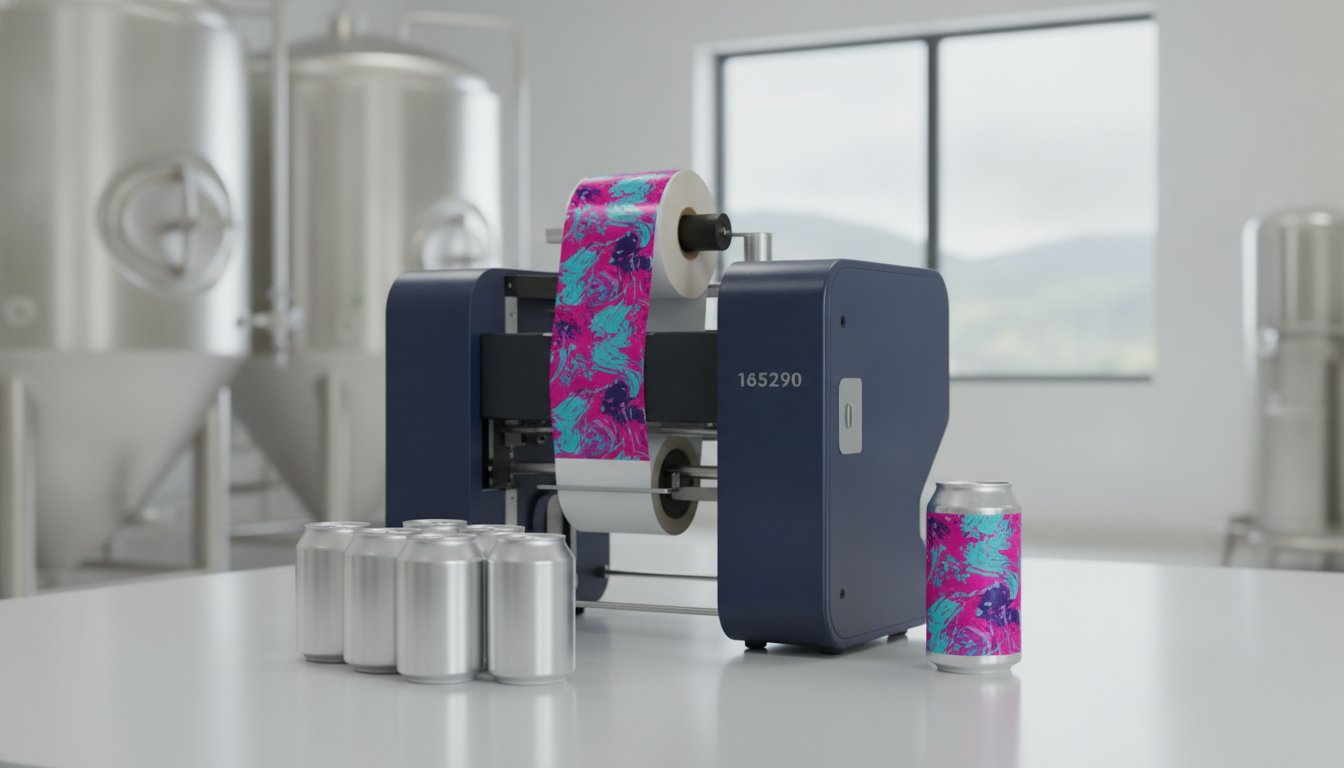
Why are you still letting a third-party print house dictate your craft brewery's release schedule? You've likely dealt with the frustration of high minimum order quantities for a small seasonal batch. Perhaps you've even watched your brand's hard work peel off or blur in a customer's ice bucket because of inferior ink. It's a common struggle for Canadian brewers who need agility but face constant shipping delays and rigid external production timelines.
Finding the right brewery label printer Canada offers is the most effective way to reclaim your margins and your schedule. This guide provides a clear path to transitioning your production in-house for 2026. You'll discover how to produce professional-grade, moisture-resistant labels that withstand cold storage while significantly reducing your cost-per-label for limited editions. We will break down the latest Afinia and Epson colour hardware, discuss compliance with new Canadian labelling regulations, and show you how to streamline your workflow with industry-standard software like BarTender.
Key Takeaways
- Eliminate high minimum order quantities and gain full control over your production schedule by moving to in-house printing.
- Ensure your branding survives the cold-chain by utilizing pigment-based inks and moisture-resistant materials designed for Canadian beverage environments.
- Evaluate top hardware from Afinia and Epson to select the best brewery label printer Canada offers for your specific production volume and budget.
- Automate regulatory compliance and manage variable data like ABV and batch codes with integrated software and finishing solutions.
- Maintain operational efficiency by sourcing high-quality blank labels and ink cartridges from a reliable national distributor.
The Shift to In-House Brewery Label Printing in Canada
Modern craft breweries are rethinking their supply chains. In-house label printing involves moving the entire production process from external vendors to your own facility. This shift allows you to print professional-grade labels as needed, rather than ordering thousands of rolls months in advance. The Shift to In-House Brewery Label Printing in Canada reflects a broader trend toward agility in a market that reached 1.9 million hectolitres in 2025. You gain total control over the look, feel, and timing of your packaging.
Selecting a brewery label printer Canada businesses trust is no longer just about convenience. It's a strategic move to protect margins. When you print on-site, you adopt a just-in-time inventory model. You only produce labels for the beer you've actually brewed. This eliminates the risk of holding obsolete stock when recipes change or regulatory requirements shift. It's the difference between being reactive and being proactive in a competitive market.
The ROI for a brewery label printer Canada model often depends on several factors:
- Monthly volume across multiple unique SKUs.
- The frequency of seasonal or limited-edition releases.
- The cumulative cost of shipping and storage for outsourced rolls.
Eliminating Minimum Order Quantities
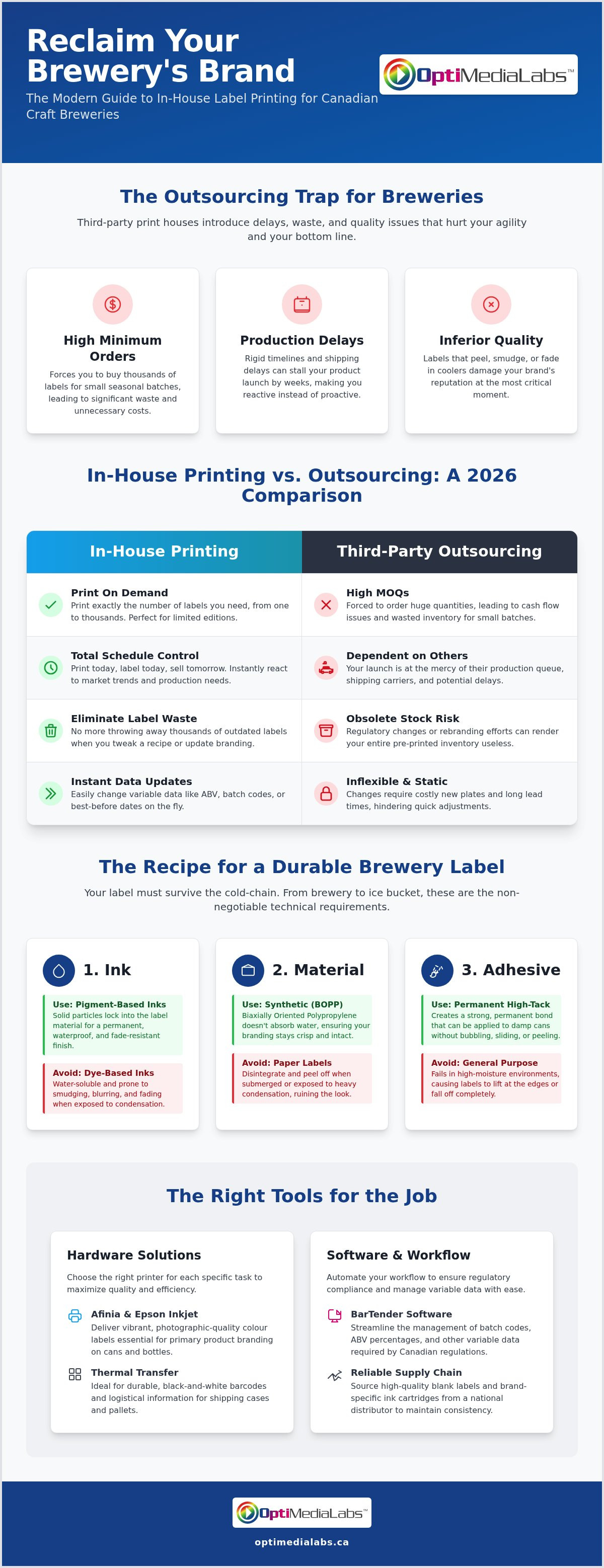
Traditional print houses often demand high minimum order quantities (MOQs) to make their runs profitable. For a small-batch seasonal IPA or a limited-edition barrel-aged stout, these MOQs result in significant waste. In-house printing provides the freedom to print exactly 250 or 500 labels without a price penalty. It also frees up valuable storage space previously occupied by massive rolls of pre-printed inventory. You don't have to worry about throwing away thousands of labels if a recipe is tweaked or a brand is refreshed.
Managing Production Timelines
Waiting for a shipping carrier to deliver your labels can delay a product launch by weeks. By controlling your own equipment, you can respond to market trends instantly. If a specific brew gains traction, you can scale up labelling immediately. You also gain the ability to update variable data, such as batch codes or ABV percentages, without ordering new plates. Print today. Label today. Sell tomorrow. For a detailed breakdown of the financial transition, see our In-House Label Printing vs Outsourcing: 2026 Cost Guide.
Technical Requirements for Durable Craft Beer Labels
Canadian craft beer exists in a high-moisture environment. From the moment a can is filled to the time it sits in a customer's ice bucket, the label faces constant exposure to condensation and temperature shifts. A standard brewery label printer Canada setup must produce more than just pretty colours. It must produce a chemical bond that survives the cold-chain. Unlike simple splash-resistant stickers, industrial brewery labels require pigment-based inks. These inks contain solid particles that lock into the media, preventing the smudging or fading common with cheaper dye-based alternatives.
Substrate choice is equally critical. While paper labels offer a rustic feel, they often disintegrate when submerged. Synthetic materials, such as biaxially oriented polypropylene (BOPP), are the industry standard for 2026. These films don't absorb water, ensuring your branding remains crisp and professional even after hours in a cooler. Choosing the right adhesive is the final piece of the puzzle. You need a permanent, high-tack adhesive that can be applied to damp cans without bubbling or sliding. Scaling Your Brewery requires a focus on these technical details to maintain brand integrity as you reach more retailers across the country.
Inkjet vs. Thermal Transfer for Breweries
High-resolution colour inkjet printers are the primary choice for the branding on your cans and bottles. They deliver the photographic quality and vibrant gradients that modern beer art demands. However, many facilities also utilize thermal transfer label printers for logistics. These are ideal for printing durable, black-and-white barcodes for shipping cases and pallet tracking. To ensure colour consistency across every batch, always use brand-specific ink cartridges. Third-party inks can shift your brand's signature hues, leading to a mismatched look on the shelf.
Choosing the Right Finish: Matte vs. Gloss
The finish you choose defines the personality of your brew. Gloss finishes are popular for IPAs and fruit sours because they make bright colours pop and suggest a crisp, refreshing experience. Matte finishes provide a sophisticated, tactile feel that suits stouts, porters, or barrel-aged series. Beyond aesthetics, gloss often provides an extra layer of protection against scuffing during transport. If you aren't sure which look fits your current lineup, you can explore the differences in our guide on Matte vs Gloss Label Finish: Which Suits Your Brand?. If you need help matching hardware to your specific bottle dimensions, speak with one of our specialists for a technical consultation.
Top Hardware Solutions: Afinia, Epson, and Primera
Selecting the right brewery label printer Canada requires balancing production speed with output quality. Three brands dominate the Canadian market in 2026: Afinia, Epson, and Primera. Each serves a distinct production profile. High-volume facilities typically lean toward Afinia for raw speed. Premium brands requiring photographic colour accuracy often choose Epson. Start-up breweries or those with limited floor space find Primera to be a reliable entry point. Choosing between these systems depends on your daily throughput and the complexity of your label designs.
Afinia L801 and L901 Series
The Afinia printers utilize Memjet "Waterfall" technology to achieve industry-leading speeds. This stationary printhead design allows the L801 Plus and L901 series to print at up to 60 feet per minute without sacrificing resolution. For a busy brewery, this means thousands of labels can be produced in a single afternoon. Beyond speed, these units offer a significantly lower cost-per-print than smaller desktop units. The L901 series is particularly effective for inline production; it allows you to integrate the printer directly with a label applicator for a seamless workflow. Maintenance is straightforward. The modular design ensures that printheads can be replaced quickly to minimize downtime during peak brewing seasons.
Epson ColorWorks for Industrial Reliability
If your brewery operates in a harsh, damp environment, Epson printers are the preferred choice. The PrecisionCore technology found in the ColorWorks C7500 and the newer C8000 series is engineered for industrial duty cycles. These machines excel at handling pigment inks. These inks provide superior resistance to the chemicals and sanitizers used on a production floor. Epson hardware is known for its nozzle verification technology. This feature automatically detects and clears clogs to ensure every label is perfect. To maintain this level of precision and ensure your colours remain consistent batch after batch, it is essential to use genuine Epson ink cartridges. This combination of hardware and ink ensures that your branding remains legible and vibrant from the warehouse to the retail shelf.
Primera remains a vital option for smaller operations. The Primera LX3000 offers a balance of quality and affordability. It uses a "Big Ink" system to reduce the cost-per-label compared to traditional cartridges. While it may not match the blistering speed of an Afinia L901, it provides the professional 1200 dpi resolution needed to compete with larger brands on the shelf. It's a compact solution for breweries that prioritize high-quality output over massive volume.
Streamlining the Workflow: Software and Finishing
A successful in-house setup requires more than just the physical brewery label printer Canada hardware. You need a complete ecosystem to ensure your packaging looks professional and remains compliant. This system includes design software to manage variable data and finishing equipment to turn raw printed rolls into finished products. Managing batch codes, expiry dates, and ABV percentages becomes a background task rather than a manual hurdle when your workflow is properly integrated. Taking control of these steps ensures your brand maintains a consistent, high-quality appearance across every SKU.
Professional Labelling Software
Breweries must navigate complex Canadian labelling requirements. As of 2026, many prepackaged beverages must display front-of-package nutrition symbols and clear declarations for allergens like wheat or barley. Using BarTender software allows you to automate these elements by pulling data directly from your production logs. This minimizes manual entry errors and ensures every batch meets federal standards for bilingual text and health warnings. While NiceLabel and Loftware provide excellent enterprise-scale features, BarTender remains the preferred choice for its versatility. For a detailed comparison of these tools, see The Professional Guide to Barcode Labeling Software in Canada for 2026.
Afinia Label Cutters and Finishers
Most operations begin with pre-die-cut labels on standard rolls. As your portfolio grows, digital finishing offers a distinct competitive edge. Transitioning to Afinia label cutters & finishers allows you to print on continuous media and cut custom shapes on the fly. This is ideal for unique bottle profiles or limited-run can wraps that require a specific aesthetic. These machines also apply lamination to protect your ink from scuffs and moisture during transport. By adding a finisher, you eliminate the need to stock dozens of different pre-cut label sizes. You simply stock a few widths of continuous rolls and let the hardware handle the rest. This reduces your inventory costs and increases your creative freedom.
Integrating your labelling workflow with your existing brewery management software ensures that production data flows seamlessly to the printer. This connection minimizes the time spent on administrative tasks and allows your team to focus on the brewing process. By centralizing your label assets, you ensure that the correct version of a label is always used, regardless of who is operating the equipment. If you need help selecting a finisher that matches your printer's speed, contact our specialists for a workflow audit.
Scaling Your Brewery with OptiMediaLabs
Scaling a craft brewery involves more than just increasing fermentation capacity. It requires a robust, reliable supply chain for your packaging. Choosing a brewery label printer Canada specialist like OptiMediaLabs ensures you have a partner that understands the technical demands of high-volume production. As your fleet of printers grows, procurement strategies become vital to maintaining your margins. You need a distributor that can provide not only the hardware but also the technical support and consumables required to keep your lines running. We'll act as a technical authority, helping you troubleshoot issues and optimize your settings for different substrates.
National Distribution and Consumables
Sourcing label printer consumables domestically is a strategic advantage for Canadian businesses. It eliminates the unpredictability of cross-border shipping and customs delays that can halt production during a busy launch. OptiMediaLabs maintains a specialized inventory of blank inkjet labels designed specifically for high-moisture brewery environments. By purchasing brand-specific ink and media in bulk, you can significantly reduce your cost-per-unit and protect your bottom line. National shipping across Canada ensures that your supplies arrive on time regardless of your location. This reliability allows your team to focus on brewing while we manage the logistics of your labelling inventory.
Implementing RFID in Brewery Logistics
Looking beyond 2026, smart packaging is becoming the standard for large-scale distribution and logistics. RFID printers allow breweries to implement advanced keg tracking and inventory management systems. Unlike traditional barcodes, RFID tags can be read without a direct line of sight; this drastically improves warehouse efficiency. You can track the location and status of every keg in your fleet in real-time. This technology reduces loss and streamlines the return process for reusable containers. Implementing RFID today future-proofs your logistics and prepares your brand for the requirements of major national retailers. It's a secure, streamlined path to obtaining the resources you need for long-term growth.
Transitioning to an in-house model is a significant step toward operational independence. Speak with an OptiMediaLabs expert today to organize your brewery’s labelling transition. We provide the expertise and hardware needed to scale your brand with confidence.
Future-Proofing Your Canadian Brewery Packaging
Taking control of your labelling process is a strategic necessity for growth in 2026. Transitioning to in-house production allows you to eliminate high minimum order quantities and respond instantly to market trends. By selecting the right brewery label printer Canada offers, you ensure your branding survives harsh cold-storage environments. High-quality pigment inks and moisture-resistant substrates are essential for maintaining a professional image in every customer's ice bucket.
OptiMediaLabs is your partner in this transition. As an authorized Afinia and Epson Canadian distributor, we provide the industrial hardware and specialized media your facility requires. We maintain a deep inventory of moisture-resistant labels and offer national shipping across Canada to keep your production lines moving. Our team is ready to help you optimize your workflow and reduce your long-term cost-per-label.
Request a Quote for Your Brewery Labelling Solution today and reclaim your production schedule. We look forward to supporting your brand's expansion.
Frequently Asked Questions
What is the best label printer for a small craft brewery in Canada?
The Primera LX3000 is an ideal choice for small craft breweries due to its balance of professional 1200 dpi resolution and affordable entry cost. For breweries requiring higher durability and pigment-based inks, the Epson ColorWorks C6000 series provides industrial reliability in a compact footprint. Both systems allow smaller operations to produce high-quality branding in-house without the burden of high minimum order quantities from external print houses.
How do I ensure my beer labels won’t peel off in an ice bucket?
Use biaxially oriented polypropylene (BOPP) synthetic media paired with a permanent, high-tack adhesive. Unlike standard paper, synthetic labels don't absorb moisture or disintegrate when submerged. You must also use a brewery label printer Canada businesses trust to utilize pigment-based inks. These inks lock into the substrate to prevent smudging or running. This combination ensures your branding remains intact and legible even after prolonged submersion in ice and water.
Is it cheaper to print beer labels in-house or outsource them?
In-house printing is typically more cost-effective for breweries managing multiple SKUs or frequent seasonal releases. Outsourcing often involves setup fees and high minimum order quantities that lead to wasted inventory. By printing your own labels, you only produce what you need for each batch. This reduces your cost-per-label over time and eliminates shipping expenses. The return on investment for hardware is often realized quickly through these saved operational costs.
What software do I need to print GHS or CFIA compliant labels?
BarTender is the industry standard software for managing Canadian regulatory compliance. It allows you to automate the inclusion of mandatory elements such as bilingual text, allergen declarations, and front-of-package nutrition symbols required by the CFIA. The software integrates with your production data to ensure accuracy across batch codes and expiry dates. Other professional options like NiceLabel and Loftware also provide robust tools for maintaining compliance in a commercial brewery environment.
Can I print on metallic or clear labels with an inkjet printer?
Yes, you can print on metallic and clear synthetic media using compatible inkjet technology. Printers like the Afinia L801 and Epson ColorWorks series are designed to work with specialized inkjet-receptive coatings on these materials. Clear labels allow for a "no-label" look on glass bottles, while metallic stocks provide a premium, reflective finish. It's essential to use high-quality blank inkjet labels to ensure the ink adheres properly and dries instantly without smearing.
What is the difference between pigment and dye-based inks for brewery labels?
Pigment inks contain solid colour particles that offer superior resistance to water, UV light, and chemicals. This makes them the standard for brewery environments where condensation is constant. Dye-based inks utilize liquid colourants that provide exceptionally vibrant hues and deep blacks but are prone to smudging when exposed to moisture. For labels that must survive an ice bucket or refrigerated transport, pigment-based systems are the more reliable choice for long-term brand integrity.
How much space does a professional brewery label printer require?
Space requirements vary depending on your production volume. Compact desktop units like the Primera LX3000 require only a standard tabletop or workbench. Industrial workhorses like the Afinia L901 or Epson C7500 have a larger footprint and often require additional space for unwinders and rewinders. A typical professional setup for a brewery label printer Canada facility might occupy a space roughly 1.5 to 2 metres in length to allow for comfortable media loading and finishing.
Do I need a separate machine to cut my labels into specific shapes?
You don't need a separate machine if you use pre-die-cut labels on rolls. However, if you want to create custom shapes or print on continuous media, a digital label finisher is necessary. Machines like Afinia label cutters & finishers allow you to laminate, cut, and strip your labels in one process. This provides the flexibility to create unique packaging shapes for different bottle types without the need to stock multiple sizes of pre-cut rolls.