
Compare Materials for Chemical Resistant Drum Labels
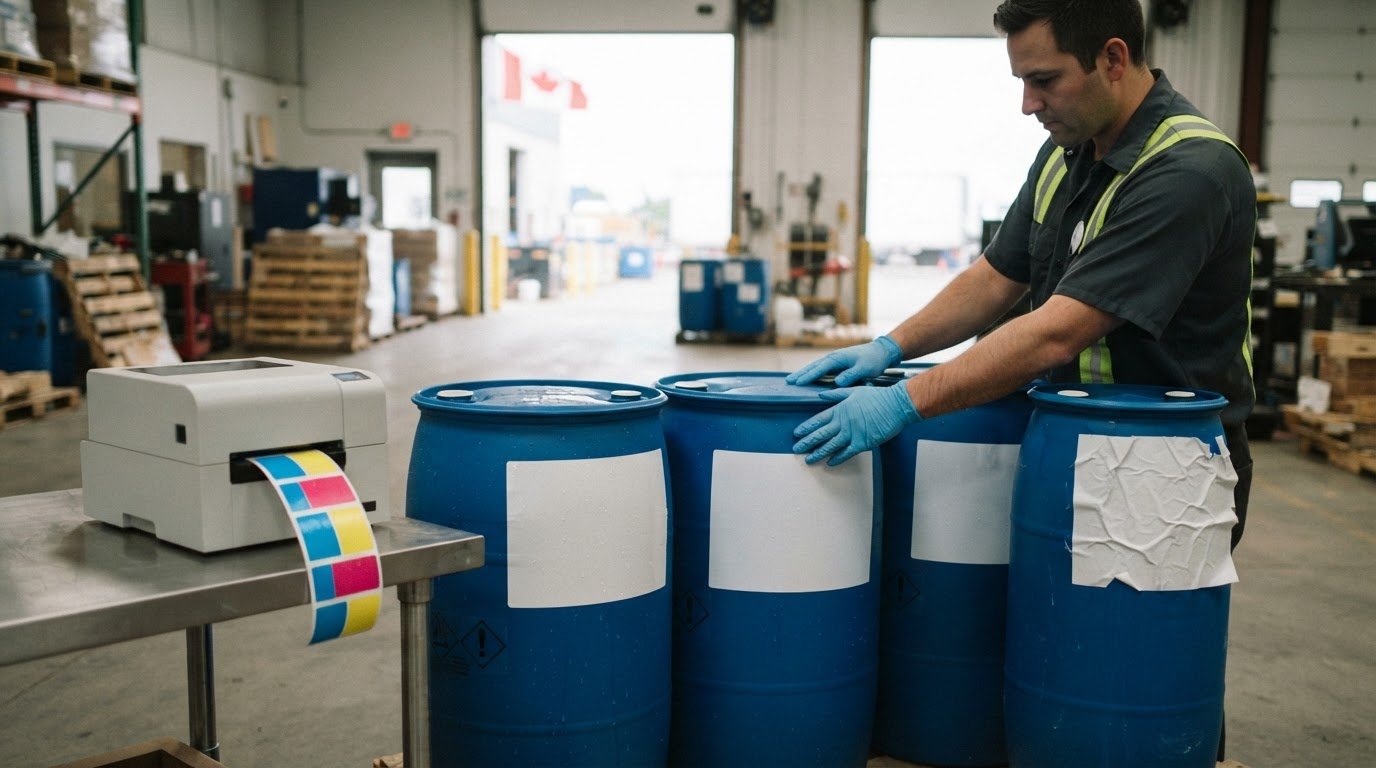
The toughest drum label isn’t always made from the toughest-sounding material. Choosing chemical resistant drum label printing solutions means matching the label face and adhesive to the chemical, drum surface and conditions the label will encounter.
It’s reasonable to focus on material first, but durability also depends on moisture, abrasion, fading and how well the adhesive holds to the drum. A protective UV varnish or laminate can slow fading from light exposure. It’s one part of the decision, not a substitute for choosing a suitable label material and adhesive.
This comparison explains how polyester, vinyl, polypropylene and paper differ as label-face materials, and why chemical resistance, adhesive durability and protection from everyday exposure depend on the complete construction. You’ll also learn where a protective finish can help and how to narrow the options for your drum-label application without assuming one material suits every chemical or surface.
Key Takeaways
- Choose a label material based on the chemical exposure, drum surface and handling conditions, rather than material name alone.
- Compare polyester, vinyl, polypropylene and paper against your application’s needs for chemical resistance and durability.
- A protective UV varnish or laminate can help slow fading from light, but it is only one part of label protection.
- Assess the adhesive on a finished-size sample applied to each representative container surface.
- Use the decision guide to narrow your options by moisture, abrasion, fading and label-adhesion requirements.
How Do I Choose The Right Label Material For My Product?
In Canada, apply the WHMIS and GHS labelling requirements relevant to the chemical and workplace. Chemical labels in industrial settings must identify chemicals accurately and communicate their hazards. The label material must also suit the drum surface, environment and possible incidental chemical exposure.
Required label information and pictograms depend on the chemical’s hazard classification. Include approved content that identifies the product and communicates its hazards. The responsible buyer or compliance team must approve the classification and pictograms. A label printer should not decide which hazard pictogram applies.
Start with the chemical and the conditions the drum will face. List expected contact, including accidental splashes, moisture, UV light and mechanical stress. Then identify the drum surface and shape. A label that fits a smooth panel may behave differently on a curved or textured area, so assess the actual application rather than choosing by material name alone.
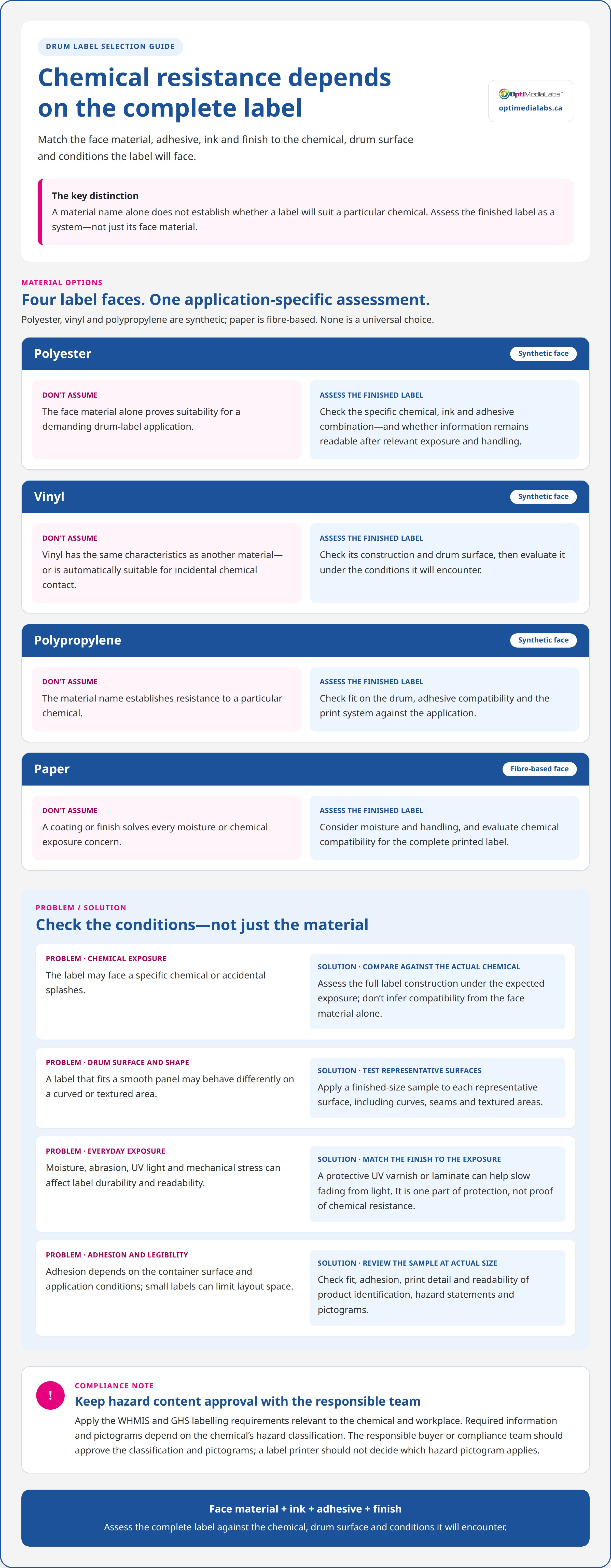
Compare the options against those conditions. Polyester, vinyl and polypropylene are synthetic label-face materials; paper is fibre-based. Their names alone don’t establish whether they’re suitable for a particular chemical. Use this comparison to assess material and finish, not to assume there’s one universal ranking.
| Option | Chemical exposure | Surface and adhesive | Moisture, abrasion and fading | Print detail |
|---|---|---|---|---|
| Polyester | Assess against the specific chemical | Match adhesive to drum surface | Assess exposure and finish together | Check text, symbols and colour |
| Vinyl | Assess against the specific chemical | Match adhesive to drum surface | Assess exposure and finish together | Check text, symbols and colour |
| Polypropylene | Assess against the specific chemical | Match adhesive to drum surface | Assess exposure and finish together | Check text, symbols and colour |
| Paper | Assess against the specific chemical | Match adhesive to drum surface | Assess exposure and finish together | Check text, symbols and colour |
Consider the adhesive separately from the label face. Adhesive performance depends on the container surface and application conditions. A finished-size sample applied to each representative drum surface can reveal fit, adhesion and print issues before you select a production setup. Include the drum’s curves, seams and textured areas in the assessment.
Choose a finish based on exposure. A protective UV varnish or laminate can slow fading from light, while a suitable finish may also provide a barrier during routine handling. It cannot make every label chemical-resistant, so assess the complete combination: face material, ink, adhesive and finish.
Review image detail at the actual label size. Confirm that product identification, hazard statements and pictograms remain legible, especially when a smaller label limits layout space. Choose the material, adhesive and finish as one system, based on the chemical, drum surface, exposure and approved label content.
Apply the WHMIS and GHS requirements relevant to the chemical and workplace, using its hazard classification to guide the label content. The responsible buyer or compliance team should approve the classification and pictograms.
Labels should identify the product and communicate its hazards. Required information and pictograms depend on the chemical’s hazard classification, which the responsible buyer or compliance team should approve.
Label materials: polyester, vinyl, polypropylene, and paper
Polyester, vinyl, polypropylene and paper are label-face materials, not guarantees of chemical resistance. A material name alone doesn’t describe the complete label. Adhesive, ink, finish and drum surface all affect how a finished label performs. Compare material options against the actual chemical exposure and handling conditions rather than treating one as universally suitable.
- Polyester: Treat polyester as a candidate for demanding drum-label applications, then assess the specific chemical, ink and adhesive combination. Don’t infer performance from the face material alone. Check whether the printed information remains readable after the relevant exposure and handling.
- Vinyl: Consider vinyl as a separate option, not a substitute assumed to have the same characteristics as polyester. Its suitability depends on the label construction and drum surface. Assess the finished label under the conditions it will encounter, including any incidental contact with chemicals.
- Polypropylene: Evaluate polypropylene using the same application-specific criteria. Compare the label’s fit on the drum and the compatibility of its adhesive and print system. A material name by itself cannot establish resistance to a particular chemical.
- Paper: Paper is a fibre-based face material, so consider moisture and handling as part of the decision. A finish may alter the surface, but it doesn’t establish chemical compatibility. Assess the complete printed label rather than assuming a coating solves every exposure concern.
For a fair comparison, keep the label content and application consistent. Use the same drum surface, print design and exposure conditions for each candidate. Record changes such as edge lifting, scuffing, fading or reduced legibility. These observations help distinguish a face-material issue from an adhesive, ink or finish issue.
Consider what the label needs to do. A drum label carrying product identification and hazard information must keep its text and symbols readable through normal handling. If it wraps around a drum, assess how each material conforms to the surface. If it sits near a seam or textured area, include that location in the evaluation.
Finish and print system matter too. A protective varnish or laminate can slow fading caused by light, but it doesn’t make every material suitable for chemical contact. Compare the finished output, including small text, colour fields and pictograms, to ensure surface protection doesn’t compromise clear information.
Choose the material only after comparing the finished label’s readability, adhesion and condition against the intended use. For questions about equipment for your label-printing workflow, contact the team about your setup.
Moisture, abrasion and fading protection
A drum label may face several kinds of exposure before someone reads it. Rain, washdown, condensation, handling and sunlight affect different parts of the printed label. Assess each exposure separately. For example, a label stored indoors may face abrasion during movement, while an outdoor drum may also be exposed to direct light and moisture.
Moisture: Identify whether the label will encounter splashes, damp storage or routine cleaning. Depending on the complete construction, moisture may affect the label face, print or edges. Check that the label remains attached and legible after exposure representative of its use. Include curved drum areas, seams and edges, where lifting could interfere with reading product or hazard information.
Abrasion: Map where contact occurs. A drum handled by equipment, stacked beside other containers or moved around a work area may experience rubbing on its label. Inspect printed text, pictograms and colour fields for scuffing. Check the entire label, not just its centre. Edge wear or surface damage can affect legibility even when most of the print looks intact.
Fading: Consider how much light reaches the drum during storage and use. A protective UV varnish or laminate can slow fading caused by light exposure. It’s a protective measure, not proof that the label will resist every chemical or type of wear. Assess the printed result under the lighting conditions the label will encounter, particularly where colour or small details carry important information.
Use a consistent evaluation process for each candidate construction. Apply a finished-size sample to each representative container surface to assess fit and adhesion on the actual drum, rather than a flat substitute. Then expose samples to relevant moisture, handling and light conditions, changing one factor at a time where practical.
- Record whether water or dampness changes the label’s appearance or edges.
- Inspect for scuffs where drum handling creates repeated contact.
- Compare printed areas before and after light exposure.
- Check that product details and hazard symbols remain readable.
Keep the label face, adhesive, ink and finish consistent during each comparison. Changing several components at once makes results harder to interpret. If a sample lifts after moisture exposure, note where the lifting starts. If the print fades, distinguish the printed area from the label material itself. These observations help identify which part of the construction needs adjustment.
Choose protection according to the drum’s route from filling through storage and handling. A sample that remains clear on a stationary container may experience different abrasion during transport or repeated handling. Assess the finished label under representative conditions, then prioritize the exposure most likely to affect legibility.
Adhesive quality and label durability
Adhesive performance depends on the drum surface, label construction and application conditions. A finished-size sample applied to each representative container surface can reveal fit and adhesion issues before you settle on a label setup. Include the actual drum material and any curved or textured areas in the assessment.
Prepare the surface by removing dirt, oil and moisture with a method suitable for the drum material. Let the application area dry, then position the label away from seams, heavy texture and damaged coatings where possible. Apply it smoothly, pressing across the full face and edges to limit trapped air or wrinkles.
Label failure can result from surface contamination, poor contact, an adhesive-container mismatch or exposure the complete label construction can’t withstand. On a curved drum, a label that doesn’t sit cleanly may also lift at the edges. Prevent problems by matching the adhesive to the surface and conditions, then testing a finished-size label in its intended position.
- Residue or moisture: Oil, dust or dampness can interfere with contact. Clean and dry the application area before placing the label.
- Curvature or texture: Drum shape and surface variation can prevent full contact. Test on the actual area, including nearby seams.
- Exposure: Incidental chemical contact, moisture, sunlight or handling can affect adhesion or legibility. Assess the full label under representative conditions.
- Application: Wrinkles, trapped air and poorly pressed edges can create weak points. Smooth the label from the centre outward.
Check the sample after application, not just while positioning it. Look for bubbles, creases, lifted corners and edges that don’t follow the drum surface. Record where lifting begins. Failure near a seam may point to placement or container geometry, while a wider adhesion issue may indicate surface preparation or adhesive compatibility.
Keep the test controlled. Use the same label size and application area when comparing adhesives. Change one element at a time, such as the adhesive or label face, so the results remain useful. If drums are cleaned before labelling in production, use the same preparation process for the sample.
Inspect readability as well as adhesion. A firmly attached label still needs to keep product and hazard information legible after expected handling. Review the printed text and symbols after exposure, and note whether rubbing or chemical contact affects the print, face material or adhesive. This helps identify which part of the label construction needs adjustment.
Review printed text and symbols after exposure, and note whether rubbing or chemical contact affects the information. Laboratory patient-information labels need to withstand testing processes, freezing temperatures and exposure to chemicals such as ethanol, DMSO, formalin and toluene. Include these conditions when assessing the complete label, checking adhesion and whether information remains legible after the relevant testing and exposure.
Chemical-resistant label characteristics
A durable drum label depends on its complete construction and production method. Chemical resistant drum label printing solutions should match the label face, ink, adhesive and finish to the exposure conditions.
Inkjet and thermal transfer are printing methods to assess against the selected label stock. Neither method alone establishes chemical resistance. Check that printed details remain legible after representative exposure, and confirm that the chosen equipment and supplies are compatible with the intended media.
Material Durability, Cost and Print Quality
Polyester, vinyl and polypropylene are synthetic label faces, while paper is fibre-based. None is automatically the most durable or lowest-cost option for every drum application. Compare the complete construction for exposure resistance and adhesion. Print quality also depends on the media and printing method, so review small text, colour fields and hazard symbols on the finished label.
There is no single typical Canadian price for custom chemical-resistant drum labels. Label dimensions, material, print coverage, finish and order quantity affect the specification and cost. For a useful comparison, assess quotations with equivalent requirements. For example, a paper label without a protective finish isn’t directly comparable with a finished synthetic label.
Outdoor and Chemical Exposure Lifespan
There is no universal service life for labels exposed outdoors or to chemicals. Sunlight, moisture, abrasion, chemical contact, adhesive and drum surface all affect ongoing legibility. A UV varnish or laminate can slow fading from light, but it doesn’t set a fixed lifespan or guarantee resistance to a particular chemical.
Assess the intended conditions instead of assuming a set lifespan. A drum kept outdoors may encounter different light and moisture exposure from one handled indoors. Consider the chemical, type of contact and storage environment. Then check the printed label’s face, ink and adhesion for changes that could make its information difficult to read.
For chemical resistant drum label printing solutions, distinguish the intended print output from the performance of the finished label. Use a finished-size sample on a representative drum surface and document its exposure. Compare samples using consistent criteria, such as legibility, print appearance and edge adhesion. This gives the selection process a practical basis without assuming that every material or printing method behaves alike.
When assessing a production method, consider whether the artwork needs colour or detailed symbols, and whether the selected media suits the equipment. Evaluate the finished output, not just the printer’s stated method. Keep approved content consistent across samples so the comparison focuses on label construction and print quality.
OptiMediaLabs Canada: Labelview software
OptiMediaLabs Canada offers Labelview software for businesses preparing drum labels for printing. Consider it when you need a software option as part of your label-production workflow, alongside the material and print requirements established for your application.
If you’re selecting equipment, Afinia Color Label Printers can support colour label production, while RFID Label Printers are designed for RFID labelling workflows. Afinia Label Cutters & Finishers are another option when finishing is part of your setup. The right combination depends on how your labels are produced and handled.
Keep the label-content and material decisions separate from the equipment choice. The printer and workflow support production, but the label’s chemical resistance still depends on its complete construction and conditions of use.
Contact OptiMediaLabs Canada to discuss your label-printing setup.
Set up your next label run with confidence
Your next step is to connect the material decision to a practical production workflow. Before a label run, align the approved content, selected label construction and printing setup so the finished drum label suits its intended use. Chemical resistant drum label printing solutions work best when production choices reflect the application’s actual requirements.
OptiMediaLabs Canada offers Afinia Color Label Printers, RFID Label Printers and Epson Ink Cartridges. These offerings can support different parts of a labelling operation, depending on its equipment and workflow. A discussion about your setup can help you identify which products are relevant to your production needs.
Move forward with a clear specification, then choose the equipment and supplies that fit it. Contact OptiMediaLabs Canada to discuss your label setup and take the next step with a focused plan.
Frequently Asked Questions
What Types Of Label Materials Are Available?
Common choices include polyester, vinyl, polypropylene and paper. These are label-face materials that can be combined with different adhesives, inks and finishes. For example, the same printed design may use a synthetic face with a protective finish or an uncoated paper face. Compare complete label constructions, not just material names, and consider whether the label must display colour, small text or detailed symbols.
What label materials resist chemicals, solvents, and corrosion on drums?
No material should be assumed to resist every chemical or solvent. Polyester, vinyl and polypropylene are options to evaluate, but performance depends on the chemical and the complete label construction. The face, ink, adhesive and finish may respond differently to exposure. Match the label to the specific contents and handling conditions, then evaluate a finished sample on the drum before choosing a production setup.
Which Canadian suppliers print GHS-compliant chemical drum labels?
For in-house production, OptiMediaLabs Canada supplies label-printing equipment and consumables, including Afinia Color Label Printers and Epson Ink Cartridges. These support a production setup; GHS compliance depends on the approved label content and its application to the chemical. The responsible buyer or compliance team should approve hazard classifications and pictograms. A printer or supplier should not determine the chemical’s classification.
Can chemical drum labels be printed in-house, and what equipment and supplies are needed?
Yes, in-house production can use a compatible label printer, suitable label stock and the matching print supplies. OptiMediaLabs Canada offers Afinia Color Label Printers, Epson Ink Cartridges, Thermal Transfer Ribbons and Labelview software. The right combination depends on the printer and media selected. Plan for approved label artwork, compatible consumables and a sample run to assess output before printing labels for drums.