
Durable Label Materials Canada: The 2026 Industrial Buyer’s Guide
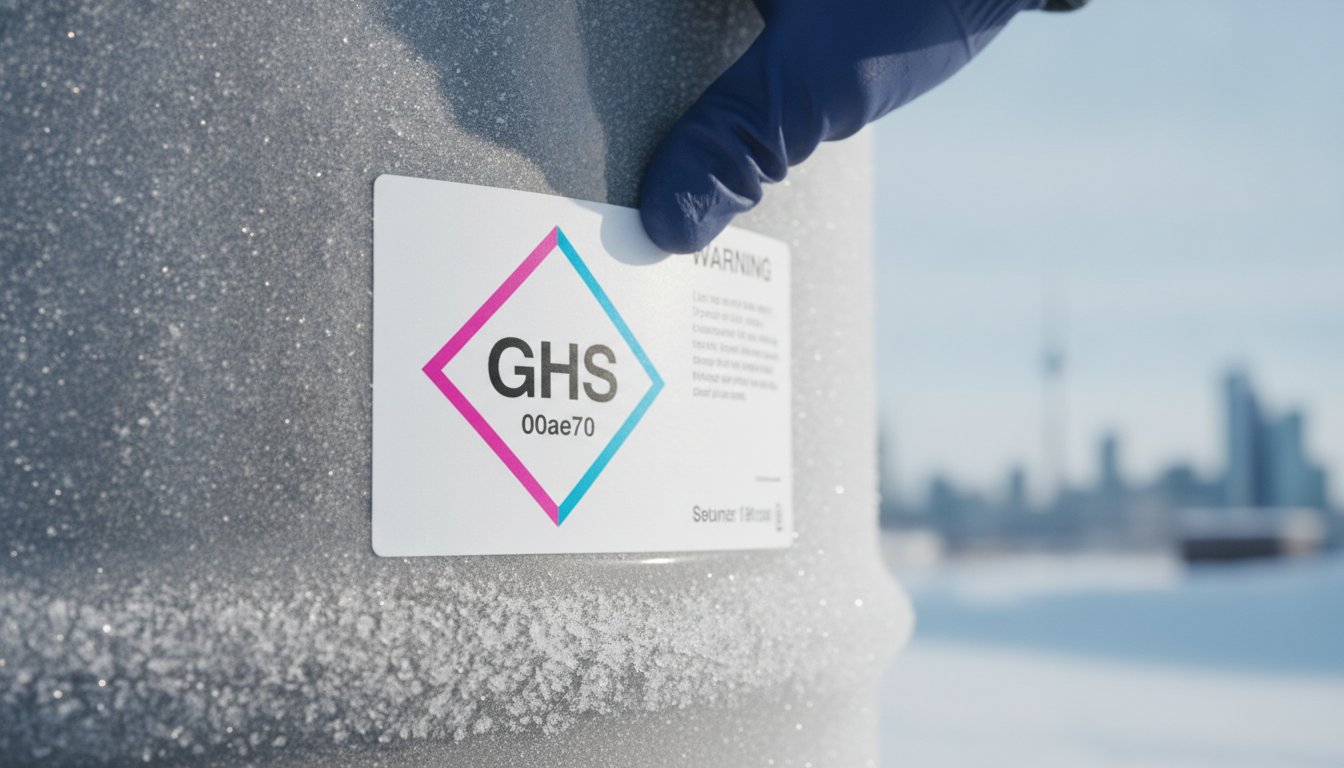
An industrial label that fails isn't just a minor technical glitch; it's a direct threat to your regulatory compliance and operational safety. In a market where durable label materials Canada must withstand everything from chemical exposure to extreme sub-zero temperatures, choosing the wrong substrate is a liability you can't afford. You know the frustration of labels falling off in cold storage or ink fading under harsh UV light, turning critical safety data into an unreadable mess.
This 2026 guide helps you master the technical specifications of high-performance substrates to ensure your products remain legible and compliant in any environment. We'll break down the specific use cases for BOPP, PET, and Vinyl while addressing the latest GHS and Bill 96 requirements. You will learn how to identify the exact material and adhesive combination for your application, ensuring your labels stay attached and clear from the factory floor to the end user. We'll also provide a clear path for sourcing reliable media to keep your Canadian operations running at peak efficiency.
Key Takeaways
- Understand the "Triple Crown" of durability by evaluating how substrates, adhesives, and liners work together to prevent label failure.
- Compare the performance of durable label materials Canada professionals rely on, such as BOPP for general industrial use and PET for high-heat environments.
- Learn to navigate Canadian-specific environmental challenges, including the freeze-thaw cycle and strict GHS/WHMIS compliance standards.
- Identify the best printing technology for your needs, from pigment-based inkjet systems like Afinia and Epson to traditional thermal transfer ribbons.
- Discover why sourcing brand-certified media through local Canadian distributors reduces lead times and ensures optimal storage conditions.
Defining Durability: What Makes an Industrial Label Material?
Industrial durability isn't just a marketing term; it's a technical requirement for safety and logistics. In the context of durable label materials Canada, durability means a label remains legible and attached despite mechanical abrasion, chemical exposure, and extreme weather. A label that peels in a warehouse or smudges on a chemical drum isn't just a nuisance. It's a compliance failure. You need materials that can withstand the rigours of the supply chain without losing their integrity.
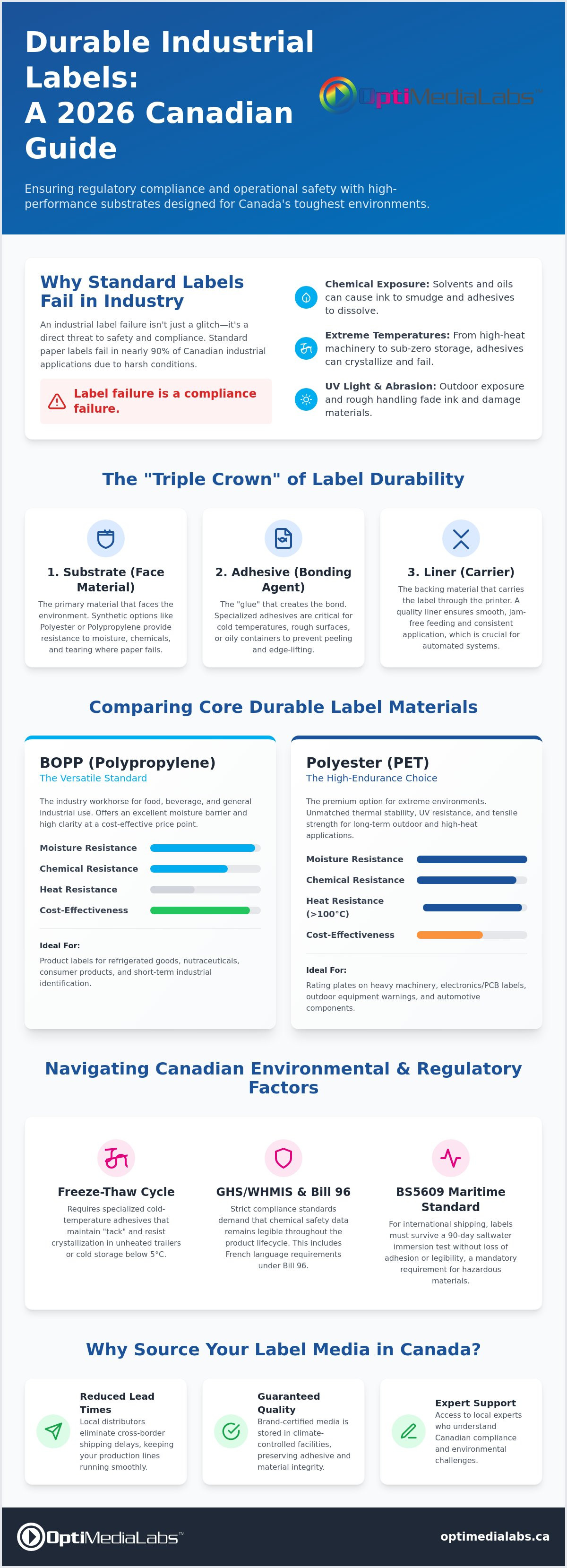
Think of industrial labels as a three-part system often called the "Triple Crown" of durability. This system includes the substrate (the face material), the adhesive (the bonding agent), and the liner (the carrier that ensures smooth feeding). If any of these three components fails, the entire identification system collapses. While standard paper labels are cost-effective for indoor office use, they fail in nearly 90% of Canadian industrial applications. Paper absorbs moisture, tears under tension, and degrades rapidly when exposed to oils or cleaning agents.
Durability also extends to regulatory compliance. A "tough" label might resist tearing, but a "compliant" label must meet specific international standards. For example, labels meeting BS5609 standards must survive 90 days of saltwater immersion without losing legibility or adhesion. This level of performance is mandatory for many maritime and hazardous material applications where safety data must remain visible at all times.
The Role of Synthetic Substrates
Synthetic materials like polypropylene and polyester have replaced wood-pulp paper in high-performance environments. These plastics provide superior dimensional stability. They don't shrink or expand when humidity levels shift, which is vital for maintaining barcode scan rates. High-quality Afinia labels and Epson labels utilize advanced top-coatings. These coatings are essential because they lock in the ink, preventing smearing or fading even when the surface is scratched or handled frequently.
Adhesive Science: Beyond Simple Stickiness
The bond between the label and the product depends on Pressure-sensitive adhesive (PSA) technology. For Canadian industries, adhesive choice is critical due to winter logistics. Standard adhesives often crystallize and lose their grip at temperatures below 5°C. You need specialized cold-temperature adhesives that maintain "tack" during shipping in unheated trailers or storage in cold-room facilities. For rough surfaces or oily containers, high-tack acrylic adhesives provide the necessary chemical resistance to prevent edge-lifting over time.
Core Durable Label Materials: Comparing Synthetic Options
Selecting the right substrate requires matching the material's physical properties to the specific stress factors of your facility. When sourcing durable label materials Canada based, you'll primarily choose between three synthetic families: polypropylene, polyester, and vinyl. Each offers a distinct balance of tensile strength, chemical inertness, and thermal stability. With the Canadian label market projected to reach USD 1379.77 million by 2035, the shift toward these specialized synthetics is accelerating. Understanding these differences is vital for meeting Canadian labeling requirements across various industrial sectors.
BOPP: The Versatile Standard
Biaxially Oriented Polypropylene (BOPP) serves as the industry workhorse. It's the go-to choice for the food, beverage, and nutraceutical sectors because it provides an excellent moisture barrier at a lower cost than polyester. You can choose from matte, gloss, or clear finishes to suit your brand's colour palette. While BOPP is highly resistant to water and oils, it lacks the thermal stability required for high-heat industrial engines or long-term outdoor exposure. It's ideal for products that face refrigeration or frequent handling but stay within moderate temperature ranges.
Polyester (PET): The High-Endurance Choice
Polyester (PET) is the premium option for extreme environments. It offers superior heat resistance, making it the standard for electronics, circuit boards, and heavy machinery. Unlike polypropylene, PET won't shrink or warp when exposed to temperatures exceeding 100°C. It also features exceptional UV stability. If your equipment sits outdoors in the Canadian sun, PET ensures your safety warnings don't yellow or become brittle. When you compare PET to standard Afinia labels or Epson labels made of BOPP, the polyester variant provides significantly higher tear resistance and chemical shielding.
Beyond these two, Vinyl (PVC) remains the best choice for maximum flexibility. If you're labelling curved surfaces, such as small-diameter pipes or vials, vinyl's ability to stretch and conform prevents the "flagging" that occurs with stiffer materials. For maritime or heavy chemical applications, specialized materials like Kimdura offer a "paper-like" feel with the ruggedness of a synthetic. These materials are essential for meeting the amended Hazardous Products Regulations that took effect on June 22, 2026. GHS-compliant drums must survive saltwater spray and heavy abrasion without the label peeling or the ink dissolving. If you're unsure which substrate fits your specific production line, our technical team can help you narrow down the options.
Environmental Resistance Factors for Canadian Industry
Canadian industrial environments present a unique set of challenges that standard labelling solutions simply cannot handle. The most significant factor is the "freeze-thaw" cycle. When products move from a temperature-controlled production floor to an unheated shipping container in January, the rapid drop in temperature can cause the substrate and adhesive to contract at different rates. Without the right durable label materials Canada based companies risk labels "popping" off the surface or cracking under the stress of thermal shock. This physical stress is compounded by the high humidity levels found in coastal facilities or food processing plants where condensation is constant.
Chemical resistance is equally vital for regulatory compliance. Under the amended Hazardous Products Regulations, hazardous materials must bear legible, bilingual labels for their entire lifecycle. If your containers are exposed to solvents, cleaners, or industrial oils, the ink must be anchored to the substrate to prevent smudging. This is where pigment-based inks and top-coated synthetics become essential. Beyond chemical exposure, long-haul national shipping introduces significant abrasion. Constant vibration during transit can rub labels against other packaging, so a durable top-coat or laminate is your best defence against friction-induced data loss.
Cold Storage and Cryogenic Performance
Selecting the right material requires an understanding of the difference between minimum application temperature and service temperature range. The application temperature is the thermometer reading when the label is first pressed onto the surface. The service temperature is the range it survives after the bond is set. For food processing and medical laboratories, you need materials that can withstand cryogenic conditions. The critical service temperature for Canadian cold-chain logistics typically requires materials rated to maintain adhesion at -40°C or lower to account for unheated transport and deep-freeze storage.
UV and Weatherization
Outdoor equipment and storage tanks face constant UV bombardment, which can cause standard inks to fade and substrates to yellow or become brittle. While a varnish can provide some protection against minor scuffing, lamination offers the highest level of outdoor durability. It creates a physical barrier against sunlight and moisture, significantly extending the life of the label. For businesses looking to produce these high-performance labels in-house, utilizing Afinia Label Cutters & Finishers allows you to apply a protective laminate film during the finishing process. This ensures your safety warnings and barcodes remain scannable even after years of exposure to the Canadian elements.
Matching Durable Materials to Printing Technology
Choosing the right substrate is only half the battle. To achieve true industrial endurance, the printing technology must chemically or mechanically bond with the face stock. When sourcing durable label materials Canada professionals frequently choose between digital colour inkjet and traditional thermal transfer. Each method requires specific media coatings to prevent the image from smearing, scratching, or fading. Digital printing allows for on-demand colour coding and GHS compliance, while thermal transfer remains the standard for high-volume, single-colour barcodes and shipping tags. The ink must bond perfectly to the surface, or the most rugged PET film becomes useless.
Inkjet Durability: Afinia and Epson Solutions
Modern systems like those from Afinia and Epson utilize pigment-based inks. Unlike dye inks, which soak into the material, pigment inks consist of solid particles that sit on the surface and bond with specialized synthetic top-coats. This creates a label that is instantly dry and highly resistant to water, oils, and UV exposure. To achieve the best results, you must use media specifically engineered for your printer's ink chemistry. For instance, using Epson labels ensures the top-coat is optimized for the PrecisionCore printhead technology. Adjusting your print settings to 'High Quality' or 'Max Durability' can further increase the ink density, improving rub resistance in high-friction environments.
Thermal Transfer: The Resin Advantage
Thermal transfer printing relies on a heated printhead to melt a ribbon onto the label surface. The durability of the final print depends entirely on the ribbon composition. Wax ribbons are suitable for basic shipping, but for industrial applications, you need wax-resin or full resin ribbons. Full resin ribbons provide the highest level of resistance to chemicals, extreme heat, and heavy abrasion. High-performance hardware from Zebra and TSC is designed to handle these ribbons at high speeds without sacrificing clarity. Sourcing the correct Zebra ribbons is essential when printing on polyester or polyimide substrates. The resin must 'bite' into the synthetic surface to create a permanent bond. This combination is the gold standard for asset tags and circuit board labelling.
A common mistake is using direct thermal materials in environments with high heat or UV exposure. Direct thermal labels turn black when exposed to heat, rendering them useless for machinery or outdoor storage. Always verify that your substrate's melting point is higher than the printhead's operating temperature to avoid damaging your equipment. If you need help verifying the compatibility of your current hardware with high-performance synthetics, contact our technical specialists for a media audit. We can ensure your hardware and substrates are perfectly matched for your specific Canadian production environment.
Sourcing High-Performance Label Media in Canada
Sourcing durable label materials Canada based ensures your production line remains resilient against supply chain volatility. Local distribution is not just about speed; it's about quality control. Adhesives and synthetic top-coats are sensitive to environmental fluctuations. When media sits in unregulated international shipping containers for weeks, the adhesive can degrade or the liner can warp. By sourcing from a Canadian centre, you receive materials stored in climate-controlled environments, preserving the integrity of the substrate and adhesive bond before they ever reach your printer.
Using brand-certified media from manufacturers like Afinia, Epson, and Primera is the most effective way to protect your hardware investment. These substrates are rigorously tested to ensure they don't shed dust or leach chemicals that could damage sensitive printheads. While generic alternatives might seem cost-effective, they often lead to premature equipment failure and inconsistent print quality. For specialized industrial equipment, custom die-cuts and sizes allow you to tailor your identification system to your specific machinery, ensuring a perfect fit for every application, from small-diameter vials to large chemical drums.
Inventory Management and National Shipping
Reliable consumable supply is the backbone of any manufacturing operation. Production downtime due to a lack of labels or ink is an expensive mistake that is easily avoided with a dedicated Canadian partner. OptiMediaLabs Canada provides expert consultation on material selection for new product launches, ensuring your labels meet all regulatory standards from day one. If you're looking for industry-specific insights, our guide on the Best Label Printer for Cosmetics Canada offers a deep dive into the aesthetic and durability requirements of the personal care sector.
The OptiMediaLabs Canada Difference
OptiMediaLabs Canada functions as a technical partner rather than just a supplier. We understand that durable media is only effective when paired with the right data management tools. We provide access to professional labelling software like BarTender and NiceLabel to help you automate your compliance workflows. Our team offers comprehensive technical support to ensure your hardware and media are perfectly integrated. This holistic approach reduces errors and streamlines your labelling processes across the country. Browse our full range of durable labels and printers to find the ideal solution for your facility's unique requirements.
Secure Your Supply Chain with Rugged Labelling Solutions
Mastering the technical nuances of durable label materials Canada is the most effective way to prevent compliance failures and operational downtime. You now understand that industrial endurance depends on a precise synergy between synthetic substrates, specialized adhesives, and advanced printing technologies. Whether you are managing complex chemical identification or navigating the logistics of national transport, selecting brand-certified media is your best defence against label failure in the field.
OptiMediaLabs Canada serves as your technical authority and reliable partner for all industrial identification needs. As an authorized distributor for Afinia, Epson, and Zebra, we specialize in GHS and BS5609 compliance to ensure your products meet the most stringent standards. With national Canadian shipping on all consumables and expert support for hardware integration, we provide a streamlined path to professional results. Shop Durable Label Materials and Industrial Printers at OptiMediaLabs Canada to modernize your facility today. We look forward to helping you build a more resilient and compliant production environment.
Frequently Asked Questions
What is the most durable label material for outdoor use in Canada?
Polyester (PET) is the most durable choice for Canadian outdoor applications because it resists UV degradation and remains stable across extreme temperature shifts. While polypropylene might yellow or become brittle after prolonged sun exposure, PET maintains its structural integrity. Adding a protective laminate further extends the lifespan of the label by shielding the ink from mechanical abrasion and the harsh Canadian climate.
Can I print on waterproof vinyl with a standard inkjet label printer?
You cannot print on standard sign vinyl with a typical inkjet printer because the ink won't bond to the non-porous surface. You must use inkjet-receptive vinyl specifically engineered with a top-coat that anchors pigment-based inks. Using the correct durable label materials Canada based suppliers provide ensures that your waterproof labels won't smudge or run when exposed to moisture or frequent handling.
What is BS5609 compliance and why does it matter for durable labels?
BS5609 is an international standard that tests a label's ability to remain attached and legible after three months of saltwater immersion. This certification is critical for hazardous chemical containers transported via sea freight. It confirms that both the adhesive and the printed image can withstand aggressive maritime environments, ensuring your GHS compliance remains intact even if a container is lost at sea.
How do I prevent my labels from peeling off in cold storage?
To prevent peeling in cold storage, you must select a material with a cold-tack or cryogenic adhesive. Standard adhesives often crystallize and lose their grip when temperatures drop below freezing. For the best results, apply the label to a clean, dry surface at room temperature before moving the product into the freezer. This allows the bond to set properly before the adhesive faces extreme thermal stress.
Are polyester labels better than polypropylene labels?
Polyester (PET) labels are superior to polypropylene (BOPP) for high-heat and long-term outdoor use. PET offers higher tensile strength and better dimensional stability, meaning it won't shrink or warp under stress. However, BOPP is a more cost-effective workhorse for indoor applications where moisture resistance is the primary concern but extreme temperature resistance or UV stability isn't required for the application.
What is the difference between matte and gloss finishes for durability?
Gloss finishes provide a slick surface that helps liquids and chemicals run off, which can improve chemical resistance in some industrial environments. However, matte finishes are often preferred for industrial durability because they hide surface scratches and scuffs better than high-gloss materials. Additionally, matte surfaces reduce glare, which can significantly improve the scan rates of barcodes under bright warehouse or factory lighting.
How much does specialized durable label media cost compared to paper?
Specialized durable label media carries a higher initial price point than standard paper because of the complex synthetic polymers and high-tack adhesives involved. However, the cost of a failed paper label includes re-labelling labour, potential shipping errors, and regulatory fines. Investing in durable label materials Canada manufacturers trust reduces the total cost of ownership by ensuring your identification stays permanent for the product's entire lifecycle.
Can I use thermal transfer ribbons on any durable label material?
You cannot use the same thermal transfer ribbon for every material. Wax ribbons are designed for paper, while synthetic materials like PET and BOPP require wax-resin or full resin ribbons. A full resin ribbon is necessary for maximum durability because it chemically bonds with the synthetic substrate. Using the wrong ribbon will result in ink that flakes off or smudges easily under even light contact.