
Epson C6500 or Afinia L502 Printer: Why the L502 is the Better Buy for 2026

The most recognizable brand name in the room isn't always the one that protects your bottom line. When comparing the Epson C6500 or Afinia L502 Printer - L502 better buy, many Canadian facility managers assume the Epson is the default standard for industrial work. However, investing in hardware that lacks flexibility can lead to significant costs if your product requirements shift. At OptiMediaLabs Canada, we realize you shouldn't have to choose between a printer that handles GHS-compliant chemicals and one that produces vibrant retail packaging.
This guide demonstrates why the Afinia L502 offers superior versatility and long-term value compared to the Epson C6500 for Canadian industrial labelling. We'll examine the unique Duo Ink system, compare the 4800 dpi resolution against the Epson's 1200 dpi, and analyze how to achieve a lower cost per label. You'll learn how the L502 serves as a future-proof solution that adapts to diverse materials and strict retail standards without requiring a hardware overhaul.
Key Takeaways
- Understand how Duo Ink technology provides the flexibility to switch between pigment and dye inks for both industrial and retail applications.
- Compare performance benchmarks to see how the Afinia L502’s 4800 dpi resolution delivers higher quality output than the Epson C6500.
- Assess the long-term durability of an all-metal industrial chassis built to withstand demanding Canadian warehouse environments.
- Discover why the Epson C6500 or Afinia L502 Printer - L502 better buy comparison highlights the Afinia as the more versatile investment for 2026.
- Identify how in-house labelling reduces the high costs associated with third-party printing and minimizes the risk of hardware obsolescence.
The 4-Inch Industrial Label Printer Showdown: Epson vs. Afinia
Canadian industrial sectors are undergoing a significant shift in how they manage production. By 2026, the transition from outsourced printing to on-demand, in-house production has become a primary strategy for cost containment and supply chain agility. Central to this movement is the 4-inch colour inkjet market. Modern Label printer technology has advanced to the point where small and medium-sized enterprises can achieve the same quality as commercial print houses.
Selecting the right hardware often comes down to two heavyweights. The Epson ColorWorks C6500 is the established incumbent, known for its consistent performance in logistics and manufacturing. However, when evaluating the Epson C6500 or Afinia L502 Printer - L502 better buy, the Afinia L502 stands out as a versatile challenger. It's built for rugged environments and offers a level of flexibility that many traditional industrial printers lack.
Why 4-Inch Printers are the Industry Standard
The 4-inch width is the functional sweet spot for most Canadian businesses. This format is ideal for prime product labels found on retail shelves and standard GHS shipping labels used in chemical transport. Standardizing on 4-inch media allows facility managers to reduce warehouse inventory by using the same roll sizes across multiple product lines. These machines offer a compact footprint that fits into existing workstations while maintaining the throughput required for high-volume production cycles.
Defining the Professional Labelling Needs of 2026
Modern labelling requirements are increasingly complex. Brands now face dual demands: they need high-resolution colour for retail shelf appeal and extreme durability for industrial applications. A single product might require a vibrant, glossy label for the consumer and a chemical-resistant, smudge-proof label for the shipping crate. Meeting these standards requires more than just speed. It demands hardware that can handle varied ink types and substrates. Reliability is also paramount. Access to national distributor support for consumables like ink and blank media ensures that production lines remain operational without costly downtime. As product requirements change, the ability to adapt without purchasing new hardware is the ultimate measure of value.
Performance Benchmarks: Speed, Resolution, and Throughput
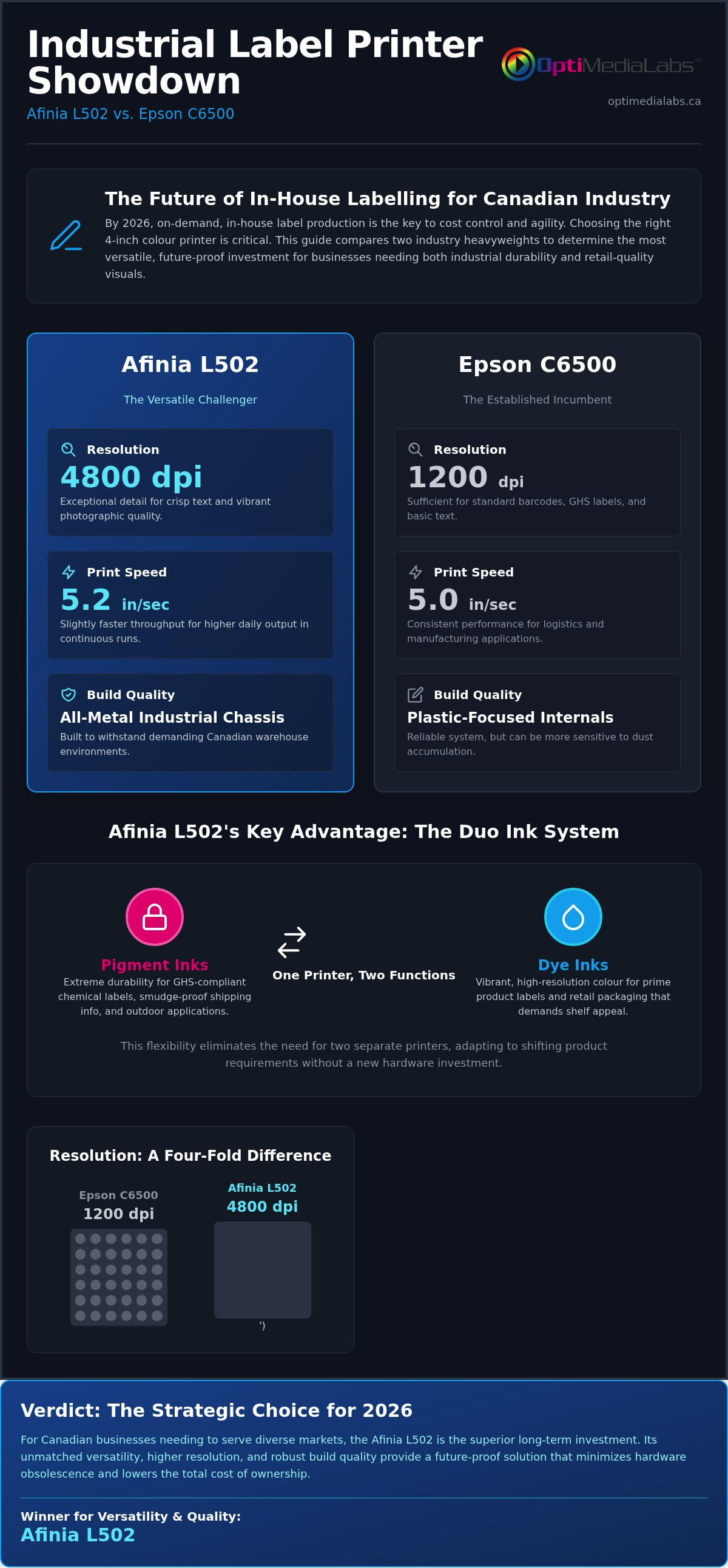
Analyzing technical specifications reveals why the Epson C6500 or Afinia L502 Printer - L502 better buy debate often leans toward the Afinia for high-detail work. Print speed is a critical metric for high-volume environments. The Afinia L502 delivers up to 5.2 inches per second. The Epson C6500 reaches 5 inches per second. In a continuous production cycle, these small gains accumulate over a shift, resulting in higher daily output.
Resolution is where the hardware diverges significantly. The Epson C6500 provides a respectable 1200 x 1200 dpi. This is sufficient for standard barcodes and basic text. The Afinia L502 offers up to 4800 dpi. This four-fold increase in potential resolution ensures that fine photographic details and small fonts remain crisp. For Canadian manufacturers integrating these units into local networks, both machines offer standard Ethernet and USB connectivity. They fit into existing IT architectures with minimal configuration.
Media handling is equally vital for throughput. Both printers accommodate 4-inch wide rolls, but the L502 features a robust internal unwinder that manages tension effectively. This prevents skewing during long runs. While the Epson C6500 also handles internal rolls well, its plastic-focused internal path can be more sensitive to dust accumulation in industrial settings. Maintaining a clean media path is easier with the open-access design of the Afinia model.
Print Quality and Colour Accuracy
Epson utilizes PrecisionCore technology to maintain sharp edges on 1D and 2D barcodes. It's a reliable system for logistics and shipping. The L502 focuses on colour vibrance. It produces rich, saturated hues that are essential for premium retail packaging. Consistency is managed through advanced printhead monitoring. This ensures the first label in a multi-thousand run matches the last. If you're unsure which output suits your brand, contact our specialists for a custom sample print.
Workflow Integration: Peeler vs. Auto-Cutter
Operational efficiency depends on how labels exit the machine. The Epson C6500 requires buyers to choose between specific models. You must pick the C6500A for an auto-cutter or the C6500P for a peeler at the time of purchase. This limits long-term flexibility if your application changes. The Afinia L502 is designed for modularity. It integrates seamlessly with external finishing equipment. You can explore Afinia Label Cutters & Finishers to create a fully automated production line. This modular approach allows businesses to scale their finishing capabilities as demand grows. You won't need to replace the primary printer if your workflow shifts from bulk rolls to individual cut labels.
The Duo Ink Factor: Why Versatility Matters for Canadian Brands
Most industrial printers force a permanent choice between durability and aesthetics. The Epson C6500 utilizes a pigment-only system. It's excellent for smudge resistance but can struggle to produce the high-gloss "pop" required for premium consumer goods. The Afinia L502 solves this through Duo Ink technology. This system allows operators to swap between pigment and dye-based inks by changing the printhead. When evaluating the Epson C6500 or Afinia L502 Printer - L502 better buy, this versatility makes the Afinia a superior long-term investment for businesses with diverse product lines.
Strategic flexibility is essential for the Canadian market in 2026. A manufacturer might produce industrial lubricants on Monday and retail-ready car wax on Tuesday. Using the same machine for both tasks reduces capital expenditure and simplifies operator training. It eliminates the fear of purchasing hardware that becomes obsolete if your product requirements change. This adaptability is the primary reason why specialized distributors recommend the L502 for companies that anticipate growth or market shifts.
Pigment Ink for Harsh Industrial Environments
Pigment inks are the standard for durability. They offer exceptional resistance to water, harsh chemicals, and prolonged UV exposure. This is mandatory for meeting Canadian safety labelling standards, particularly for chemical products requiring GHS or BS5609 certification. While we stock Epson C6000/C6500 Ink Cartridges for dedicated industrial use, the L502 provides this same level of ruggedness without locking you into a single ink type. It ensures your labels remain legible in freezing warehouse conditions or under direct sunlight. The pigment particles sit on the surface of the media, creating a bond that resists abrasion during transit and handling.
Dye Ink for Premium Retail Branding
Dye-based inks excel at saturation and vibrance. They penetrate the top layer of glossy media to create deep blacks and vivid colours that pigment inks cannot replicate. This is the preferred choice for gourmet food products, cosmetics, and craft beverages where shelf appeal drives sales. By utilizing Afinia L501/L502 Ink Cartridges in dye format, you can achieve a professional "prime" label look on a wide range of substrates. The ability to pivot your branding strategy without buying a second printer provides a significant competitive edge. You can maintain high-impact visuals for your consumer-facing products while relying on the same hardware for your industrial needs.
Build Quality and Long-Term Cost of Ownership
Physical durability is the foundation of a reliable production line. When deciding between the Epson C6500 or Afinia L502 Printer - L502 better buy, the structural integrity of the machine is a deciding factor. Epson's C6500 features a plastic-heavy exterior. This is standard for office-grade equipment but can be a liability in high-traffic industrial zones. The Afinia L502 utilizes a heavy-duty all-metal cover. This ruggedized design protects sensitive internal components from physical impact and the vibrations common in manufacturing facilities.
Maintenance requirements also dictate the long-term value of your investment. The L502 features a user-replaceable printhead. This design choice is a significant advantage for operational uptime. If a printhead fails or becomes clogged, your staff can perform a replacement in minutes. You don't have to wait for a service technician or ship the unit to a repair centre. This level of self-sufficiency reduces the risk of extended production halts and lowers the total cost of ownership over a three-year period.
Industrial Ruggedization
A metal chassis matters in Canadian warehouse conditions where temperature fluctuations and dust are constant challenges. Plastic housings can become brittle over time or warp slightly in extreme environments, potentially leading to media alignment issues. The L502’s metal build provides a stable platform for the high-precision 4800 dpi printing process. It effectively seals out environmental debris that could compromise print quality. For a deeper look at hardware standards, consult our Industrial Labeling Solutions Canada: The 2026 Reference Guide.
Ink Efficiency and Consumables Support
Operational costs are heavily influenced by ink consumption and waste. Both the Epson and Afinia models utilize individual CMYK ink cartridge systems. This ensures you only replace the specific colour that is depleted, preventing the waste associated with tri-colour cartridges. However, the L502’s ability to use different ink types means you aren't wasting specialized media on test runs or low-priority labels. Reliability also depends on a steady supply of consumables. We maintain extensive stock of Afinia Labels and Epson Labels to support our clients nationally. Buying from a Canadian distributor ensures you avoid the customs delays and high shipping fees associated with cross-border orders. If you're ready to calculate the specific TCO for your facility, contact our team for a detailed cost analysis.
Verdict: Why the Afinia L502 is the Strategic Choice for 2026
Choosing the Epson C6500 or Afinia L502 Printer - L502 better buy comes down to long-term operational resilience. While the Epson is a capable legacy machine, the Afinia L502 is the superior choice for 2026 due to its unmatched versatility. It eliminates the need for separate industrial and retail printers, allowing Canadian companies to consolidate their hardware footprint. This consolidation simplifies training and reduces the physical space required for your production line.
The Epson C6500 remains a viable option only for organizations with massive, established Epson fleets where ZPL II integration is non-negotiable. However, for most growing brands, the inability to swap ink types on the Epson creates a strategic ceiling. The L502 allows for effortless pivots between chemical-resistant GHS labels and high-gloss consumer packaging, ensuring your investment remains relevant as market trends shift. This flexibility is the cornerstone of a modern, responsive supply chain.
The L502 Advantage for Small to Mid-Sized Enterprises
For smaller producers, the L502 reduces initial capital requirements by serving multiple roles. It provides a professional-grade solution that grows with your output without requiring a hardware overhaul when you launch new product categories. You can explore further details on scaling your production in our Afinia Color Label Printers: The Ultimate Canadian Buyer’s Guide for 2026. This guide helps you align your hardware choices with your projected growth over the next three years.
Next Steps: Procurement and Setup
Verifying media compatibility on your specific substrates is the first step toward successful in-house production. Requesting sample prints helps realize how the 4800 dpi resolution translates to your specific branding and materials. Contact OptiMediaLabs Canada for a professional consultation to determine the ideal configuration for your facility. Our national support network ensures you have the technical expertise required for a seamless deployment across any province.
Secure Your Future Labelling Requirements
Transitioning to an in-house model requires a partner that understands the technical nuances of industrial production. Throughout this comparison, we've demonstrated why the Epson C6500 or Afinia L502 Printer - L502 better buy is a critical distinction for Canadian businesses seeking long-term agility. The Afinia L502 provides the specific flexibility needed to avoid hardware obsolescence in a fast-paced market, ensuring your facility can handle both chemical-resistant markings and high-impact retail visuals without additional capital expenditure.
We provide national Canadian shipping on all hardware and ink sets to ensure your production line never stalls. Our team offers expert technical support for industrial setups and maintains a comprehensive inventory of brand-specific consumables across all provinces. Shop Afinia and Epson Color Label Printers at OptiMediaLabs Canada to secure a solution that meets your retail and industrial standards. Take the next step toward a more efficient, cost-effective labelling workflow today and realize the benefits of a truly versatile production environment.
Frequently Asked Questions
Can the Afinia L502 use both dye and pigment ink at the same time?
No, the Afinia L502 cannot utilize dye and pigment inks simultaneously. It features a Duo Ink system that requires you to swap the printhead and the corresponding ink cartridges to switch between ink types. This design ensures that there's no cross-contamination between the different ink formulations. While you must choose one type for each production run, this flexibility allows a single machine to handle both durable industrial markings and vibrant retail packaging.
Is the Epson C6500 compatible with third-party labelling software like BarTender?
Yes, the Epson C6500 is fully compatible with professional third-party software including BarTender, NiceLabel, and Loftware. It utilizes standard Windows and Mac drivers to integrate into existing workflows. Because it supports ZPL II emulation, it's often used as a direct replacement for thermal transfer printers in logistics environments. This compatibility ensures that your current label templates and databases remain functional without requiring a complete software overhaul during hardware upgrades.
Which printer is better for GHS-compliant chemical labels in Canada?
Both machines produce GHS-compliant labels when used with pigment inks and certified media. However, the Epson C6500 or Afinia L502 Printer - L502 better buy comparison often favours the Afinia for long-term compliance. Its all-metal construction provides better durability in the harsh environments where chemical labels are typically applied. The L502’s 4800 dpi resolution also ensures that small safety pictograms and warning text remain perfectly legible under Canadian safety standards.
How often do I need to replace the printhead on the Afinia L502?
Printhead lifespan on the Afinia L502 varies based on your specific print volume and environment. Unlike many industrial units that require professional service for printhead issues, the L502 features a user-replaceable design. You can swap the component in minutes if quality degrades or if you're switching between dye and pigment inks. This modular approach minimizes downtime and eliminates the need for expensive on-site repairs or shipping the unit to a repair centre.
Does the Epson C6500 support Mac and Windows operating systems?
Yes, the Epson C6500 supports both Windows and macOS operating systems. It includes dedicated drivers that allow for seamless integration with varied computing environments. This cross-platform support is essential for Canadian businesses that utilize different systems for design and production. Whether your team operates on a standard PC network or uses Mac-based creative workstations, the printer maintains consistent colour management and data throughput across both platforms without requiring specialized hardware adapters.
Can I print on matte and gloss synthetic labels with both printers?
You can print on both matte and gloss synthetic materials with these printers, but results depend on your ink selection. The Afinia L502 excels here because you can switch to dye ink for superior vibrance on high-gloss synthetics. The Epson C6500 is restricted to pigment ink, which is ideal for matte surfaces but may appear duller on gloss finishes. When deciding if the Epson C6500 or Afinia L502 Printer - L502 better buy for your needs, consider your primary label finish.
What is the maximum roll diameter supported by these industrial printers?
Both the Epson C6500 and the Afinia L502 support a maximum outer roll diameter of 8 inches (approximately 203 mm) on a 3-inch core. This standard sizing allows you to utilize high-capacity label rolls, reducing the frequency of media changes during long production runs. Standardizing on 8-inch rolls helps Canadian facilities maintain consistent throughput and simplifies inventory management. Both units feature internal unwinders designed to handle the weight and tension of these larger industrial media rolls.