
Epson Ink Cartridges: 2026 Canadian Label Printer Guide
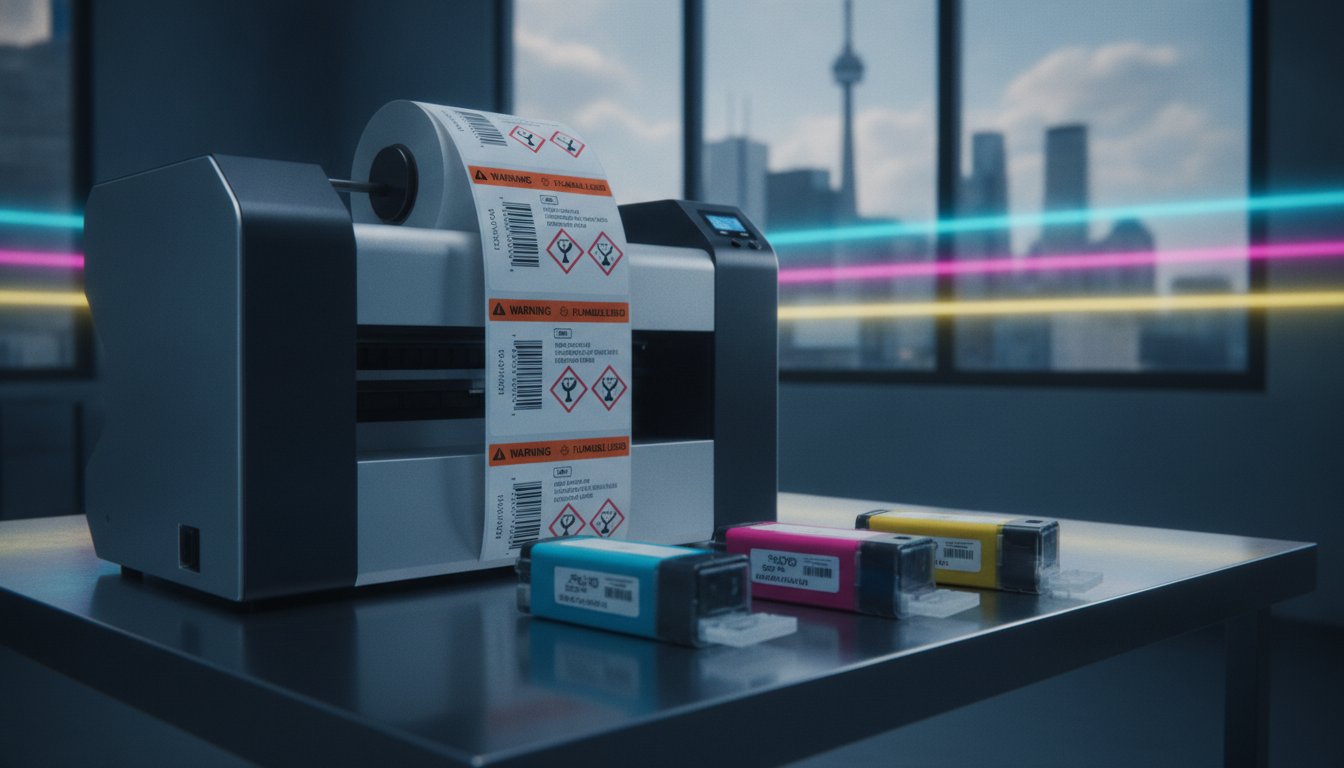
A single smudged barcode on a glossy industrial label can halt an entire shipment, yet many Canadian businesses still struggle with the performance of their Epson ink cartridges and rising operational costs. You likely realize that maintaining high-speed production while ensuring GHS or food-safe compliance is a constant balancing act. It's frustrating when frequent cartridge swaps and clogged printheads eat into your margins and cause unnecessary downtime at your production centre.
This 2026 guide helps you master technical nuances to ensure high-durability results and peak performance across your Canadian operations. We'll show you how to choose between pigment and dye-based chemistry for specific media types like the ColorWorks C6000 series, maximize your ink yield for better margins, and navigate the new Extended Producer Responsibility recycling regulations in Ontario. By the end, you'll have a clear strategy to produce crisp, industry-standard labels while securing a reliable supply chain from a national distributor. Whether you're managing a small boutique or a massive warehouse, these insights ensure your hardware stays protected and your output remains professional.
Key Takeaways
- Learn how Epson’s PrecisionCore technology enables high-speed, industrial-grade label production that standard office equipment cannot match.
- Identify whether pigment or dye ink is appropriate for your specific media to ensure GHS compliance or high-impact colour vibrancy.
- Calculate your true cost per label and protect your printer warranty by using genuine Epson ink cartridges instead of unreliable third-party alternatives.
- Master proper storage techniques to protect your inventory from Canadian temperature fluctuations and maintain the chemical stability of your ink.
- Optimize your supply chain by partnering with a national Canadian distributor that offers expert consultation and reliable coast-to-coast shipping.
Understanding Epson Ink Technology for Professional Label Printers
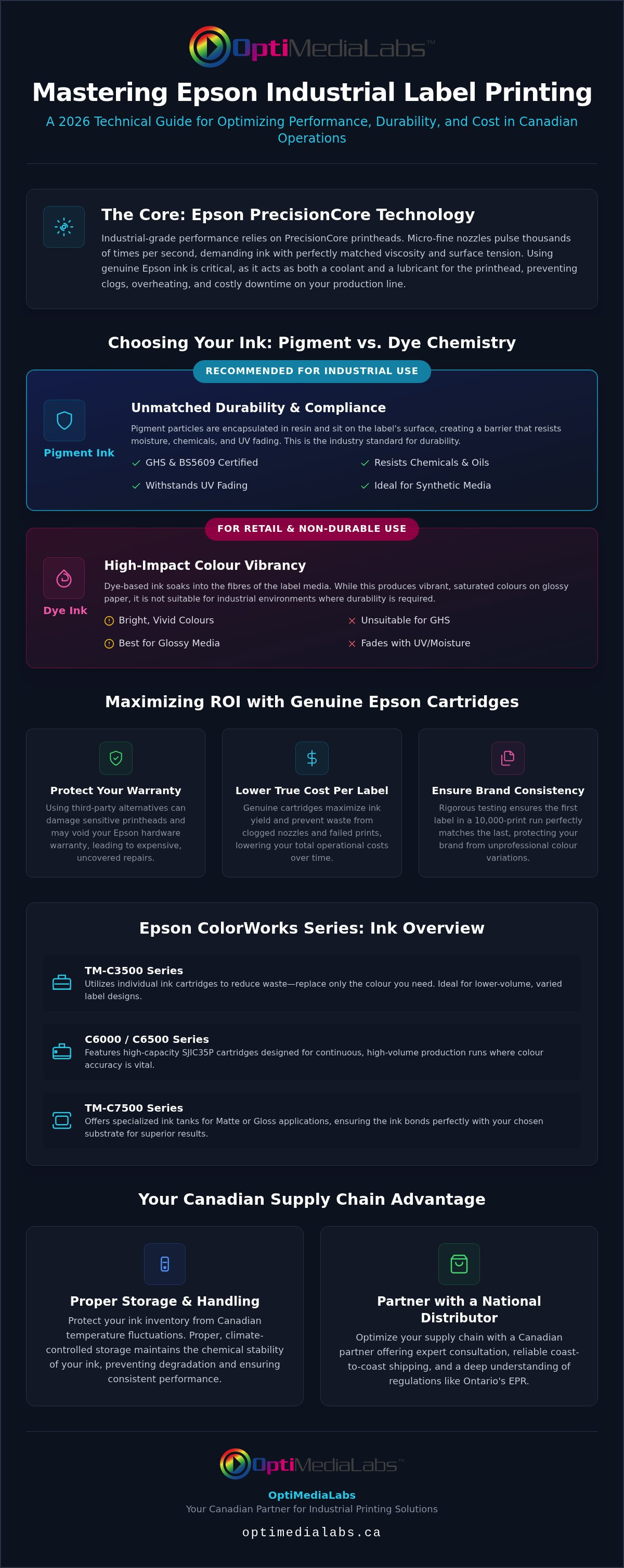
Professional label production requires a level of precision that standard office equipment simply can't provide. While consumer-grade printers prioritize cost and speed for paper documents, the Epson ColorWorks ecosystem is built for durability on synthetic media. This performance relies heavily on PrecisionCore technology. These printheads feature micro-fine nozzles that pulse thousands of times per second. Using genuine Epson ink cartridges ensures the viscosity and surface tension of the fluid match these hardware specifications exactly.
Modern Inkjet printing technology has evolved from simple desktop tasks to high-volume industrial applications. In this context, the ink isn't just a colourant; it's a coolant and a lubricant for the printhead. If the ink chemistry is slightly off, the nozzles can clog or overheat. This leads to colour shifting and expensive downtime across your production line. Maintaining this technical balance is what allows for consistent, high-speed output without frequent maintenance cycles or ruined media.
Epson ColorWorks Series: A Consumable Overview
Legacy printers like the Epson TM-C3500 utilize individual TM-C3500 ink cartridges to reduce waste by allowing you to replace only the colour you need. For higher-volume environments, the C6000 and C6500 series offer high-capacity SJIC35P cartridges. These are designed for continuous production runs where colour accuracy is vital for brand integrity. The TM-C7500 series takes this further with specialized tanks for matte or gloss applications. This specialization ensures the ink bonds perfectly with your chosen substrate, whether you're printing GHS chemical labels or premium cosmetic packaging.
The Chemistry of DuraBrite Ultra and UltraChrome DL
Most Epson industrial printers use pigment-based chemistry, specifically DuraBrite Ultra or UltraChrome DL. Unlike dye ink that soaks into the fibres of the paper, pigment particles sit on the surface of the label. They are encapsulated in a resin that hardens upon contact. This creates a label that resists moisture, chemicals, and UV fading. Such durability is essential for products stored in unheated warehouses or transported during harsh Canadian winters. Industrial ink also undergoes rigorous testing to ensure colour consistency across different batches. This means the first label in a production run of 10,000 matches the last one perfectly, protecting your brand from the unprofessional look of varied shades.
Pigment vs. Dye Ink: Choosing the Right Cartridge for Your Labels
Selecting the correct chemistry is the most critical decision in label production. It dictates the lifespan of the label and the long-term reliability of your printer hardware. While some retailers suggest dye ink for its lower price point, this advice often ignores the harsh realities of industrial environments. Understanding the fundamental chemistry of pigment vs. dye inks is essential for any Canadian operation. The choice between these two types isn't just about cost; it's about matching the ink to the specific environment where the label will live.
GHS Compliance and Chemical Resistance
Pigment ink serves as the industry standard for durability and is mandatory for BS5609-certified chemical labels. These labels must withstand three months of immersion in saltwater without losing legibility. If you produce chemical drums or safety warnings, dye ink is unsuitable because it will bleed or fade when exposed to moisture. Pigment-based Epson ink cartridges create a resilient bond that resists oils, alcohols, and abrasive cleaning agents. This ensures your safety data remains legible for the entire life cycle of the product, regardless of whether it's stored in a damp warehouse or an outdoor yard.
Matching Ink to Label Media
Your choice of media often dictates your ink type. Using Epson matte ink is the best path for industrial applications where readability and permanence are the priorities. It pairs perfectly with matte-coated papers and synthetic films like BOPP. Conversely, when retail aesthetics are the goal, you might utilize gloss ink cartridges for premium cosmetics or high-end food packaging. These cartridges provide the colour pop required to stand out on a shelf. However, synthetic materials like PET react differently to each chemistry. Gloss ink on a matte surface can lead to bronzing, while matte ink on a high-gloss substrate may not dry correctly. This mismatch can lead to smudging during the application process.
Environmental factors also play a significant role in performance. Canadian warehouses face unique challenges, such as high humidity in the summer which can slow drying times for dye inks. Extreme cold during winter transport can also affect the viscosity of the fluid. Pigment inks generally offer better stability across these temperature swings. If you're unsure which combination fits your facility's climate, you can consult with our technical specialists to find the right match for your specific environment.
Maximizing ROI: Yield, Maintenance, and Genuine Epson Cartridges
Return on investment for industrial printing isn't found on the initial invoice for a cartridge. It's calculated by the cost of every successful label that leaves your facility. High-volume production requires predictable results. Genuine Epson ink cartridges are engineered to provide this consistency through integrated IC chips that communicate directly with your printer software. This real-time tracking prevents "dry firing," a situation where the printer continues to run without ink, potentially damaging the PrecisionCore printhead and wasting an entire roll of media.
Third-party alternatives often seem attractive due to lower upfront prices, but they carry hidden risks that can erase those savings. Non-genuine inks frequently suffer from pigment settling, which leads to colour shifting across a single production run. More importantly, the chemical composition of off-brand fluids can degrade the delicate seals within the ink delivery system. This often results in leaks that can short-circuit internal electronics. When you use genuine consumables, you're investing in the long-term health of your hardware and the professional appearance of your brand.
Optimizing Ink Yield and Reducing Waste
Your printer settings significantly impact your total ink consumption. While 1200 dpi provides incredible detail for high-end retail packaging, it uses substantially more ink than 300 or 600 dpi. For standard shipping or GHS labels, lower resolution settings offer excellent legibility while maximizing your yield. Regular maintenance cycles also play a role in efficiency. Industrial printers perform automated nozzle checks to ensure every drop is placed precisely. Properly managing your inventory is the final piece of the ROI puzzle. By tracking usage patterns, you can avoid emergency shipping costs or production halts caused by a single empty colour tank.
Protecting Your Equipment Investment
Epson's limited warranty is a vital safety net for your business, but it typically doesn't cover damage caused by third-party consumables. If an unverified cartridge leaks and ruins the printhead, the resulting repair bill can be thousands of dollars. Beyond the ink itself, you must monitor your maintenance box. This component collects excess fluid during cleaning cycles. If it reaches capacity, the printer will stop until it's replaced. To ensure you're receiving authentic products in the Canadian market, always look for the holographic security seal on the packaging. Sourcing directly from an authorized distributor like OptiMediaLabs guarantees you receive factory-fresh Epson ink cartridges that meet strict manufacturing standards.
Proper Storage and Handling of Epson Industrial Ink
Managing your inventory effectively requires more than just keeping stock on a shelf. It involves protecting the chemical integrity of your supplies against the environmental extremes of the Canadian climate. High-capacity Epson ink cartridges are precision-engineered fluids that can degrade if exposed to improper conditions. During transport in harsh Canadian winters, ink must be protected from freezing, which can cause the pigment particles to clump and permanently damage your printer's internal plumbing. Similarly, warehouse heat in the summer can accelerate chemical breakdown, leading to reduced shelf life and poor colour adhesion.
Chemical stability is the cornerstone of professional label production. Every cartridge has an expiry date that you must monitor closely. Using fresh ink ensures that the suspension remains stable and the resin carriers perform as intended. For high-capacity tanks used in the ColorWorks series, the "shake before use" rule is mandatory. Pigment particles are heavier than the carrier fluid and will naturally settle over time. Gently shaking the cartridge before installation redistributes these particles, ensuring consistent colour density from the first label to the last. Failure to do this can result in "thin" colours and increased wear on the printhead nozzles.
Step-by-Step Cartridge Replacement for Minimal Downtime
Replacing a cartridge should be a swift, controlled process to avoid introducing air into the ink lines. Always have your replacement ready before removing the empty unit. Verify the specific ink codes to ensure they match your Epson printers, as similar-looking cartridges may have different chip configurations. Once installed, the printer may perform a brief initialization. If you notice slight shifts in output, run a quick calibration through your driver software. This ensures perfect colour matching, which is vital when producing multiple batches of the same product label over several months.
Environmental Best Practices for Canadian Businesses
As of 2026, Canadian businesses must navigate stricter regulations regarding hazardous e-waste. In Ontario, the Extended Producer Responsibility (EPR) model now places the full lifecycle responsibility on producers and users. You should never dispose of industrial ink in standard recycling bins. Epson Canada operates a dedicated mail-back programme where used cartridges can be sent to their Mississauga, Ontario, recycling centre. This programme ensures that toxic chemicals are handled safely and non-renewable resources are recovered. Beyond recycling, you can reduce your footprint by optimizing label designs to use less ink and choosing high-yield cartridges that reduce packaging waste. If you need assistance setting up a reliable supply chain that aligns with these new regulations, contact our logistics team today for expert guidance.
Procuring Epson Ink Cartridges in Canada: The OptiMediaLabs Advantage
Maintaining a consistent supply of consumables is the backbone of any industrial printing operation. For Canadian businesses, the challenge isn't just finding a product; it's ensuring it arrives on time and performs as expected. OptiMediaLabs operates as a national distributor, bridging the gap between high-tech manufacturing and local production centres. We provide a secure, streamlined path to obtaining the exact Epson ink cartridges your hardware requires, ensuring your production line never stops. Our logistics network is designed to handle the unique geographical challenges of Canada, providing reliable delivery from coast to coast.
Our expertise extends beyond simple distribution. We understand that matching the right Epson ink to your specific media is critical for durability. Whether you're running the legacy TM-C3500 or the latest C4000 and C6000 series, our inventory is managed to meet the demands of professional labelling environments. We also ensure your hardware works in perfect synergy with professional labelling software. This creates a complete technical ecosystem where ink, media, and data work together to produce high-quality results without the need for constant troubleshooting.
Why Canadian Manufacturers Trust OptiMediaLabs
Unlike general office suppliers, we focus exclusively on industrial labelling solutions. This specialization allows us to provide deeper technical insights and proactive inventory management. We don't just sell ink; we partner with you to ensure long-term stability in your production process. This commitment aligns with our broader mission to provide the most reliable industrial labeling solutions Canada has to offer. By choosing a partner that understands the technical requirements of GHS compliance and food-grade packaging, you reduce the risk of non-compliant output or hardware failure. We maintain stock levels that reflect the needs of our long-term business partners, preventing the "out of stock" delays that plague general retailers.
Streamlining Your Supply Chain
Efficiency is maximized when you bundle your ink with blank inkjet labels. This ensures total chemical compatibility, preventing the smudging and adhesion issues discussed in earlier sections. Our clients gain access to a wealth of technical resources, including our professional guide to label printer consumables Canada. This holistic approach simplifies your procurement process and protects your bottom line by reducing shipping overhead and administrative time. We help you calculate your usage patterns so you can order with confidence.
Ready to optimize your labelling operations? Browse our full inventory of Epson ink cartridges to find the exact match for your printer model. Our team is available to assist with volume requirements and technical specifications to ensure your facility remains productive, efficient, and fully compliant with all industry standards.
Future-Proof Your Canadian Label Production
Mastering the technical requirements of industrial printing is essential for maintaining a competitive edge in 2026. You now understand how to match ink chemistry to your specific media and why genuine Epson ink cartridges are vital for protecting your hardware warranties. By prioritizing proper storage and navigating the new Extended Producer Responsibility regulations, you ensure your operations remain both efficient and compliant. These steps reduce the risk of downtime and ensure your brand maintains a professional appearance on every shelf.
OptiMediaLabs stands ready to support your facility as an Authorized Epson Distributor. We combine specialized expertise in GHS and industrial compliance with reliable national Canadian shipping to keep your production lines moving. Whether you're managing a single ColorWorks unit or a national fleet, we provide the secure supply chain and technical consultation you need to succeed. Our team ensures that your consumables and hardware work in perfect synergy for long-term stability.
Ready to optimize your labelling workflow? Shop Genuine Epson Ink Cartridges at OptiMediaLabs and consult with our specialists today to secure your inventory. We look forward to helping you achieve professional, high-durability results for your business.
Frequently Asked Questions
Can I use dye ink in an Epson printer designed for pigment ink?
No, you should never use dye-based ink in a printer designed for pigment chemistry. These fluids have different viscosities and drying properties that can clog the micro-fine nozzles of a PrecisionCore printhead. Dye ink also lacks the moisture and UV resistance required for industrial labels. Mixing these chemistries often leads to permanent hardware damage and poor print quality on synthetic materials like BOPP or other plastic films.
How long does an Epson ink cartridge last in an industrial label printer?
Lifespan depends entirely on your print resolution and the percentage of ink coverage on your label design. High-resolution retail labels consume significantly more fluid than simple black barcodes. Most industrial users track their cost per label using Epson's monitoring software to predict replacement cycles accurately. It is best to maintain a buffer stock of Epson ink cartridges to avoid production halts during high-volume runs or seasonal peaks.
Are Epson ink cartridges GHS compliant for chemical labeling?
Yes, Epson pigment inks are designed to meet GHS requirements when paired with certified media. Specifically, they help labels achieve BS5609 certification, which ensures durability in harsh maritime environments. This compliance is critical for chemical manufacturers in Canada who must ensure safety data remains legible even after exposure to saltwater or chemicals. The encapsulated pigment particles provide the necessary resistance to smudging and fading over time.
What is the difference between matte and gloss Epson ink?
Matte ink is formulated for maximum durability on matte-coated papers and synthetic films, making it ideal for industrial and GHS applications. Gloss ink is optimized for high-impact visual appeal on glossy media, providing a wider colour gamut for retail packaging. You cannot easily switch between them in most printers without a significant flushing process. It is best to choose the type that matches your primary label finish.
How do I check the ink levels on my Epson ColorWorks printer?
You can check levels directly on the printer's LCD panel or through the Epson Status Monitor utility on your connected computer. This software provides real-time data on remaining ink and maintenance box capacity. For large-scale operations, network management tools allow administrators to monitor multiple devices across a facility. This ensures you can order replacement Epson ink cartridges before a tank runs completely dry and stops your production.
Why is my Epson printer not recognizing a new ink cartridge?
This is often caused by a dirty IC chip or an improperly seated cartridge. Start by removing the unit and gently wiping the gold contacts with a lint-free cloth. Ensure the cartridge clicks firmly into place. If the error persists, check for firmware updates via the Epson Software Updater. Using genuine consumables prevents most recognition issues, because third-party chips frequently fail after the printer receives security updates.
Does using third-party ink void my Epson printer warranty in Canada?
Using third-party ink does not automatically void your entire printer warranty under Canadian consumer protection laws, but Epson will not cover repairs for damage specifically caused by non-genuine supplies. If a third-party cartridge leaks or clogs the printhead, you will be responsible for the full cost of the repair. Using genuine consumables is the only way to guarantee that your PrecisionCore hardware remains protected by the manufacturer's limited warranty.
How should I store spare Epson ink cartridges in a warehouse?
Spare cartridges should be stored in a cool, dry place away from direct sunlight. Maintain a temperature between 15°C and 25°C to preserve chemical stability. In Canadian facilities, avoid storage near exterior walls or loading docks where temperature fluctuations are extreme. Always store cartridges in their original sealed packaging and keep them upright. This prevents the pigment from settling unevenly before you are ready to install the unit.