
GHS Label Software Canada: The Complete 2026 Compliance Guide
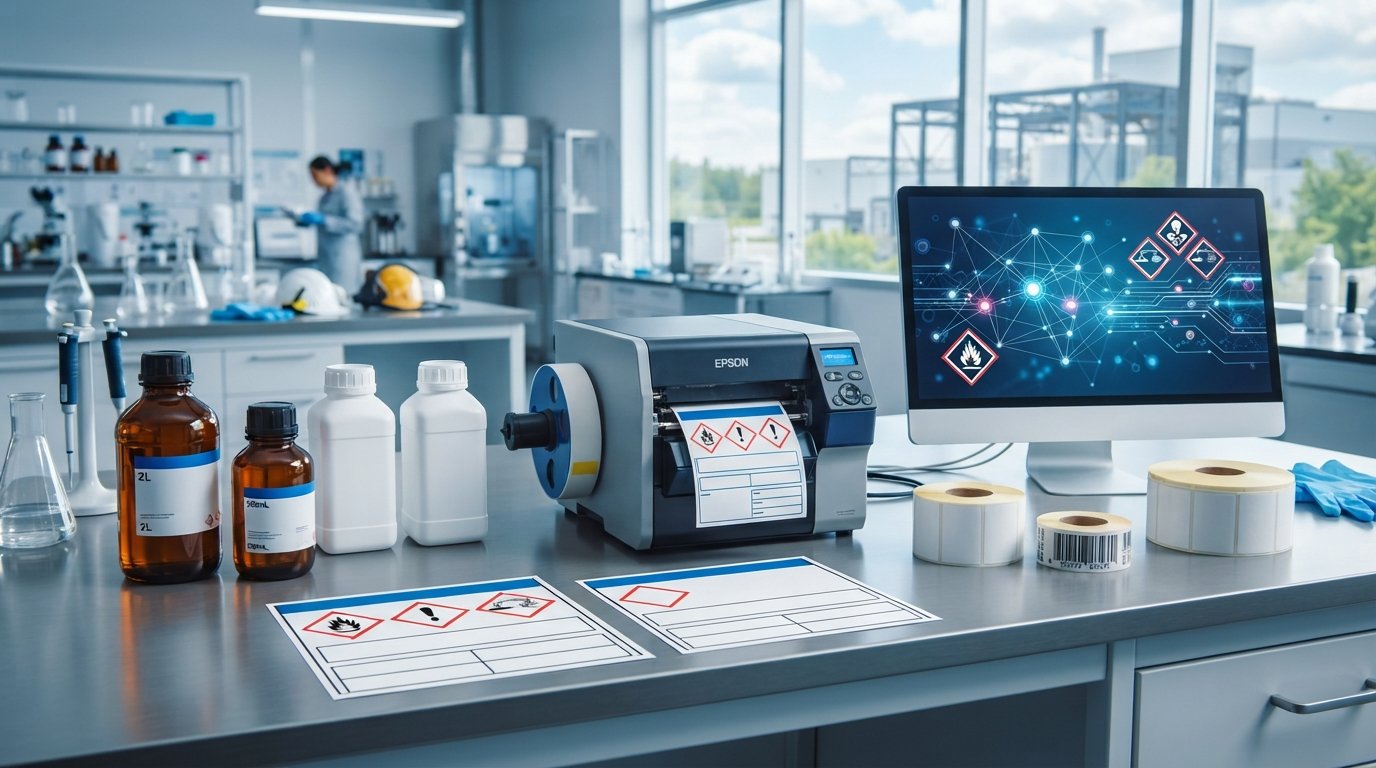
A single non-compliant chemical label can trigger thousands of dollars in WHMIS fines; however, many Canadian manufacturers still rely on manual data entry that invites human error. Finding the right barcode software for chemical labels Canada requires is often the difference between a seamless audit and a costly penalty. You likely feel the pressure of managing complex chemical databases while trying to ensure your colour label printer communicates perfectly with your design software. It's frustrating when systems don't sync, especially when bilingual requirements and safety pictograms are non-negotiable.
This guide helps you identify and implement the precise software solutions to automate your workflow and secure your facility's compliance for the 2026 standards. You'll learn how to eliminate manual labour through intelligent data integration and reliable hardware synchronization. We'll cover everything from automatic pictogram generation to seamless English and French label production, ensuring your labelling process remains efficient, accurate, and legally sound.
Key Takeaways
- Understand the latest WHMIS requirements and how GHS standards apply to your Canadian facility to avoid non-compliance fines.
- Discover how to select the best barcode software for chemical labels Canada offers to automate pictogram generation and bilingual data management.
- Compare industry-leading platforms like BarTender and NiceLabel to find the most efficient interface for your safety officers and production staff.
- Learn the essential steps for in-house implementation, including auditing your inventory and selecting BS5609-certified colour label printers.
- Streamline your labelling workflow by integrating your chemical database directly with your printing hardware for zero-error production.
Understanding GHS Labelling Requirements in Canada
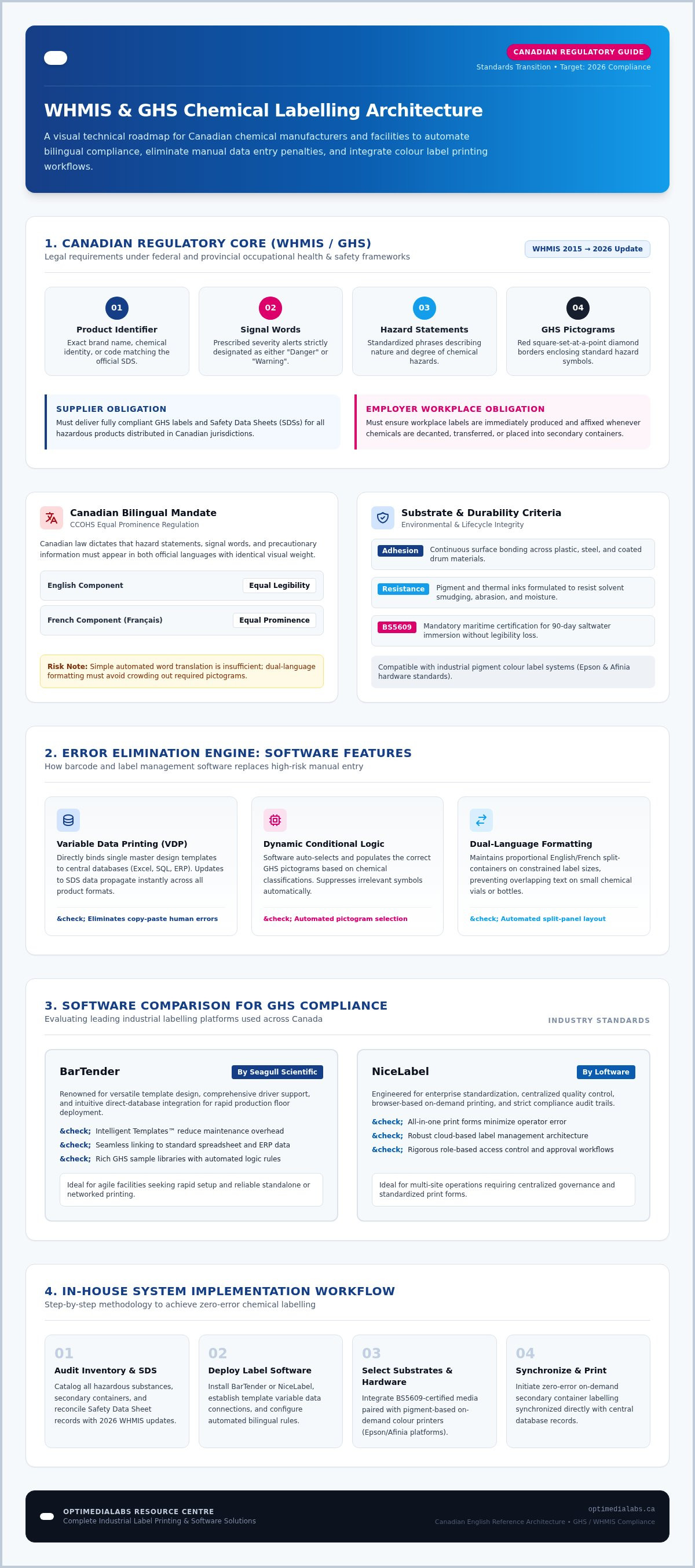
The Globally Harmonized System of Classification and Labelling of Chemicals, or GHS, provides a universal framework for identifying hazardous materials. In Canada, these international standards are implemented through the Workplace Hazardous Materials Information System (WHMIS). Compliance isn't optional. It's a legal necessity for any business handling, storing, or shipping chemicals within Canadian borders. Every label must include specific elements: product identifiers, signal words like "Danger" or "Warning", hazard statements, and the nine standard GHS pictograms.
The Role of WHMIS in Canadian Workplaces
WHMIS 2015, which is currently transitioning toward 2026 updates, integrates GHS standards into federal and provincial legislation. Suppliers must provide compliant labels and Safety Data Sheets (SDSs) for all hazardous products they sell. Once these products enter a facility, the responsibility shifts to the employer. You must ensure all decanted or secondary containers are properly labelled. Don't rely on manual processes for this task. Non-compliance leads to severe consequences, including workplace safety audits, hefty fines, and potential work stoppages. Using professional BarTender software or NiceLabel helps automate this transition, ensuring your data matches the latest legal requirements.
Bilingual Requirements and Canadian Standards
Canada has a unique regulatory landscape that requires all hazard information to be presented in both English and French. This isn't just about a simple translation. The formatting must ensure both languages are equally legible and prominent. Selecting the right barcode software for chemical labels Canada mandates ensures your bilingual text and hazard symbols align perfectly with CCOHS guidelines. Professional barcode software for chemical labels Canada businesses trust can handle these dual-language layouts without compromising the visibility of pictograms or signal words.
Beyond text, the physical durability of the label is vital. Chemical environments often involve moisture, abrasion, and exposure to harsh solvents. Labels must remain legible throughout the product's lifecycle. Consider these physical requirements:
- Adhesion: Labels must stay attached to various container surfaces, including plastic and metal.
- Resistance: Ink must not smudge or fade when exposed to the chemical contents.
- Marine Standards: Some applications require BS5609 certification for saltwater immersion.
Using high-quality Epson labels or Afinia labels ensures your compliant designs actually stay attached and readable in the toughest conditions. It's easier to automate your production now than to fix a compliance error during a surprise inspection.
Essential Features of Professional GHS Label Software
Professional GHS software isn't just a design tool. It's a compliance engine that secures your data integrity. When you evaluate the best barcode software for chemical labels Canada requires, you must look for features that eliminate manual entry. Basic design programs fail because they require users to "copy and paste" hazard statements, which is where most compliance errors occur. A professional system pulls information directly from your source of truth, ensuring your labels always match your Safety Data Sheets (SDS) exactly.
Database Automation and Accuracy
Linking your labels to a centralized registry is the most effective way to reduce human error. Advanced labeling platforms utilize variable data printing (VDP) to handle thousands of SKUs from just a few templates. If a hazard statement changes, you update it once in your Excel or ERP database; the software automatically pushes that change to every relevant label. This real-time synchronization ensures that your production line never prints outdated or incorrect safety information.
Pictogram and Symbol Management
Conditional logic is a critical feature for chemical safety. Instead of a designer manually selecting icons, the software "decides" which symbols to display based on the specific hazard class data. If a substance is corrosive but not toxic, the software automatically suppresses the skull-and-crossbones and displays the corrosion pictogram. This logic keeps your bilingual (English and French) layouts clean and compliant, even on small-format labels. For enterprise-level needs, professional cloud solutions provide advanced version control, preventing unauthorized users from printing unapproved designs.
High-resolution graphics are equally important. GHS pictograms must be clear and recognisable to meet WHMIS standards. Professional software ensures these symbols don't pixelate when resized for different container types. If you're unsure which automation features suit your current database structure, you can consult with our technical team at OptiMediaLabs Canada for a tailored recommendation. This level of precision protects your workers and your business from the risks of mislabelled hazardous materials.
A robust system also includes translation management tools. These allow you to store and trigger French and English text strings simultaneously. This ensures that every label leaving your facility meets Canadian bilingual standards without requiring a fluent translator on the production floor. By automating these essential features, you transform your labelling from a bottleneck into a streamlined, secure workflow.
Comparing BarTender vs. NiceLabel for GHS Compliance
Selecting between the top platforms for GHS compliance often comes down to your existing IT infrastructure and the scale of your chemical inventory. For many facilities, the choice is between the established power of BarTender and the modern, cloud-first approach of NiceLabel. Both provide the necessary tools for WHMIS compliance, but their execution differs significantly in terms of user interface and database connectivity. Finding the right barcode software for chemical labels Canada businesses need involves evaluating how your safety officers will interact with the system daily.
BarTender: The Industry Standard for Automation
BarTender has long been the go-to choice for manufacturers requiring deep integration with ERP systems like SAP or Oracle. BarTender Software by Seagull excels in environments where complex logic is required to drive label output. The Automation edition is particularly popular among Canadian chemical manufacturers because it allows for "headless" printing. This means labels are triggered automatically by database events without manual user intervention. It's a robust, on-premise solution that offers unparalleled control over printer performance and security settings.
NiceLabel and Loftware: Modern Cloud Solutions
As businesses move toward decentralized operations, cloud-based management has become a priority. NiceLabel Barcode Software offers an incredibly intuitive interface that reduces the learning curve for safety officers and production staff. It's designed for rapid deployment across multiple Canadian sites. When paired with Loftware Cloud Software, it provides a centralized platform where a single administrator can manage label templates for facilities across the country. This ensures that every branch is using the exact same approved bilingual designs, regardless of their local hardware setup.
Choosing the best barcode software for chemical labels Canada requires a look at your team's technical expertise. If your IT department prefers local server control, BarTender is the logical choice. If you want a system that safety managers can update without heavy IT support, the NiceLabel and Loftware ecosystem is often more accessible. Both platforms support the high-resolution pictograms and bilingual text blocks essential for WHMIS 2015 and the upcoming 2026 standards.
- BarTender: Best for high-volume, on-premise automation and deep ERP integration.
- NiceLabel: Best for user-friendly design and rapid multi-site deployment.
- Loftware: Best for enterprise-level cloud management and strict version control.
Implementing Your GHS Labelling System In-House
Transitioning from software selection to full-scale implementation requires a methodical four-step process. First, audit your current chemical inventory to ensure your Safety Data Sheets (SDS) are up to date. This data serves as the foundation for your automation. Integrating this information with the barcode software for chemical labels Canada requires will eliminate the risk of manual entry errors on the production floor. Once your data is structured, you can move to hardware selection and media sourcing.
Step 3 involves selecting software that matches your database complexity. If you're running a single workstation, a basic professional edition might suffice. However, enterprise-wide deployments require the centralized management tools discussed in previous sections. Finally, Step 4 is sourcing durable, chemical-resistant blank media. Standard paper labels will fail immediately when exposed to solvents or moisture; synthetic materials are mandatory for industrial safety.
Hardware Synergy: Afinia and Epson Printers
GHS compliance mandates full-colour pictograms, specifically the red diamond border. While some facilities attempt to use pre-printed labels, this often leads to wasted stock and logistical delays. Afinia Color Label Printers and Epson Color Label Printers provide the necessary inkjet technology to print these red borders on demand. This flexibility allows you to print one label or one thousand without changing rolls, ensuring your barcode software for chemical labels Canada setup remains responsive to production changes.
The Importance of BS5609 Certified Media
For chemicals that may be exposed to harsh environments or marine transport, BS5609 certification is essential. This international standard tests the label's ability to remain legible and attached after three months in saltwater. Achieving this requires a perfect match between your pigment-based ink and your synthetic label stock. Not all "waterproof" labels meet this rigorous 3-part standard. You can find detailed compatibility charts and material recommendations in our Professional Guide to Label Printer Consumables. Matching the right media to your specific chemical resistance needs is the final step in securing your compliance chain.
Successful in-house implementation depends on hardware, software, and media working in total harmony. If your software doesn't communicate with your printer's colour management system, your pictograms may not meet the required saturation levels for WHMIS inspections. To ensure your system is configured for maximum efficiency and legal compliance, contact our Canadian support team for a technical assessment of your current workflow.
The OptiMediaLabs Advantage: Complete GHS Solutions
OptiMediaLabs Canada serves as a dedicated partner for manufacturers navigating the complexities of WHMIS 2015 and 2026 updates. As a national distributor, we provide a unified source for all GHS-capable hardware and software. Our expertise lies in the technical integration of these systems. We ensure your Afinia Color Label Printer, such as the Afinia L502, communicates flawlessly with your design platform. Selecting the right barcode software for chemical labels Canada mandates is only the first step. Maintaining that system requires a reliable supply of pigment inks and specialized synthetic media.
For a deeper dive into modern manufacturing standards, review our Industrial Labeling Solutions Canada guide. We help you navigate the transition from legacy systems to automated, compliant workflows.
In-House Production vs. Outsourcing
Printing GHS labels on-demand offers clear financial and operational advantages. Outsourcing often requires high minimum order quantities that lead to wasted stock when regulations change. By printing in-house, you eliminate these costs. You also reduce lead times for new chemical product launches from weeks to minutes. If a hazard statement needs an update, you can implement the change in your database and print the corrected labels immediately. This level of control is vital for maintaining WHMIS compliance without slowing down your production line.
National Support for Canadian Manufacturers
Operating a facility in Canada requires a partner that understands local logistics and regulatory requirements. OptiMediaLabs Canada provides reliable shipping for all essential consumables, from Epson ink cartridges to BS5609-certified blank labels. Our technical team is available to assist with selecting the best barcode software for chemical labels Canada offers, ensuring you do not over-invest in features you do not need. We focus on creating long-term stability for your labelling process.
Your facility's safety and legal standing depend on accurate, durable labelling. Do not leave your compliance to chance with generic software or uncertified media. You can contact OptiMediaLabs Canada for a GHS software consultation to discuss your specific database integration and hardware requirements. Our goal is to streamline your workflow while securing your facility against the risks of non-compliance.
Future-Proofing Your Chemical Labelling Strategy
Automation and database integration are your strongest defenses against non-compliance. By linking your safety data directly to your production line, you eliminate manual errors and ensure every bilingual label meets WHMIS standards. This technical synergy between your software and high-performance colour printers creates a reliable, repeatable workflow that protects your workers and your business.
Selecting the specific barcode software for chemical labels Canada requires means balancing ease of use with technical power. OptiMediaLabs Canada is an authorized distributor for BarTender and NiceLabel. We provide the national Canadian inventory and specialized expertise needed for BS5609 compliant labelling. Our team understands the unique regulatory landscape and the hardware requirements for industrial environments.
Take control of your facility's safety today. Browse GHS-ready labelling software at OptiMediaLabs Canada to find a solution tailored to your database and production needs. It's a practical step toward long-term operational stability and peace of mind.
Frequently Asked Questions
Does GHS software in Canada need to support both English and French?
Yes, Canadian regulations require all hazardous product labels to be bilingual in English and French. Professional barcode software for chemical labels Canada businesses use simplifies this by storing both languages in a central database. This allows the system to trigger the correct text blocks automatically for every print job. It's essential that both languages are equally prominent and legible to maintain compliance with federal and provincial safety legislation.
Can I use a standard office printer for GHS labels?
Standard office printers generally fail to meet GHS requirements for several reasons. First, they lack the pigment-based ink needed for chemical and moisture resistance. Second, office hardware cannot accurately produce the specific red diamond borders required for hazardous pictograms on synthetic media. You need a dedicated colour label printer, such as an Afinia or Epson model, paired with specialized synthetic stock to ensure your labels remain readable under harsh conditions.
What is the difference between WHMIS 2015 and GHS?
GHS is the international framework developed by the United Nations to standardize chemical classification globally. WHMIS is the specific Canadian system that adopts these GHS standards into law. While GHS provides the building blocks, WHMIS includes unique Canadian requirements like bilingual text and specific supplier responsibilities. Using compliant barcode software for chemical labels Canada ensures your facility aligns with both the global framework and the local WHMIS 2015 and 2026 mandates.
Is BarTender or NiceLabel better for GHS compliance?
The choice depends on your facility's specific technical needs and workflow. BarTender is often preferred by IT teams for its deep automation capabilities and robust on-premise server control. NiceLabel is frequently chosen for its modern, user-friendly interface and cloud-based management features. Both platforms fully support the mandatory pictograms and bilingual data required for Canadian compliance. We recommend evaluating your database complexity before selecting a software package for your production line.
What are BS5609 certified labels and why do I need them?
BS5609 is a three-part international standard that certifies the durability of a label and its printed information in marine environments. You need these if you ship hazardous chemicals by sea, as the labels must remain attached and legible after three months of saltwater immersion. Achieving this certification requires using specific pigment-based ink cartridges and compatible synthetic label media. This ensures safety information survives even the most extreme transportation conditions.
How do I link my chemical database to my labelling software?
You can link your chemical database by utilizing the variable data printing features found in professional labelling software. Most systems allow you to connect directly to Excel spreadsheets, SQL databases, or enterprise ERP systems like SAP. Once connected, the software pulls the product name, hazard statements, and pictograms directly from your source file. This automation eliminates manual entry and ensures that your printed labels always match your current Safety Data Sheets.
What happens if my GHS labels are not compliant in Canada?
Non-compliant labels can lead to severe operational and financial penalties. Canadian inspectors may issue orders for immediate correction, levy significant fines, or even mandate work stoppages until the issues are resolved. More importantly, incorrect labels pose a direct safety risk to your employees and emergency responders. Implementing a professional labelling system reduces these risks by ensuring that every pictogram and signal word meets the strict requirements of the CCOHS.
Can I print GHS labels on demand for small batches?
You can absolutely print GHS labels on demand for small batches using in-house colour inkjet technology. Unlike outsourcing, which often requires high minimum orders, in-house printers allow you to produce a single label or a small run without extra costs. This flexibility is ideal for facilities that handle a wide variety of chemical products or specialized formulations. It ensures you always have the exact labels you need without maintaining an expensive inventory.