
In-House Label Printing vs. Outsourcing: The 2026 Canadian Business Guide
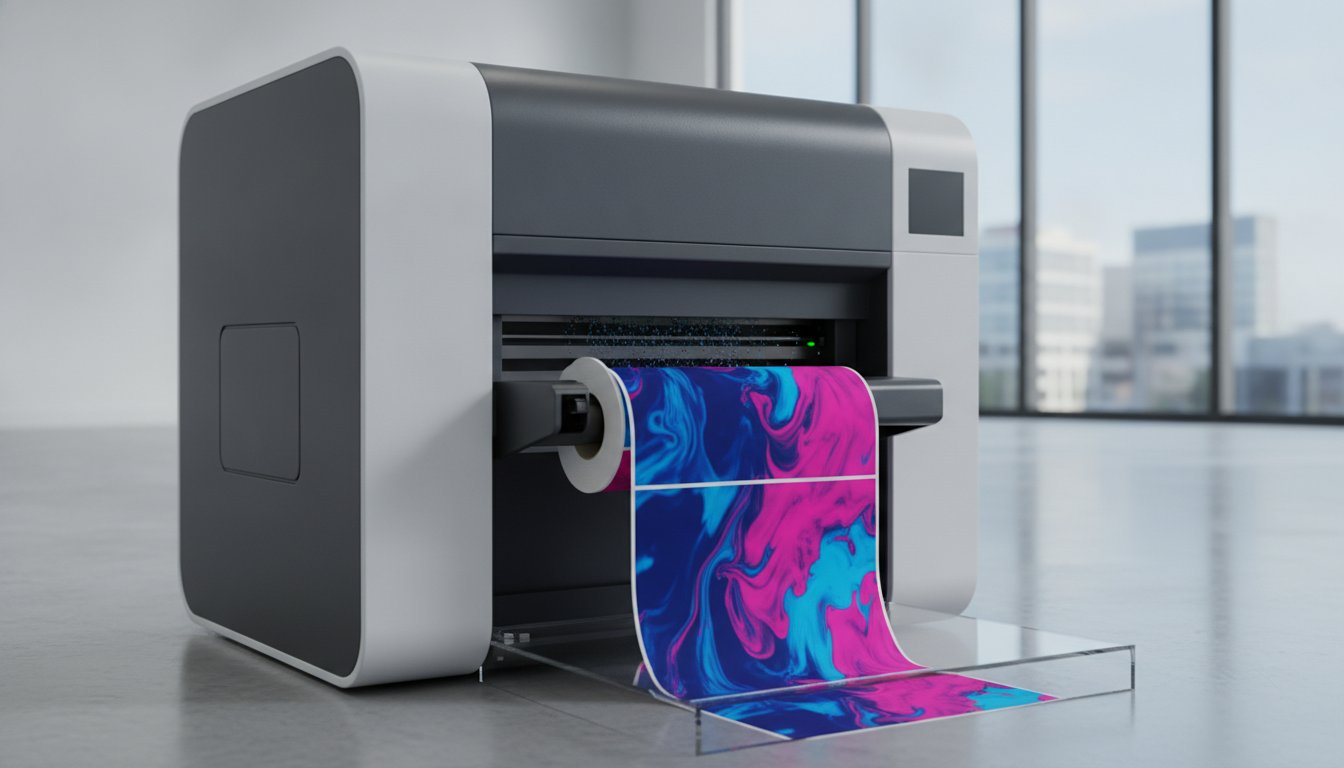
How much is a ten-day wait for a shipment of labels actually costing your production line this year? Many Canadian businesses feel trapped between high minimum order quantities and the risk of inventory becoming obsolete overnight. Deciding between in-house label printing vs outsourcing often comes down to how much waste your budget can absorb. With the latest Health Canada front-of-package nutrition symbols and updated WHMIS standards now mandatory, a single regulatory shift can turn thousands of dollars of pre-printed labels into waste.
We understand that you need a labelling strategy that balances technical precision with fiscal responsibility. Use this guide to determine which path optimizes your supply chain and protects your margins. You'll discover how to calculate the total cost of ownership, gain same-day turnaround capabilities, and maintain better control over your branding. Examine the strategic advantages of bringing production in-house with professional hardware from Afinia or Epson, and ensure your business remains agile in a demanding market.
Key Takeaways
- Understand why traditional outsourcing models struggle to keep pace with 2026 supply chain demands and shifting Canadian regulatory requirements.
- Evaluate the true financial impact of in-house label printing vs outsourcing by calculating total cost of ownership (TCO) rather than just the price-per-label.
- Achieve same-day turnaround and eliminate inventory waste by producing labels on-demand for every SKU in your catalogue.
- Identify your specific tipping point for transitioning production by auditing label variety, shipping fees, and lead-time delays.
- Select professional Afinia or Epson hardware to ensure consistent brand colour and high-quality finishes across your entire product range.
The Shift to In-House Label Production in 2026
In-house label printing involves using professional digital equipment to produce high-quality labels directly at your facility on an as-needed basis. As Canadian businesses face tighter margins and faster market cycles in 2026, the debate between in-house label printing vs outsourcing has shifted from a matter of convenience to a core strategic decision. Traditional commercial print houses often struggle to match the agility required by modern supply chains, where product iterations and regulatory updates happen in real-time. Digital inkjet technology has matured, making professional results accessible to businesses of all sizes without the need for massive capital outlays.
The on-demand model replaces the practice of ordering thousands of identical labels in advance with the ability to print the exact quantity required for each production run.
The Problem with Traditional Outsourcing
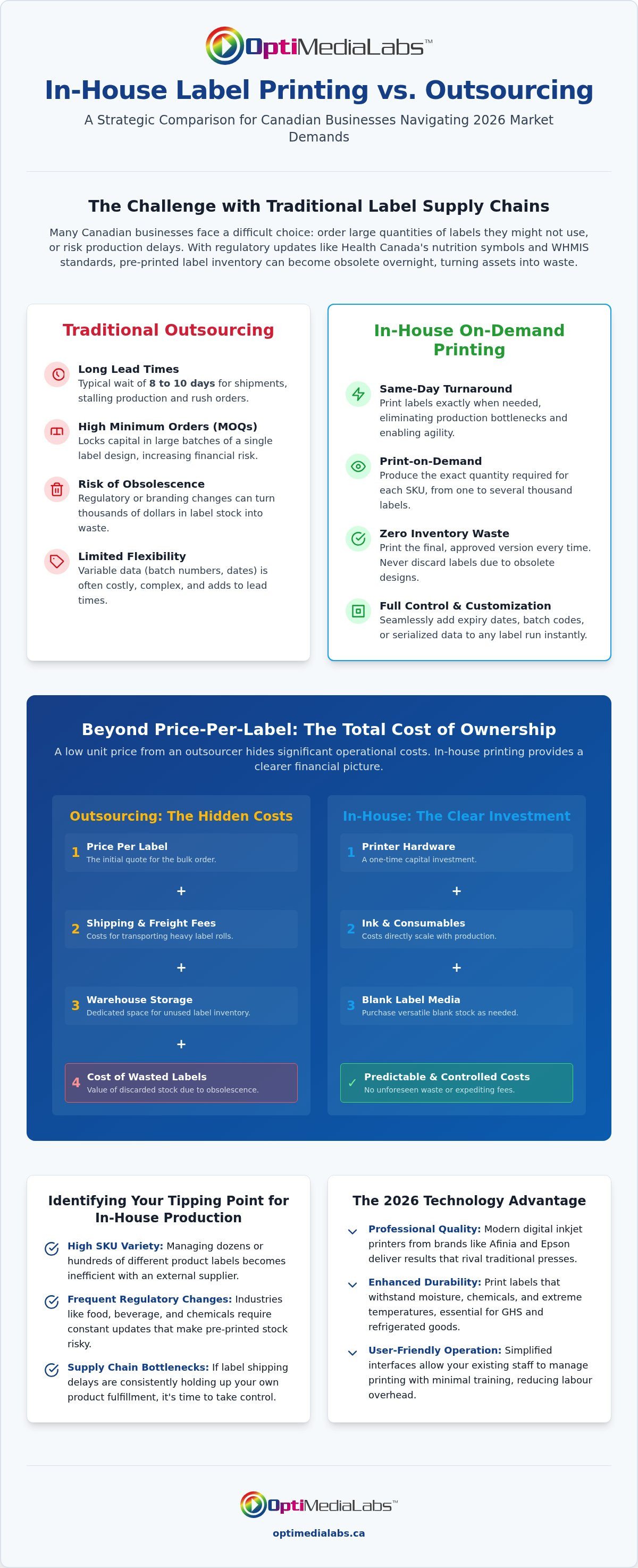
When evaluating in-house label printing vs outsourcing, the hidden costs of high Minimum Order Quantities (MOQs) become clear. Outsourcing typically requires these large orders to achieve a reasonable price-per-unit, which ties up significant capital in physical inventory. If Health Canada updates front-of-package labelling requirements or a marketing team decides to pivot a brand's colour palette, existing stock becomes expensive waste. This inventory risk is a primary driver for companies moving production inside their own walls.
Lead times present another significant hurdle. Many Canadian businesses report waiting eight to ten days for external shipments to arrive. These delays can stall product launches or prevent a company from fulfilling a rush order for a major retailer. Additionally, outsourcing offers limited control over variable data. Printing unique batch numbers, expiry dates, or serialized barcodes in-house is seamless, whereas commercial printers often charge premiums for these modifications and require longer processing times.
Technological Advancements in 2026
Modern label printing hardware has evolved to become more efficient and user-friendly than ever before. Digital inkjet technology now provides professional-grade results that rival traditional flexographic presses. For instance, the latest Afinia Color Label Printers offer significantly increased print speeds and lower ink costs, making them viable for medium-to-large batch runs. These units allow you to maintain high throughput without sacrificing the crisp detail required for small text and intricate logos.
Durability has also improved. Modern inkjet labels can now withstand harsh environments, including moisture, chemicals, and extreme temperatures. This is vital for GHS-compliant chemical labelling and food products requiring refrigeration. Simplified user interfaces mean that your existing warehouse staff can manage the equipment with minimal training. You don't need specialized technicians to operate the machinery, which reduces labour overhead and integrates the printing process directly into your existing production workflow.
Comparative Cost Analysis: TCO vs. Price Per Label
The "price per label" quoted by commercial printers is often a misleading metric. It ignores the capital tied up in inventory and the inevitable waste from obsolete stock. To understand the true financial difference between in-house label printing vs outsourcing, businesses must evaluate the Total Cost of Ownership (TCO). This comprehensive calculation includes not just the raw materials, but the logistical overhead, storage requirements, and the cost of missed market opportunities caused by external delays.
Hidden Costs of Outsourcing
Outsourcing carries several "invisible" taxes that rarely appear on the initial quote. Shipping fees for heavy rolls of labels add up quickly. This is particularly true when expedited delivery is required to meet a sudden production deadline. If you rely on international suppliers, customs delays can halt your operations entirely, causing a ripple effect through your supply chain. You also need dedicated, climate-controlled warehouse space to store thousands of pre-printed labels that might not be used for months.
The most significant financial risk is label obsolescence. A single regulatory change, such as the 2026 Health Canada front-of-package nutrition requirements, can instantly turn thousands of dollars of pre-printed labels into trash. When you are forced to discard 50,000 labels because a single ingredient or a government symbol changed, the "low unit cost" of that bulk order vanishes. You are left paying for paper that will never touch a product.
The In-House Investment Breakdown
Switching to an on-demand model requires an initial investment in hardware, but this cost is amortized over the life of the printer. Once the equipment is in place, your primary expenses become predictable consumables like blank media and Epson ink cartridges. This shift transforms a variable, unpredictable service fee into a stable, manageable operational expense. You gain the ability to accurately forecast your costs per production run without worrying about external price hikes or surcharge fees.
Modern systems improve labour efficiency through advanced automation. Professional software allows your team to manage complex variable data, such as batch numbers and expiry dates, without manual entry errors. You print exactly what you need for the day's production run; no more, no less. This eliminates dead stock and ensures your cash flow remains liquid rather than sitting on a shelf. If you are unsure which hardware fits your specific volume requirements, you can request a cost-per-label analysis to see the potential savings for your specific SKUs.
Beyond the Invoice: Flexibility, Speed, and Quality Control
While the financial breakdown is vital, the operational advantages often provide the highest return on investment. In the debate of in-house label printing vs outsourcing, speed is the ultimate differentiator. Canadian businesses can react to market trends or competitor moves in hours rather than waiting weeks for a commercial print run. You maintain total control over brand colour consistency across every product line. This ensures your boutique Canadian brand looks premium on every shelf, regardless of whether you're printing a batch of 50 or 5,000. You no longer have to settle for "close enough" when it comes to your brand identity.
Variable Data and Customization
Modern production demands high levels of personalization. You can print unique QR codes, serial numbers, and batch data on the fly without paying a premium for each variation. This allows for hyper-local marketing or seasonal promotions that would be cost-prohibitive when outsourcing. Integrating your printer with internal databases ensures data integrity and eliminates manual entry errors. Utilizing professional barcode labeling software Canada professionals trust, like BarTender or NiceLabel, simplifies this process. You can update a single field in your database and see it reflected on your labels instantly. This level of customization helps small Canadian manufacturers compete with larger entities by offering retail-ready packaging for niche markets without the burden of massive inventory.
Compliance and Security
Regulatory agility is no longer optional. Following the December 2025 WHMIS deadline and the January 2026 Health Canada nutrition labelling mandate, the ability to pivot is essential. With in-house equipment, you ensure GHS compliance for chemical products without waiting for external proofs. This is vital for hazardous materials where labelling errors carry significant legal risks. Keeping sensitive product data internal protects your intellectual property. You don't need to share proprietary ingredient lists or upcoming product details with third-party vendors. Modern inkjet printers maintain the high-resolution standards required for fine-print ingredient lists and mandatory bilingual text. This ensures every label meets Canadian legal standards for legibility and durability, even on small containers. You control the proofing process, which eliminates the back-and-forth delays that often plague outsourced projects.
Strategic Roadmap: Identifying Your Tipping Point
Deciding between in-house label printing vs outsourcing requires a clear audit of your current production bottlenecks. It isn't just a matter of volume. You must account for the total logistical footprint of your labelling process. Start by calculating your annual spend on shipping, rush fees, and the cost of labels discarded due to branding updates. A business printing 10,000 labels across 50 different SKUs faces a much higher "complexity tax" when outsourcing than a company printing the same volume for a single product. Analyze your space and power needs as well; modern industrial printers are compact, but they require a stable environment and dedicated workspace to ensure consistent output.
Step 1: The Volume and Variety Audit
Identify your "high-pain" SKUs. These are the products frequently delayed because you're waiting for a specific label shipment. If you regularly experience lost sales or retailer penalties due to labelling bottlenecks, the tipping point has already arrived. The "sweet spot" for transitioning often falls between 5,000 and 50,000 labels per month. Within this range, the savings on unit costs and the elimination of MOQs typically provide a rapid return on investment. You'll realize that the cost of a missed production day often exceeds the monthly lease or purchase payment of a professional printer.
Consider the required durability of your finish. Do you need matte, gloss, or chemical-resistant materials? Determining these specifications early helps you narrow down the hardware requirements. If your product line involves various shapes and sizes, you'll need to account for finishing equipment as well. This allows you to maintain professional standards without relying on a supplier's limited stock of die-cut sizes.
Step 2: Selecting the Right Technology
Choosing between inkjet and thermal technology depends on your colour requirements and environment. High-resolution colour is essential for retail packaging, while thermal transfer is often preferred for simple shipping or warehouse tracking. If you produce unique shapes or want to eliminate the cost of custom dies, consider integrating Afinia Label Cutters & Finishers into your workflow. This allows you to cut any shape on-demand, providing total design freedom without the wait for external tooling.
Software compatibility is the final piece of the roadmap. Ensure your chosen hardware integrates seamlessly with your existing ERP or warehouse management systems. This connectivity allows for automated data flow and reduces the risk of manual errors. If you're ready to map out your transition, you can book a strategic consultation to audit your current labelling costs and identify the most efficient hardware path for your business.
Optimizing Your Production with Professional Hardware
The final stage in the transition of in-house label printing vs outsourcing is selecting the hardware that will anchor your production line. Success depends on more than just the printer itself; it requires a partnership with a specialized distributor like OptiMediaLabs Canada. As hardware experts, we provide the technical guidance and long-term support necessary to ensure your equipment remains a reliable asset rather than a maintenance burden. We focus on integrating Afinia and Epson systems into your specific workflow to maximize throughput and minimize downtime. This specialized approach ensures that your team can focus on production rather than troubleshooting technical specifications.
Reliability also depends on the quality of your supplies. Using brand-specific label printer consumables Canada professionals trust is the only way to guarantee equipment longevity. Third-party inks or uncertified media can lead to inconsistent colour reproduction and premature printhead failure. By sticking to genuine consumables provided by OptiMediaLabs Canada, you protect your investment and ensure that every batch of labels meets your brand's quality standards. This consistency is vital when you are managing a diverse range of SKUs across different product categories.
The Afinia Advantage for High-Volume Colour
For industrial-speed production, the Afinia L801 and L901 series provide a significant competitive edge. These printers utilize Memjet technology to achieve high-resolution results at speeds up to 60 feet per minute. This technology is specifically designed to reduce the cost-per-print by delivering precise ink droplets that minimize waste. You can produce professional "prime" labels with vibrant colours and sharp detail directly in your warehouse. This allows you to maintain the high-end look of boutique packaging while benefiting from the speed and flexibility of an on-demand model. As your volume grows, these systems scale effectively to handle increased demand without requiring a complete overhaul of your production line.
Epson Solutions for Durability and Precision
When your application demands extreme durability, the Epson ColorWorks series is the recognized standard. These units are engineered for precision, particularly for GHS and chemical labelling where resistance to moisture and solvents is mandatory. You can manage operational expenses effectively using high-capacity Epson ink cartridges, which are designed for long production runs and consistent output. Epson's PrecisionCore technology ensures that your brand colours remain identical across multiple national locations. This level of consistency is essential for Canadian businesses that need to maintain a unified brand image across different provinces while meeting strict regulatory requirements for legibility and label adhesion.
Future-Proof Your Labelling Strategy
The landscape of 2026 demands absolute agility. By bringing production in-house, you eliminate the logistical bottlenecks of commercial suppliers and the financial drain of obsolete inventory. You've seen how the right technology allows you to respond to Health Canada mandates and WHMIS updates in hours rather than weeks. The decision between in-house label printing vs outsourcing ultimately depends on how much control you want over your production timeline and brand quality. Transitioning to an on-demand model ensures your cash flow isn't tied up in warehouse shelves filled with unusable stock.
As an authorized Canadian distributor for top global brands like Afinia and Epson, OptiMediaLabs Canada provides more than just hardware. We offer expert technical guidance on software integration and provide national shipping on all inks and blank label media to keep your lines running. Explore our range of Afinia and Epson label printers to start saving today. Take the next step toward a more efficient, cost-effective supply chain. We're ready to help you organize a more resilient production model that grows with your business.
Frequently Asked Questions
How much can I save by printing labels in-house vs. outsourcing?
Savings vary based on your specific SKU variety and waste levels. Most businesses realize a rapid return on investment by eliminating the hidden taxes of outsourcing, such as expedited shipping and minimum order quantities. When comparing in-house label printing vs outsourcing, the greatest savings often come from preventing label obsolescence. Printing on-demand ensures you never discard thousands of labels because of a single ingredient change or a new Health Canada nutrition symbol mandate.
Is it difficult to learn how to operate a professional label printer?
Operating professional equipment is straightforward for most warehouse teams. Modern hardware features simplified user interfaces that guide users through setup and maintenance tasks. You don't need specialized technicians to manage daily production runs. Most systems integrate directly with standard design software, allowing your existing staff to trigger print jobs with minimal training. This accessibility ensures your production line remains agile without adding significant labour overhead or requiring extensive technical expertise.
What is the minimum volume required to justify buying a label printer?
The tipping point typically occurs when a business reaches a monthly volume between 5,000 and 50,000 labels. However, high SKU variety often justifies the investment at even lower volumes. If you frequently order small batches of different designs, the setup fees and shipping costs of outsourcing quickly exceed the cost of owning a printer. Auditing your current spend on discarded stock and rush orders will help identify your specific break-even point for the switch.
Can in-house printers achieve the same quality as commercial print shops?
Current digital inkjet technology provides professional results that rival traditional flexographic printing. Systems from Afinia and Epson produce high-resolution prime labels with vibrant colours and crisp, legible text. These units maintain brand consistency across large production runs, ensuring your packaging looks premium on retail shelves. You gain the same quality standards as a commercial shop while enjoying the flexibility to update your designs instantly without waiting for external proofs or samples.
Do I need special software to print labels in-house in Canada?
Utilizing professional barcode software like BarTender or NiceLabel is essential for maintaining data integrity. These programs ensure your labels meet GS1 standards and Canadian regulatory requirements for food and chemical products. While basic drivers allow for simple printing, professional software automates variable data like batch numbers and expiry dates. This connectivity reduces manual entry errors and allows your hardware to communicate directly with your existing ERP or warehouse management systems for a seamless workflow.
How do I handle different label shapes without buying custom dies?
You can produce any shape on-demand by integrating a digital label cutter into your production line. Systems like Afinia Label Cutters & Finishers use digital blades to cut complex designs without the need for expensive physical dies. This technology provides total design freedom and eliminates the lead times associated with ordering custom tooling. It is the most cost-effective way to handle seasonal promotions or boutique product shapes without maintaining a large inventory of different sizes.
What maintenance is required for industrial colour label printers?
Maintenance primarily involves routine cleaning and periodic printhead checks to ensure optimal output. Modern industrial systems are designed for reliability and include automated maintenance cycles that keep the equipment ready for use. Using genuine consumables, such as Afinia or Epson ink cartridges, is the most important factor in preventing clogs and hardware failure. Following the manufacturer's recommended cleaning schedule ensures consistent print quality and extends the overall life of your professional labelling hardware.
Can I print GHS-compliant chemical labels on an in-house inkjet printer?
You can produce fully compliant GHS labels in-house using pigment-based inkjet systems like the Epson ColorWorks series. These printers are specifically engineered to produce durable labels that meet BS5609 standards for chemical and saltwater resistance. This capability is vital for Canadian manufacturers who must meet strict WHMIS requirements. Printing these labels on-site allows you to update Safety Data Sheets and warning symbols immediately, ensuring your facility remains compliant with the latest hazardous materials regulations.