
Industrial Printing Supplies Canada: The 2026 Procurement Guide
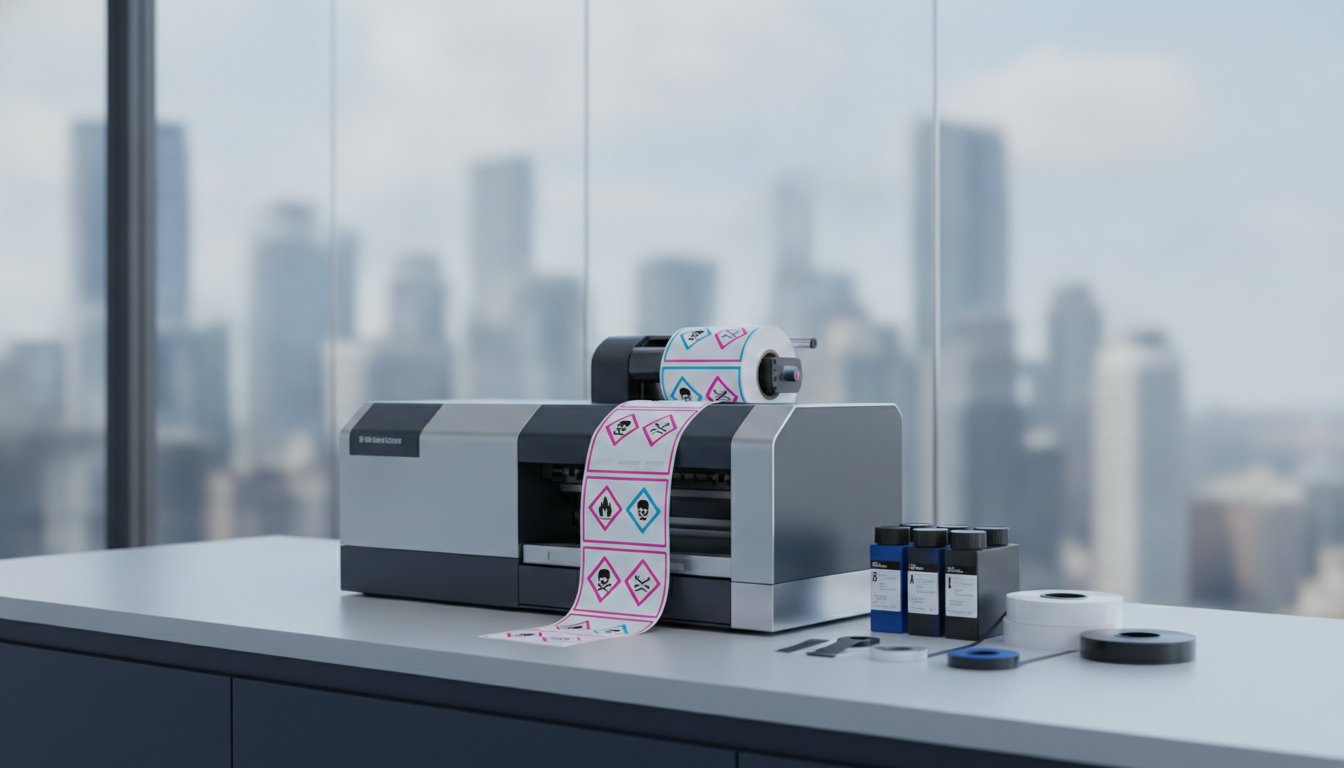
What if your current label stock fails a WHMIS audit or your supply chain halts due to the August 2026 trade tariffs? For many facility managers, securing reliable industrial printing supplies Canada is no longer just about finding the lowest price. It's about ensuring every ribbon and ink cartridge meets the 7th and 8th revised editions of the GHS standards that are now fully mandatory. You've likely felt the frustration of production downtime when a shipment is delayed or labels fail in moisture-heavy or cold storage environments.
We understand that reliability and technical precision are your top priorities for a stable workflow. This guide helps you master your production cycle by identifying the exact hardware and high-performance consumables needed for frictionless operations. You'll learn how to reduce your cost-per-label through in-house efficiency with Afinia or Epson systems while ensuring your chemical labelling remains fully compliant. We'll preview the best strategies for national procurement and verified shipping across Canada to keep your facility running without interruption.
Key Takeaways
- Learn how transitioning from traditional outsourcing to in-house digital colour labelling can significantly reduce lead times and production costs.
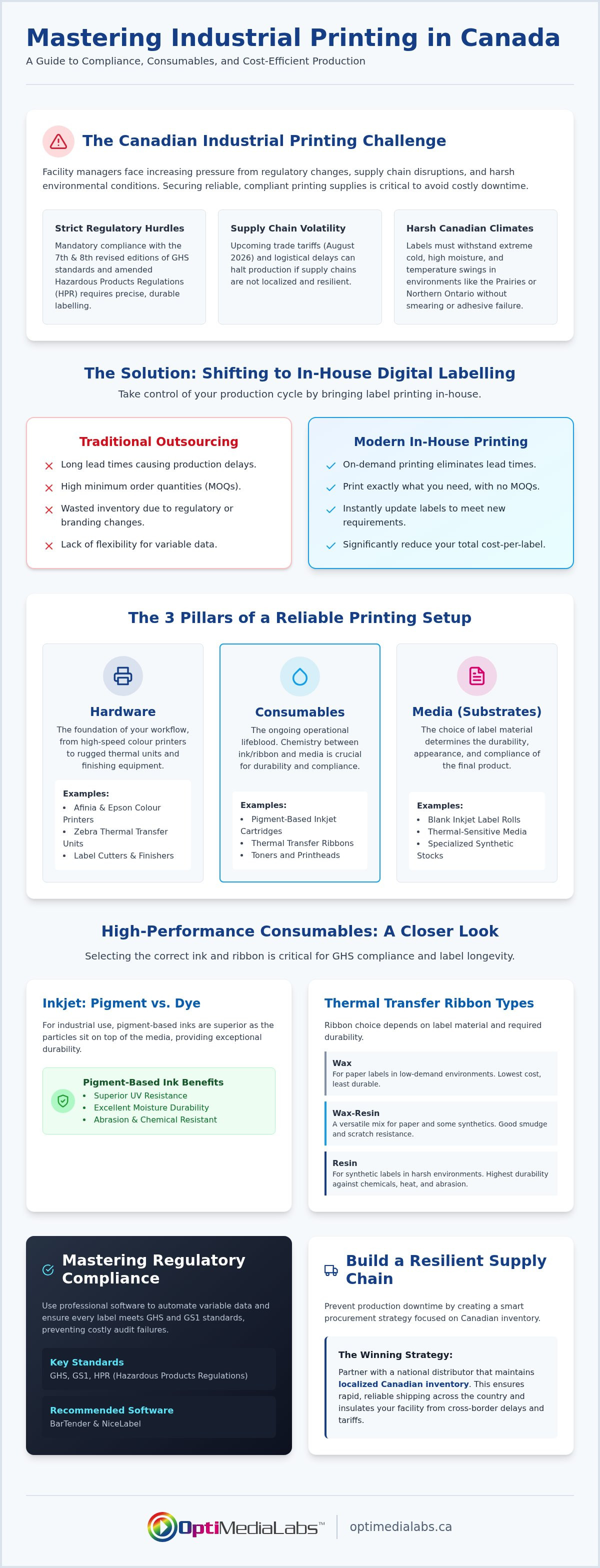
- Identify the technical specifications required for industrial printing supplies Canada, including the critical performance differences between wax, resin, and wax-resin thermal transfer ribbons.
- Compare the total cost of ownership for inkjet and thermal transfer technologies to determine the most efficient hardware for your specific print volume and environment.
- Master regulatory compliance by using professional software like BarTender or NiceLabel to automate variable data for GHS and GS1 standards.
- Build a resilient procurement strategy by partnering with a national distributor that maintains localized Canadian inventory to prevent downtime.
Understanding the Landscape of Industrial Printing Supplies in Canada
The term industrial printing supplies Canada refers to a comprehensive ecosystem that integrates hardware, media, and specialized software. It is no longer sufficient to view a printer as an isolated tool. Instead, modern production managers now manage a sophisticated "roll-to-final-cut" workflow where every component must be perfectly synchronized. While a general overview of printing technologies might cover legacy methods like screen or pad printing, the 2026 market focuses on digital agility and immediate output.
Canadian manufacturers face unique challenges, particularly regarding variable climates and rigorous regulatory standards. Labels used in the Prairies or Northern Ontario must survive extreme cold storage and high-moisture environments without adhesive failure or ink smearing. This requires specialized media that can withstand temperature swings while maintaining the clarity required for GHS compliance. Finishing equipment, such as Afinia label cutters and finishers, completes this landscape. It allows businesses to move from a raw roll of media to a finished, precision-cut product in one continuous motion, reducing the need for secondary processing steps.
The Core Components of an Industrial Printing Setup
A reliable setup consists of three primary pillars. Hardware remains the foundation, ranging from high-speed Afinia Color Label Printers to rugged Zebra thermal units. Consumables represent the ongoing operational requirements, including brand-specific inks, toners, and thermal transfer ribbons designed for specific printhead technologies. Finally, the choice of substrates, such as blank inkjet labels or thermal-sensitive media, determines the durability and visual impact of the final output. Every piece of the puzzle must work in tandem to prevent production bottlenecks.
Why In-House Labelling is Dominating the 2026 Market
The shift from traditional outsourcing to in-house digital colour labelling is driven by a need for total production control. By printing on-demand, Canadian facilities eliminate the long lead times and high minimum order quantities (MOQs) typical of external print houses. This agility prevents production downtime caused by supply chain delays or sudden regulatory shifts. Implementing In-House Label Printing allows teams to update variable data instantly. It ensures that every batch reflects the latest compliance or branding requirements without wasting pre-printed stock. This transition isn't just about cost; it's about building a resilient, self-sufficient supply chain that responds to market demands in real time.
High-Performance Consumables: Ink, Ribbons, and Media
High-quality output depends entirely on the chemistry between the printer and its consumables. For businesses managing Canadian commercial printing industry analysis data, it's clear that the shift toward on-demand digital labelling requires a deeper understanding of ink and ribbon specifications. Procuring the right industrial printing supplies Canada ensures that labels don't just look professional but also survive the rigours of the supply chain.
Compliance is a critical driver for consumable selection. As of August 2026, all hazardous products in Canadian workplaces must feature labels that comply with the amended Hazardous Products Regulations (HPR). This means your media and ink must be tested as a unified system to ensure readability after exposure to chemicals or abrasion. If you're unsure about your current media compatibility, you can speak with our technical team for a compatibility audit.
Inkjet Consumables: Maximizing Colour Accuracy
Digital colour printers from Epson and Afinia rely on pigment-based inks for industrial applications. Unlike dye-based alternatives, pigment particles sit on top of the substrate. This provides superior UV resistance and moisture durability. Using genuine Afinia ink cartridges or Epson supplies protects the precision-engineered printheads from clogging or premature wear. Matching your media to the ink type is essential; for instance, matte-finished synthetic labels often require specific pigment formulations to achieve GHS-level durability.
Thermal Transfer Ribbons for High-Volume Logistics
Thermal printing remains the benchmark for high-speed logistics and barcode tracking. The choice of ribbon formulation directly dictates the label's functional lifespan. Zebra ribbons and other high-performance options are categorized by their resin content:
- Wax Ribbons: These are the most economical choice for paper shipping labels. They offer high contrast but low resistance to smudging.
- Wax-Resin Ribbons: These provide a durable middle ground. They're ideal for synthetic labels used in warehouse racking or cold storage.
- Resin Ribbons: This is the gold standard for chemical resistance. They're required for labels exposed to solvents, heat, or heavy abrasion.
Advanced systems often utilize near-edge ribbon technology. This allows for faster throughput on high-speed Zebra or Toshiba systems without losing the sharp edge definition required for high-density barcodes. Selecting the wrong ribbon for these units can lead to poor transfer quality and increased printhead maintenance.
Choosing Between Inkjet and Thermal Transfer Technology
Selecting the right hardware is the most significant factor in managing the total cost of ownership (TCO) for your production line. In the Canadian market, TCO isn't just the initial purchase price; it includes the ongoing cost of ink, ribbons, and the specialized media required for local environmental conditions. Organizations like the Canadian Printing Industries Association (CPIA) help businesses understand these operational overheads, but the technical choice often comes down to the specific needs of your industry sector. While inkjet provides vibrant colour, thermal transfer remains the standard for high-durability tracking.
Durability requirements often dictate the procurement of industrial printing supplies Canada. Pigment-based inkjet labels offer excellent moisture resistance, yet they may struggle with heavy solvent exposure. Conversely, resin-based thermal transfer labels are nearly indestructible in chemical environments. Use this selection matrix to guide your technology investment:
- Food & Beverage: Inkjet is preferred for prime branding and moisture-resistant refrigerated storage labels.
- Logistics & Warehousing: Thermal transfer is the gold standard for high-speed barcode generation and shipping.
- Pharmaceuticals: Both technologies are used, but inkjet is increasingly popular for high-resolution colour coding and variable data compliance.
- Chemical Manufacturing: Resin-based thermal transfer is essential for GHS labels that must survive harsh abrasion and chemical spills.
When to Choose Inkjet Colour Printers
Inkjet technology is the ideal solution for prime labelling where visual impact is paramount. Retail products, gourmet foods, and health supplements benefit from the 1200 dpi resolution provided by Afinia Color Label Printers. These systems allow for short-run variety without the waste of obsolete pre-printed stock. If you're specifically looking for cosmetic applications, see our sibling guide on the Best Label Printer for Cosmetics Canada. This flexibility ensures your brand remains agile as Canadian packaging regulations evolve.
The Case for Industrial Barcode Printers
For high-volume logistics and warehouse tracking, Industrial barcode printers offer unmatched speed and reliability. These units are designed for 24/7 operation, producing thousands of shipping labels per shift with minimal maintenance. Modern hardware now integrates RFID encoding capabilities, allowing you to print and program tracking tags simultaneously. This integration is vital for Canadian logistics hubs that require real-time inventory visibility across vast geographic distances. Thermal transfer remains the most cost-effective method for high-volume, black-and-white data printing where speed is the primary KPI.
Software and Compliance: Organizing Your Production Line
Software acts as the command centre for your hardware. It bridges the gap between raw industrial printing supplies Canada and a finished, compliant label. Managing variable data manually is a significant risk factor for production errors. By integrating professional software, you automate serial numbers, batch codes, and expiration dates directly from your database. This ensures every label matches the physical product and reduces the waste caused by typos or outdated information.
Integration is vital for a seamless workflow. Modern software suites are designed to communicate natively with hardware from Seiko, Toshiba, and Afinia. This allows for real-time status monitoring and precise control over print settings like heat levels and print speed. For organizations with multiple facilities across Canada, cloud-based solutions like Loftware provide centralized control. This ensures that a label design updated in a central office is instantly available for production across the country. It eliminates the risk of local facilities using outdated or non-compliant templates.
Leading Labelling Software Solutions
BarTender remains a top choice for its robust automation capabilities and extensive driver support. It's particularly effective for complex GS1 barcode requirements and high-volume thermal printing. Alternatively, NiceLabel software offers a highly intuitive interface that mimics familiar office applications. This reduces the training time for warehouse staff and empowers them to manage print jobs without constant IT intervention. Both options ensure your production line stays organized and maintains high throughput.
Achieving GHS and GS1 Compliance
Canadian manufacturing requires strict adherence to safety standards. As of August 2026, the transition period for amended Hazardous Products Regulations (HPR) has ended. All hazardous products must now feature safety data sheets and labels that align with the 7th and 8th revised editions of the GHS. This makes the selection of high-performance industrial printing supplies Canada even more critical. You must use chemical-resistant media and pigment-based inks that won't degrade or peel when exposed to harsh substances.
Using Afinia label cutters allows you to produce custom-shaped safety warnings that fit specific container dimensions. This precision is essential for maintaining visibility and compliance on smaller or uniquely shaped industrial packaging. For a deeper look at these requirements, consult our Industrial Labeling Solutions Canada Reference Guide. If you need help selecting the right software for your compliance needs, contact our experts for a consultation.
Procurement Strategy: Securing Your Supply Chain in Canada
A robust procurement strategy is the final piece of the production puzzle. In the 2026 market, where trade tariffs and supply chain shifts are constant, securing a reliable flow of industrial printing supplies Canada is a competitive necessity. Relying on cross-border shipments often leads to unpredictable delays and hidden brokerage fees. A localized procurement model ensures that your facility maintains a safety stock of ink and media. This prevents the high costs associated with an idle production line.
Efficiency increases when you consolidate your hardware and media procurement with a single-source provider. This approach ensures technical compatibility between your substrates and your ink or ribbons. When the same specialist who supplied your Afinia or Epson hardware also manages your media inventory, they can verify that the adhesives and topcoats are optimized for your specific printhead technology. This technical synergy reduces trial-and-error waste and stabilizes your cost-per-label.
Vetting a supplier requires looking beyond the price tag. A simple reseller might offer a low initial cost but lacks the expertise to troubleshoot a failing barcode or a GHS compliance issue. Look for a partner that provides technical support and understands the nuances of the Canadian regulatory environment. This ensures you receive more than just a shipment; you gain a technical resource that protects your operational uptime. Choosing a partner with specialized knowledge in industrial printing supplies Canada means you have support when scaling your production or updating your compliance labels.
National Distribution and Reliability
OptiMediaLabs Canada functions as a national hub, maintaining a deep inventory of consumables to ensure supply consistency across all provinces. As a Canadian-owned specialist, we prioritize the needs of local manufacturers who require immediate access to Epson and Afinia stock. This localized presence eliminates the uncertainty of international logistics and ensures your consumables arrive when needed. Contact our specialists for a procurement audit to optimize your current stock levels and secure your supply chain.
Setting Up a Preventive Maintenance Schedule
Long-term reliability depends on the quality of the consumables you run through your machines. Using genuine ink cartridges is the most effective way to reduce printhead replacement costs. Non-genuine inks often lack the precise viscosity required for high-speed industrial units, which leads to clogs and expensive repairs. Similarly, managing your finishing equipment is vital for a smooth workflow. Regularly cleaning and maintaining your Afinia label cutters & finishers ensures that blades remain sharp and tracking remains precise. A disciplined maintenance schedule, supported by a reliable supply of genuine parts, extends the life of your investment and keeps your production flow frictionless.
Future-Proofing Your Canadian Production Line
Efficient industrial labelling in 2026 requires more than just high-speed hardware. It demands a synchronized strategy that combines the right technology choice with rigorous compliance standards. While earlier sections explored the shift to in-house agility and the technical nuances of wax versus resin ribbons, your long-term success depends on the stability of your supply chain. Transitioning to a digital model eliminates external MOQs and lead times, but it requires a partner who can support the technical demands of a self-sufficient production floor.
Partnering with a specialized national distributor ensures you have access to a consistent inventory of industrial printing supplies Canada. As an authorized distributor for Afinia, Epson, and Zebra, OptiMediaLabs Canada provides the specialized media and technical expertise required for GHS and GS1 compliance. Our team offers expert technical support for every hardware unit we sell; this ensures your production line remains operational and efficient. Secure your workflow by consolidating your procurement with a partner that understands the unique technical requirements of the Canadian market.
Take the next step in optimizing your facility. Request a quote for your industrial printing supplies today and let us help you build a more resilient production environment.
Frequently Asked Questions
Where can I find GHS-compliant industrial printing supplies in Canada?
You can procure GHS-compliant media and chemical-resistant industrial printing supplies Canada directly from OptiMediaLabs Canada. We stock specialized synthetic materials and pigment inks that meet the current Hazardous Products Regulations (HPR) standards. These components are tested as a unified system to ensure safety labels remain legible after exposure to harsh solvents or abrasion. Using verified compliant materials is essential for passing workplace safety audits and maintaining international shipping standards.
Can I use third-party ink in my Afinia or Epson label printer?
It's strongly recommended to avoid third-party inks to prevent printhead damage and maintain your equipment warranty. Genuine Afinia and Epson ink cartridges are formulated with specific viscosity and drying properties that match your printer's thermal or piezo technology. Non-genuine inks often cause clogging or inconsistent colour saturation, leading to expensive repairs and production delays. Authentic consumables ensure the long-term reliability of your hardware and the durability of your final labels.
What is the difference between wax and resin thermal transfer ribbons?
Wax ribbons are the most economical choice for standard paper shipping labels where extreme durability isn't required. Resin ribbons contain higher concentrations of synthetic materials, making them nearly indestructible against chemicals, heat, and heavy friction. For mid-range applications like refrigerated storage or warehouse racking, wax-resin formulations provide a durable middle ground. Selecting the correct ribbon depends on your substrate and the environmental conditions your labels will face during transit.
How do I choose the right barcode labelling software for my warehouse?
Choose your software based on the complexity of your data integration and the technical skill of your staff. BarTender is ideal for facilities requiring deep database connectivity and advanced automation for GS1 barcodes. Alternatively, NiceLabel software offers a more intuitive, drag-and-drop interface that simplifies label design for warehouse teams. Both platforms integrate natively with major hardware brands, ensuring that your variable data remains accurate and compliant across your entire production line.
Are there specific label materials for high-moisture or cold-storage environments?
Yes, polypropylene (BOPP) and polyester labels are engineered with aggressive adhesives specifically for high-moisture and cold-storage applications. These synthetic substrates don't absorb water and won't peel or wrinkle when exposed to condensation or sub-zero temperatures. When paired with the correct pigment-based ink or resin ribbon, these labels remain securely attached and fully legible throughout the cold chain. This prevents the loss of critical tracking data in demanding industrial environments.
Does OptiMediaLabs Canada offer national shipping for industrial printers and supplies?
OptiMediaLabs Canada provides verified national shipping for all industrial printers and industrial printing supplies Canada across every province and territory. By maintaining local inventory centres, we eliminate the brokerage fees and unpredictable delays associated with international procurement. This ensures that manufacturers from British Columbia to Newfoundland receive their inks, ribbons, and hardware consistently. Our logistics network is designed to support high-volume facilities that cannot afford downtime due to supply shortages.
What is the most cost-effective way to print professional product labels in-house?
The most cost-effective strategy involves using high-capacity inkjet systems like Afinia or Epson to eliminate external minimum order quantities and plate charges. By printing on-demand, you only produce the exact number of labels required for each batch, which removes the cost of obsolete pre-printed stock. Managing your own production allows for instant design updates and better control over your consumable spend. This shift often results in a significantly lower total cost per label over time.
Do I need a label finisher if I am printing on pre-die-cut labels?
You don't need a label finisher if your production uses pre-die-cut labels that are already sized for your containers. Finishing equipment is only necessary when you print on continuous "bolt" rolls and need to laminate, slit, or cut custom shapes in-house. While pre-die-cut labels offer convenience for standard sizes, a finisher provides the ultimate flexibility for businesses with diverse product lines. It allows you to create any label dimension from a single roll of continuous media.