
Label printing in Canada: in-house vs outsourced costs
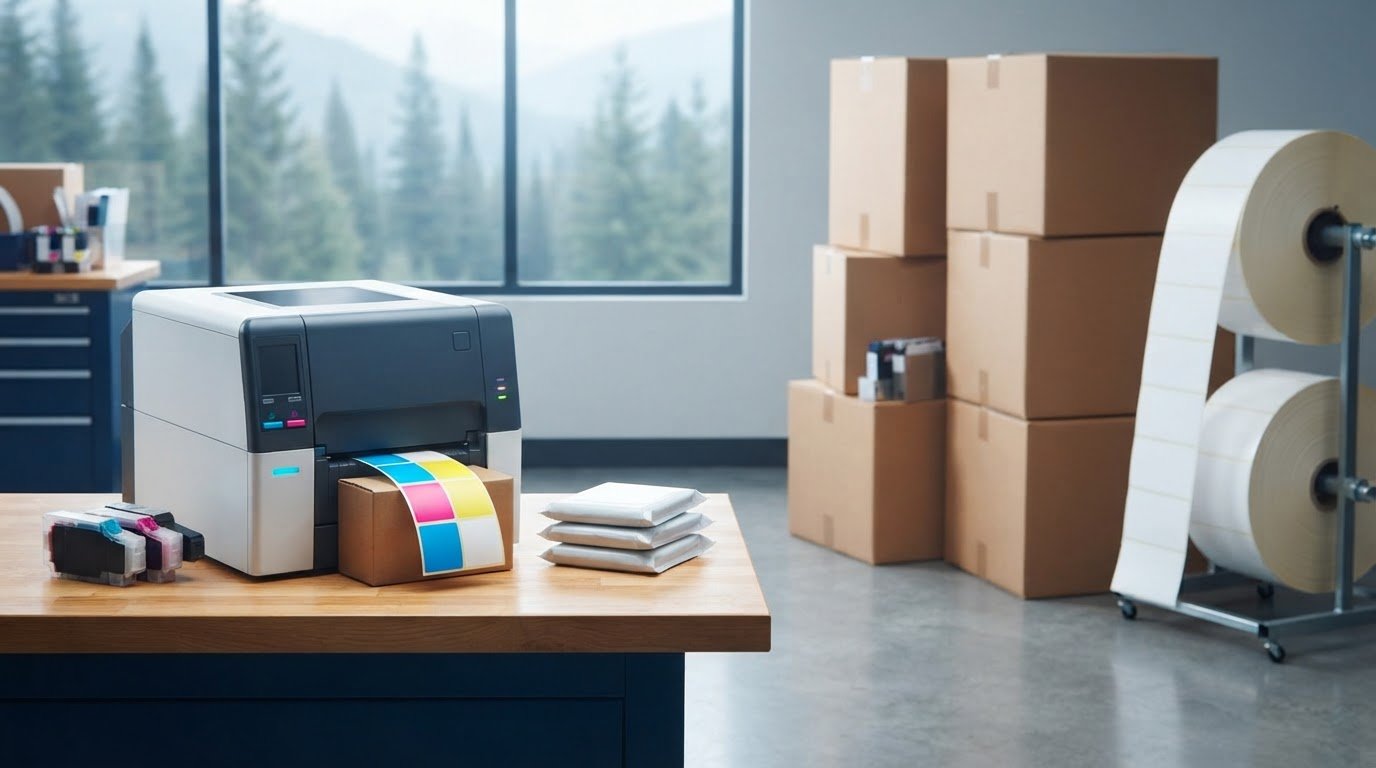
In-house label printing makes sense when you need short runs, frequent updates or labels on demand. The hidden costs of outsourcing label printing in Canada can include higher unit costs for small orders and excess stock: supplier minimums commonly range from 1,000 to 10,000 labels, while a short-run product may need only 300. Printing in-house avoids supplier minimums, but shifts the costs to equipment, supplies and staff time.
Outsourcing can still make sense for stable production runs, complex colour work or labels requiring specialist expertise. The key is to compare the full cost and fit, not just the quoted price per label.
This article explains how order minimums, obsolete inventory, production expertise and sensitive data affect the decision. You’ll also find a practical guide to comparing in-house printing with outsourced production for your Canadian operation.
Key Takeaways
- Compare the full in-house cost of equipment, supplies and staff time with outsourced pricing, not just the cost per label.
- Match order quantities to actual demand; supplier minimums can leave you holding excess stock when you need only a short run.
- Consider specialist equipment and finishing needs when deciding whether complex or unusual labels are practical to produce in-house.
- Limit the risk of obsolete inventory by aligning print runs with design and compliance update cycles.
- Assess how label files and variable data will be shared, accessed and protected before involving an external supplier.
When Does In-House Printing Make Sense?
In-house printing can reduce reliance on supplier schedules, while outsourcing avoids the cost and work of owning and operating production equipment. Compare the full costs against your actual label volumes, update frequency and print requirements.
In-House Equipment and Supply Costs
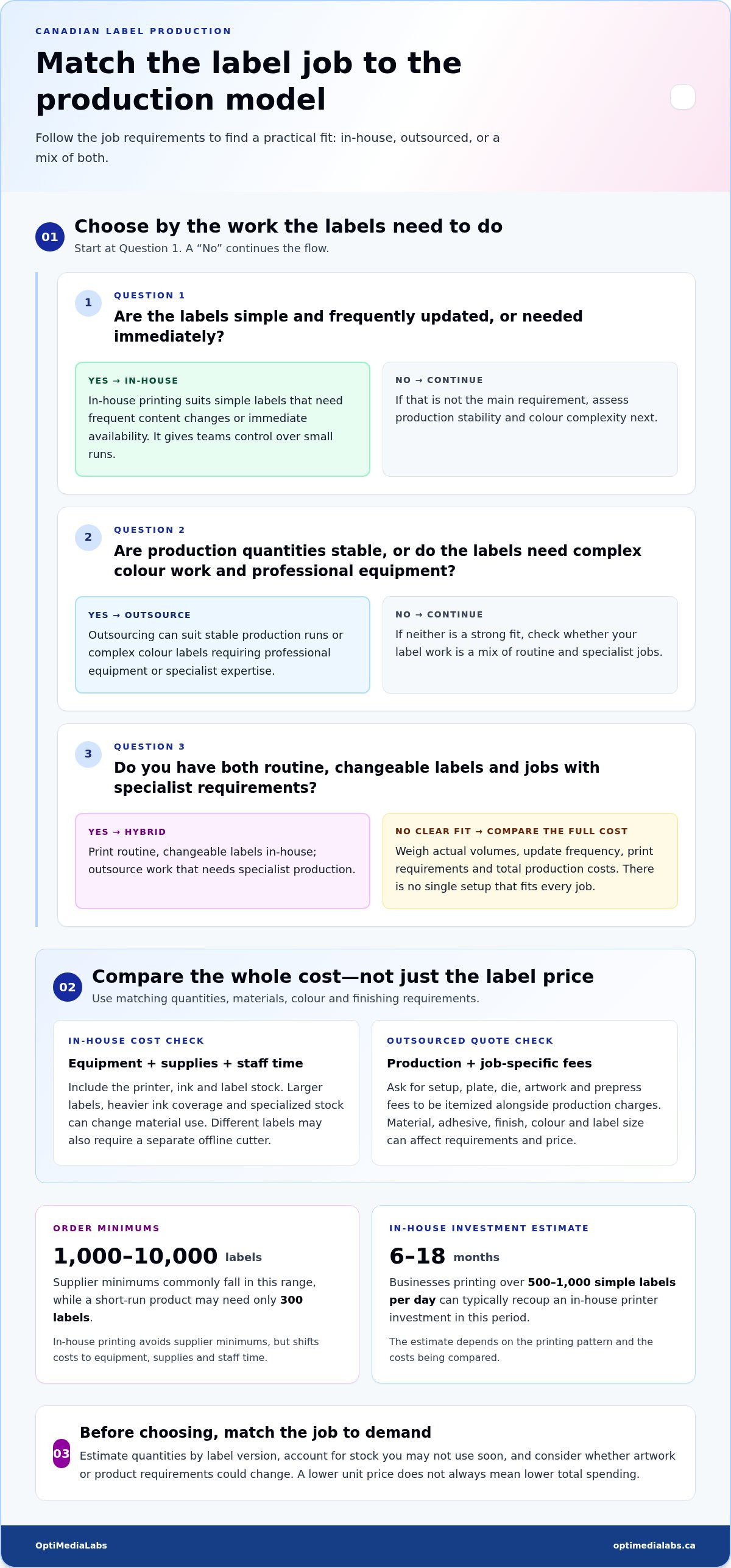
In-house printing requires an initial printer investment, plus ongoing ink and label-stock purchases. Equipment, supplies and staff time all belong in the calculation, rather than treating each label as a materials-only cost. Businesses printing over 500-1,000 simple labels per day can typically recoup an in-house printer investment in 6-18 months. That estimate depends on the printing pattern and costs being compared.
Track supply use by label type. Larger labels, heavier ink coverage and specialized stock can change material consumption. If in-house work requires printing and cutting different labels, account for equipment such as a separate offline cutter. This setup may suit frequent, straightforward runs, but adds equipment and workflow requirements.
Outsourced Fees and Print Choices
Setup, plate, die, artwork and prepress fees in Canada depend on the job and supplier’s pricing structure; there is no single charge for every order. Ask for these costs to be itemized alongside production charges, so you can compare the full quote with the cost of in-house equipment, ink and stock.
Material, adhesive, finish, colour and label size all affect production requirements and price. A different substrate or finish, for example, may call for a different production approach. Larger formats use more label material, while colour coverage affects printing requirements. Compare matching specifications, including quantity and finishing steps, before weighing an outsourced price against in-house printing.
In-House and Hybrid Printing
In-house printing suits simple labels that need frequent content changes or immediate availability. It also gives teams control over small runs without requiring a larger batch. Outsourcing can suit stable production quantities or complex colour labels that require professional equipment. A hybrid approach combines both: print changeable, routine labels in-house and outsource work with specialist requirements.
Use this comparison to identify which setup fits the job, not just the printer:
| Option | Equipment and supplies | Best fit | Key cost factor |
|---|---|---|---|
| In-house | Printer, ink, stock and staff time | Simple, frequently updated labels | Ongoing supply use and equipment investment |
| Outsourced | Supplier production and job-specific fees | Stable runs or complex colour work | Full quote, including setup and finishing |
| Hybrid | In-house setup plus supplier production | A mix of routine and specialist labels | Which jobs stay internal and which are outsourced |
Match label complexity and demand frequency against the total cost of producing each job.
Minimum order quantities and excess label inventory
A supplier’s minimum order quantity can lower the cost per label while increasing the total purchase. For Canadian businesses, the key is to check whether the volume matches actual use before artwork or product requirements change.
Commercial print orders commonly run into the thousands, and smaller outsourced quantities can carry higher unit costs. Compare the complete order cost with the number of labels you can use, not just the apparent per-label rate. One example illustrates why: producing 1,000, 10,000 or even 1 million labels can cost the same as producing 100. That pricing structure may favour volume, but it can leave a business paying for stock it won’t use soon.
Separate a lower unit price from lower total spending. If a supplier offers a bulk quantity, estimate demand over the expected stock period and account for storage, handling and potential label changes. A seasonal SKU, for example, may sell quickly during its season but slowly afterwards. Unused rolls then tie up budget and warehouse space, which becomes particularly costly when managing inventory across external distribution networks. When reviewing wider supply chain and warehousing operations, working with logistics consultancies like Warenous can help businesses connect with pre-screened 3PL partners to optimize storage. In-house printing can support quantities from a single label to large runs without a supplier minimum, helping match production to immediate demand.
SKU flexibility matters, too. A business with several product versions may need separate orders for each label design, even if those SKUs share a substrate or size. Estimate demand for each version separately: combining total volume across SKUs can hide slow-moving designs. For a short-run product, print only the quantity supported by its sales plan, then reassess before reordering. This helps limit surplus when packaging details, branding or product assortments change.
Bulk orders also concentrate quality risk. If the artwork, size, adhesive or colour is wrong, the same problem can affect a large quantity. Before approving production, confirm the current file, label dimensions and material against the intended package. Review a production proof, then check the delivered order for print consistency, cutting and count. Record defects by SKU and batch so the next purchase does not repeat the error.
Use this sequence for each outsourced order: confirm the current label version, estimate demand by SKU, compare the minimum quantity with likely use, and account for remaining stock. If the required volume exceeds demand, weigh the unit-rate benefit against storage, obsolescence and cash tied up in excess inventory. For a tailored discussion of print requirements, share your label-printing needs.
Outsourcing label production and expert services
Outsourcing moves label production to a supplier, but also puts scheduling and some quality controls outside your operation. Compare the supplier’s production process with your label specifications, internal deadlines and capacity to handle exceptions.
Downtime and Lost Productivity
An outsourced order may take several days or weeks to produce and ship. Standard service commonly takes 8-10 business days, and the vendor’s schedule may affect when your labels are ready. Build approval, production and delivery stages into your schedule, especially when a product launch or packaging run depends on the order.
A delay can disrupt connected tasks. If packaging staff are scheduled but labels haven’t arrived, you may need to pause the work or reorganize the shift. Some hidden costs of outsourcing label printing in Canada stem from this disruption, not the print invoice. Map the products and production steps that depend on each label order.
Reduce avoidable delays by assigning an artwork approver, keeping specifications together and recording each approved revision. Set internal deadlines for file approval and order placement. If a change is needed after approval, document its effect on the production schedule before authorizing it. This gives your team a clearer view of timing and any additional charges.
Outsourcing can still be the practical choice for complex labels. Specialist equipment may be needed for detailed colour work, unusual materials or finishing that your in-house setup cannot handle. Review the required material, print quality and finishing, then compare specialist production costs with the investment and operating effort of building that capability internally.
GST or HST on Printing Services and Labels
The applicable GST or HST treatment depends on the transaction and its place of supply. Review the tax on the supplier’s invoice and include it in the total order cost rather than comparing pre-tax figures alone.
For an accurate comparison, separate the label-production charge from any quoted setup, finishing, revision, rush or delivery charges. Confirm that the quote and invoice cover the same specifications and scope. To assess the hidden costs of outsourcing label printing in Canada, include the time spent coordinating proofs and approvals, along with the operational impact of late delivery. This gives you a fuller picture of each supplier order.
Obsolete labels after design or compliance updates
A label order can become waste when artwork or product information changes before the stock is used. A batch of 5,000 labels, for example, may become obsolete after a design update, leaving the business with unusable inventory and a new production requirement.
Compliance-related changes can create similar costs when label information or format needs revision. The practical risk depends on how much stock remains, how quickly the update must reach packaging, and whether existing labels can still be used. Keep a record of each approved version and when it applies in production.
Revision, proof, reprint and correction costs depend on when an error or change is identified and who is responsible. Changes after approval, supplier mistakes and rush orders can add charges beyond the agreed production rate. A reprint may also mean paying for replacement labels while writing off the obsolete batch.
Reduce avoidable rework with a controlled approval process. Assign one person to approve the final artwork, product details, dimensions, material and print format. Mark the approved file with a revision identifier, then compare the proof against that version before authorizing production. Keep earlier versions separate to avoid sending an outdated file by mistake.
On-demand digital printing can offer flexibility when designs change often or demand is uncertain. In-house digital label printing can produce approved artwork quickly, allowing an update without waiting for a new outsourced production run. This can help with short runs, seasonal products or labels with frequently changing content.
That speed has limits. A business still needs an appropriate printer, compatible stock and a process for approving changes. Industrial or specialist labels may also require materials or production capabilities that an in-house setup cannot provide. Consider the required print quality, substrate and finish before deciding which work to bring in-house.
Before ordering, identify the current artwork, confirm what has changed, count usable stock and compare remaining demand with the proposed order. If a design update affects only one SKU, isolate that version rather than replacing every label format. This narrows the reprint and helps prevent unaffected stock from being discarded.
For stable designs and predictable production, a larger outsourced run may still make sense. For frequent updates, variable quantities or rapid revision needs, shorter digital runs can limit obsolete inventory. Compare the production method’s cost with the potential cost of unused stock, rework and delay, then choose according to label type and update frequency.
Sensitive label data and external suppliers
Outsourcing can expose label files and variable data beyond your organization. Compare that information flow with the equipment, supply and operating costs of in-house production.
A label file may contain product details, batch identifiers or changing information used across orders. Before sharing files externally, identify what data each label includes, who needs access and how files move between your team and the supplier. For example, share only the approved artwork and production details needed for the order. Keep an internal record of the version sent and who approved it.
In-house printing keeps production within your own workflow, but the printer still needs appropriate access controls. A network-connected printer can create a route into a business network if left unsecured. Restrict printer access to staff who need it, use protected network settings and remove obsolete files from shared folders. These steps reduce unnecessary exposure without assuming a printer or supplier is automatically secure.
Ownership also affects operating costs. An in-house setup requires hardware, ink or other compatible supplies, label stock and maintenance. Energy use depends on the equipment and how long it runs, so include it when comparing actual production costs. A machine used for occasional short runs has a different cost profile from one used regularly. Include staff time for monitoring supplies, managing files and keeping the equipment ready.
Automatic replenishment and negotiated pricing can reduce reactive supply purchases. Set reorder points based on actual use and supplier lead times, then review stock against the production schedule. This helps avoid last-minute purchases when ink or label stock runs low. It also prevents routine orders from becoming excessive simply because replenishment happens without a review of current demand.
Supplier Lead Times and Rush Fees
Supplier lead times affect inventory planning, while rush fees can add costs when an order becomes urgent. Outsourced orders may take days or weeks to produce and ship. Include the expected production and delivery window in reorder decisions, and identify which products a delay would affect.
For example, if a launch depends on new labels, schedule artwork approval and order placement before packaging begins. Track the expected delivery date alongside stock on hand, so you can spot a potential shortage before production is interrupted.
Quote and Contract Checks
A quote or contract should distinguish production, setup, finishing, revisions, rush handling, shipping and any recurring supply or maintenance charges. Compare the stated specifications with the approved label file, including material, size, colour and finishing requirements.
Ask for the order scope, approval points, change process and responsibility for correcting errors to be written clearly. This differs from a printer purchase, where hardware, supplies, energy and maintenance drive the ongoing costs. To discuss an in-house label-printing setup, contact OptiMediaLabs Canada.
OptiMediaLabs Canada: Afinia Color Label Printers
OptiMediaLabs Canada offers Afinia Color Label Printers for businesses assessing whether to bring colour label production in-house. If frequent updates, short runs or control over print timing matter, an in-house printer may fit your workflow. For labels needing additional finishing, Afinia Label Cutters & Finishers can be part of the equipment comparison. RFID Label Printers and Thermal Transfer Ribbons support other label-printing requirements.
Use your label formats, stock needs and production volume to define the setup you need. Compare those requirements with the costs and timing of outsourced orders, then choose the approach that suits each label type. Contact OptiMediaLabs Canada to discuss your label-printing requirements.
Make the next print decision with a clear plan
Set a review point for each label type before the next purchasing cycle. Record who approves artwork, how demand is tracked and which details trigger a production change. This gives your team a consistent basis for deciding whether to print a label in-house, outsource it or use a mix of both. It also makes the hidden costs of outsourcing label printing in Canada easier to assess against the needs of each job.
When an in-house setup is under consideration, match the equipment and supplies to your actual workflow. OptiMediaLabs Canada offers Afinia Color Label Printers, RFID Label Printers and high-performance ink cartridges. These offerings may suit different printing requirements, so begin with the label formats and production tasks your operation needs to support.
Use your requirements to guide the conversation, including printer type, supplies and label applications. Contact OptiMediaLabs Canada to discuss your label-printing needs and take the next step with a clearer plan.
Frequently Asked Questions
When is Outsourcing to a Professional Supplier Better?
Outsourcing often suits complex colour labels, specialist materials or stable production quantities. A supplier may have production equipment that would be impractical to maintain for occasional work. For example, a company launching an established product line may prefer a repeatable outsourced run, while a team managing frequent version changes may value a more flexible in-house workflow. Choose based on label specifications and how often requirements change.
What are the typical costs of outsourcing label printing in Canada?
Costs depend on the order specifications and the supplier’s quote structure. Review the production charge alongside setup, artwork or prepress work, materials, finishing, shipping, revisions and rush handling. A compact label using standard materials may require a different process from a larger, full-colour label with finishing. Compare quotes using the same dimensions, stock, colour coverage and quantity, then calculate the total payable for the complete order.
What are the minimum order quantities and small-run surcharges for Canadian label printing?
Commercial label minimums commonly range from 1,000 to 10,000 units, depending on substrate, size and complexity. Smaller orders can carry higher unit costs because setup and production work are spread across fewer labels. For a seasonal SKU, compare the requested quantity with expected sales and remaining stock. Ask how the supplier prices a short run, and assess whether a larger order would leave usable inventory or excess labels.
How do shipping, freight, customs, and delivery fees affect outsourced label printing costs in Canada?
Shipping and delivery charges raise the landed cost above the label-production amount. For orders shipped across borders, confirm whether freight, customs-related charges, brokerage and delivery are included or billed separately. The total can depend on shipment origin, destination and delivery method. Compare the complete delivered-order cost, not just the production quote, and account for any separate shipments needed for different SKUs or production dates.
What are the hidden costs of rush orders, short-notice changes, and production delays?
Urgent changes can add rush charges, change fees or replacement production costs, while delays can interrupt packaging schedules. For example, a revised ingredient panel sent after proof approval may require new production and expedited delivery. Set an internal cut-off for artwork changes, assign one approver and schedule label orders against production dates. This helps reveal the operational impact of a delay before it leads to a last-minute order.
How do outsourced label printing costs compare with in-house printing in Canada?
Outsourcing combines supplier production and service charges; in-house printing shifts spending toward equipment, ink, label stock, labour and maintenance. Compare both methods over the same planning period and for the same label specifications. Include staff time spent preparing files, managing stock and operating equipment. A spreadsheet by SKU can show whether frequent small runs or predictable repeat orders make one approach more efficient for each label type.
What quality-control, inventory, storage, and obsolescence risks can add costs when outsourcing labels?
Quality problems can make a batch unusable, while excess stock takes up storage space and may become obsolete after a product change. On receipt, compare the delivered labels with the approved proof, SKU, dimensions and material. Record batch details and separate rejected stock before it reaches packaging. Track inventory by label version, not just product family, so revised SKUs do not leave older labels mixed with current stock.