
Primera AP362 Bottle Label Applicator Alternatives in Canada: 2026 Comparison
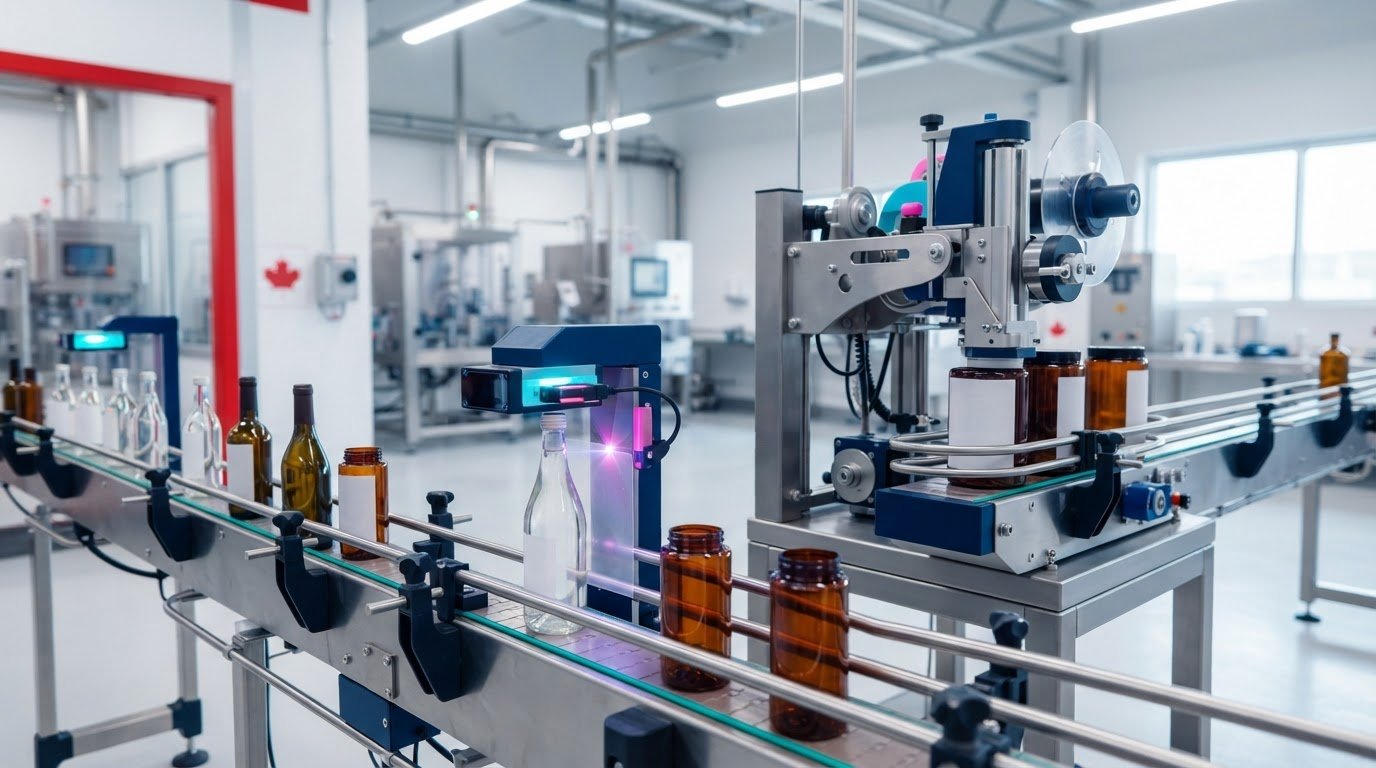
Why are you still letting a mechanical sensor pin dictate your production schedule? If you're struggling with labels sticking to the sensor or inconsistent placement on tapered bottles, you've likely outgrown your current setup. Many Canadian businesses find that while their previous semi-automatic setup served them well, it now creates bottlenecks during high-volume runs. Finding the right Primera AP362 bottle label applicator alternatives Canada offers is essential for maintaining a professional finish without wrinkles or bubbles.
We know that reliability in label application is driven by sensor technology, not just motor speed. You need equipment that handles thin BOPP films and clear-on-clear substrates without failure. This guide promises to help you discover the best industrial alternatives to standard desktop applicators to improve your labelling speed and reliability. We will examine the latest ultrasonic sensors, compare high-throughput labelling models, and identify which machines meet the strict CSA electrical standards required for Canadian facilities.
Key Takeaways
- Understand why mechanical sensor pins cause labelling bottlenecks and how transitioning to optical or ultrasonic sensors eliminates label sticking and jams.
- Compare the top Primera AP362 bottle label applicator alternatives Canada offers, specifically focusing on the Afinia Label lineup for increased reliability.
- Learn to select the appropriate hardware for complex container geometries, including tapered bottles, to achieve a professional finish without bubbles.
- Evaluate the long-term ROI of upgrading from entry-level plastic components to industrial-grade steel frames for high-volume production environments.
- Secure your production line by sourcing through a national Canadian distributor to ensure local access to consumables and technical hardware expertise.
Why Businesses Seek Primera AP362 Bottle Label Applicator Alternatives
The Primera AP362 has long been a staple for Canadian start-ups looking to move away from hand-applying labels. It offers a low entry cost and simple operation for cylindrical containers. However, as production volumes realize growth, the limitations of this entry-level hardware become clear. Many operators find that what worked for a hundred bottles a week fails to keep pace with a thousand bottles a day. This shift in demand drives the search for Primera AP362 bottle label applicator alternatives Canada businesses can rely on for consistent, high-speed output.
The Mechanical Sensor Hurdle
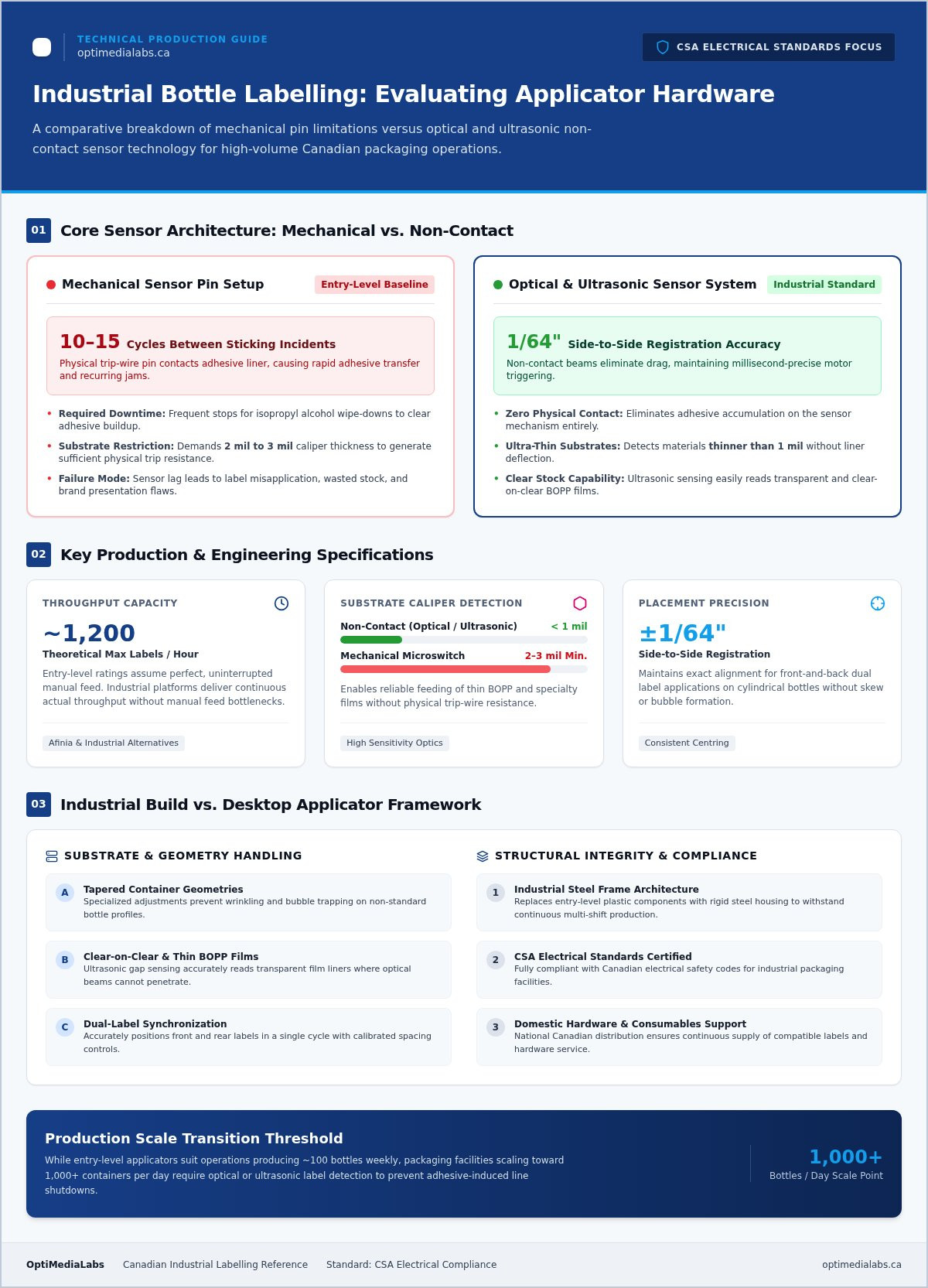
The primary technical limitation of the AP362 is its reliance on a physical sensor pin to detect label gaps. This mechanical arm must physically touch the label liner to function. Over time, adhesive transfers from the labels to the pin, creating a sticky surface. Some industry professionals report that this can lead to a label sticking to the pin as frequently as every 10 to 15 cycles. It's a frustrating bottleneck that stops production in its tracks.
This buildup doesn't just cause occasional jams; it leads to significant downtime. Operators must stop the line to clean the mechanical components with isopropyl alcohol. If the pin isn't perfectly clean, the sensor fails to trigger correctly. This results in misapplied labels and wasted material. For businesses using premium Primera labels or custom-branded stock, these errors represent a direct loss of profit and a hit to brand presentation.
Production Speed and Scalability
Speed is the next major bottleneck. The AP362 is rated for roughly 1200 labels per hour, but this is a theoretical maximum that assumes a perfect, uninterrupted manual feed. In a real-world Canadian packing room, the actual throughput is often much lower. As a business scales, the labour cost of having a staff member dedicated to a slow, manual-feed system becomes a heavy burden on the bottom line.
Moving toward semi-automatic or automatic Primera AP362 bottle label applicator alternatives Canada allows for higher throughput and better long-term ROI. Modern alternatives, such as Afinia finishers and industrial applicators, often utilize non-contact sensors. These systems bypass the physical pin issues entirely. This allows for faster cycle times and a more professional finish on every container. Upgrading ensures your labelling speed matches your production capacity without the constant threat of adhesive-related mechanical failure.
Mechanical vs. Optical Sensors: The Technical Difference
Understanding the technical shift from mechanical to optical sensing is vital when evaluating Primera AP362 bottle label applicator alternatives Canada businesses can source today. While the AP362 utilizes a physical pin to detect the gap between labels, modern alternatives use non-contact technology. This distinction isn't just a technical detail; it's the difference between a production line that runs smoothly and one that requires constant intervention.
Optical sensors use light beams or ultrasonic waves to identify where one label ends and the next begins. Because there's no physical contact with the label liner, the sensor technology maintains consistent label centring without the risk of mechanical lag. This precision is critical for maintaining a professional look, especially when applying dual labels to the front and back of a container where alignment must be perfect.
How Optical Sensors Improve Reliability
Optical sensors are the gold standard for non-contact label detection. By eliminating the physical "trip-wire" pin, you remove the component most likely to catch on aggressive adhesives. In high-volume production environments, this upgrade significantly reduces the frequency of cleaning and maintenance. You no longer have to stop the machine to scrape adhesive off a metal arm; instead, the light beam passes through the gap unimpeded, ensuring the motor triggers at the exact millisecond required.
Standard mechanical microswitches often require labels with a caliper thickness of at least 2 mil to 3 mil to generate enough physical resistance. In contrast, optical and ultrasonic sensors can detect materials thinner than 1 mil. This allows for higher application accuracy, typically maintaining side-to-side registration within 1/64 of an inch on consistent cylindrical containers.
Handling Special Label Materials
The growth of transparent or "clear-on-clear" label stocks in the Canadian craft beverage and cosmetic markets has made mechanical sensors nearly obsolete. Detecting a clear label on a clear liner is a significant challenge for light-based sensors and impossible for mechanical pins. This is where ultrasonic sensors, found on premium Primera AP362 bottle label applicator alternatives Canada distributors provide, become essential.
Ultrasonic sensors measure acoustic density variations rather than light. This allows them to reliably detect clear-on-clear substrates that would otherwise cause a standard applicator to fail. If your brand relies on the "no-label look" or uses ultra-thin films, an ultrasonic upgrade is the only way to ensure your applicator can realize the potential of these premium finishes. To find the right sensor configuration for your specific container geometry, speak with a technical specialist who understands these hardware nuances.
Top Industrial Alternatives Available in Canada
Identifying the right Primera AP362 bottle label applicator alternatives Canada offers requires a focus on industrial-grade durability. While entry-level applicators serve start-ups well, they often rely on plastic components and lighter frames that can vibrate during long production runs. High-performance alternatives from the Afinia Label range are engineered with heavy-duty steel frames. This rigid construction provides the stability necessary for consistent label registration, ensuring that every container looks identical as it leaves the line.
The transition to industrial equipment also introduces essential safety and cleanliness features. Many professional-grade applicators include integrated waste liner rewinders as a standard component. In Canadian food and beverage plants, preventing spent glassine backing from spilling onto the floor is a priority for workplace safety. These integrated systems ensure the liner is wound tightly onto a manageable spool, keeping the packing room organized and reducing the risk of slip-and-fall accidents.
Afinia Label Finishers and Applicators
For operations that require a complete production ecosystem, Afinia label cutters and finishers allow for a level of precision that standalone applicators can't match. These systems enable you to laminate and die-cut your own labels in-house, which ensures the rolls are wound with the exact tension required for high-speed application. This synergy between finishing and applying is particularly beneficial for the craft beer and wine sectors, where front and back label alignment must be flawless to meet retail standards.
By utilizing these integrated systems, you eliminate the common alignment errors found in lighter-duty hardware. The industrial rollers and high-torque motors found in Afinia units handle heavier glass containers with ease, providing a professional finish that reinforces your brand's premium positioning in the marketplace.
Specialized High-Volume Solutions
Scaling a production line often involves more than just primary labelling. Integrating thermal transfer label printers into your workflow allows for secondary labelling, such as adding lot codes or shipping data, without slowing down the main applicator. This multi-stage approach is common in high-volume Canadian manufacturing facilities that need to organize complex production schedules across multiple product lines.
Working with a national distributor like OptiMediaLabs Canada ensures that your hardware choice is supported by a reliable supply of consumables. Because we maintain inventory within the country, you don't have to worry about the international shipping delays or currency fluctuations that often impact cross-border procurement. Having a local partner means your high-volume production remains steady, backed by technical expertise and immediate access to the ribbons and labels your equipment requires.
Choosing an Applicator Based on Bottle Geometry and Volume
Selecting hardware that aligns with your specific container dimensions is as critical as the print quality itself. If you've optimized your workflow with a high-speed colour label printer, your applicator must be capable of sustaining that momentum. When evaluating the various Primera AP362 bottle label applicator alternatives Canada offers, prioritize units featuring high-torque, heavy-duty motors. These motors maintain consistent speed even when applying larger labels to heavy glass bottles, preventing the minor timing variances that lead to slanted placement.
Tapered and Irregular Containers
Containers that aren't perfectly cylindrical, such as tapered wine bottles or conical cosmetics jars, present a unique challenge for entry-level rollers. In a standard setup, a tapered bottle causes the label to "walk" or spiral upward because the linear speed at the top of the bottle differs from the bottom. Premium alternatives solve this by incorporating adjustable idler rollers and precision guides. These components allow operators to angle the application path to match the bottle's specific taper. This adjustment ensures the label remains perfectly horizontal across the entire surface, preserving the visual integrity of your brand's packaging.
Volume-Based Decision Making
The decision to upgrade often comes down to a simple calculation of labour hours versus machine throughput. While the AP362 is rated for 1200 containers per hour, this figure rarely accounts for the downtime required for manual adjustments and sensor maintenance. As your production targets for 2026 increase, the cost of a dedicated staff member managing a slower, manual-feed machine becomes harder to justify. Industrial-grade Primera AP362 bottle label applicator alternatives Canada provides offer a higher ROI by reducing wasted materials and allowing for faster cycle times.
Transitioning to more robust hardware ensures your facility can handle peak demand without the risk of motor burnout or sensor fatigue. OptiMediaLabs Canada provides the technical support needed to evaluate your current volume and project future needs. Investing in scalable equipment now prevents the need for another replacement as your business reaches its next growth milestone. To find a solution that perfectly matches your container geometry, contact our team for a custom hardware assessment.
Procuring Professional Labelling Equipment in Canada
Procuring industrial hardware within the domestic market is a strategic decision for Canadian manufacturers. When you source Primera AP362 bottle label applicator alternatives Canada distributors provide, you bypass the complexities and hidden costs of international trade. Direct imports from the United States often incur a 5 percent federal GST plus applicable provincial taxes. Commercial customs brokerage fees frequently add C$100 to C$300 or more per shipment. By working with a national distributor like OptiMediaLabs Canada, these overhead costs are eliminated. This provides a transparent and predictable procurement path for your production facility.
We position our service as a technical authority and a welcoming partner for businesses across the entire country. We understand that your labelling equipment is the final step in your production chain. If the applicator fails, your product doesn't ship. This is why we prioritize stability and reliability in our hardware offerings. We support manufacturers nationwide, ensuring every piece of equipment we provide is vetted for performance in the Canadian market. Every choice is backed by localized expertise and a commitment to operational uptime.
National Distribution and Consumables
Maintaining a production line requires more than just the applicator itself. You need immediate access to a reliable supply of Afinia labels and Primera labels to avoid costly production halts. OptiMediaLabs Canada serves as a single source for both hardware and consumables. This ensures that your media choice perfectly matches your sensor technology. Our national coverage ensures fast shipping times compared to cross-border orders. It also allows you to maintain a consistent supply of inks and ribbons for your entire fleet. You won't have to worry about currency fluctuations or customs delays when your supplies are stocked and shipped from within Canada.
Expert Consultation for Canadian Manufacturers
The technical nuances of container geometry and adhesive properties mean that one size rarely fits all. A technical consultation prevents expensive procurement errors by evaluating your specific label material and container type before you commit to a purchase. Whether you're upgrading to solve sensor hurdles or need to accommodate irregular bottle shapes, expert guidance ensures your hardware choice is scalable for future production targets. We understand the Canadian regulatory landscape and the standard requirements for electrical safety compliance. To ensure your next hardware investment delivers the precision your brand demands, contact OptiMediaLabs for a professional labelling consultation. Our team is ready to assist you in selecting a high-performance system that drives your business forward.
Scaling Your Canadian Production Line with Precision
Transitioning to industrial-grade hardware is a necessary step for any Canadian brand aiming for consistent retail quality. Optical and ultrasonic sensors eliminate the mechanical bottlenecks that plague entry-level systems. By moving beyond the limitations of legacy setups, you ensure your throughput matches your sales growth without the frustration of adhesive buildup or misaligned labels.
As you evaluate Primera AP362 bottle label applicator alternatives Canada offers, remember that local support is your greatest asset. OptiMediaLabs Canada is an authorized Canadian distributor specialising in Afinia and Primera hardware. We provide national shipping and support to ensure your facility remains operational and efficient. Our team understands technical requirements. We help you select the right motor torque and sensor configuration for your unique needs.
Don't let outdated equipment slow your 2026 production targets. Request a custom quote for industrial label applicators today to secure your supply chain. We look forward to helping your business realise its full potential.
Frequently Asked Questions
What is the main difference between the Primera AP360 and AP362?
The AP360 is designed for applying single labels to containers, whereas the AP362 is a dual-label applicator that handles front and back labels in one pass. The AP362 includes a built-in LED counter and memory for up to nine front-to-back label offsets. Both legacy models have now been succeeded by the AP380, which offers 30 percent faster application speeds and an integrated liner rewinder for a cleaner workspace.
Why do labels keep sticking to the sensor on my Primera applicator?
Labels stick because the mechanical sensor pin physically touches the label liner during every cycle. Adhesive often bleeds from the edges of the labels and transfers to this metal pin, creating a sticky residue that traps the next label in the sequence. While cleaning with isopropyl alcohol provides a temporary fix, the only permanent solution is transitioning to a non-contact optical or ultrasonic sensor system that avoids physical contact entirely.
Are there bottle label applicators with optical sensors available in Canada?
Yes, several Primera AP362 bottle label applicator alternatives Canada businesses utilize feature advanced non-contact sensing. The Afinia A200, for instance, utilizes an ultrasonic gap sensor to detect labels without any physical interference. These industrial-grade units are available through national distributors like OptiMediaLabs, ensuring your hardware meets Canadian safety standards while providing the reliability needed for high-volume production runs without the risk of adhesive-related jams.
Can I apply labels to tapered wine bottles with a standard applicator?
Standard cylindrical applicators generally cause labels to wrinkle or spiral when used on tapered bottles. To achieve a professional finish, you need an applicator with adjustable idler rollers or specialized guides that compensate for the container's changing diameter. Premium industrial models allow you to tilt the application path to match the specific angle of the bottle, ensuring the label remains perfectly level and free of bubbles or creases.
Is it worth upgrading from a Primera AP362 to an Afinia finisher?
Upgrading to an Afinia finisher is a strategic move if you need to realize greater control over your production workflow. These systems allow for in-house lamination and custom die-cutting, which significantly reduces the cost per label compared to ordering pre-cut rolls. For Canadian manufacturers, this integration ensures that your labelling speed matches your printing output, providing a scalable solution that grows alongside your daily production targets and volume requirements.
How do I handle clear labels that my current applicator cannot detect?
Clear labels on clear liners are invisible to standard light-based optical sensors and often snag on mechanical pins. You must utilize an ultrasonic sensor that measures acoustic density rather than light to detect the gap. The Afinia A200 is specifically engineered for these "no-label look" applications. It provides reliable detection without requiring expensive black registration marks on the liner, allowing you to use premium transparent stocks with total confidence.
Where can I find replacement rollers and parts for label applicators in Canada?
Replacement rollers, belts, and specialized hardware components are available through OptiMediaLabs. As a national distributor, we maintain a comprehensive inventory of parts for both Afinia and Primera systems to ensure your production line experiences minimal downtime. Sourcing parts within Canada allows you to avoid the high duty costs, customs brokerage fees, and international shipping delays that often occur when ordering from suppliers outside the country.
What is the average speed of an industrial-grade bottle labeler?
Industrial-grade semi-automatic labelers typically apply between 1,000 and 1,500 labels per hour, depending on the container size and operator efficiency. The latest Primera AP362 bottle label applicator alternatives Canada offers, such as the AP380, reach speeds of up to 1,500 pieces per hour. If your daily volume exceeds these manual feed limits, it may be time to evaluate fully automatic inline systems that integrate directly with your existing conveyor production lines.