
Primera LX910 vs LX2000: Print Speed and Ink Cost Comparison (2026)
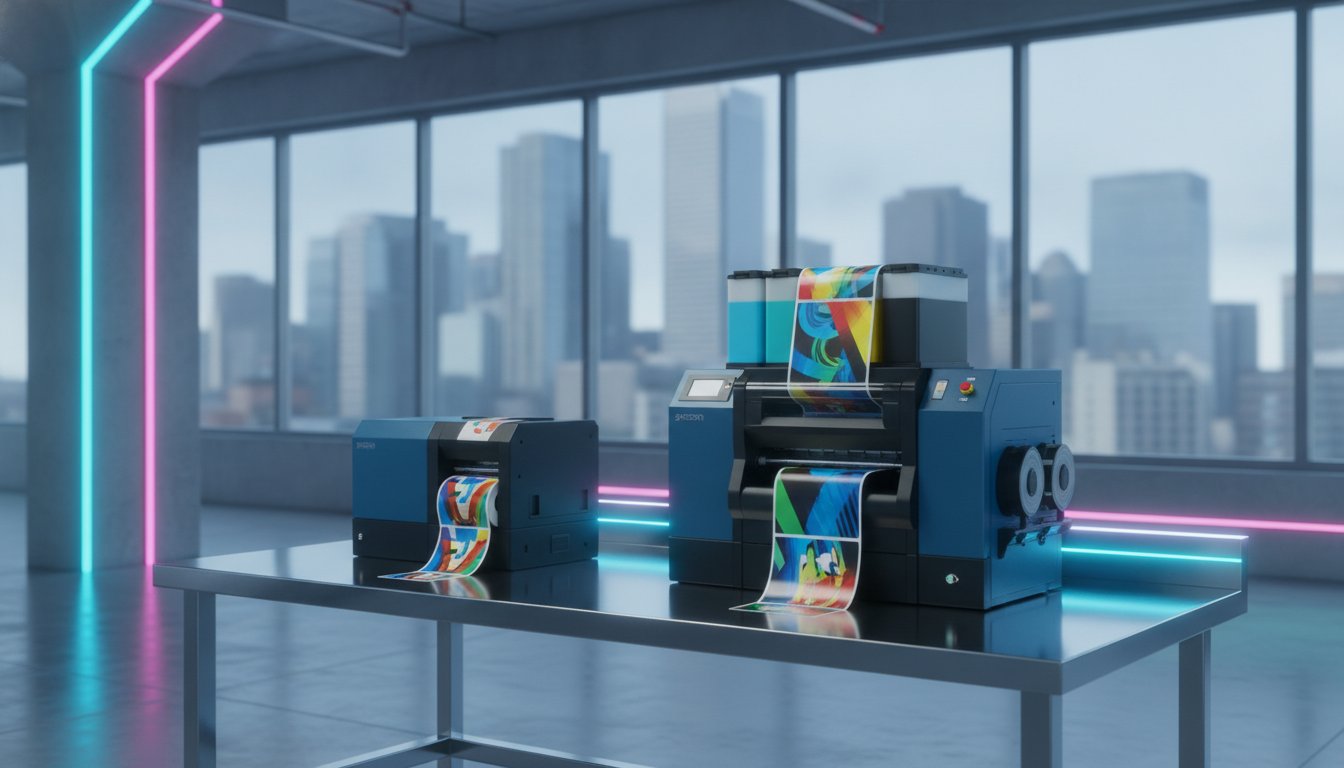
The printer that costs less upfront often becomes your most expensive asset within six months of operation. If you're deciding between two of the industry's most popular models, a detailed Primera LX910 vs LX2000 print speed and ink cost comparison is the only way to protect your margins. You likely already know that consistent, professional branding is non-negotiable for your Canadian business. However, managing the production bottlenecks caused by slow output or the shock of unpredictable tri-colour cartridge costs can quickly stall your growth.
It's time to replace guesswork with hard numbers. This analysis explores how these machines perform under real-world conditions, from GHS-compliant durability to cost-per-label metrics in C$. You'll gain a clear understanding of which unit handles your monthly volume without breaking the budget. We break down the technical specifications and ink chemistry to ensure your chosen hardware meets your specific durability standards and production timelines. By the end of this guide, you'll have the data needed to make a confident investment for your facility and ensure a reliable supply chain for your ongoing production needs.
Key Takeaways
- Perform a comprehensive Primera LX910 vs LX2000 print speed and ink cost comparison to determine if your production volume justifies an industrial-grade upgrade.
- Learn how to translate technical "inches per second" ratings into real-world production times to eliminate labelling bottlenecks in your facility.
- Evaluate the long-term savings of individual ink tanks over tri-colour cartridges to lower your total cost-per-label in C$.
- Determine whether dye-based or pigmented inks are necessary to meet your specific GHS compliance or environmental durability requirements.
- Identify the ideal use cases for each printer, from versatile small-batch branding to high-volume industrial manufacturing and logistics.
Primera LX910 vs LX2000: Key Technical Specifications
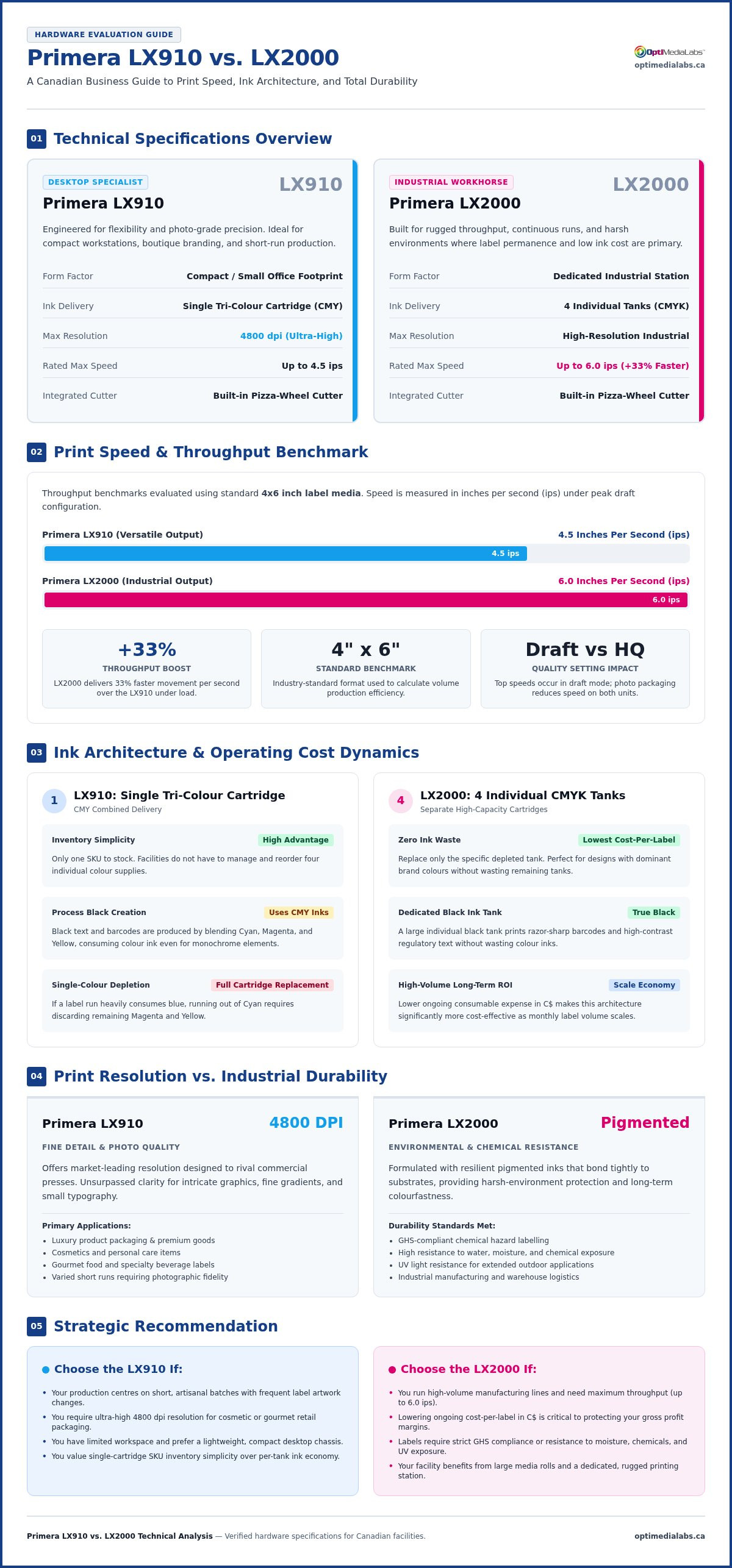
Selecting the right hardware for your Canadian production line requires a clear understanding of engineering trade-offs. The Primera LX910 is a versatile, high-resolution desktop solution that prioritizes print quality and flexibility. In contrast, the LX2000 is an industrial-grade workhorse built for high-volume runs and harsh environments. A comprehensive Primera LX910 vs LX2000 print speed and ink cost comparison must start with these fundamental differences in build quality and delivery systems.
The LX910 fits comfortably in a small office or retail backroom. It uses a lightweight chassis that's easy to move but remains stable during high-speed operation. The LX2000 requires a dedicated station. Its larger footprint accommodates a more robust internal mechanism and larger rolls of media. This is essential for industrial logistics where downtime is a significant cost factor and printer stability is paramount.
Ink Architecture: Tri-Colour vs. Individual Tanks
The core of any inkjet printing technology is how it delivers colour to the page. These two models take polar opposite approaches to ink management. This choice impacts your daily maintenance and your long-term operational costs.
- LX910 Tri-Colour System: This model uses a single CMY cartridge. It's the ultimate in simplicity. You don't have to stock four different items. This setup is ideal for boutique brands in Canada that print varied, low-volume batches. Check our LX910 ink supplies for current availability.
- LX2000 Individual Tanks: This unit utilizes four separate CMYK tanks. If your labels use a lot of blue, you only replace the cyan tank. This prevents the waste seen in tri-colour systems where one empty colour forces you to discard the entire cartridge.
- Dedicated Black Ink: The LX2000 includes a large, separate black ink tank. This ensures crisp, professional barcodes and text without wasting expensive colour pigments to create "process black." Explore LX2000 individual tanks to see the industrial advantage.
Print Technology and Resolution Capabilities
Resolution needs vary by industry. While higher numbers look better on a spec sheet, they don't always translate to better ROI for every business. Real-world applications dictate which technology wins.
The LX910 offers a staggering 4800 dpi resolution. It's designed for luxury packaging, cosmetics, and gourmet food labels where every fine detail matters. It produces photo-quality results that rival commercial presses. The LX2000 focuses on industrial durability. It uses pigmented inks that are highly resistant to water, chemicals, and UV light. This makes it the standard choice for GHS-compliant chemical labelling and outdoor applications. While its resolution is excellent, its primary value lies in the permanence of the image rather than extreme detail. For many standard product labels, the industrial durability of the LX2000 provides more long-term value than the ultra-high resolution of the LX910.
Print Speed Comparison: Benchmarking Production Efficiency
Production efficiency isn't just about the maximum number on a spec sheet. When conducting a Primera LX910 vs LX2000 print speed and ink cost comparison, you must look at throughput under load. Inches per second (ips) measures how fast the media moves, but it doesn't account for data processing or the physical cutting of the label. In a busy Canadian warehouse, these seconds accumulate into hours over a single production week.
A standard 4x6 inch label serves as the best benchmark for these machines. While the LX910 is rated for up to 4.5 ips, the LX2000 pushes that limit to 6 ips. This 33% increase in speed is a game changer for businesses moving from small-batch artisanal production to industrial-scale distribution. However, these speeds are usually achieved in "Draft" mode. High-quality settings, which are often required for retail-ready packaging, will significantly reduce these figures on both models.
The built-in pizza-wheel cutter also impacts total job time. Both units feature integrated cutters, but the frequency of the cut matters. If your workflow requires a cut after every label, the mechanical reset time becomes a bottleneck. For high-volume logistics, it's often more efficient to print an entire roll and use a secondary finishing system to maintain the maximum rated speed of your colour label printer.
LX910 Speed Performance
The LX910 excels at short-run prime labels where visual impact is the priority. It reaches its 4.5 ips peak easily on simple designs. When you introduce complex, high-coverage graphics at the maximum 4800 dpi setting, the printer's processor works harder to maintain precision. This naturally slows the output. It's an ideal choice for businesses printing fewer than 5,000 labels per month. If you're trying to determine if your current volume warrants an upgrade, you can speak with our technical team for a customized workflow assessment.
LX2000 Industrial Speed and Reliability
The LX2000 is engineered to maintain higher speeds during large-batch production. It doesn't just print faster; it handles data better. With Ethernet connectivity, the LX2000 receives large print files across a network much faster than a standard USB connection. This is critical in industrial environments where multiple workstations may be sending jobs to a single unit. Larger ink capacities also mean the printer stops less frequently for maintenance. This reliability ensures that your Primera label printers remain active during peak production cycles without the constant need for operator intervention.
Ink Cost Analysis: Calculating Your Long-Term ROI
The financial impact of your printer choice extends far beyond the initial purchase price. A detailed Primera LX910 vs LX2000 print speed and ink cost comparison reveals that the LX910's tri-colour cartridge system carries a hidden "unbalanced ink" tax. In a standard CMY cartridge, if your label design uses a heavy amount of cyan, you must replace the entire unit once that specific colour is depleted. This often results in discarding perfectly good magenta and yellow ink. For Canadian businesses with high-coverage designs, this waste can increase your effective cost-per-label by 20% or more.
The LX2000 solves this by using four individual high-capacity tanks. You only replace what you use. This efficiency is particularly noticeable when printing high-coverage graphics where ink consumption is significant. Conversely, for low-coverage shipping labels or simple barcodes, the cost difference is smaller but still favours the individual tank system over time. You can browse Primera LX910 ink cartridges to see the integrated design compared to the industrial tanks of its larger sibling.
Consumables Management for Canadian Businesses
Maintenance workflows differ between these models. The LX910 utilizes a cartridge with an integrated print head. Every time you change the ink, you get a brand-new head. This simplifies maintenance but adds to the per-unit cost. The LX2000 features a separate, semi-permanent print head. While this requires more attention to cleaning cycles, it lowers the cost of the ink tanks themselves. Sourcing reliable Primera ink cartridges in Canada is essential for keeping your production line moving. High-volume manufacturers benefit from stocking the LX2000's individual CMYK tanks in bulk to ensure they never face a production halt due to a single colour running dry.
ROI Breakdown: When does the LX2000 pay for itself?
The break-even point for the LX2000 typically occurs when your monthly volume exceeds 5,000 labels. At this scale, the lower cost-per-label of the individual tanks begins to offset the higher upfront equipment cost. A small boutique brand printing 500 labels a week will find the LX910 more economical due to lower capital expenditure. However, a mid-sized industrial facility printing daily batches will see the LX2000 pay for itself in ink savings alone within the first year. You must also factor in labour. The faster throughput of the LX2000 means operators spend less time monitoring the machine and more time on packing and shipping.
Durability and Compliance: Pigmented vs. Dye-Based Inks
The environment where your labels live dictates your ink choice. While the previous Primera LX910 vs LX2000 print speed and ink cost comparison focused on production efficiency, durability is where the two machines diverge most sharply. Dye-based inks, standard on the LX910, produce the most vibrant colours for retail packaging. However, they lack the chemical stability required for industrial applications. Pigmented inks, utilized by the LX2000, are engineered for survival against moisture, UV rays, and abrasion.
Canadian environmental standards often require labels to remain legible under harsh conditions. For products stored outdoors or in damp warehouses, the pigmented ink of the LX2000 provides a permanent bond that dye-based alternatives cannot match. When performing a Primera LX910 vs LX2000 print speed and ink cost comparison, durability often becomes the deciding factor for industrial users. If you're unsure which chemistry fits your workflow, you can consult our compliance experts for a media compatibility test.
UV and Chemical Resistance
The LX2000 pigmented inks consist of microscopic solid particles suspended in a liquid carrier. Once dry, these particles are highly resistant to fading and smudging. This makes the LX2000 ideal for horticultural tags, outdoor power equipment, and cleaning supplies. The LX910 offers a unique middle ground. It features a dual-ink capability, allowing users to swap between dye and pigment cartridges depending on the job. While versatile, this requires manual intervention and specific Primera labels designed for each ink type to ensure proper adhesion and dry times.
GHS and BS5609 Section 3 Compliance
For chemical manufacturers in Canada, GHS (Globally Harmonized System) compliance is mandatory. The LX2000 is the preferred choice for this sector because its pigmented ink meets BS5609 Section 3 requirements. This standard involves rigorous testing, including a 90-day seawater immersion test. Labels must remain attached and legible to ensure safety during maritime transport. You can find more detail in our Industrial Labeling Solutions Canada: The 2026 Reference Guide. Ensuring your labelling process meets 2026 safety regulations protects your business from liability and ensures your products move through the supply chain without regulatory delays. The LX2000 provides the industrial reliability needed for these high-stakes environments.
The Verdict: Which Primera Printer Suits Your Needs?
The final decision in the Primera LX910 vs LX2000 print speed and ink cost comparison rests on your specific operational priorities. If your business values print quality and versatility above all else, the LX910 is the superior choice. If your focus is on industrial throughput and minimizing the total cost of ownership, the LX2000 wins. Canadian businesses must weigh the initial capital expenditure against the projected monthly ink consumption to find the true break-even point. This involves looking beyond the sticker price and calculating the C$ impact of your specific label designs over a standard fiscal year.
Boutique brands often benefit from the smaller footprint and higher resolution of the LX910. It allows for rapid prototyping and seasonal product launches without a heavy investment in separate ink tanks. Conversely, industrial facilities require the ruggedness and individual CMYK tanks of the LX2000 to maintain high-speed production lines. For a deeper look at the supplies required to keep these units running, see our Professional Guide to Label Printer Consumables: Canada. This resource helps you map out your long-term procurement strategy for labels and ink.
Choose the LX910 if...
The LX910 is built for agility. It's the right fit for your facility if you require the highest possible photographic resolution of 4800 dpi for luxury packaging or gourmet food items. This model is most efficient when your monthly volume stays under 2,500 labels, as the tri-colour cartridge system is easier to manage at this scale. It also offers the unique ability to switch between dye and pigment ink frequently, giving you the flexibility to print both vibrant retail labels and more durable industrial tags using the same hardware. This versatility is perfect for companies with diverse product lines that change throughout the seasons.
Choose the LX2000 if...
The LX2000 is an industrial workhorse. It's the essential choice if the lowest cost-per-label is your primary financial metric. This unit is designed for environments where you print GHS compliant or industrial-strength labels daily. Because production speed is critical to your supply chain efficiency, the 6 ips throughput and Ethernet connectivity provide the necessary reliability for high-volume logistics. Over a multi-year period, the savings on individual ink tanks will significantly outweigh the higher initial price of the printer. The robust build quality ensures that your investment remains a stable part of your facility for years to come. Ready to upgrade your production floor? Contact OptiMediaLabs for a personalized Primera quote to see how these models fit your specific Canadian business requirements.
Optimize Your Canadian Production Line
Choosing the right hardware is a critical step in scaling your business. This Primera LX910 vs LX2000 print speed and ink cost comparison highlights that while the LX910 offers unmatched resolution for boutique brands, the LX2000 provides the industrial durability and individual ink tank ROI required for high-volume manufacturing. Your decision should align with your specific monthly throughput and the environmental conditions your labels must endure.
As an authorized Primera distributor, OptiMediaLabs provides expert Canadian technical support and national shipping on all ink and label supplies. We ensure your facility remains operational with a reliable supply chain tailored to your production needs. Don't let unpredictable costs or production bottlenecks slow your growth. Request a Primera Print Speed & Cost Consultation today to receive a data-driven recommendation for your facility. We're here to help you secure a stable and efficient labelling future.
Frequently Asked Questions
Is the Primera LX910 faster than the LX2000?
No, the LX2000 is the faster machine for industrial production. While the LX910 reaches a maximum speed of approximately 4.5 inches per second, the LX2000 increases this throughput to 6 inches per second. This difference is significant during high-volume runs. A detailed Primera LX910 vs LX2000 print speed and ink cost comparison shows that the LX2000's industrial architecture is designed to maintain these higher speeds more consistently during long-batch jobs in Canadian warehouses.
Can I use pigmented ink in the Primera LX910?
Yes, you can use either pigmented or dye-based ink in the LX910. This model features a unique dual-ink capability that allows you to swap the single tri-colour cartridge based on your specific project needs. You must ensure you use compatible Primera labels that match the ink type for proper adhesion. This flexibility makes the LX910 an excellent choice for boutique brands that need to produce both vibrant retail packaging and durable industrial tags.
Which Primera printer has a lower ink cost per label?
The LX2000 consistently offers a lower ink cost per label due to its individual tank system. Unlike the LX910, which uses a single tri-colour cartridge, the LX2000 utilizes four separate CMYK tanks. This design prevents ink waste because you only replace the specific colour that runs out. For businesses printing high-coverage graphics, the savings in C$ become substantial over time. This efficiency is a primary driver in any Primera LX910 vs LX2000 print speed and ink cost comparison.
Does the LX2000 support Wi-Fi and Ethernet for Canadian office networks?
The LX2000 is fully equipped for modern Canadian office and warehouse networks. It includes both built-in Wi-Fi and a wired Ethernet port. This connectivity allows multiple workstations to send print jobs to the unit simultaneously. Ethernet is particularly useful for industrial environments where large print files need to be transferred quickly and reliably. The LX910 primarily relies on a standard USB connection, though it's well-suited for dedicated, single-station desktop setups.
What is the maximum label width for the LX910 and LX2000?
Both the LX910 and the LX2000 support a maximum label width of 8.25 inches. This wide-format capability allows you to produce everything from small product stickers to large chemical drum labels. You can adjust the internal guides to accommodate various media sizes, starting from as narrow as 0.5 inches. This consistency across the LX-series ensures that you can use the same blank inkjet labels even if you decide to upgrade from one model to the other.
Are Primera ink cartridges easily available in Canada?
Yes, Primera ink cartridges and labels are readily available through OptiMediaLabs. As a national distributor, we maintain a deep inventory of consumables for both the LX910 and LX2000 models. We provide reliable national shipping across Canada to ensure your production line never stops due to a lack of supplies. Choosing a domestic source helps you avoid unpredictable cross-border duties and ensures you receive expert technical support from a local authorized dealer.
Which printer is better for GHS compliant chemical labels?
The LX2000 is the superior choice for GHS compliant chemical labelling. Its pigmented ink system is specifically designed to meet BS5609 Section 3 standards, which are required for labels on hazardous materials. These labels are tested for seawater immersion and UV exposure to ensure they remain legible in extreme conditions. While the LX910 can use pigmented ink, the LX2000's industrial build and ink chemistry are the standard for Canadian manufacturers requiring maximum durability.
Do I need to replace the print head on the LX2000?
Yes, the LX2000 uses a semi-permanent print head that will eventually require replacement. This is a separate component from the individual ink tanks. In contrast, the LX910 uses a cartridge with an integrated print head, meaning you get a new head with every ink change. While the LX2000's head involves an occasional maintenance cost, it allows for the use of more economical individual ink tanks, which lowers your total cost of ownership over time.