
Professional Sticker Printing Equipment: The 2026 Canadian Buyer’s Guide
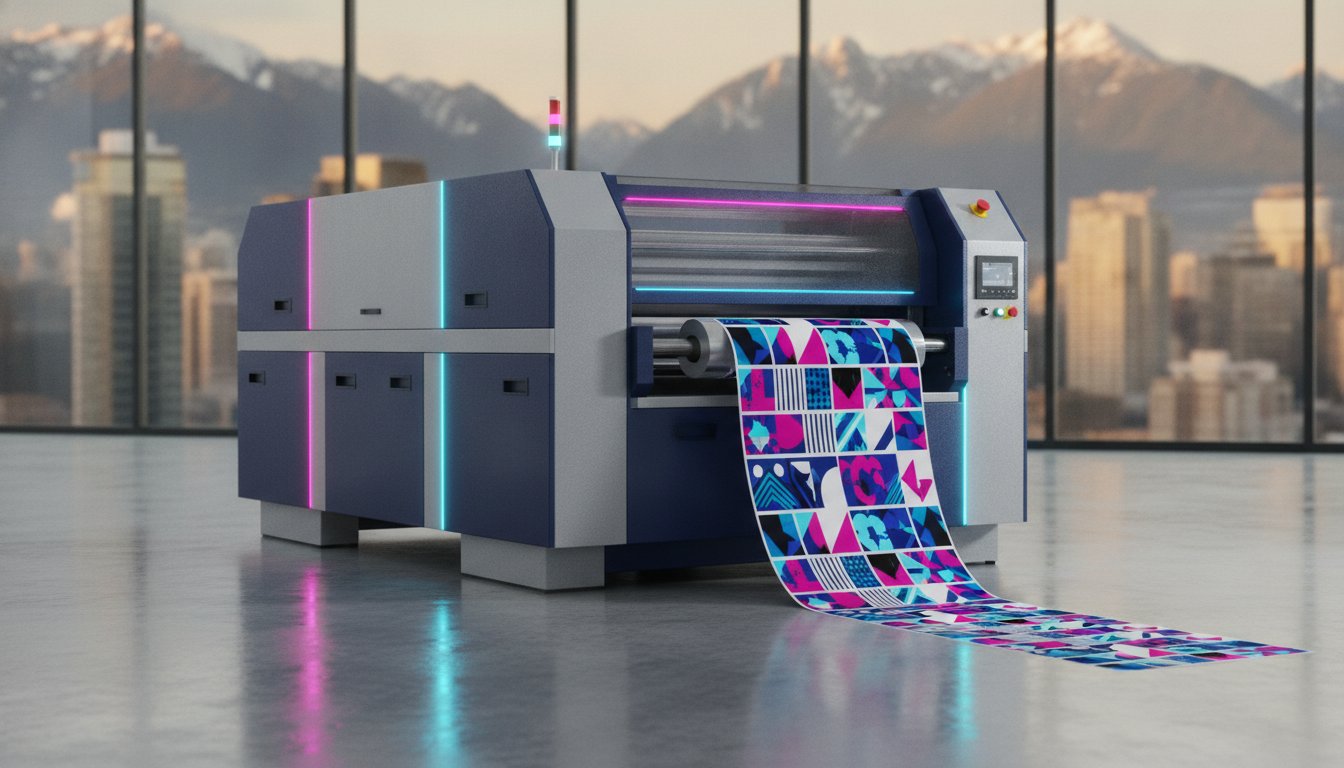
Is your current "affordable" setup actually the most expensive part of your business? Many Canadian entrepreneurs start with consumer-grade machines, only to realize that slow production speeds and tiny, expensive ink cartridges quickly erode profit margins. When your sticker printing equipment can't keep up with demand or fails to provide consistent colour matching for brand logos, it becomes a major bottleneck. Finding reliable Canadian suppliers for media and ink shouldn't be a constant struggle for a growing company.
This 2026 guide will show you how to transition to professional-grade tools to slash your cost-per-label and improve output quality. You will learn to achieve professional durability and a streamlined workflow from design to final cut. We will break down essential hardware from industry leaders like Afinia and Epson, examine high-speed digital finishers, and provide a clear path to securing the ink and software needed to keep your Canadian production line running at peak efficiency. It is time to move beyond hobbyist limitations and stabilize your local supply chain.
Key Takeaways
- Identify the "Sticker Productivity Gap" and learn how industrial ink tanks offer a significantly lower cost-per-millilitre than consumer cartridges.
- Select the right professional sticker printing equipment for your volume, featuring the versatile Afinia L502 and the GHS-compliant Epson C6000 series.
- Transition to a roll-to-roll workflow with digital finishers to eliminate manual cutting and achieve professional-grade durability.
- Understand the environmental and power requirements necessary to maintain consistent colour output in a professional Canadian workspace.
- Secure your production uptime by sourcing media and consumables from a reliable national distributor to avoid cross-border shipping delays.
Hobbyist vs. Professional Sticker Printing Equipment: Why Upgrade?
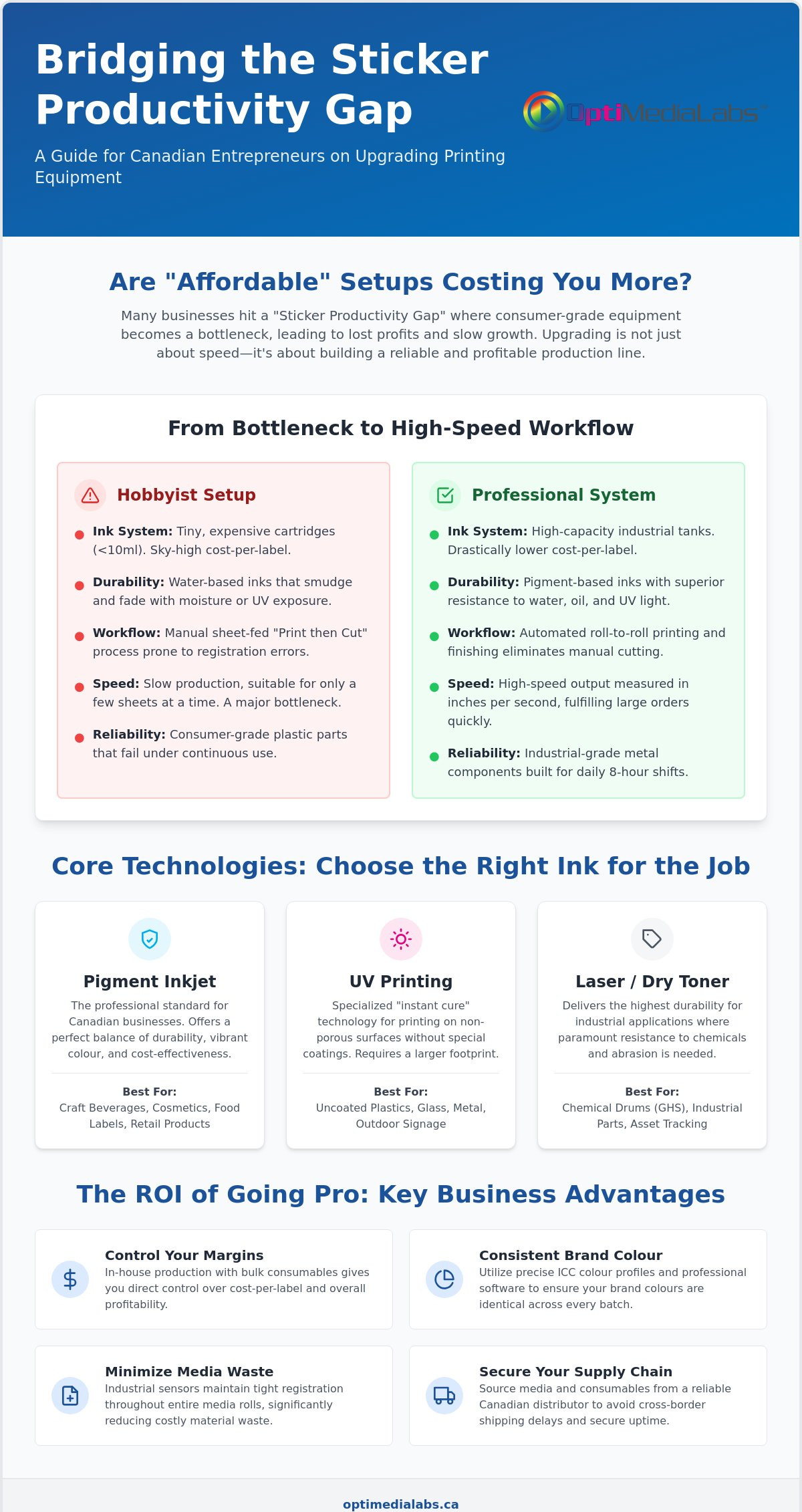
Scaling a Canadian sticker business requires more than just creativity; it demands robust infrastructure. Many entrepreneurs start with desktop machines but quickly hit the "Sticker Productivity Gap." This occurs when orders exceed the physical capacity of consumer hardware. While a hobbyist machine might handle a few sheets, professional sticker printing equipment is designed for continuous duty cycles. Orders often exceed capacity. Relying on entry-level gear leads to missed deadlines and frustrated clients.
The most immediate difference is the cost of consumables. Consumer-grade cartridges often contain less than 10 millilitres of ink, leading to an astronomical cost-per-label. In contrast, professional Afinia ink cartridges or industrial tanks allow for high-volume output at a fraction of the price. Understanding Core Technologies: Inkjet vs. Laser for Sticker Production helps businesses realize that pigment-based systems offer superior durability. Unlike water-based hobby inks that smudge or fade, professional pigment inks provide resistance to moisture and UV exposure. This is essential for Canadian wholesale orders where product longevity is a non-negotiable requirement. High-speed color label printers deliver results at several inches per second, ensuring you can fulfill large batches in hours rather than days.
The Limitations of Consumer Die-Cutters
Desktop cutters rely on "Print then Cut" methods that often suffer from registration errors. Even a one-millimetre shift can ruin a batch of die-cut stickers. These machines are typically sheet-fed, creating a manual bottleneck that requires constant supervision. Transitioning to roll-to-roll sticker printing equipment allows for automated finishing. Industrial machines use metal components instead of plastic gears; this ensures they don't fail under the pressure of daily eight-hour shifts. It's a matter of reliability and precision.
The ROI of Industrial Sticker Equipment
Moving production in-house provides immediate control over your margins. You can calculate your break-even point by comparing the cost of outsourced sheets to the cost of blank media and bulk ink. Professional equipment also utilizes precise ICC colour profiles and software like BarTender. This ensures your brand colours remain consistent across different batches. Better media handling reduces waste, as industrial sensors maintain tight registration throughout an entire roll. This efficiency translates directly into higher profits and faster growth for your business.
Core Technologies: Inkjet vs. Laser for Sticker Production
Selecting the right technology for your sticker printing equipment depends entirely on your target market and the environment where your products will live. For most Canadian small businesses, aqueous pigment inkjet represents the most accessible and versatile path. While some competitors argue that UV printing is the only solution for durability, modern pigment-based systems provide exceptional water and UV resistance at a significantly lower entry cost. This technology is particularly effective for the craft beverage and cosmetic industries, where labels must withstand refrigeration, condensation, and contact with oils.
UV printing remains a specialized choice for businesses requiring "instant cure" technology. It allows for printing on non-porous substrates without specialized coatings, but the equipment often requires a larger footprint and specific ventilation standards. Laser or dry toner systems, such as the Afinia LT5C, are excellent for high-durability industrial applications where chemical resistance is paramount. Understanding these technical nuances is a key part of , as your choice dictates your long-term material costs and production speed.
Dye-Based vs. Pigment-Based Inkjet
Dye-based inks offer the highest possible vibrancy and are ideal for indoor, photo-quality stickers that require "pop." However, they lack the longevity required for outdoor or retail shelf use. Pigment ink is the professional standard for Canadian businesses. It uses solid particles suspended in liquid to provide superior lightfastness and moisture durability. If your products face harsh environments, sourcing the correct Afinia ink cartridges or Epson pigment sets is vital for maintaining brand integrity over time.
Understanding Media Compatibility
Inkjet technology requires specialized media coatings to "lock in" the ink. You can't simply use any vinyl or BOPP roll found at a general hardware store. Matching your ink type to the correct blank inkjet labels ensures maximum adhesion and prevents bleeding. Without these specialized coatings, the ink will sit on the surface and smudge, leading to wasted material and lost time. Proper media selection is just as important as the printer itself for achieving a professional finish. If you're unsure which technology aligns with your specific industry requirements, you can speak with a technical specialist to review your sample designs.
Top Professional Sticker Printers for Canadian Small Businesses
Selecting the right hardware requires balancing your initial investment with long-term production versatility. While consumer gadgets dominate the low-end market, the mid-range desktop industrial segment offers the durability needed for genuine business growth. This shift reflects a broader global trend in Hobbyist vs. Professional Sticker Printing Equipment: Why Upgrade? where extreme personalization drives the need for agile, in-house production. Professional sticker printing equipment allows Canadian businesses to maintain high resolutions, often reaching 1200 x 1200 DPI. This precision is critical for fine-text legibility on ingredient labels or intricate character-driven designs that are popular in 2026.
The Primera LX-series remains a staple for those entering the professional space. The LX3000, for instance, utilizes a reusable print head and large individual ink tanks to keep operating costs low. While it provides a lower entry point than some high-speed industrial presses, it doesn't sacrifice the colour depth required for premium retail packaging. It's a reliable starting point for boutique operations that need to move away from sheet-fed consumer machines and toward a more efficient roll-to-roll workflow.
Afinia L502: The Dual-Ink Powerhouse
The Afinia L502 stands out for its unique interchangeable print head system. It allows users to switch between dye and pigment inks depending on the specific project requirements. This versatility makes it the ideal choice for flexible product lines that require both the visual "pop" of dye ink and the rugged "protection" of pigment ink. By utilizing Afinia Color Label Printers, businesses can adapt to changing market demands without purchasing multiple machines. It's a strategic asset for companies that produce both indoor decorative stickers and outdoor industrial labels. The heavy-duty industrial construction ensures it handles daily production without the registration errors common in plastic consumer models.
Epson ColorWorks C6000/C6500 Series
The Epson ColorWorks series is engineered for seamless industrial integration. It's the first choice for businesses requiring GHS compliance or chemical-resistant stickers. Models like the C6000A feature an integrated auto-cutter, while the C6000P offers a "peel-and-present" function to speed up manual application lines. These Epson Color Label Printers utilize PrecisionCore technology to deliver consistent results across thousands of labels. This reliability is essential for Canadian manufacturers who can't afford downtime during peak production cycles. The pigment-based ink sets used in these machines are specifically formulated for high-durability applications, ensuring your labels remain legible even in harsh environments. Choosing the right Epson model allows you to match your printer's width and speed to your specific container sizes.
Finishing the Job: Digital Cutters and Finishers
Professional sticker production doesn't end when the ink hits the media. High-volume output requires a "Roll-to-Roll" workflow to maintain peak efficiency. While some entry-level sticker printing equipment attempts to combine printing and cutting into a single unit, this often creates a production bottleneck. If the cutter is engaged, the printer sits idle. A modular approach using separate digital finishers allows both machines to operate simultaneously, effectively doubling your throughput and reducing lead times for your clients.
Digital die-cutting eliminates the need for expensive physical dies. A digital blade follows a programmed path, allowing for infinite shape variety without additional tooling costs. Traditional rotary cutting is fast but lacks the flexibility required for custom character-driven stickers or seasonal product runs. Digital finishing also facilitates matrix removal. Stripping away the excess waste material around the stickers creates an "easy-peel" experience for the end user, which is a hallmark of professional-grade manufacturing.
Afinia Label Cutters and Digital Finishers
The Afinia Label Cutters & Finishers, specifically the DLF series, provide a complete post-print solution. These machines can laminate, contour cut, strip, and slit in one pass. Lamination is a critical step for Canadian businesses targeting the outdoor or automotive markets. It adds a protective layer against UV rays, scratches, and oils, while providing a premium matte or gloss finish. This extra step ensures your stickers survive harsh Canadian winters and frequent handling. Investing in a dedicated finisher allows you to offer premium finishes that command higher retail prices.
Workflow Software: BarTender and NiceLabel
Precise finishing requires more than just hardware; it needs sophisticated software to manage registration marks. Utilizing a Professional Guide to Barcode Software helps businesses integrate tools like BarTender or NiceLabel into their production line. This software ensures the cutter stays perfectly aligned with the printed image, even across long rolls. It also allows for the management of variable data, such as unique QR codes or serial numbers, directly on the sticker. Maintaining this digital link between design and finish is essential for a frictionless workflow. If you are ready to automate your finishing process, you can contact our technical team for a custom workflow assessment.
Setting Up Your Sticker Production Line in Canada
Planning your production environment is the final step in transitioning to professional sticker printing equipment. Aqueous inkjet systems require stable conditions to ensure consistent ink absorption and colour accuracy. High-performance finishers also have specific power requirements that often necessitate dedicated circuits to avoid interference. For businesses in the cosmetics sector, the 2026 Health Canada allergen disclosure requirements make this in-house agility even more valuable. You can update labels instantly as formulations change instead of waiting for external print runs to arrive.
Your logistics strategy determines your long-term success. Relying on U.S. retailers often leads to hidden costs like brokerage fees and unpredictable customs delays. Sourcing your Afinia ink cartridges and Epson ink cartridges from a local distributor ensures you stay operational. Local stock means faster shipping across Canada and zero border-related headaches. A reliable partner also provides the necessary Afinia labels and Epson labels to match your specific adhesive and finish requirements.
Before you begin production, use this final checklist to ensure your facility is ready:
- Verify power capacity for both printers and finishers.
- Install environmental monitoring to maintain humidity between 40% and 60%.
- Register for GST/HST if your revenue is approaching the $30,000 threshold.
- Establish a reliable supply line for Canadian-sourced media to prevent stockouts.
Why OptiMediaLabs Canada is the Preferred Canadian Partner
As a national distributor, OptiMediaLabs Canada focuses on providing a complete ecosystem. We understand the technical requirements of Afinia and Epson equipment. Our expertise covers everything from hardware selection to software integration. We prioritize your uptime by keeping brand-specific ink and blank media in stock. This localized support is a strategic advantage for Canadian businesses competing in the global sticker market. We provide the stability you need to scale without the risks associated with cross-border shopping.
Next Steps for Your Business
Verification is essential before making a significant investment. We recommend requesting a print sample using your specific brand artwork. This allows you to verify colour accuracy and material durability in person. Once you're satisfied with the quality, consult with a specialist to size your sticker printing equipment to your projected order volume. We can help you identify the specific combination of printers and finishers that will maximize your ROI. Contact OptiMediaLabs Canada for a Professional Consultation to begin your transition to industrial-grade production.
Scaling Your Canadian Sticker Production for 2026
Transitioning to professional sticker printing equipment is a strategic move that stabilizes your margins and output quality. Moving away from expensive consumer cartridges and manual cutting gives you direct control over production costs and colour consistency. Modular workflows allow your business to scale effortlessly without the bottlenecks found in entry-level integrated units. You can now fulfill larger wholesale orders with confidence while maintaining a significantly lower cost-per-label.
OptiMediaLabs Canada provides the stable foundation your business needs to succeed in the Canadian market. As an authorized distributor for Afinia and Epson in Canada, we offer national shipping on all consumables to ensure your production line never stops. Our team provides expert technical guidance for industrial labelling to help you select the right ecosystem for your specific volume. We stock the brand-specific ink and media required to keep your hardware running at peak performance year-round.
Take the next step toward industrial efficiency and professional results. Browse Professional Sticker Printing Equipment at OptiMediaLabs Canada. We are ready to help you build a high-performance production line that grows with your business.
Frequently Asked Questions
What is the best sticker printing equipment for a small business in Canada?
The best sticker printing equipment for a Canadian small business depends on your specific volume, but the Afinia L502 and Epson ColorWorks C6000 series are current industry leaders. These machines provide the industrial durability and colour precision required for retail-grade products. They are also designed for easy integration into a professional workspace, ensuring you can fulfill wholesale orders without the mechanical failures common in consumer-grade gadgets.
Do I need a separate machine for printing and cutting stickers?
You should utilize separate machines for printing and cutting to maximize your daily production throughput. Integrated units often create a bottleneck because the printer must remain idle while the cutter is active. By using a modular setup, you can print one roll of media while simultaneously finishing another on a digital cutter. This approach effectively doubles your output capacity and allows for much faster turnaround times on client orders.
How much does it cost to print stickers in-house vs. outsourcing?
Printing in-house typically lowers your cost-per-label significantly compared to outsourcing, especially for short to medium production runs. While the initial hardware investment is higher, the savings on bulk ink and blank media usually lead to a fast break-even point for growing businesses. You also gain total control over your production schedule, allowing you to print exactly what you need without waiting for external shipping or minimum order quantities.
What kind of ink is best for waterproof stickers?
Pigment-based ink is the superior choice for waterproof stickers because it uses solid particles that bond with specialized media coatings. Unlike dye-based inks that smudge when wet, pigment inks provide long-term resistance to moisture and UV light. This is essential for products like craft beverages or cosmetics that face condensation or frequent handling. It ensures your brand remains legible and professional throughout the entire life of the product.
Can I use a regular inkjet printer to make professional stickers?
A regular inkjet printer cannot produce professional stickers at scale because the ink costs are too high and the speeds are too slow. Consumer machines use tiny cartridges that lead to an unsustainable cost-per-label for any serious business. Professional sticker printing equipment utilizes industrial-sized tanks and robust internal components designed for continuous duty cycles. This allows you to maintain high quality while keeping your operational expenses manageable as you grow.
What software do I need to run a professional sticker printer?
Professional label software like BarTender or NiceLabel is necessary to manage complex registration marks and variable data. These tools ensure your digital cutter aligns perfectly with your printed artwork across an entire roll. They also allow you to automate the creation of barcodes, QR codes, and serialized numbers for your sticker batches. Without this software, achieving the precision required for professional-grade die-cutting is extremely difficult and leads to excessive material waste.
How do I ensure my stickers don’t fade in the sun?
To prevent fading, you must use pigment-based inks and consider adding a lamination layer during the finishing stage. Pigment particles are naturally more resistant to UV rays than liquid dyes, which tend to break down quickly in sunlight. Using a digital finisher to apply a clear laminate provides an extra physical barrier against environmental wear. This combination ensures your stickers maintain their vibrancy and professional appearance even when used in outdoor applications.
Where can I buy sticker printing supplies in Canada?
You should buy your supplies from an authorized Canadian distributor like OptiMediaLabs Canada to ensure fast national shipping and avoid expensive customs duties. We stock brand-specific ink cartridges, blank labels, and ribbons for Afinia, Epson, and Primera systems. Sourcing locally guarantees that your production line stays operational without the unpredictable delays associated with cross-border logistics. It also provides you with access to specialized technical support within your own time zone.