
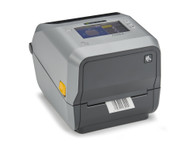
RFID Label Printers Canada: The 2026 Industrial Buyer’s Guide
The North American RFID market has claimed a massive 36.90% share of global adoption as we move through 2026. If your facility still relies on manual inventory counts, you're likely feeling the pressure of modern retail mandates and the rising cost of labour. It's a common frustration to deal with wasted media due to poor encoding calibration or the fear that your tags won't meet strict EPC Global Gen 2 standards. You need hardware that works the first time, every time.
Finding the right RFID label printers Canada businesses can rely on involves more than just picking a brand. It requires synchronizing specialized encoding hardware with high-performance software and verified inlay media. This guide will show you how to master these technical requirements and identify the ideal printer for your specific logistics needs. We will cover ISED frequency regulations for the 902-928 MHz band, bilingual labelling compliance, and the best industrial hardware to reduce your manual workload and ensure 100% encoding accuracy.
Key Takeaways
- Understand the dual process of visual imaging and digital encoding to ensure your RFID inlays meet Canadian supply chain requirements.
- Compare the technical advantages of thermal transfer versus colour inkjet RFID label printers Canada businesses use for durable or high-impact branding.
- Identify the correct hardware category-desktop, industrial, or mobile-based on your facility’s duty cycle and environmental demands.
- Synchronize the "Workflow Trinity" of professional software, verified UHF Gen 2 media, and specialized hardware to eliminate encoding errors.
- Ensure full compliance with ISED frequency standards and retail mandates while significantly reducing manual inventory labour costs.
What are RFID Label Printers and Why is Canada Adopting Them?
Radio-frequency identification (RFID) printing is a dual-action process. It combines traditional visual imaging with digital data encoding. While a standard printer only applies ink or toner to a surface, an RFID printer writes information to a tiny chip embedded inside the label. This chip, known as an integrated circuit, is connected to an antenna. Together, they form what the industry calls an "inlay." This inlay is hidden beneath the face stock, making the label look standard while carrying a powerful digital signature.
The Canadian supply chain is rapidly shifting toward UHF Gen 2 EPC standards. This isn't just a trend; it's a technical evolution. Unlike 1D or 2D barcodes that require a direct line-of-sight to a scanner, RFID tags can be read from several metres away. You can scan an entire pallet of goods in seconds without opening a single box. This massive leap in efficiency is why RFID label printers Canada adoption is soaring. It eliminates the slow, manual labour associated with scanning individual items one by one, allowing for real-time inventory visibility.
The Rise of RFID Mandates in Canadian Retail
Major retailers across Canada now mandate RFID tagging for all incoming shipments. These organizations use the technology to achieve near-perfect inventory accuracy and reduce out-of-stock events. If your labels don't scan or aren't encoded correctly, you'll face stiff financial chargebacks. Some retailers will even reject entire shipments, causing significant logistics delays. Printing in-house gives you total control over the process. It's often more cost-effective than ordering pre-encoded tags from a third party, as you avoid long lead times and the premium markups often found on small batches.
Key RFID Terminology for Canadian Buyers
Choosing the right hardware requires understanding a few technical terms. UHF (Ultra-High Frequency) is the industrial standard for logistics because of its long read range and high-speed data transfer. In contrast, HF or NFC is usually reserved for short-range "taps" like credit card payments or secure access badges. You should also look for printers that offer both encoding and verification. A printer with a verification feature will "void" a label if the chip is defective, which prevents a bad tag from reaching your customer.
Calibration is the most common technical hurdle. The "pitch" refers to the distance between the start of one RFID inlay and the next. Because the antenna position varies between different label brands, your printer must be precisely calibrated to align its internal encoder with the chip. If the alignment is off, you'll end up with wasted media and failed encodes. Reliable RFID label printers Canada suppliers provide the technical support needed to master these settings, ensuring your workflow remains uninterrupted and compliant.
Thermal Transfer vs. Inkjet RFID Printers: Selecting Your Technology
Selecting the right technology for your facility is a decision that impacts long-term operational costs. Most RFID label printers Canada installations currently utilize thermal transfer technology. This method is the established standard for high-volume, monochrome encoding. Brands like Zebra and Toshiba produce rugged machines designed for 24/7 warehouse cycles. These printers use a thermal ribbon to fuse ink onto the label surface. It's a reliable process that creates crisp, permanent text and barcodes that won't smudge in harsh shipping environments.
Contrast this with the emerging colour inkjet RFID market, featuring solutions from manufacturers like Afinia. These machines allow you to print high-resolution colour graphics while simultaneously encoding the RFID chip. This is a game-changer for GHS chemical labelling or premium retail packaging where branding is essential. Instead of maintaining a massive inventory of pre-printed colour labels, you can print exactly what you need on demand. This flexibility is increasingly common in RFID applications in healthcare, where tracking medical devices requires both visual clarity and digital accuracy.
When to Choose Thermal Transfer RFID
Thermal transfer is the best fit for high-speed logistics and warehouse applications. If you only need black-and-white shipping labels, this is your most cost-effective path. You'll need to select the right ribbon based on your label material. Wax ribbons are economical for paper tags. Resin ribbons provide extreme durability for synthetic labels used in outdoor or industrial settings. If your shipments face the fluctuating Canadian climate, resin-based thermal printing on synthetic stock ensures your data remains legible from the loading dock to the final destination.
The Advantages of Color Inkjet RFID
Inkjet technology excels when you need "impact." Many cutting-edge inkjet systems, for example, integrate RFID encoders directly into a full-colour inkjet engine. This eliminates the need for two separate processes. It's ideal for cosmetics, nutraceuticals, and luxury retail where the label is part of the customer experience. While ink cartridges generally have a higher price point than thermal ribbons, the savings come from reduced label waste and the elimination of pre-printed stock. For those looking to upgrade, you can browse our current inventory of both technologies to find the right balance for your budget.
Media Versatility and Canadian Environments
Your choice of technology also dictates your media options. Thermal transfer printers handle a wider variety of synthetic face stocks, including polyesters and polypropylenes. These are essential for Canadian businesses dealing with moisture or sub-zero temperatures. Inkjet RFID media is specialized; it requires a treated surface to absorb the ink properly. While modern inkjet synthetics are very durable, they often come at a premium compared to thermal transfer counterparts. Always test your label stock in its intended environment before committing to a high-volume rollout.
Categorizing RFID Hardware: Desktop, Industrial, and Mobile Solutions
Selecting the right form factor is the next step after deciding between thermal and inkjet technologies. In the Canadian market, hardware needs vary from quiet retail boutiques to high-velocity distribution centres. Choosing the wrong category leads to premature hardware failure or unnecessary capital expenditure. You must match the physical build of your RFID label printers Canada fleet to your specific duty cycle and environmental stressors. Form factor determines how many labels you can produce per day and how well the internal encoder handles continuous data streams.
Industrial Powerhouses for High-Volume Encoding
Industrial RFID printers are the rugged powerhouses of the manufacturing floor. These machines feature all-metal frames and heavy-duty internal components designed for 24/7 high-duty cycles. Unlike lighter models, they accommodate large label rolls with an 8-inch outer diameter (OD). This capacity significantly reduces downtime; operators spend less time changing media and more time managing throughput. When selecting an industrial model, prioritize fast processing speeds and high onboard memory. These features allow the printer to handle complex EPC data streams and high-speed encoding without lagging. Brands like Toshiba and Zebra offer industrial models specifically built to withstand the dust and vibrations of a heavy manufacturing environment.
Compact Desktop Solutions for Small Business
Compact desktop solutions are ideal for businesses with space constraints. They provide a smaller footprint for retail backrooms or administrative offices. Despite their size, many desktop models offer 300 DPI resolution, which is critical for encoding small asset labels or jewellery tags. These printers prioritize ease of use for staff who aren't specialized technicians. Simple media loading and intuitive interfaces make them a reliable choice for low-to-medium volume needs. They provide a professional entry point into RFID without the capital investment of a full-scale industrial unit. They are perfect for tagging high-value items where precision is more important than raw speed.
Mobile RFID printers and handheld printers bring encoding capabilities directly to the warehouse floor. This enables on-the-spot re-tagging and increases cross-docking efficiency. If a tag is damaged during transit, a worker can encode and apply a replacement immediately at the loading dock. This prevents bottlenecks at central printing stations and ensures your RFID label printers Canada strategy remains flexible. For the most advanced Canadian facilities, RFID print engines represent the peak of automation. These units integrate into automated applicator systems, encoding and applying labels to cartons as they move along high-speed conveyors. This hands-free approach is essential for meeting the throughput demands of major Canadian retail distributors.
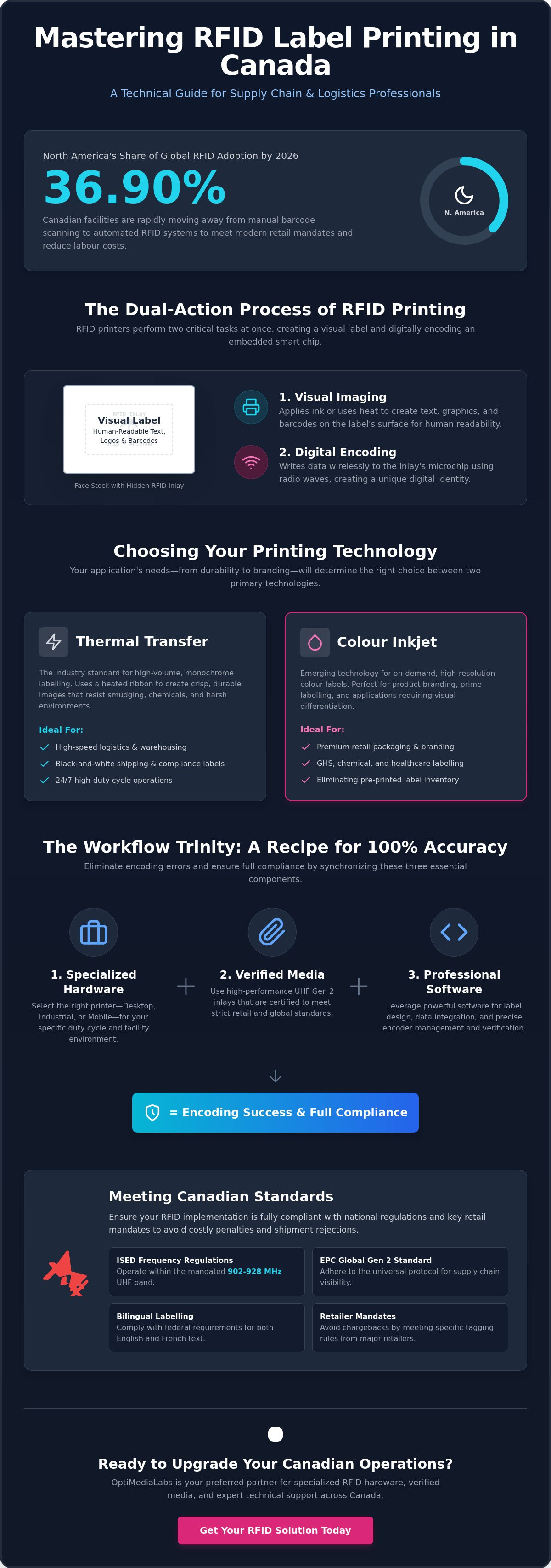
The Workflow Trinity: Integrating Software, Media, and Hardware
Success with RFID label printers Canada depends on the synergy between three specific pillars: the software driving the data, the media housing the chip, and the hardware executing the command. If one element is misaligned, the entire inventory system fails. You must treat these as a single integrated ecosystem rather than isolated purchases. A high-performance printer cannot compensate for poorly formatted data or a low-quality inlay that lacks the sensitivity to receive a signal.
Software: The Brain of Your RFID Operation
Professional labelling software acts as the translator between your database and the printer encoder. BarTender is the industry favourite for complex RFID data structures because it allows you to map Electronic Product Code (EPC) data directly to your existing database fields. It handles the heavy lifting of serialisation automatically. For businesses operating across multiple Canadian sites, NiceLabel provides a centralized management platform. This ensures that a label printed in a warehouse in Calgary is identical in format and encoding to one produced in Toronto. Larger enterprise-level operations often require Loftware to manage global supply chain integration and high-volume data streams.
Media Selection: Not All RFID Labels are Equal
Sourcing blank labels with verified UHF Gen 2 inlays is a technical requirement, not a suggestion. You must match the inlay's physical position on the liner to your printer’s internal antenna location. If the chip sits even a few millimetres outside the encoder's "sweet spot," the signal will be too weak to write data reliably. You also need to consider the physical environment of your facility. Standard labels fail when placed near liquid or metal. If you're tagging industrial machinery or metal containers, you must use "On-Metal" RFID tags. These specialized tags feature a buffer layer that prevents the metal surface from interference with the radio signal. Canadian warehouses with dense metal racking require thorough read-range testing to ensure the signal penetrates the environment effectively.
Calibration is the final step in the trinity. You must adjust the printer's power settings based on the specific sensitivity of your chosen inlay. Setting the power too high can lead to "over-encoding," where the printer accidentally writes data to the next tag on the roll. To maintain high standards, implement a quality control workflow that utilizes "void" printing. If the hardware detects a failed encode, it should immediately print a "VOID" pattern across the face stock. This prevents a non-functional tag from ever reaching your production line. Connecting your ERP system directly to the encoding engine ensures this data remains accurate and serialised in real-time. To build your complete system, you can view our selection of RFID-ready hardware and software to find compatible components.
Why OptiMediaLabs is Canada’s Preferred RFID Hardware Partner
Operational uptime is the primary metric for any industrial facility. If your encoding hardware fails, your entire distribution chain comes to a halt. OptiMediaLabs serves as a critical link in your supply chain by providing national Canadian distribution for all high-performance hardware and consumables. We ensure fast access to resources across the country, from major hubs in Ontario to remote distribution centres in the Prairies. Our curated brand selection includes only the industry leaders like Afinia, Zebra, and Toshiba. We provide the specific RFID label printers Canada requires to meet ISED frequency regulations and strict retail compliance standards.
We offer a comprehensive, one-stop procurement experience. You can source your industrial printers, thermal transfer ribbons, and specialized RFID media from a single, trusted entity. This ensures that every component of your "Workflow Trinity" is verified for compatibility before it reaches your floor. We realize that business continuity depends on more than just the initial hardware purchase. It requires a stable supply of brand-specific ink cartridges and high-sensitivity inlays. By consolidating your labelling infrastructure with us, you reduce the risk of mismatched media and encoding failures.
Expertise in Industrial Labeling Solutions
Our focus remains on high-performance hardware that outclasses generic office supplies. We understand the technical nuances of both inkjet and thermal transfer technologies. This expertise allows us to support various industrial needs:
- High-resolution colour inkjet RFID for premium retail and GHS compliance.
- Rugged thermal transfer RFID for 24/7 warehouse duty cycles.
- Brand-specific consumables including Zebra ribbons and Epson ink cartridges.
We maintain a reliable inventory of RFID label printers Canada stock to keep your operation running. This prevents stockouts that could jeopardize your retail mandates or logistics agreements. Whether you need a desktop unit for a small retail backroom or a rugged industrial powerhouse for a manufacturing plant, we provide the technical authority to guide your selection.
Streamlined Procurement for Canadian Enterprises
We prioritize professional, transactional efficiency. Busy operations managers don't have time for complex sales narratives or high-pressure tactics. You need clear technical specifications and a secure path to obtaining resources. OptiMediaLabs acts as an efficient facilitator for your labelling infrastructure. We provide a stable foundation for your RFID implementation, from the initial hardware selection to the ongoing supply of verified UHF Gen 2 media. We are a stable, established entity that values precision and customer satisfaction above all else.
Contact OptiMediaLabs today for a professional RFID hardware consultation. Our expertise ensures your Canadian facility remains compliant, efficient, and ready for the demands of the 2026 industrial landscape.
Future-Proof Your Canadian Supply Chain
OptiMediaLabs is your stable partner in this transition. As an authorized distributor for Afinia, Zebra, and Toshiba, we provide the technical expertise needed to integrate high-volume software like BarTender into your existing systems. We offer national Canadian shipping on all hardware and consumables to ensure your production lines never stop. Don't let technical complexity or non-compliance hold your business back. Take control of your encoding workflow and achieve the precision your logistics partners demand.
Browse our full range of RFID Label Printers and encoding hardware to secure your facility's future today. We're here to help you navigate every technical requirement with confidence.
Frequently Asked Questions
What is the difference between an RFID printer and a standard barcode printer?
An RFID printer contains an internal encoder that writes digital data to a chip, whereas a standard barcode printer only applies ink to the label surface. While both machines can produce visual text and barcodes, the RFID model performs a dual-action process. It simultaneously encodes the hidden inlay and verifies that the data was written correctly before the label exits the machine.
Do I need special software like BarTender to print RFID labels in Canada?
Yes, professional software is necessary to communicate with the encoding engine. Standard office applications cannot handle the complex data structures required for the Electronic Product Code (EPC). Using RFID label printers Canada businesses rely on often involves BarTender or NiceLabel to automate serialisation and ensure your digital tags match your physical inventory database.
Can I use any blank RFID label with my Zebra or Toshiba printer?
No, you must ensure the inlay's physical position on the liner matches the printer's antenna location. If the chip is placed outside the encoder’s "sweet spot," the signal will be too weak for a successful write. Always verify the inlay pitch and placement specifications with your hardware provider to avoid wasted media and frequent encoding errors.
Is it better to use thermal transfer or inkjet for RFID retail tags?
Thermal transfer is the established standard for high-speed, monochrome warehouse labels because of its durability and lower consumable costs. Inkjet technology is better for premium retail environments where you need full-colour branding. If your tags require GHS compliance or high-impact graphics alongside digital tracking, colour inkjet is the more efficient choice for single-pass production.
What happens if the printer fails to encode an RFID inlay?
Industrial printers feature an automatic "over-strike" or "void" function to handle failed encodes. If the internal sensor detects a defective chip, the printer will stop and mark the face stock with a "VOID" pattern. This prevents the non-functional tag from entering your supply chain and protects you from retailer chargebacks caused by dead tags.
How much does it cost to implement in-house RFID printing for a Canadian warehouse?
Total implementation costs depend on your required throughput and the environment of your facility. You'll need to account for the initial hardware investment, software licensing, and the ongoing cost of verified media. Because every facility has different technical needs, it's best to request a professional consultation to determine the specific budget for your logistics operation.
Can RFID labels be read through metal or liquid-filled containers?
Standard UHF labels won't work effectively when applied directly to metal or liquid-filled containers because these materials interfere with radio signals. You must use specialized "On-Metal" tags for these applications. These labels include a spacer that prevents the metal from grounding the antenna, ensuring your read ranges remain consistent in dense industrial environments.
What is the lifespan of an industrial RFID label printer?
A rugged industrial printer typically lasts between five and seven years in a high-volume environment. Regular maintenance of the printhead and internal sensors is critical to reaching this milestone. The RFID label printers Canada facilities use for 24/7 cycles are built with metal frames to withstand the dust and vibrations found in heavy manufacturing and distribution centres.