
ROI Calculator for In-House Colour Label Printing in 2026
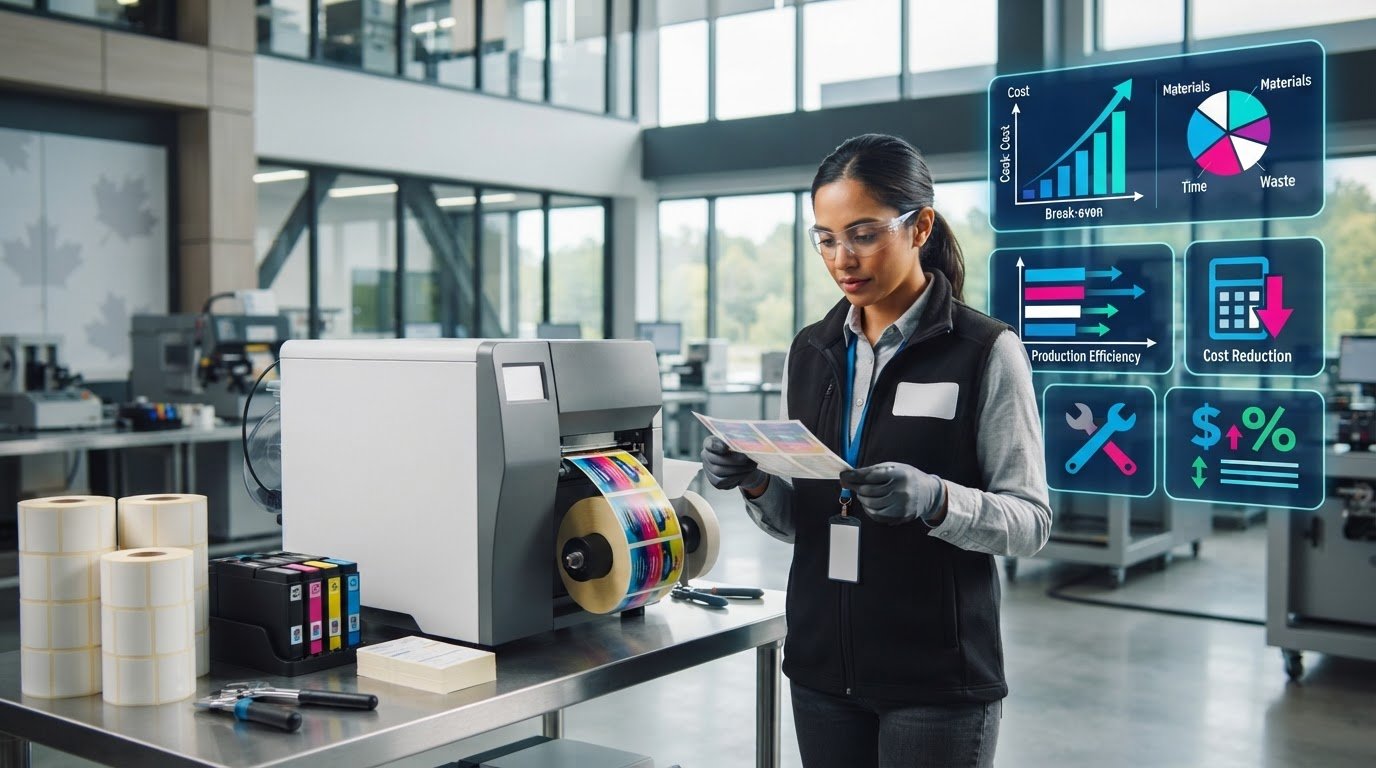
Will an in-house colour label printer pay back for your production workflow, or will ink, labour and wasted labels erode the savings? The ROI calculator for in-house color label printing 2026 should compare more than the printer purchase price with an outsourced quote. It should capture the full cost of producing and applying labels.
Whether your current or forecast volume justifies bringing production in-house depends on more than labels per year. Media compatibility, ink use, setup time, print waste, maintenance and downtime all affect your cost per usable label. Outsourced quotes also need to match your specifications, quantities and purchasing requirements before you compare them.
This guide shows you how to build a practical 2026 model using your own volumes and costs. Estimate in-house production cost, calculate a break-even volume and payback period, and identify which printer, ink and label-stock details to confirm before requesting a quote. Use the model to assess your actual workflow, not just the equipment price.
Key Takeaways
- Separate one-time equipment investment, recurring production costs and avoidable outsourced costs for a clearer ROI calculation.
- Use the ROI calculator for in-house color label printing 2026 to estimate break-even volume and payback from your own business inputs.
- Compare equivalent label dimensions, materials, finishes, colour requirements and quantities, then account for applicable fees and inventory effects.
- Test conservative, expected and higher-volume cases by changing volume, consumable yield, labour time, waste and order frequency.
- Before choosing a setup, confirm equipment specifications, label compatibility, consumables and finishing requirements with a qualified supplier.
What should an in-house colour label printing ROI calculator measure?
An in-house colour label printing ROI calculator compares the financial benefits of printing labels internally with the full cost of acquiring and operating the equipment. The return on investment (ROI) concept helps frame the comparison, but the result depends on your volumes, workflow and documented costs. Treat the ROI calculator for in-house color label printing 2026 as a planning estimate, not a promise of savings.
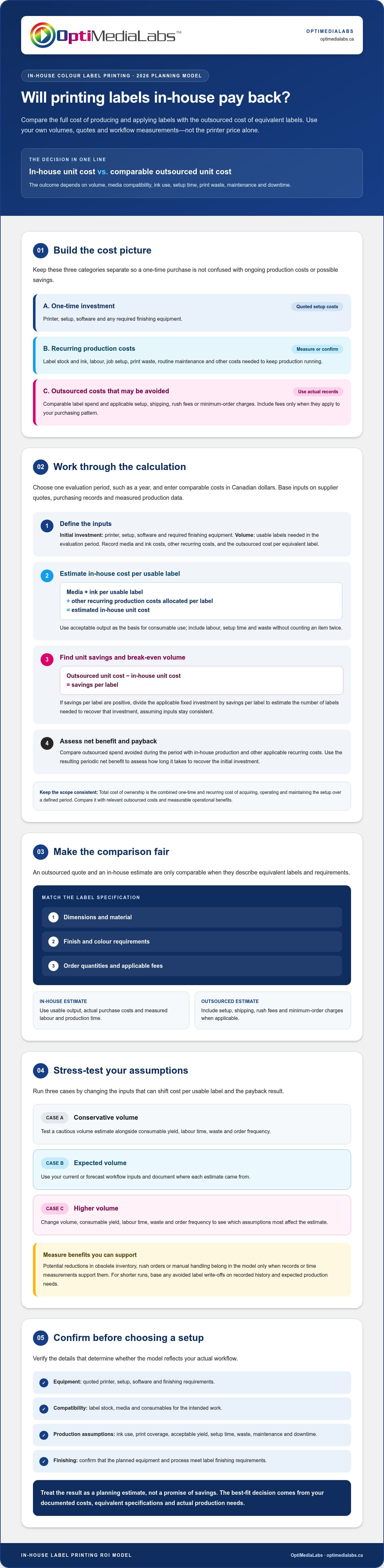
Keep three categories separate: one-time investment, recurring production costs and costs that in-house printing could avoid. This makes it easier to see what drives the result and update individual assumptions without mixing purchase costs with ongoing expenses.
Which costs belong in the in-house printing model?
Start with the equipment your workflow requires, not just the printer. Record quoted costs for the printer, setup, software and any necessary finishing equipment. Then estimate ongoing expenses using supplier information and measurements from your own production. Avoid assumed prices or generic cost-per-label figures that may not reflect your media or artwork.
- Consumables: Include label stock and ink. Confirm compatibility, then use measured consumption or supplier guidance for your planned media and print coverage.
- Production time: Include labour for preparing jobs, loading media, printing, checking output and finishing labels.
- Losses and upkeep: Account for expected print waste, routine maintenance and other costs required to keep production running.
Separate one-time purchases from recurring costs over the same evaluation period you’ll use to assess payback. Before entering quotes in your model, confirm equipment specifications, consumable compatibility and availability.
Which benefits count as measurable financial value?
Use benefits you can support with invoices, records or time measurements. Estimate the outsourced label spend that in-house production could replace, but compare equivalent label dimensions, materials, finishes, colour requirements and order quantities. Include setup, shipping, rush fees and minimum-order charges only when they apply to your current purchasing pattern.
You can also include documented reductions in obsolete inventory, rush orders or manual handling. For example, if shorter print runs could reduce labels discarded after a product change, base the estimate on recorded write-offs and expected production needs. Don’t count a possible improvement as a saving unless you can explain how it would occur and measure its value.
Total cost of ownership (TCO) for label production is the combined one-time and recurring cost of acquiring, operating and maintaining an in-house printing setup over a defined period. Compare that total with relevant outsourced costs and measurable operational benefits. Label estimates clearly, then test how changes in volume, waste or labour affect the result.
How to calculate break-even volume, payback, and ROI
Choose one evaluation period, such as a year, and enter comparable costs in Canadian dollars. The ROI calculator for in-house color label printing 2026 is only as useful as its inputs. Use supplier quotes, purchasing records and measured production data rather than assumed prices or yields.
- Define the inputs. Initial investment is the one-time cost of the printer, setup, software and required finishing equipment. Media and ink cost per usable label is based on actual purchase costs and the number of acceptable labels produced. Other recurring cost per label covers direct labour, setup time, waste and applicable ongoing costs, without counting any item twice. Outsourced unit cost is the current cost per equivalent label, including applicable charges. Volume is the number of usable labels required during the evaluation period.
- Calculate in-house unit cost. Add media and ink cost per usable label to other recurring production costs allocated per label. This gives the estimated in-house cost per usable label.
- Find unit savings and break-even volume. Subtract in-house unit cost from outsourced unit cost to find savings per label. If savings are positive, divide the applicable fixed investment by savings per label. The result is the number of labels needed to recover that investment, assuming the inputs remain consistent.
- Estimate periodic net benefit and payback. Subtract recurring in-house production costs and other applicable recurring costs from comparable outsourced spend avoided during the period. Divide initial investment by this periodic net benefit to estimate payback in periods. Match the periods in both inputs, such as monthly investment recovery using monthly net benefit.
- Calculate ROI for the evaluation period. Compare measurable benefits with all in-house costs incurred during that period, including the initial investment and recurring costs.
ROI (%) = (Net benefit ÷ Total investment) × 100
Net benefit is measurable financial value gained over the evaluation period, minus the total in-house costs for that period. Total investment is those in-house costs, including initial and recurring costs. Keep the evaluation period and cost categories consistent across both values.
How do you estimate cost per in-house label?
Use usable output, not the number of labels purchased or fed into the printer. Divide actual media and ink costs by the acceptable labels produced, then add labour, setup and waste once, allocating them across the relevant run or period. Review colour label printer options while confirming which equipment costs apply to your requirements.
How do you find the break-even point?
Compare the current outsourced unit cost with the calculated in-house unit cost for identical label specifications and quantities. Divide applicable fixed investment by positive per-label savings. If savings are zero or negative, the standard break-even formula won’t produce a meaningful volume. Recheck the assumptions or assess non-financial workflow benefits separately.
How to compare in-house and outsourced label costs fairly
Start with equivalent output. Match label dimensions, material, finish, colour requirements and order quantity before comparing unit costs. An outsourced quote for different stock, print coverage or run size isn’t a like-for-like input for the ROI calculator for in-house color label printing 2026.
Compare both options over the same period and usable label volume. Record outsourced setup, shipping, rush charges and minimum-order effects where they apply. Consider inventory effects too: a large order may leave you holding labels that become obsolete, while smaller in-house runs may change how much stock you keep. Include only effects you can document or reasonably support with business records.
Which production assumptions can distort the comparison?
Check that outsourced and in-house labels use comparable media and artwork coverage, since these affect material and ink use. Calculate cost per usable label, not per label started, and account for rejected or spoiled output on both sides where relevant. Keep current volume separate from forecast growth. Projections are scenarios to test, not guaranteed demand.
Use quotes and measured consumption rather than assumed prices or yields. Check whether outsourced charges are already included in the quoted unit price so you don’t count them twice. For equipment evaluation, consult the Afinia colour label printer buyer’s guide alongside current specifications and supplier information.
How do consumables and finishing affect unit economics?
Ink and media yield depend on the planned artwork, label stock and production conditions. Verify expected consumption for your requirements, then use the resulting usable output in the unit-cost estimate. Include a cutter or other finishing equipment only if your workflow needs it. If finishing is outsourced, add that cost to the outsourced comparison. Review Afinia label options when assessing compatible media.
To check assumptions about equipment and supplies, you can discuss your equipment and supply requirements with OptiMediaLabs Canada, a Canadian distributor of colour label printers, consumables and finishing equipment.
How to stress-test the 2026 ROI estimate before buying
A single forecast can hide how sensitive the result is to changing production conditions. Use the ROI calculator for in-house color label printing 2026 to compare three clearly labelled cases: conservative, expected and higher-volume. Base each case on stated business assumptions, not a savings target. Keep the evaluation period and label specifications consistent so you can see which inputs drive the differences.
- Conservative: Use lower expected monthly volume, cautious consumable yield, more labour time and higher waste based on your records or reasonable planning assumptions.
- Expected: Use the best-supported estimate from current demand, measured run times and supplier guidance.
- Higher-volume: Model a plausible increase in demand, clearly marked as a forecast rather than committed volume.
Change one input at a time as well as testing complete scenarios. Monthly volume and outsourced order frequency affect how often you avoid ordering externally. Consumable yield and waste change the cost of each usable label. Labour time can also shift the result, especially if setup and handling take longer than expected. Note which adjustment causes the largest change in break-even or payback. That is the assumption to validate first.
What data should you collect before trusting the result?
Gather recent outsourced invoices, label specifications, order quantities and rush-order records. Measure setup and handling time across representative runs, including short and larger batches if your workflow varies. Record usable output and spoiled labels. Before settling equipment and consumable assumptions, request current supplier information on specifications, compatibility, yield guidance and availability.
Date your 2026 quotes and confirm they still apply before making a purchase decision. Treat taxes, financing costs and accounting treatment as items to verify with an authoritative Canadian source or qualified advisor. Don’t build the model around an unconfirmed tax benefit or financing assumption.
How should you interpret a weak or uncertain payback case?
Trace the result to its drivers. Low monthly volume may spread the initial investment across too few labels. High waste or lower-than-expected consumable yield can raise unit cost, while longer labour time can reduce net benefit. Test whether updated measurements or a different production workflow change the result, but don’t adjust inputs simply to make payback look favourable.
Direct savings aren’t the only consideration. Document operational benefits, such as having labels available for changing requirements, and assess their business value separately if you can’t reliably quantify them. Report the full scenario range, key assumptions and unresolved questions. The estimate is a decision aid, not a guarantee of savings or payback.
To review equipment and consumable assumptions for your scenarios, contact OptiMediaLabs to discuss your requirements.
Choose a colour label printing setup that fits your ROI case
Use the calculator to define the workflow a printer must support, then check that the equipment matches it. Consider regular and peak print volumes, label dimensions and format, colour coverage, media requirements, and whether labels need cutting or other finishing. A printer that supports your label stock but can’t meet your production pace or finishing needs may not deliver the assumptions used in your ROI estimate.
OptiMediaLabs is a Canadian distributor of colour label printers, compatible supplies and label finishing equipment. The company sells products for businesses to print their own labels; it doesn’t provide custom label printing or label design services. Explore Afinia printer options if Afinia equipment fits your evaluated workflow, and confirm current specifications before selecting a model.
What should buyers confirm with a printer supplier?
Ask for current product information that matches your intended use. Confirm supported media and label formats, expected consumable use for your artwork and production conditions, and whether the workflow requires separate cutting or finishing equipment. Clarify which items are included in the quote and which require separate equipment, software, ink or labels. Verify consumable compatibility and availability before treating the figures as final calculator inputs.
Use model-selection resources for additional context, but make your decision using confirmed specifications and the labels you actually produce. A broad product description alone can’t establish suitability for your media, volume or finish requirements.
When is the ROI model ready to support a purchase decision?
Your estimate is more decision-ready when it remains acceptable under conservative, evidence-based assumptions and the proposed equipment and consumables fit your actual workflow. If the case depends on unconfirmed volume growth, unusually low waste or unverified yield, pause and validate those inputs. Keep the scenario range and outstanding questions with the calculation.
Final decision checklist:
- Have you matched printer capacity to current volume and plausible peak demand?
- Are label dimensions, media, colour needs and finishing requirements supported?
- Have you confirmed current specifications, consumable compatibility and what the quote includes?
- Does the conservative case still meet your business’s purchase criteria?
Once you’ve completed the checklist, you can discuss your label printing requirements with OptiMediaLabs and review the equipment and supply assumptions in your calculation.
Make your next label-printing decision with confidence
A reliable ROI estimate starts with your actual workflow. Include the full cost of in-house production, compare it with outsourced labels that match your specifications, and test conservative as well as expected volume assumptions. The ROI calculator for in-house color label printing 2026 can help clarify break-even and payback, but its results remain estimates based on verified costs, usable output and realistic demand.
Before choosing equipment, confirm that its specifications, compatible media and consumables, and any finishing requirements suit the labels you need to produce. OptiMediaLabs Canada distributes professional colour label printers and related supplies, including equipment from trusted industry manufacturers like Afinia and VIPColor.
Have your volume estimates and label requirements ready? Discuss your colour label printing requirements with OptiMediaLabs Canada to review the equipment and supply details relevant to your calculation. Clear inputs and a setup matched to your needs can help you make a more informed decision.
Frequently Asked Questions
What is the formula for calculating ROI on an in-house colour label printer?
Calculate ROI as net benefit divided by total investment, multiplied by 100. Net benefit is the measurable financial value gained during the evaluation period minus the full in-house costs for that period. Total investment includes initial equipment and setup costs, plus the recurring costs included in the model. Use the same time period for both figures and enter actual operating inputs. The formula can’t make an estimate reliable if benefits and costs aren’t measured consistently.
How do you calculate the break-even point for in-house label printing?
Divide applicable fixed investment by per-label savings, but only when those savings are positive. Fixed investment is the relevant one-time equipment and setup cost. Per-label savings are the comparable outsourced unit cost minus the in-house unit cost. Compare equivalent label specifications and include expected waste when calculating usable-label costs. If in-house cost equals or exceeds the comparable alternative, this standard break-even calculation isn’t meaningful because each label doesn’t recover the investment.
How much does it cost to print colour labels in-house in 2026?
There’s no universal cost per label. Your result depends on equipment, ink, media, labour, waste, production volume and workflow. Use current supplier quotes in C$ and measured consumable use to estimate the cost per usable label, accounting for rejected output. An ROI calculator for in-house color label printing 2026 should reflect your label requirements, not a generic price range. Update the estimate when quotes, volumes or operating assumptions change.
How many labels do you need to print in-house for a printer to pay for itself?
There’s no universal volume threshold for printer payback. The required label count depends on initial investment, comparable outsourced unit cost, in-house variable cost per usable label and production volume. Calculate break-even by dividing applicable fixed investment by positive per-label savings. Then test the result against conservative and expected volume scenarios. If the in-house unit cost equals or exceeds outsourcing, the standard break-even formula won’t provide a meaningful label count.
Can in-house colour label printing save money for a small business?
It can, but the result depends on order patterns, label requirements, labour, waste and how fully the equipment is used. Compare actual outsourced invoices with current equipment and consumable quotes for equivalent labels and quantities. Control, responsiveness or reduced inventory may also matter to the business, but count them as financial value only when you can substantiate their impact. Model realistic volume and usable output rather than assuming that bringing printing in-house automatically reduces costs.
What costs should an in-house label printing ROI calculator include?
Include equipment, setup, software where applicable, media, ink, labour, expected waste, maintenance and finishing equipment when required. For the outsourced alternative, include applicable supplier charges, shipping, rush costs, order minimums or inventory effects. Use records and current supplier quotes to verify amounts, and keep the comparison period consistent. Check for bundled charges before adding them separately so setup or shipping isn’t counted twice.
How long does it take for an in-house colour label printer to pay for itself?
Payback depends on upfront investment and the net benefit achieved in each period, so it varies with workflow and volume. A basic estimate is initial investment divided by net benefit per period, where net benefit is comparable outsourced costs avoided minus recurring in-house costs for that same period. Model conservative and expected scenarios, and state the period, assumptions and excluded costs clearly. The calculation is an estimate, not a guaranteed timeline.