
Teklynx Labelview vs BarTender Label Design Software: 2026 Comparison
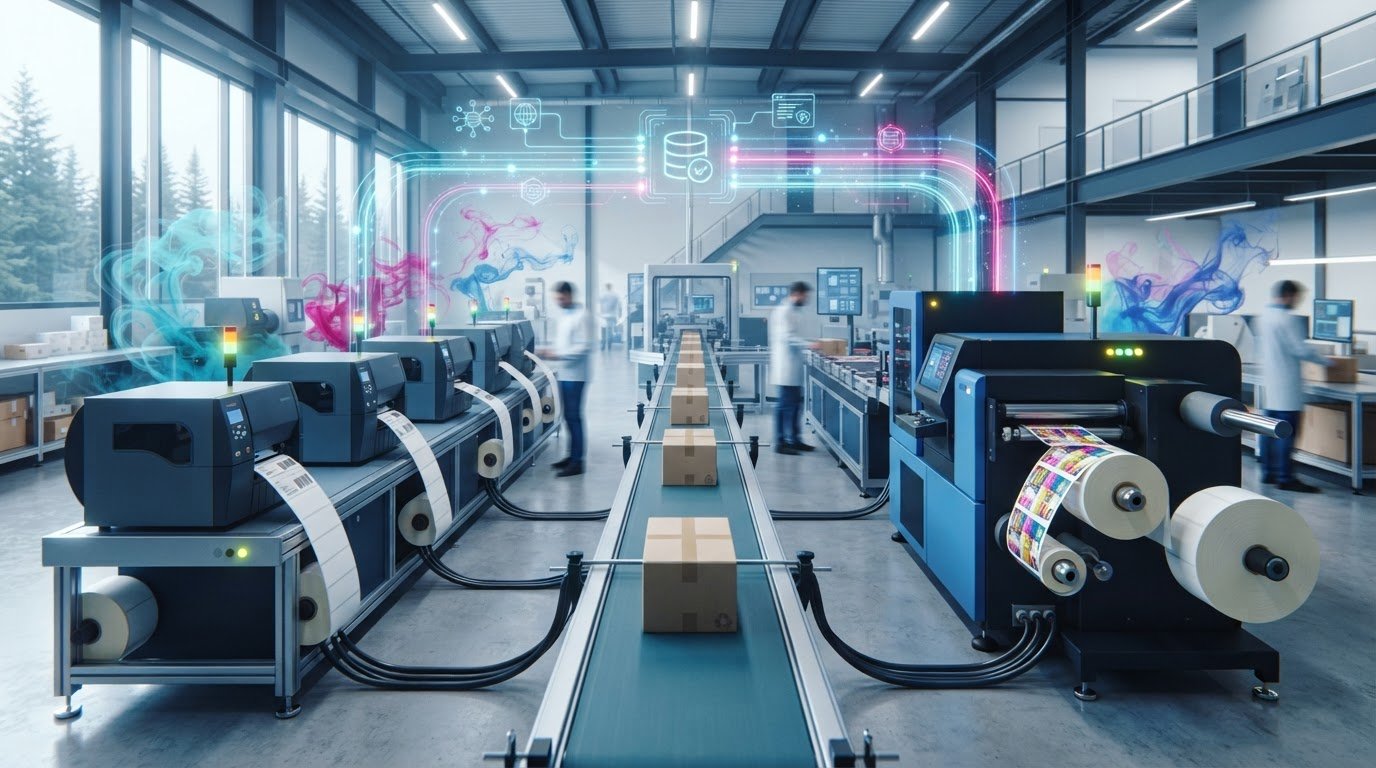
The most expensive bottleneck on your packaging line often isn't your physical hardware; it's the software queue feeding it. When evaluating Teklynx Labelview vs BarTender label design software, facilities frequently realize that driver stability and clean database integration dictate line uptime far more than template aesthetics. You already know the frustration of production stoppages caused by spooler crashes, mixed-fleet driver conflicts, or messy ERP spreadsheet handoffs. You need a platform that prints reliably without unpredictable licensing surprises.
This 2026 comparison evaluates both platforms across critical operational benchmarks, including mixed thermal and colour printer compatibility, database connectivity, and licensing structures that scale alongside your business. We'll examine how each suite handles regulatory compliance mandates, driver architecture, and operator interfaces, helping you select the ideal software engine for your facility.
Key Takeaways
- Assess Teklynx Labelview vs BarTender label design software across core functional tiers to determine whether mid-level database linking or enterprise-grade automation aligns with your production goals.
- Identify key differences in template canvas tools, dynamic database connections, and emerging packaging compliance standards to minimize manual operator touchpoints.
- Evaluate how native driver architectures impact overall throughput and print queue stability across mixed fleets of thermal barcode and colour label printers.
- Compare workstation-seat structures against centralized, printer-based licensing to forecast long-term operating costs and avoid unexpected expansion fees.
- Follow a step-by-step audit framework evaluating template complexity, legacy ERP connections, and active hardware assets to make an informed software investment.
Evaluating Teklynx Labelview vs BarTender Label Design Software
In high-throughput manufacturing, label software serves as the operational bridge connecting your product databases to physical marking hardware. Choosing between Teklynx Labelview vs BarTender label design software determines how efficiently your production line manages data handoffs, printer command spooling, and inventory compliance. While basic software utilities can generate a standard 2D code, automated packaging lines require robust engines that handle variable data in real time without bottlenecking the print spooler.
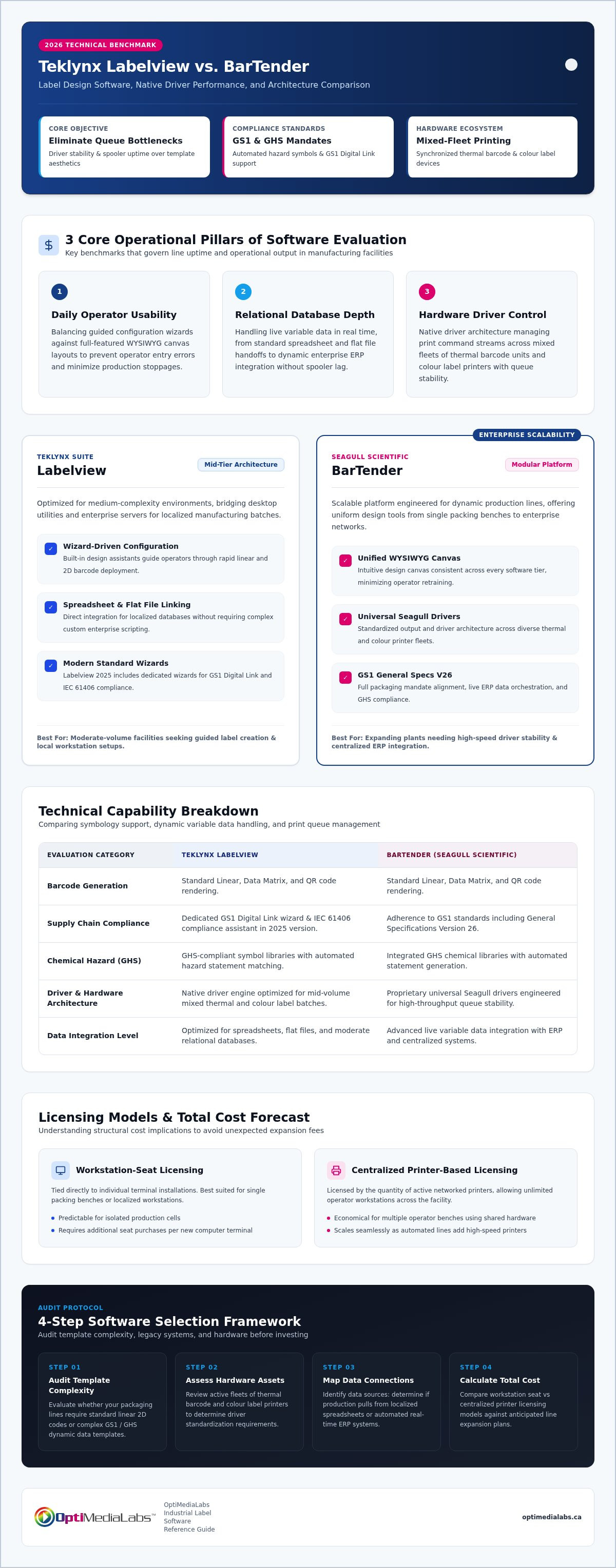
Modern production facilities demand a transition away from static label designs toward dynamically driven workflows. Baseline evaluation criteria centre on three operational pillars: daily operator usability, relational database integration depth, and granular hardware driver control. If an engine mismanages print streams across mixed thermal and colour fleets, unexpected spooler errors occur. This directly triggers production downtime, wasted media rolls, and non-compliance fines from retail distribution centres.
Teklynx Labelview Architecture and Ideal Use Cases
Positioned within the broader Teklynx hierarchy, Labelview functions as a mid-tier solution optimized for medium-complexity environments. It bridges the gap between rudimentary desktop utilities and complex enterprise automation servers. Built-in configuration wizards guide operators through standard linear and 2D generation, ensuring rapid template deployment. This structure suits facilities running moderate-volume, localized manufacturing batches that pull product identifiers from spreadsheets or flat files without requiring custom enterprise scripting.
BarTender by Seagull Scientific Platform Overview
BarTender by Seagull Scientific delivers a scalable, modular architecture engineered for complex production floors. Whether deployed on a single packing bench or orchestrated across enterprise systems, the software uses an intuitive WYSIWYG canvas across every edition. Production teams looking to expand infrastructure often consult The Professional Guide to Barcode Labeling Software to map software editions against enterprise resource planning (ERP) systems. By utilizing Seagull's universal driver architecture, it ensures standardized output across diverse machinery.
For organizations managing extensive distribution operations across Canada, selecting between these platforms requires balancing software features against operational complexity. Many facilities also evaluate specialized tools such as NiceLabel barcode and label design software or Loftware Cloud software when auditing cross-platform cloud ecosystems. Ultimately, comparing Teklynx Labelview vs BarTender label design software helps plant managers determine whether a wizard-driven local workstation or a modular, driver-centric platform best preserves printing uptime while accurately rendering each Barcode across packaging lines.
Core Feature Comparison: Template Design, Data, and Compliance
Direct comparisons between Teklynx Labelview vs BarTender label design software reveal fundamental differences in how each application manages template design, data integration, and compliance rules. Both platforms feature precise drag-and-drop design canvases with snap-to-grid tools and dynamic graphic rendering. However, their internal architectures handle live variable data and operator input using noticeably different workflows.
Barcode Generation, Serialization, and Compliance Standards
Both applications generate standard linear symbologies, Data Matrix, and QR codes accurately. Where they diverge is in automated compliance validation. Labelview 2025 features dedicated design assistants for modern barcode standards, including direct support for the GS1 Digital Link wizard and IEC 61406 requirements. BarTender delivers equivalent support across global packaging mandates, maintaining strict adherence to GS1 standards such as General Specifications Version 26. For chemical manufacturing, both platforms incorporate GHS-compliant symbol libraries with automated hazard statement matching. Plant supervisors balancing complex packaging mandates can verify their supply chain requirements using the Industrial Labeling Solutions Reference Guide.
Database Linking and Dynamic Data Entry Forms
Connecting variable text to label objects determines operator efficiency. Labelview simplifies mid-level data pulling through standard ODBC and OLE DB drivers, featuring an intuitive database query assistant that links multiple disparate spreadsheets without manual SQL coding. In contrast, BarTender excels at interactive shop-floor controls. Its customizable data-entry forms allow system administrators to build locked-down operator prompts, complete with drop-down menus, automated record lookups, and visual data validation before printing commences.
| Operational Capability | Teklynx Labelview | BarTender (Seagull Scientific) |
|---|---|---|
| Data Integration | ODBC, OLE DB, Excel, cloud storage (Google Drive, OneDrive) | ODBC, OLE DB, direct enterprise SQL, cloud database connectors |
| Operator Print Interface | Form design utilities within Pro/Gold tiers | Configurable, touch-screen-ready data entry forms |
| Custom Logic | Basic formulas and formula builders | Advanced Visual Basic (VB) Scripting across all data fields |
| Global Compliance Tools | GS1 Digital Link wizard, GHS pictogram tools | Automated GS1 Application Identifiers, native GHS templates |
When custom data calculations, concatenation, or mathematical formulas are required on the packaging line, BarTender's Visual Basic scripting provides deeper programmatic customization. If your facility needs guidance mapping your legacy spreadsheets or ERP outputs to the right software engine, you can speak with our technical team to audit your operational requirements.
Printer Driver Performance, Hardware Support, and Integration
Print spooler efficiency directly dictates your production speed. When comparing Teklynx Labelview vs BarTender label design software, driver architecture often separates continuous line speed from frustrating bottleneck pauses. Standard generic Windows print drivers convert labels into bulky raster images, choking local networks. Industrial label suites bypass this limitation by translating label elements directly into native printer languages like ZPL, EPL, and DPL.
Driver Architecture: Drivers by Seagull vs Teklynx Embedded Drivers
Driver architecture represents a distinct engineering contrast between both suites. TEKLYNX develops embedded drivers for over 4,000 printer models, communicating directly with printer firmware to ensure precise head-temperature control and font recall. Conversely, Seagull Scientific maintains a dedicated library supporting over 11,000 printer models. Drivers by Seagull generate clean printer command code, offloading rendering calculations to the printer hardware itself. This optimization minimizes spool file sizes, eliminating communication lag during high-speed, continuous batch production runs.
Hardware Fleet Flexibility: Thermal Barcode and Colour Label Printers
Modern packaging environments rarely rely on a single printer brand. Warehouses frequently run thermal transfer units for shipping alongside high-resolution colour inkjet printers for secondary retail packaging. Evaluating BarTender Label Design Software by Seagull shows strong cross-platform stability across mixed hardware fleets, including industrial systems from Zebra, Epson, and Afinia. BarTender provides robust color management and ICC profile handling, ensuring dynamic colour graphics print with brand consistency. While Labelview handles thermal barcode fleets reliably, managing high-definition variable colour profiles across mixed inkjet hardware often requires more manual calibration.
Enterprise Connectivity: ERP, WMS, and Automation Triggers
Automating production print jobs eliminates operator touchpoints entirely. BarTender handles automated data ingestion through its Integration Builder utility, orchestrating headless printing triggered by file drops (XML, CSV), direct TCP/IP socket messages, or database insertions. Labelview utilizes command-line parameters and basic file-drop monitoring for automated execution. However, large enterprise plants running complex ERP environments often transition to centralized enterprise frameworks such as Loftware Cloud software to manage multi-facility distribution workflows seamlessly.
For high-throughput packaging operations balancing thermal engines and on-demand colour hardware, choosing between Teklynx Labelview vs BarTender label design software ultimately rests on your hardware diversity and required level of background automation.
Licensing Models, Scalability, and Total Cost of Ownership
Software acquisition models fundamentally alter your long-term return on investment. When evaluating Teklynx Labelview vs BarTender label design software, operations teams must look beyond initial deployment and assess how licence models accommodate hardware expansion. An edition structure that fits a single packaging station can generate friction when you add backup lines or additional shipping docks.
Workstation-Based vs Printer-Based Licensing Explained
The primary financial divide between these platforms stems from what the licence actually counts. Labelview Pro and Gold editions generally utilize workstation-based licensing, tying software activation to specific client computers while allowing output to an unlimited number of connected printers. This architecture benefits small packaging rooms where one or two dedicated computers drive multiple desktop thermal units.
BarTender approaches scaling from the opposite perspective, deploying a network-centric model tied to the number of active, communicating printers. System administrators can install the client software across unlimited workstations throughout the facility. Operators across assembly benches, receiving docks, and packaging cells can all access centralized label designs without purchasing additional user seats. If your plant operates dozens of packing benches printing to just two shared high-speed engines, BarTender's printer-based architecture significantly reduces administrative overhead.
Subscription Lifecycles, Version Upgrades, and Technical Support
Both vendors offer traditional perpetual licences alongside modern annual subscriptions. Selecting the optimal software route requires auditing ongoing infrastructure requirements:
- Perpetual Licences: Involve higher upfront capital investment, granting permanent use of a static software build. They require separate annual maintenance contracts to maintain access to technical support and critical security patches.
- Annual Subscriptions: Shift procurement into operating budgets, guaranteeing ongoing compatibility with updated Windows operating systems, refreshed ERP database drivers, and cloud-storage updates.
Running unmaintained legacy software builds introduces severe operational hazards. As network security protocols evolve, out-of-date label engines create authentication failures across SQL databases and enterprise network shares. When auditing licensing flexibility and hybrid migration options, many Canadian facilities also benchmark NiceLabel barcode and label design software to evaluate multi-site centralized management.
To avoid unexpected upgrade fees and select the ideal licensing tier for your current hardware count, request a licensing consultation with our technical specialists today.
Decision Framework: Selecting the Right Label Software for Your Facility
Selecting between Teklynx Labelview vs BarTender label design software requires a structured audit of your operational reality. Before purchasing licences, catalogue every active thermal desktop, industrial engine, and colour inkjet unit on your plant floor. Next, evaluate your template inventory and data sources. If your workflow relies on decentralized spreadsheets, your software requirements differ drastically from an operation running automated database transactions across enterprise networks.
When to Choose Teklynx Labelview
Teklynx Labelview delivers an ideal balance for facilities operating dedicated, self-contained packaging lines. Choose Labelview if your operation matches these parameters:
- Your production relies on fixed workstations where individual design seats handle multiple local printers.
- Your facility has an existing library of Teklynx label assets and prefers preserving familiar operator workflows.
- Your labelling requirements centre on standardized compliance formats and wizard-guided designs without needing custom programming.
When to Choose BarTender by Seagull Scientific
BarTender serves environments that demand centralized administration and automated print execution. Select BarTender if your workflow requires:
- Automated print jobs triggered directly by ERP, WMS, or file-drop integrations without manual operator interaction.
- Centralized network licensing that allows unlimited workstations and operators across the floor to share networked printers.
- Customized, locked-down data entry forms designed to prevent shop-floor typing errors on touch-screen terminals.
Template Migration, Proof of Concept, and Deployment Support
Neither platform converts proprietary label template files with complete fidelity. Transitioning between vendors requires auditing existing templates, rebuilding core label formats, and verifying dynamic data links. Always execute a controlled proof of concept before deploying software across active packaging lines. Print live sample batches on production label media, validating barcode scan grades, font scaling, and cutter responsiveness under real-time line speeds.
Selecting the right software edition safeguards your facility against unexpected upgrade costs as your hardware fleet expands. Reach out to our technical software specialists to configure your licensing, audit hardware compatibility, and ensure a seamless deployment across your facility.
Optimize Your Packaging Line with the Right Label Architecture
Selecting between Teklynx Labelview vs BarTender label design software comes down to matching your operational reality. Choosing the right platform balances workstation-level simplicity against automated, enterprise-wide print spooling. The proper software engine prevents print line stoppages, maintains strict GS1 and GHS compliance, and scales smoothly alongside your hardware.
As an authorized distributor across the country for BarTender, Teklynx, NiceLabel, and Loftware platforms, OptiMediaLabs Canada assists operations in pairing software editions with industrial thermal transfer units and colour label printers. We complement your software setup with complete consumables support, including verified label media and matched thermal transfer ribbons, ensuring continuous print quality from day one.
Contact our label software specialists to audit your print fleet, configure your software licences, and build an efficient, error-free labelling operation today.
Frequently Asked Questions
Can BarTender open and convert Teklynx Labelview label files directly?
No, BarTender cannot natively open or convert proprietary Teklynx Labelview (.lbl) files directly. Both platforms utilize distinct, proprietary template architectures. Migrating between them requires rebuilding label layouts within BarTender's design canvas and reconnecting database sources. While static graphic assets can be imported, text fields, serialization formulas, and barcode symbology settings must be manually reconfigured to ensure complete scan integrity on the packaging line.
What is the difference between Teklynx Labelview Pro and Labelview Gold editions?
Labelview Pro is designed for mid-tier operations using simple database connections, while Labelview Gold includes advanced enterprise connectivity and security controls. Pro connects to flat files and spreadsheets via OLE DB or ODBC. Gold unlocks advanced SQL queries, command-line automation, multi-table database joins, and password protection for template files. Facilities requiring complex database queries or administrative security controls typically upgrade to Gold.
How does BarTender count printers under its network licensing model?
BarTender counts unique physical or network printers that receive a print job from the software within a rolling seven-day period. Under this architecture, an unlimited number of networked workstation computers can send jobs to the licensed queue. A printer only consumes a licence seat once it executes an active print job. If a device stops printing for seven days, its licence seat releases automatically.
Are Seagull Scientific drivers compatible with Teklynx Labelview software?
Yes, Seagull Scientific printer drivers function as standard Windows drivers and are fully compatible with Teklynx Labelview. When evaluating Teklynx Labelview vs BarTender label design software, many operators intentionally pair Seagull drivers with Labelview. While Teklynx includes proprietary embedded drivers, Seagull drivers provide reliable throughput across thermal and colour units. This hybrid combination allows Labelview to communicate cleanly with Zebra, TSC, and Epson hardware.
Can both Teklynx Labelview and BarTender print full-colour labels to inkjet printers?
Yes, both software packages support full-colour label printing across industrial inkjet systems like Afinia, Primera, and Epson. Each platform sends colour raster graphics and dynamic images to standard Windows-compatible inkjet drivers. BarTender offers broader native colour profiling and PANTONE matching tools within its canvas. This simplifies high-resolution packaging runs where precise corporate branding and variable colour coding are mandatory.
What happens if a network printer exceeds my BarTender printer licence limit?
BarTender provides a 30-day grace period when an unlicensed printer receives a print job, preventing immediate production line stoppages. During this window, the software continues spooling jobs to the new hardware while logging licence compliance warnings in the Administration Console. If you don't license the additional printer before the grace period expires, BarTender halts print jobs to that specific hardware address until licensing adjusts.
Is an active internet connection required to run BarTender or Labelview?
No, neither BarTender nor Teklynx Labelview requires a continuous internet connection for day-to-day packaging line production. Both platforms run locally installed on-premises client engines. Perpetual licences only require initial online activation, while annual subscription tiers verify licence status periodically via background web pings. In the comparison between Teklynx Labelview vs BarTender label design software, both systems ensure local plant floor production continues uninterrupted during network outages.