
The Comprehensive Guide to 110Xi4 Ribbons for Canadian Industrial Labelling
Your Zebra 110Xi4 remains a high-performance workhorse, but using the wrong 110xi4 ribbons will turn it into a costly bottleneck before your next shift ends. You already know that maintaining high-speed production requires more than just a functional printer. It demands specialized consumables that don't snap under tension or smudge on glossy synthetic labels. Dealing with inconsistent print quality and failed barcode scans is a drain on your facility's efficiency and your bottom line.
This comprehensive guide ensures you master the technical specifications and selection criteria to keep your operations running smoothly. Precision matters. We'll show you how to match specific formulations to your substrates to achieve crisp, durable barcodes while minimizing expensive printhead wear. We will examine wax, resin, and hybrid options to streamline your procurement through a reliable Canadian distributor. By the end of this article, you'll have the technical knowledge to realize better print results and maintain the stability of your industrial labelling workflow.
Key Takeaways
- Understand how the interaction between thermal transfer chemistry and the printhead impacts the long-term reliability of your hardware.
- Learn to distinguish between wax, resin, and hybrid formulations to ensure your labels withstand harsh Canadian industrial environments.
- Apply technical sizing rules for 110xi4 ribbons to prevent premature edge wear and maximize your printer's daily roll capacity.
- Identify the correct ribbon types for specialized regulatory applications, including GHS chemical safety and freezer-grade food labelling.
- Streamline your procurement process by sourcing from a national distributor to eliminate cross-border customs delays and hidden fees.
Understanding the Zebra 110Xi4 Thermal Transfer Mechanism
The Zebra 110Xi4 is widely recognized as a heavy-duty industrial workhorse, specifically engineered for 24/7 operations in demanding environments. While newer models have entered the market, many Canadian businesses continue to rely on the Xi4 series for its rugged durability and high-speed output. Achieving peak performance from this hardware depends entirely on the consumables you select. Understanding the Zebra 110Xi4 Thermal Transfer Mechanism is essential for anyone managing high-volume labelling lines. Unlike direct thermal printing which uses heat-sensitive paper, thermal transfer uses a heated printhead to melt ink from 110xi4 ribbons onto the substrate. This process creates a permanent, crisp image that withstands friction, heat, and moisture.
Ribbon quality directly impacts the lifecycle of your printhead. Low-grade ribbons often lack adequate back-coating, which leads to increased friction and static buildup. This friction acts like sandpaper, grinding down the delicate heating elements of the printhead over time. By investing in high-quality Zebra ribbons, you protect your hardware investment. You also avoid the frequent, costly replacement of printheads that can disrupt your production schedule and inflate your operational costs.
The 110Xi4 Printhead and Ribbon Synchronicity
The 110Xi4 supports multiple resolutions, typically 203, 300, or 600 dpi, depending on your specific model. Each resolution requires precise ribbon synchronicity to ensure the ink transfers cleanly without bleeding or skipping. High-quality ribbons feature a specialized back-coating designed to dissipate static and reduce drag across the printhead. Properly calibrated tension settings are also vital; if the ribbon is too loose, you'll see smudging, while excessive tension can cause the ribbon to snap during high-speed runs. Maintaining this balance ensures consistent scan rates for your barcodes.
Why Ribbon Choice Dictates Production Speed
Production throughput is limited by how quickly the ink can reach its melt point and bond with the label material. 110xi4 ribbons are formulated with specific melting characteristics to match the printer's high-speed capabilities. If you use a ribbon with a high melt point at top speeds, you'll be forced to increase the darkness or heat settings. This often leads to "burn-through," where the heat damages the ribbon carrier or the printhead itself. Selecting a ribbon with a lower-energy release allows for faster print speeds without compromising the integrity of the barcode or the longevity of the equipment.
Ribbon Formulations: Wax vs. Wax/Resin vs. Resin
Selecting the right formulation for your 110xi4 ribbons is a technical decision that balances chemistry with specific application requirements. Thermal transfer ink isn't a one-size-fits-all solution. It relies on a precise blend of waxes and resins that determine how well the image bonds to the label substrate. High-volume Canadian facilities must evaluate scratch resistance, chemical exposure, and heat tolerance to avoid the operational delays caused by unreadable barcodes. Matching the ink's melting point to your production speed ensures that every label remains crisp and scannable throughout the supply chain.
Wax Ribbons for General Purpose Labelling
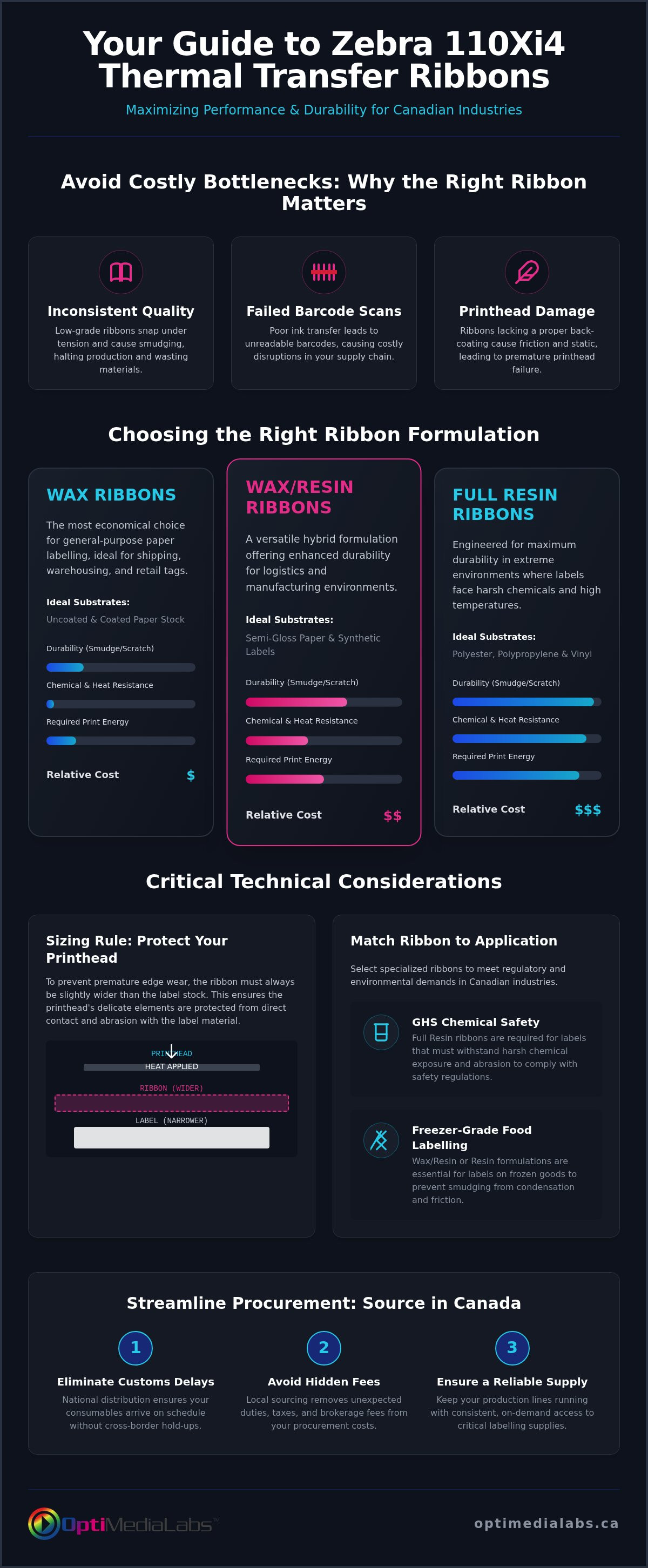
Wax is the most economical choice for standard industrial applications. This formulation uses a high percentage of wax-based components with a relatively low melting point. This allows the Zebra 110Xi4 to operate at lower heat settings, which helps extend the life of your printhead. These ribbons are ideal for uncoated or coated paper stocks typically used in shipping, warehousing, and retail tagging. While cost-effective, wax ribbons offer limited resistance to smudging or heavy friction. If your labels are subject to frequent handling or outdoor exposure, a more durable formulation is required.
Wax/Resin Ribbons for Enhanced Durability
This hybrid formulation incorporates resin to increase the ink's bond with the substrate, creating a middle-ground solution for semi-gloss and synthetic labels. In logistics and manufacturing environments where labels are frequently rubbed against other surfaces, wax/resin ribbons provide significant smear and scratch resistance. You'll need to slightly adjust the darkness settings on your 110Xi4 to realize the full durability benefits of this blend. For facilities handling diverse inventory, this versatility often justifies the slightly higher price point. If you need help determining the best fit for your substrate, contact our technical specialists for assistance.
Full Resin Ribbons for Extreme Environments
Full resin ribbons are engineered for the harshest industrial conditions. They offer maximum resistance to chemicals, solvents, and extreme temperatures. These are essential for Canadian manufacturers who must meet UL/CSA compliance standards for permanent labelling on electronics, automotive parts, or chemical drums. When paired with polyester or high-end synthetic labels, resin creates a bond that is nearly impossible to scratch or dissolve. While the cost per roll for these 110xi4 ribbons is higher, the reliability in extreme environments prevents the catastrophic cost of regulatory non-compliance or lost product traceability.
Large-scale operations must weigh the initial procurement cost against the potential for failure. Using an inexpensive wax ribbon on a chemical-exposed label results in scan failures and data loss. Conversely, using resin for simple shipping labels is an unnecessary expense. Sourcing high-quality Zebra ribbons ensures you have the right formulation to protect both your labels and your hardware investment.
Technical Sizing Guide for 110Xi4 Ribbons
Precision sizing is a non-negotiable requirement for industrial thermal transfer printing. Your 110xi4 ribbons must align perfectly with both the printer's mechanical specifications and the specific dimensions of your label stock. The Zebra 110Xi4 utilizes a standard 1-inch (25.4mm) core and requires an ink-out (coated side out) winding direction. Attempting to use ink-in ribbons, common in some competitor models, will result in the ink coating the printhead rather than the label, causing immediate hardware failure and extensive cleaning requirements.
Optimizing Ribbon Width to Protect the Printhead
A critical rule for printhead longevity is the 2mm safety margin. Your ribbon should always be slightly wider than the label liner, not just the label itself. This extra width ensures the ribbon acts as a protective barrier between the printhead and the abrasive edges of the label stock. If the ribbon is too narrow, the label liner will rub directly against the heating elements. This leads to premature edge-wear and permanent damage, manifesting as white vertical lines through your barcodes. In the Canadian logistics sector, standardizing on a 110mm ribbon for 102mm (4-inch) labels is the most effective way to realize maximum printhead life.
Length Considerations: 300m vs. 450m Rolls
Operational efficiency is often won or lost in the frequency of consumable changes. While many smaller printers are restricted to 300m ribbons, the robust 110Xi4 chassis is designed to handle high-capacity 450m ribbons. Choosing the larger roll size reduces downtime by 33% per roll change cycle. For high-volume manufacturing lines, this reduction in manual intervention keeps production moving and minimizes the risk of human error during re-threading.
- 300m rolls: Best for low-volume shifts or specialized applications with frequent format changes.
- 450m rolls: The industrial standard for maximizing uptime in 24/7 environments.
Calculating your roll change frequency is simple. Divide your total daily label length by the ribbon roll length to determine how many stops your operators must make. By standardizing on 450m lengths, you ensure your 110xi4 ribbons last as long as possible between maintenance intervals, directly supporting your facility's throughput goals. This technical alignment between roll capacity and production demand is essential for maintaining a streamlined Canadian supply chain.
Selection Matrix: Matching Ribbons to Canadian Applications
Industrial environments across the country present diverse challenges, ranging from intense seasonal humidity to extreme sub-zero temperatures. Your choice of 110xi4 ribbons must account for these environmental variables to prevent label failure during national transport or long-term warehouse storage. While the previous sections detailed the technical chemistry of these formulations, this matrix focuses on their real-world performance within specific Canadian industrial sectors. Matching the ribbon to the application ensures that your barcodes remain scannable from the production floor to the end consumer, regardless of the climate conditions they encounter.
Labelling for the Canadian Climate
In cold storage and freezer facilities, standard wax ribbons often become brittle, leading to ink flaking and unreadable barcodes as labels move through the national supply chain. High-performance wax/resin or full resin formulations are required for labels that must remain legible at temperatures below -20 degrees Celsius. Moisture resistance is equally vital in high-humidity production zones, such as meat packing or dairy processing plants, where condensation is a constant factor. Using a resin-based ribbon ensures that moisture does not cause the ink to run or smudge during handling. For outdoor asset tracking in the lumber or construction industries, UV stability is a primary concern. Specialized resin ribbons maintain high contrast under direct sunlight, preventing the fading that typically occurs with standard wax-based inks over time.
Compliance and Safety Standards
Regulatory compliance remains a critical factor for Canadian manufacturers and distributors operating on a national scale. Under WHMIS 2015 and GHS regulations, chemical labels must remain legible even after exposure to harsh solvents or heavy abrasion. Full resin 110xi4 ribbons are the only reliable choice for these high-stakes applications. For instance, a medical supply distributor like OmniMedSource must ensure that every barcode remains scannable to prevent errors in healthcare logistics. For businesses supplying national retail chains, barcode readability is a contractual requirement that impacts your vendor scorecards. Ensuring your labels meet GS1 standards requires a ribbon that produces sharp edges and consistent ink density across every roll. If you are preparing for the front-of-package nutrition labelling requirements that came into effect on January 1, 2026, selecting the correct ribbon-substrate combination is essential to avoid the cost of re-labelling entire product lines.
Sourcing 110xi4 ribbons from a domestic distributor is the most effective way to insulate your facility from international trade friction. As of late 2026, shifting trade policies and counter-tariffs between Canada and the United States have made cross-border procurement increasingly complex. Importing consumables often leads to hidden customs fees and brokerage charges that aren't apparent at the time of purchase. By sourcing locally, you eliminate these variables and ensure your production line remains operational without waiting for shipments to clear the border. National distribution ensures that your supplies arrive on a predictable schedule, allowing you to maintain leaner inventory levels without the risk of a stockout.
Local procurement also grants you access to specialized technical expertise. A Canadian labelling partner understands the nuances of national shipping regulations and the environmental factors that affect adhesive and ink performance. This partnership allows for better bulk procurement strategies. You can stage inventory for national distribution to multiple sites, ensuring every facility uses the exact same ribbon formulation. This consistency is vital for maintaining brand integrity and barcode scan accuracy across your entire supply chain. It also simplifies the training process for your operators, as they'll work with identical materials regardless of their location.
Streamlining Your Labelling Supply Chain
Efficiency relies on technical consistency across your entire operation. When you manage multiple manufacturing or distribution centres, using various ribbon formulations can lead to inconsistent print quality and scan failures. Standardize your supplies through a single national provider to realize better control over your labelling output. For more detailed insights on managing your facility's needs, read our Professional Guide to Label Printer Consumables. This strategic approach to inventory management reduces the administrative burden on your procurement team and ensures that high-volume lines never stop due to a lack of compatible 110xi4 ribbons.
Extending 110Xi4 Printhead Life
Maintenance is the key to maximizing the ROI of your hardware. The "one ribbon, one clean" rule is the industrial gold standard for preserving your equipment. Every time you replace your 110xi4 ribbons, you must clean the printhead with an isopropyl alcohol swab. This process removes the microscopic "ribbon dust" and adhesive residue that cause heat buildup and premature failure. Look for signs of wear such as vertical white lines or light spots in your barcodes; these indicate that debris is interfering with the heating elements. To maintain your equipment with the highest quality supplies, browse our full range of Zebra Ribbons for National Delivery. Consistent cleaning and the use of premium ribbons will significantly extend the life of your 110Xi4 workhorse.
Maximizing Your Industrial Labelling Efficiency
Maintaining a high-performance production line requires more than just functional hardware; it demands a precise alignment of technical specifications and environmental resilience. By matching the correct wax or resin formulation to your substrate and adhering to the 2mm safety margin rule, you protect your printer's longevity while ensuring scannable results. Sourcing your 110xi4 ribbons from a domestic provider eliminates the unpredictability of cross-border customs fees and shipping delays, keeping your facility's inventory stable and cost-effective. This local approach ensures you have the support needed to navigate complex regulatory requirements like GHS or food safety standards.
OptiMediaLabs Canada is your authorized Zebra supplies distributor, providing national Canadian shipping and expert technical support for high-volume industrial environments. We understand the unique requirements of the Canadian market and provide the specialized consumables needed to protect your hardware investment. Don't let inconsistent print quality or supply chain friction slow your operations. Order High-Performance 110Xi4 Ribbons from OptiMediaLabs Canada today to secure your production uptime. We're ready to help you optimize your labelling workflow for long-term reliability and success.
Frequently Asked Questions
Can I use third-party ribbons in my Zebra 110Xi4 printer?
You can use third-party ribbons in your Zebra 110Xi4, but you must ensure they meet the technical specifications of the printer. High-quality generic ribbons from a trusted Canadian distributor often provide comparable results to OEM supplies. However, low-grade alternatives lack the necessary back-coating to protect your printhead from friction. Always verify the ribbon's compatibility with the 110Xi4 chassis to avoid damaging the heating elements or voiding your hardware warranties.
What is the standard ribbon width for a 4-inch label on a 110Xi4?
The standard width for a 4-inch label is 110mm (4.33 inches). This provides the essential 2mm safety margin on each side of the label liner. Using a ribbon that is exactly 4 inches wide will expose the printhead to the abrasive edges of the label stock. This leads to premature wear and vertical lines in your print output. Standardizing on 110mm width for your Zebra ribbons ensures maximum protection for the delicate heating elements.
How do I know if I need a wax/resin or a full resin ribbon?
Your choice depends on the label material and the exposure environment. Use wax/resin ribbons for semi-gloss paper or synthetic labels in logistics where moderate scratch resistance is needed. If your labels face harsh chemicals, extreme heat, or outdoor weather, a full resin ribbon is necessary. Resin creates a permanent bond on polyester and specialized synthetics, which is vital for meeting Canadian safety standards like GHS or WHMIS 2015 requirements in industrial settings.
What causes the ribbon to wrinkle or snap during printing on the 110Xi4?
Ribbon wrinkling is usually caused by uneven tension or a misaligned printhead. If the ribbon snaps, it's often due to excessive darkness settings or heat that burns through the ribbon carrier. Ensure the supply spindle tension is correctly calibrated for the roll's weight. Using high-quality 110xi4 ribbons with superior back-coating also reduces the static and friction that contribute to these mechanical failures. Regular cleaning of the printhead prevents adhesive buildup that causes ribbon drag.
Are 110Xi4 ribbons compatible with other Zebra Xi series printers?
Yes, ribbons designed for the 110Xi4 are generally compatible with other printers in the Xi series, including the 140Xi4 and 170Xi4, provided the width is appropriate. These printers share the same 1-inch core requirement and ink-out winding direction. However, always check the maximum roll diameter and width capacity of your specific model. While the 110Xi4 is discontinued, its consumables remain standardized across much of the Zebra industrial lineup, allowing for inventory consolidation across multiple printer generations.
How should I store my thermal transfer ribbons to ensure maximum shelf life?
Store your ribbons in a cool, dry place away from direct sunlight and heat sources. The ideal environment is between 5 and 35 degrees Celsius with a relative humidity of 20% to 80%. Exposure to extreme heat can cause the ink layers to bond together on the roll, making the ribbon unusable. Keeping rolls in their original packaging protects them from dust and contaminants. Properly stored ribbons typically maintain a shelf life of approximately 12 to 24 months.
Does using high-speed settings on the 110Xi4 require a specific ribbon?
High-speed printing requires ribbons with a low-energy release or a specific melt point. If you operate at the 110Xi4's maximum throughput, a standard wax ribbon might smudge because the ink cannot bond quickly enough. Specialized high-speed wax/resin or resin formulations are engineered to transfer cleanly at speeds up to 14 inches per second. Using the correct 110xi4 ribbons prevents you from having to increase darkness settings, which protects your printhead from unnecessary heat stress and premature failure.
What is the "ink-out" winding direction and why does it matter?
"Ink-out" means the thermal ink is coated on the outside of the ribbon carrier. The 110Xi4 is designed specifically for this winding direction. If you attempt to use "ink-in" ribbons, the ink will face the printhead instead of the label. This causes the ink to melt directly onto the heating elements, resulting in a difficult cleaning process and potential hardware damage. Always verify the winding direction before loading your thermal transfer ribbons to ensure a functional and safe printing process.