
The Math of High-Resolution Printing: Understanding 1600 DPI and 0.8 Cent Ink Costs
Is your pursuit of premium label quality quietly eroding your Canadian manufacturing margins? It's a common frustration for production managers who feel trapped between the high costs of third-party printing and the inconsistent output of mid-grade in-house equipment. You've likely realized that maintaining a professional brand image shouldn't require a choice between speed and clarity. Whether you're currently sourcing a 0.8 x 1600 thermal transfer ribbon Canada professionals depend on or you're looking to upgrade to full-colour systems, the goal is always the same: precision at a sustainable price point.
We'll show you how to master the technical specifications of 1600 DPI Memjet technology to secure a 0.8 cent ink cost per label. You'll learn exactly how resolution affects your ink consumption and why Afinia hardware provides the stability your facility needs. By the end of this article, you'll have a clear ROI framework to justify moving your labelling in-house. We'll examine the math behind the precision and prove that high-quality output can actually be your most cost-effective asset in the Canadian market.
Key Takeaways
- Grasp the technical link between 1600 DPI resolution and the visual clarity required for professional retail branding.
- Master the cost-per-label calculations that allow Canadian facilities to hit a C$0.008 ink benchmark for high-volume production.
- Compare the cost-efficiency of 1600 DPI inkjet systems against standard 0.8 x 1600 thermal transfer ribbon Canada configurations to maximize your facility's margins.
- Learn to optimize digital artwork and select premium blank media to fully realize the benefits of high-resolution Memjet technology.
- Establish a clear ROI framework for transitioning from expensive third-party services to reliable in-house labelling solutions.
The Significance of 1600 DPI in Professional Label Production
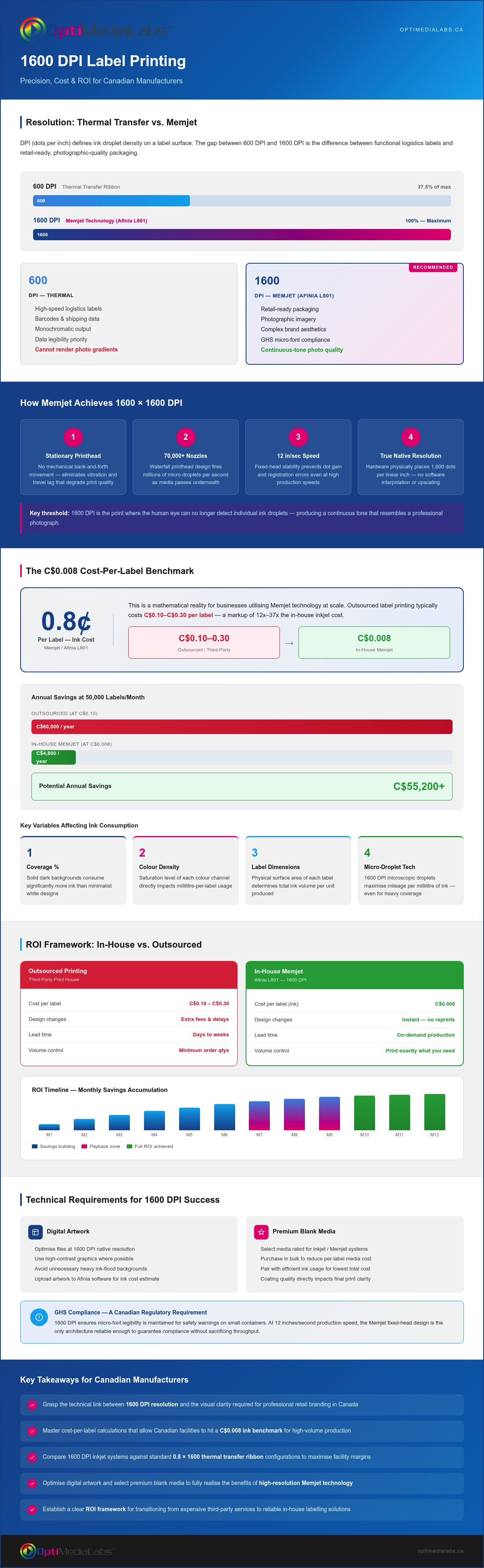
DPI stands for dots per inch. It's the metric that defines the density of ink droplets on a physical label surface. In industrial inkjet systems like those from Afinia, 1600 DPI represents the pinnacle of digital precision. While a standard 0.8 x 1600 thermal transfer ribbon Canada setup provides excellent results for simple barcodes and shipping information, it cannot compete with the photographic depth of Memjet technology. Most thermal transfer systems max out at 600 DPI. This is sufficient for text, but it fails to capture the subtle gradients required for high-end branding. For Canadian manufacturers producing luxury retail goods, high resolution isn't just a technical spec; it's a tool for building consumer trust. Crisp lines and vibrant colour gradients signal a premium product. Conversely, pixelated text or blurry logos can suggest a lack of professional quality to a discerning shopper.
- 600 DPI (Thermal): Optimized for high-speed logistics and 0.8 x 1600 thermal transfer ribbon Canada applications where data legibility is the priority.
- 1600 DPI (Memjet): Engineered for retail-ready packaging, photographic imagery, and complex brand aesthetics.
How Memjet Technology Achieves 1600x1600 DPI
Memjet's waterfall printhead design is the engine behind this precision. Unlike traditional heads that move back and forth, the Memjet head remains stationary. This eliminates mechanical vibration and travel lag. Over 70,000 nozzles fire millions of ink droplets per second as the media passes underneath. This stationary architecture allows the Afinia L801 to maintain 1600x1600 DPI even at high production speeds. This level of detail is vital for GHS compliance. It ensures that micro-font legibility is maintained for safety warnings on small containers. When your production line moves at 12 inches per second, you need this fixed-head stability to prevent dot gain or registration errors.
Effective vs. Interpolated Resolution
Distinguishing between raw hardware resolution and interpolated resolution is critical for quality control. Many entry-level printers use software to upscale images. This often results in soft edges and muddy colours because the printer is essentially guessing where to place extra ink. True 1600 DPI means the hardware physically places 1,600 dots in every linear inch. The Afinia L801 provides this native resolution. It ensures that every pixel in your digital artwork is represented accurately on the final label. 1600 DPI is the threshold where the human eye can no longer detect individual ink droplets. It creates a continuous tone that resembles a professional photograph. This clarity ensures your brand remains sharp regardless of how closely a customer examines the packaging at a retail centre.
Decoding the 0.8 Cent Metric: Analyzing Ink Costs and ROI
Achieving a C$0.008 per label ink cost is a transformative benchmark for Canadian production facilities. This figure isn't just a marketing claim. It is a mathematical reality for businesses utilizing Memjet technology. While a high-volume 0.8 x 1600 thermal transfer ribbon Canada configuration offers low per-inch costs for monochromatic shipping labels, the Memjet-powered Afinia systems bring that same economic efficiency to full-colour retail packaging. Moving production in-house allows you to bypass the massive markups of third-party print houses. Outsourced labels often range from C$0.10 to C$0.30 per unit. By reducing this to less than a cent, a facility printing 50,000 labels monthly can realize annual savings exceeding C$5,000.
Several factors influence your final ink consumption. Coverage is the most significant variable. A label with a solid dark background will consume more resources than one with a minimalist white aesthetic. Colour density and the physical dimensions of the label also play roles. However, because 1600 DPI technology uses microscopic droplets, it maximizes the mileage of every millilitre of ink. This efficiency ensures that even high-coverage designs remain affordable for mass production.
The Formula for Label Cost-Per-Print
You can accurately predict your overhead before the first label is ever printed. Afinia's proprietary software allows you to upload digital artwork and receive an immediate estimate of ink consumption per thousand units. To hit the 0.8 cent "sweet spot," focus on optimized design parameters. Use high-contrast graphics and avoid unnecessary heavy "ink-flood" backgrounds where possible. You must also factor in your blank media costs. Pairing efficient ink usage with bulk-purchased blank labels creates a total unit cost that is difficult for competitors to match. If you need help calculating your specific production costs, you can request a personalized cost-per-label analysis from our technical team.
Long-Term ROI of the Afinia L801 and L901 Series
The true value of Afinia Color Label Printers extends beyond the price of ink. On-demand printing eliminates the hidden costs of obsolete inventory. Many Canadian manufacturers lose thousands of dollars annually when regulatory changes or branding updates make pre-printed label stock unusable. With an in-house system, you print only what you need for the current production run. This flexibility reduces waste and improves your total cost of ownership. The combination of high-speed output and the durability of the 0.8 x 1600 thermal transfer ribbon Canada for secondary labelling ensures your facility remains lean and responsive to market demands.
Afinia vs. The Competition: High-Resolution Performance Benchmarks
Many production managers assume that increasing print resolution inevitably sacrifices throughput. This is a common misconception debunked by Afinia’s industrial Memjet engines. While a standard 0.8 x 1600 thermal transfer ribbon Canada configuration is a reliable workhorse for warehouse logistics, Afinia systems offer a different tier of performance for retail-facing labels. Memjet technology delivers true 1600 DPI at speeds up to 60 feet per minute. In contrast, many competitive piezoelectric systems must drop to 15 or 20 feet per minute to maintain comparable clarity. This speed advantage allows Canadian facilities to maintain high-volume output without compromising the visual integrity of their brand.
Afinia’s hardware is built for the rigours of an industrial environment. Unlike plastic-heavy desktop alternatives, these systems feature steel construction and high-capacity ink tanks. This durability is paired with a design that prioritizes ease of maintenance. Canadian operators often work without on-site technical teams; therefore, the ability to replace printheads or service components in-house is a vital benefit. It ensures that your production line stays active even during peak seasonal demands. The ink chemistry itself is also a differentiator. Afinia cartridges are engineered for precise colour matching, ensuring that your corporate colours remain consistent across every print run.
Memjet vs. Piezoelectric Inkjet Systems
The technical secret lies in droplet size and placement accuracy. Memjet printheads utilize microscopic droplets, typically around 1 to 2 picolitres. This is significantly smaller than the droplets produced by most piezoelectric heads. Smaller droplets allow for finer details, sharper text, and smoother colour gradients. This precision makes Memjet more efficient for full-bleed colour labels because it achieves total coverage without the "banding" effects often seen in slower systems. To maintain this level of performance, using genuine Afinia Ink Cartridges is essential for preventing nozzle clogs and ensuring colour accuracy.
Durable Labelling for Harsh Environments
High resolution isn't just for luxury paper labels. Afinia’s "Plus" series models, such as the L801 Plus and L901 Plus, are specifically designed for enhanced durability. These systems utilize Watershield ink, which offers significantly higher resistance to moisture and chemicals. This is a critical requirement for Canadian manufacturers in the food, beverage, and chemical sectors. You can achieve 1600 DPI clarity on synthetic and waterproof materials that would typically require a specialized 0.8 x 1600 thermal transfer ribbon Canada setup. For more information on meeting industry-specific requirements, consult our guide on Industrial Labeling Solutions Canada.
Technical Requirements for 1600 DPI Printing in Canada
Operating at 1600 DPI requires a shift in how you manage your digital assets and production environment. While a standard 0.8 x 1600 thermal transfer ribbon Canada configuration is sufficient for simple text and basic barcodes, full-colour Memjet printing demands higher source quality to avoid pixelation. Your digital artwork must be created in high-resolution formats. Vector files like .AI or .EPS are ideal because they scale without losing clarity. If you use raster images, ensure they are at least 300 DPI at the final print size. Low-resolution files will result in soft edges that undermine the professional aesthetic of your packaging.
The data load for high-resolution printing is substantial. A single 1600 DPI print spool can be several times larger than a standard 600 DPI file. To prevent production delays or print lag, your workstation should meet modern industrial standards. We recommend a PC with at least 16GB of RAM and a solid-state drive (SSD) to handle the rapid data transfer required by the Afinia L801 or L901. Additionally, Canada's seasonal climate can impact inkjet performance. Maintaining a controlled environment with 40% to 60% humidity is essential. Dry winter air can cause ink to dry prematurely at the nozzle, leading to clogged heads or inconsistent colour output.
Choosing the Right Blank Media
The surface of your label determines how the ink is received and held. Matte and gloss finishes react differently to the dense 1600 DPI ink patterns. Matte materials provide a sophisticated, non-reflective look but may require specific colour profiles to maintain vibrance. Glossy media offers maximum colour "pop" but can be prone to smudging if the ink does not dry instantly. 1600 DPI requires specialized top-coated media to prevent ink bleed. Sourcing premium Afinia labels ensures that the coating is chemically matched to the ink, providing the fastest drying times and the sharpest possible image definition.
Software Integration for Precision Labelling
Managing high-resolution variable data requires robust software. Unlike the binary on-off firing of a 0.8 x 1600 thermal transfer ribbon Canada printer, colour inkjet systems must manage complex colour mixing on the fly. Utilizing professional tools like BarTender or NiceLabel allows you to create sophisticated print profiles. These profiles calibrate the ink output for specific media types, ensuring that the "Apple Red" on your screen matches the physical label. For a deeper look at your options, read The Professional Guide to Barcode Labeling Software in Canada. To ensure your current system can handle these technical demands, you should consult with our technical specialists for a hardware compatibility review.
Implementing Afinia Solutions with OptiMediaLabs
Transitioning from a theoretical cost-per-label analysis to a full production implementation requires more than just high-end hardware. It requires a partner who understands the specific constraints of the Canadian industrial landscape. OptiMediaLabs Canada serves as this bridge for manufacturers across the country. While you might be familiar with sourcing a 0.8 x 1600 thermal transfer ribbon Canada for your secondary logistics labelling, moving to a primary colour system like the Afinia L801 requires a more specialised support structure. We streamline the procurement process by acting as a dedicated Canadian vendor for both industrial hardware and high-volume consumables. This ensures that your facility moves from the planning stage to active production without the friction of cross-border logistics.
Choosing a local partner means you gain access to expertise that is specifically tailored to Canadian manufacturing standards. We help you navigate the transition from traditional monochromatic systems to high-resolution Memjet technology. Our team ensures that your implementation strategy accounts for every variable, from media compatibility to software integration. By consolidating your hardware and consumable needs with a single national distributor, you reduce administrative overhead and create a more resilient supply chain for your facility.
National Distribution and Support
OptiMediaLabs Canada maintains a robust logistics network designed to keep your production lines moving without interruption. We recognise that even a single day of downtime can erode the margins gained through in-house printing. Therefore, we prioritise rapid supply delivery to all provinces. We maintain a consistent stock of Epson ink cartridges and Afinia supplies to ensure you never face a stock-out. This national distribution model is a significant advantage for companies that operate multiple facilities across Canada. It provides a level of reliability that international vendors simply can't match, especially when you need to replenish your 0.8 x 1600 thermal transfer ribbon Canada stock alongside your colour ink tanks.
Custom ROI Consultations
Every production environment has unique requirements that a generic calculator cannot address. To help you verify the math behind your investment, we offer custom ROI consultations. You can request a sample print to see exactly how 1600 DPI resolution handles your specific brand assets and fine-print requirements. We also provide a personalised ink cost estimate based on your actual digital artwork. This data-driven approach allows you to see the 0.8 cent benchmark in the context of your own SKUs. It provides the financial clarity needed to justify the transition to in-house labelling. To start your transition and secure your production margins, contact OptiMediaLabs Canada to optimise your labelling workflow today.
Optimizing Your Canadian Labelling Operations
Mastering the technical relationship between 1600 DPI resolution and production overhead is the most direct path to securing your manufacturing margins. You've seen how true high-resolution printing eliminates the compromise between speed and quality. By achieving a C$0.008 per label ink cost, your facility can move away from expensive third-party services while maintaining premium brand aesthetics. Whether you're currently utilizing a 0.8 x 1600 thermal transfer ribbon Canada setup for logistics or looking to upgrade your primary retail packaging, the shift to in-house Afinia technology provides a clear ROI.
OptiMediaLabs is Canada's leading Afinia distributor. We provide the expert technical consultation needed to realize these ink cost reductions. Our team maintains a high volume of consumables in stock for reliable national shipping; this ensures your production line never stops. Don't let inconsistent quality or high external fees limit your growth. Take control of your labelling precision and operational efficiency today. Contact our experts for an Afinia ROI consultation and start optimizing your workflow with a partner who understands the Canadian market.
Frequently Asked Questions
What does 1600 DPI mean for my product label quality?
1600 DPI represents the highest resolution available for industrial colour labelling. It ensures that your graphics have photographic clarity with no visible ink droplets to the human eye. This level of precision is essential for luxury branding and retail packaging where visual appeal is a priority. It also allows for the legibility of micro-fonts and complex GHS safety symbols that might appear blurry at lower resolutions.
How is the 0.8 cent per label cost calculated?
This benchmark is calculated based on a standard 4x6 inch label with approximately 15 percent ink coverage. Memjet technology achieves this by using microscopic droplets that maximize the mileage of every millilitre of ink. While your actual costs will vary based on your specific artwork density and label dimensions, this figure serves as a reliable ROI benchmark for high-volume Canadian production facilities comparing in-house costs against expensive third-party printing services.
Can Afinia printers print 1600 DPI on waterproof labels?
Yes, Afinia printers can achieve full 1600 DPI resolution on synthetic and waterproof materials. The Plus series models utilize specialized Watershield inks designed specifically for moisture resistance. These labels are ideal for the food, beverage, and chemical industries where durability is as important as visual quality. To ensure the best results, you must use top-coated media designed for inkjet reception to prevent ink bleed and maintain image sharpness.
Is 1600 DPI necessary for barcode scannability?
While standard 300 or 600 DPI systems like a 0.8 x 1600 thermal transfer ribbon Canada setup are sufficient for most shipping barcodes, 1600 DPI provides superior edge definition. This precision is particularly beneficial for micro-barcodes or 2D QR codes used on small electronic components or pharmaceutical packaging. High resolution reduces the risk of scan failures by ensuring high contrast and perfectly straight lines, even at extremely small scales.
How does Memjet technology differ from standard inkjet printers?
Memjet differs from standard inkjet systems by using a stationary waterfall printhead that spans the entire width of the media. Standard printers move a small head back and forth, which limits speed and can cause mechanical errors. Because the Memjet head remains fixed, it can fire millions of droplets per second with extreme accuracy. This architecture allows for 1600 DPI resolution at speeds up to 60 feet per minute.
What are the hardware requirements for processing 1600 DPI print files?
High-resolution print files are significantly larger than standard documents. To handle these spools without production lag, you need a modern workstation with at least 16GB of RAM and a fast solid-state drive (SSD). A high-speed USB 3.0 or Ethernet connection is also required to transfer the data to the printer quickly. Without these hardware specifications, you may experience pauses between labels as the printer waits for the data to process.
Do I need special software to print at 1600 DPI resolution?
You don't strictly need specialized software, but professional tools like BarTender or NiceLabel are highly recommended for industrial output. These programs are designed to manage high-resolution variable data and colour profiles more efficiently than standard office software. They allow you to calibrate your output for specific media types, ensuring that your 1600 DPI images maintain perfect colour accuracy and contrast across every production run.
Where can I buy Afinia ink and labels in Canada?
You can purchase genuine Afinia ink cartridges and labels directly from OptiMediaLabs. We are a premier Canadian distributor specializing in high-volume industrial labelling solutions. We maintain a full inventory of consumables for the L801 and L901 series at our Canadian warehouse to ensure rapid national shipping. Whether you need colour ink tanks or a 0.8 x 1600 thermal transfer ribbon Canada professionals trust, we provide the local support your facility requires.