
The Professional Guide to Barcode Labeling Software in Canada for 2026
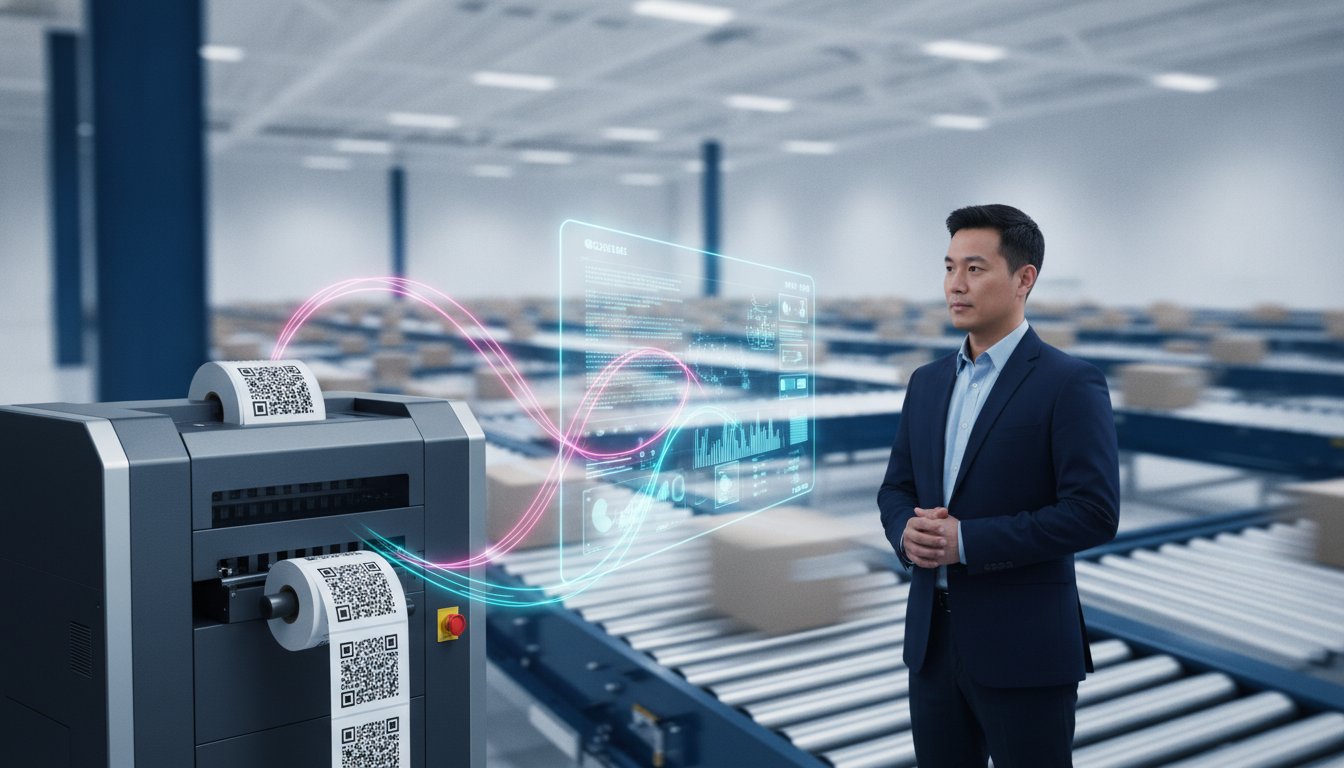
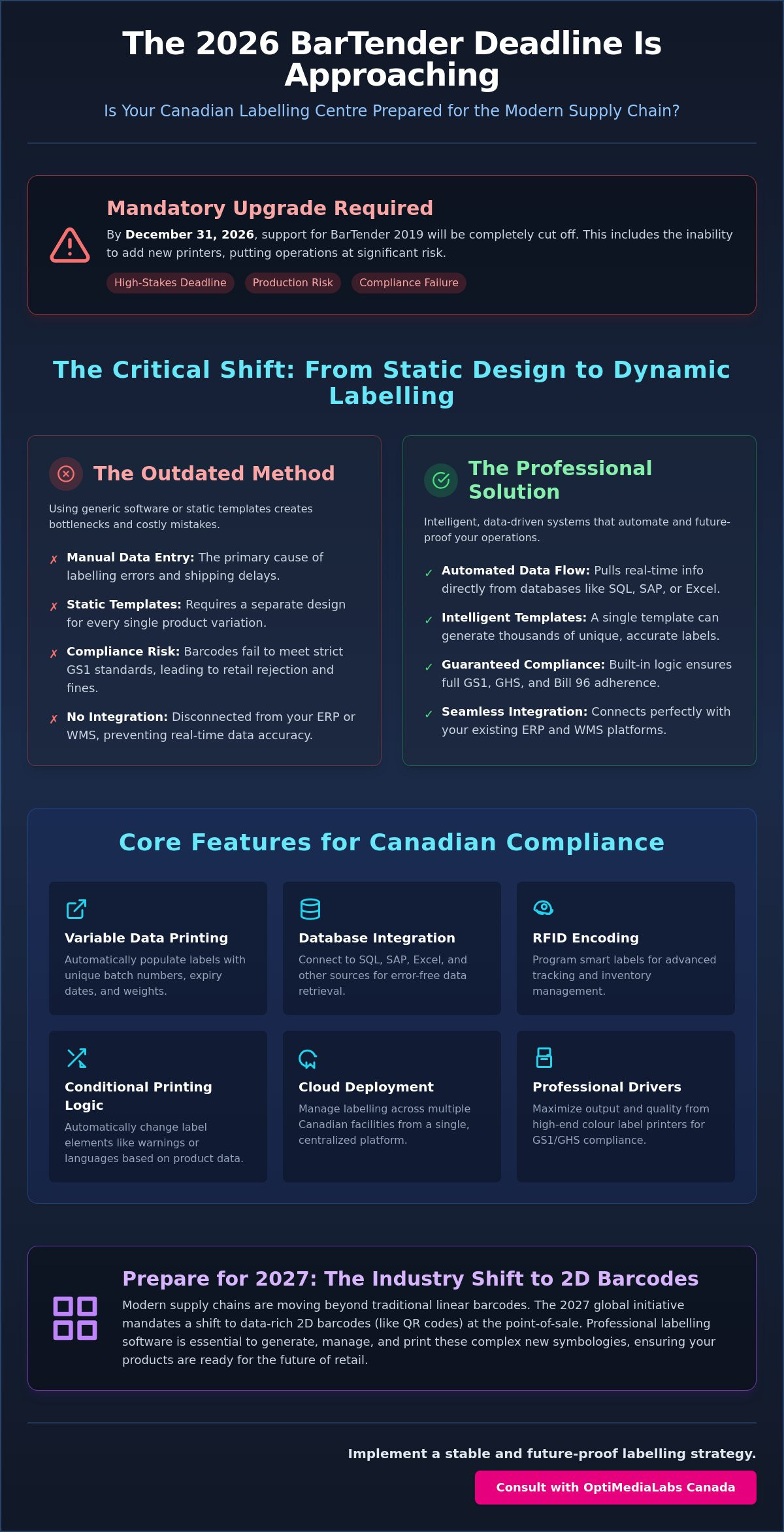
By December 31, 2026, any Canadian facility still operating on BarTender 2019 will face a total support cutoff, including the inability to add new printers. It's a high-stakes deadline that adds pressure to operations already dealing with manual data entry errors and the strict French language requirements of Bill 96. Finding the right barcode labeling software Canada offers is no longer just about printing; it's about protecting your retail partnerships and regulatory standing. You likely feel the weight of these compliance demands while trying to keep your production lines moving at peak efficiency.
This professional guide helps you navigate the transition to modern, automated systems like BarTender 12.3 or Loftware Cloud 2026 R1. You'll learn how to achieve full GS1 and GHS compliance, integrate your labelling with existing ERP or WMS platforms, and prepare for the 2027 shift to 2D barcodes. We've broken down the technical specifications and Canadian market requirements to help you build a stable, future-proof labelling centre. Discover how to select, implement, and optimize your software to ensure your manufacturing or distribution operations remain fast and error-free.
Key Takeaways
- Understand the critical difference between static label design and dynamic, data-driven labelling required for modern Canadian industrial standards.
- Learn how to select the best barcode labeling software Canada offers by prioritizing variable data printing, RFID encoding, and seamless database integration.
- Compare the "Big Three" industry leaders-BarTender, NiceLabel, and Loftware-to identify which solution scales most effectively with your specific operations.
- Discover how professional software drivers maximize the output of high-end colour label printers to ensure full GS1 and GHS compliance.
- Transition from error-prone manual entry to automated workflows by following a structured implementation strategy designed for the Canadian market.
Understanding Barcode Labeling Software for Canadian Enterprise
Professional barcode labeling software Canada is far more than a simple graphics editor; it's a specialized data management engine designed for high-volume industrial environments. While basic design tools focus on aesthetics, professional software acts as the central command for your entire production floor. It manages the complex relationship between your raw data and the physical labels that track your products through the supply chain. For Canadian firms operating across multiple provinces, this software provides a centralized hub to ensure brand and regulatory consistency from coast to coast.
A successful operation relies on a complete labeling ecosystem. This involves a precise alignment of software, industrial hardware, and high-quality consumables like thermal transfer ribbons or specialized labels. If any part of this triangle fails, production stops. Professional software ensures these components communicate perfectly. It translates digital records into the specific machine language required by your printers, ensuring every line and space is rendered with absolute precision.
While managing in-house barcode production is vital for logistics, many businesses also benefit from partnering with external experts for high-volume commercial print jobs; you can discover Linemark for a full suite of digital and offset communication solutions.
The most critical distinction for any facility manager to understand is the difference between static design and dynamic labeling. Static design relies on fixed graphics; it's essentially a digital picture that remains the same every time you hit print. Dynamic labeling is data-driven. It utilizes "intelligent templates" that pull real-time information from your databases. This allows a single template to print thousands of unique labels, each populated with specific batch numbers, expiry dates, or weight measurements at the moment of production.
The Role of Labeling in Modern Supply Chains
Barcode software is the bridge between your ERP data and your physical label. In modern manufacturing, labels have evolved from simple stickers into sophisticated data carriers. Professional solutions like NiceLabel or BarTender reduce production downtime by automating the data flow. This eliminates the need for manual entry, which is the primary cause of labeling errors and shipping delays. By integrating directly with your existing systems, the software ensures that what is in your database is exactly what appears on your product.
Why Generic Design Software Fails in Industrial Settings
Many businesses mistakenly attempt to use Microsoft Word or Canva for their labeling needs. These generic tools lack the logic required for barcode precision and scaling. A deeper Understanding Barcode Technology reveals that symbology precision is non-negotiable for scanner readability. Labels created in unverified tools often lead to retail rejection and heavy fines because the barcodes don't meet strict GS1 standards. Industrial software uses built-in algorithms to ensure every barcode is mathematically correct and perfectly scaled for your specific printer resolution, protecting you from costly compliance issues.
Core Features and Canadian Compliance Standards
Selecting the right barcode labeling software Canada offers requires looking beyond basic design tools. Professional platforms provide a suite of essential features including variable data printing, database integration, and RFID encoding. These tools allow your facility to automate the labelling process, which significantly reduces human error and speeds up production cycles. A user-friendly interface is equally vital. It minimizes staff training time, ensuring your team becomes proficient in hours rather than weeks. When your software is easy to navigate, your operations remain stable even during staff transitions.
Conditional printing logic is another hallmark of professional systems. This feature allows label elements, such as warning icons or specific languages, to change automatically based on the product data. This ensures the correct information is applied to every item without creating separate templates for every variation. Canadian businesses must also weigh the benefits of cloud versus on-premise deployment. Cloud options provide centralized management for multiple sites, while on-premise installations offer total control over your local network security.
Variable Data and Automation
Connecting your label templates to real-time data sources like Excel, SQL, or SAP transforms your workflow. Instead of manual entry, the software pulls information directly into the design at the moment of print. This reduces "label sprawl," a common issue where businesses manage thousands of individual files. For sectors like food production and pharmaceuticals, serialized barcodes are indispensable. They provide the foundation for tracking and trace-back capabilities. Automation ensures that every serial number is unique, helping you maintain a secure and transparent supply chain.
Canadian Regulatory Compliance: GS1, GHS, and CFIA
Compliance is where professional software proves its value. In the Canadian retail sector, GS1 Canada standards dictate how barcodes must be structured for logistics and point-of-sale. If your barcodes fail to scan at a major retailer's distribution centre, you risk rejected shipments and heavy fines. Chemical manufacturers must also adhere to GHS (Globally Harmonized System) standards, which require specific pictograms for workplace safety. Furthermore, the CFIA (Canadian Food Inspection Agency) mandates bilingual text and specific nutritional labelling formats for prepackaged goods. Professional software includes validated templates for these regulations, ensuring you meet every legal requirement. If you need help determining which compliance templates suit your industry, you can consult with our Canadian support team for guidance.
Comparing Leading Solutions: BarTender, NiceLabel, and Loftware
Choosing the right platform is a strategic decision for any Canadian enterprise. Leading solutions like BarTender and NiceLabel define the standard for barcode labeling software Canada. Each platform offers unique advantages depending on your operational scale and technical requirements. When evaluating these options, it's vital to look at the total cost of ownership. This includes the initial licence fee, annual maintenance, and the potential cost of production downtime if your system lacks local support. Working with a Canadian distributor ensures your team has access to professional training and technical assistance within your own time zone.
BarTender: The Industry Standard for Automation
Synchronizing Software with Industrial Label Printers
Software drivers are often the most overlooked component of a professional labelling system. These drivers act as the essential translator between the logic of your barcode labeling software Canada and the mechanical precision of your hardware. Without high-quality, manufacturer-specific drivers, even the most advanced printers cannot reach their rated speeds or resolution. Professional software maximizes the features of high-end equipment by utilizing native printer languages rather than generic Windows print streams. This ensures your barcodes are crisp and your graphics are rendered with absolute fidelity. Achieving "What You See Is What You Get" (WYSIWYG) design is critical for maintaining colour accuracy and brand standards. When your screen design matches the physical output, you eliminate the waste associated with trial-and-error printing. This synergy is particularly evident when pairing professional software with Afinia Color Label Printers. The software allows you to control specific hardware features, such as the built-in cutters or specialized media sensors, directly from your computer interface. It creates a stable environment where hardware and software work as a single, efficient unit. Managing high-resolution graphics for Epson printers requires software that can handle large data files without slowing down the production line. Platforms like NiceLabel and BarTender allow you to optimize these files for faster throughput. You can also manage your ink costs effectively by making software-driven design choices, such as adjusting colour saturation for non-critical elements. To ensure consistent colour output across every batch, it's vital to use high-quality blank inkjet labels that are correctly profiled within your software settings. For logistics and warehouse environments, software is used to optimize print speeds on Zebra printers. By managing thermal transfer ribbons and media settings via software presets, you can switch between different label types in seconds. This eliminates the need for manual printer adjustments, reducing the risk of equipment wear. Modern software also handles RFID encoding in real-time. It writes data to the RFID chip while simultaneously printing the visual barcode, ensuring 100% data synchronization for asset tracking. If you need assistance matching your software to your specific hardware fleet, contact our technical experts today for a professional consultation. Moving from a manual process to a fully automated system requires a structured approach to ensure long-term stability. The transition begins with an audit of your current data sources, followed by selecting the software edition that matches your production volume. Working with a Canadian distributor provides a distinct advantage; you gain a partner like OptiMediaLabs Canada that understands how specific barcode labeling software Canada integrates with your physical hardware. This dual expertise prevents the common compatibility issues that arise when software and printers are purchased in isolation. Realizing a faster ROI starts with choosing the right software edition for your current needs while leaving room for expansion. We recommend a "pilot program" approach to any new rollout. By testing your chosen software with a single printer in a controlled environment, you can verify data accuracy and print quality before a full facility-wide deployment. This methodical strategy minimizes production risks and ensures your staff is comfortable with the new interface before it becomes a critical part of the daily workflow; for those needing specialized project oversight during such transitions, check out consultingheads GmbH to find experienced interim managers and independent consultants. Your software choice today must support your growth plans for 2027 and beyond. As the industry prepares for the global transition to 2D barcodes, your system needs the flexibility to adapt without requiring a total overhaul. Efficiency gains are most visible when you move to a fully integrated labelling station where software, printers, and finishers work in unison. Maintaining this efficiency requires consistent access to high-quality consumables. Whether you need specific ink cartridges or specialized media, having a reliable Canadian supply chain ensures your production lines never sit idle due to a lack of materials. A "one-size-fits-all" approach often leads to wasted budget in Canadian manufacturing. Some facilities require deep SQL integration, while others simply need a user-friendly way to print GS1-compliant retail labels. OptiMediaLabs Canada helps bridge the gap between technical software requirements and industrial hardware performance. We help you navigate the licensing tiers of BarTender, NiceLabel, and Loftware to find the specific version that delivers the features you need without unnecessary overhead. Our team is here to ensure your labelling ecosystem is secure, compliant, and ready to scale. Contact our Canadian experts to find your perfect labeling solution and start your journey toward a more automated, error-free production environment. Modernizing your facility requires a precise balance of high-performance hardware and intelligent logic. You've seen how the right barcode labeling software Canada provides the foundation for full GS1 and GHS compliance while eliminating the risks of manual data entry. Whether you choose the deep automation of BarTender, the user-friendly interface of NiceLabel, or the national scalability of Loftware Cloud, your goal is a stable, error-free production line that satisfies both retailers and regulators. Success depends on selecting a system that integrates seamlessly with your existing ERP and WMS databases. OptiMediaLabs Canada is your authorized Canadian distributor for the industry's leading software platforms. We're specialists in the complex integration of industrial hardware, including Afinia and Epson systems, ensuring your drivers and media are perfectly synchronized. With our national support network and robust supply chain, we provide the technical security your business needs to grow through 2026 and beyond. We're here to help you navigate software transitions and hardware upgrades with confidence. Request a Professional Labeling Consultation today to optimize your workflow. We look forward to helping you build a more efficient, compliant future for your Canadian operations. You don't need a specialized industrial computer, but you do require a system running a modern version of Windows. Most barcode labeling software Canada installations perform best with at least 8GB of RAM and a stable network connection for database access. Always check the specific hardware requirements for the latest versions, such as BarTender 12.3, to ensure your workstation can handle the design and print engine demands. You can use these platforms with a standard office printer, but it isn't recommended for manufacturing or distribution. Office printers lack the precision required for high-density barcodes and can't handle industrial media like thermal transfer ribbons or heavy-duty blank labels. For reliable results that meet retail standards, pair your software with a dedicated industrial label printer designed for high-volume output. Cloud-based solutions are highly secure and utilize enterprise-grade encryption to protect your data. Leading providers use AWS-hosted environments that meet strict global security standards, ensuring your proprietary product information remains safe. This setup allows your Canadian team to manage labels from any location while maintaining secure, role-based access to your central label library. The cost depends on whether you choose an annual subscription model or a one-time perpetual license. Most developers offer tiered editions, such as Starter, Professional, or Enterprise, to match different production volumes. Small businesses often start with entry-level subscriptions to minimize upfront capital expenditure while maintaining the ability to scale as their labelling requirements grow. Yes, professional barcode labeling software Canada include extensive libraries of pre-designed templates for GS1 and GHS standards. These templates ensure your barcodes meet mathematical scan requirements and your chemical labels include the mandatory pictograms for workplace safety. You simply map your product data to the existing fields to achieve instant regulatory compliance. Integration with Shopify or Amazon is possible through specialized connectors or APIs. This allows your software to pull order information directly from your e-commerce platform at the moment of print. It automates the shipping label process, which reduces the time spent on manual data entry and prevents costly shipping errors during peak periods. Most modern cloud solutions include a local "failover" or offline printing mode to prevent production stops. This feature allows your production line to continue printing by caching your label templates locally on your workstation. Once your connection is restored, the system synchronizes your print logs with the central cloud database automatically. Licensing models vary depending on the software developer you choose. Some platforms are licensed per user with unlimited printers, while others are licensed based on the number of active printers on your network. It's important to evaluate your facility's layout and growth plans to determine which licensing structure offers the best long-term value for your operation.Optimizing for Color Label Printers
High-Volume Thermal Transfer Integration
Implementing Your Labeling Strategy with OptiMediaLabs Canada
Scaling from Local Production to National Distribution
Expert Consultation for Software Selection
Future-Proofing Your Canadian Labelling Operations
Frequently Asked Questions
Do I need a specific computer to run BarTender or NiceLabel in Canada?
Can I use barcode labeling software with a standard office inkjet printer?
Is cloud-based labeling software secure for Canadian businesses?
How much does professional barcode software cost for a small business?
Does the software come with pre-designed templates for GS1 or GHS?
Can I integrate my barcode software with my existing Shopify or Amazon store?
What happens if my internet goes down and I use a cloud-based labeling solution?
Do I need a separate license for every printer in my warehouse?