
Thermal Transfer Ribbon Canada: The 2026 Industrial Guide to Selection and Performance
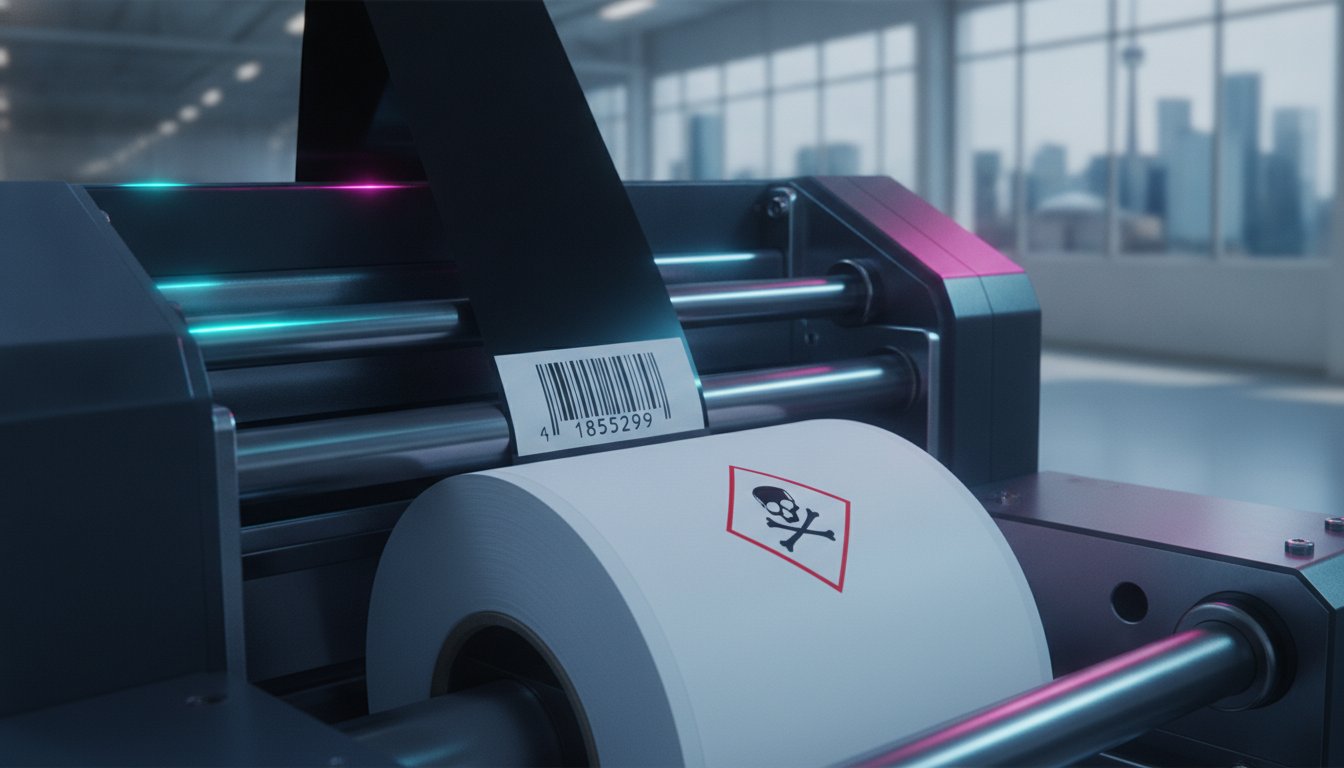
A single smudged barcode on a chemical drum or a label that fails in a cold storage unit can halt your entire production line. Your choice of thermal transfer ribbon Canada is the most critical, yet often overlooked, component of your facility's operational efficiency. In an era of strict GHS regulations and shifting trade landscapes, a "good enough" ribbon often leads to expensive scan failures or compliance penalties at the border.
You know that durable, scannable labels are non-negotiable for maintaining safety and workflow. It's frustrating when labels smudge during transit or when confusing CSI versus CSO winding specifications lead to unnecessary downtime. This guide provides the technical clarity you need to master ribbon selection for your Zebra, Datamax, or Toshiba printers. You'll learn how to match ribbon chemistry to your specific substrate, ensure GHS compliance, and optimize your procurement costs for 2026. We'll break down everything from resin durability to sizing strategies so your Canadian facility stays productive, compliant, and cost-efficient.
Key Takeaways
- Identify the ideal ink chemistry—wax, wax-resin, or resin—to ensure your barcodes remain scannable across diverse label substrates.
- Understand how to match ribbon specifications to Zebra, Datamax, or Toshiba printheads to prevent premature equipment failure and wear.
- Navigate the 2026 GHS labeling standards to maintain strict compliance for hazardous materials within the Canadian market.
- Optimize your procurement of thermal transfer ribbon Canada by applying precise sizing rules that reduce waste and protect your hardware.
- Learn to adjust your selection for environmental factors like high humidity and cold storage to prevent label smudging or adhesive failure.
Understanding Thermal Transfer Ribbon Technology in Canada
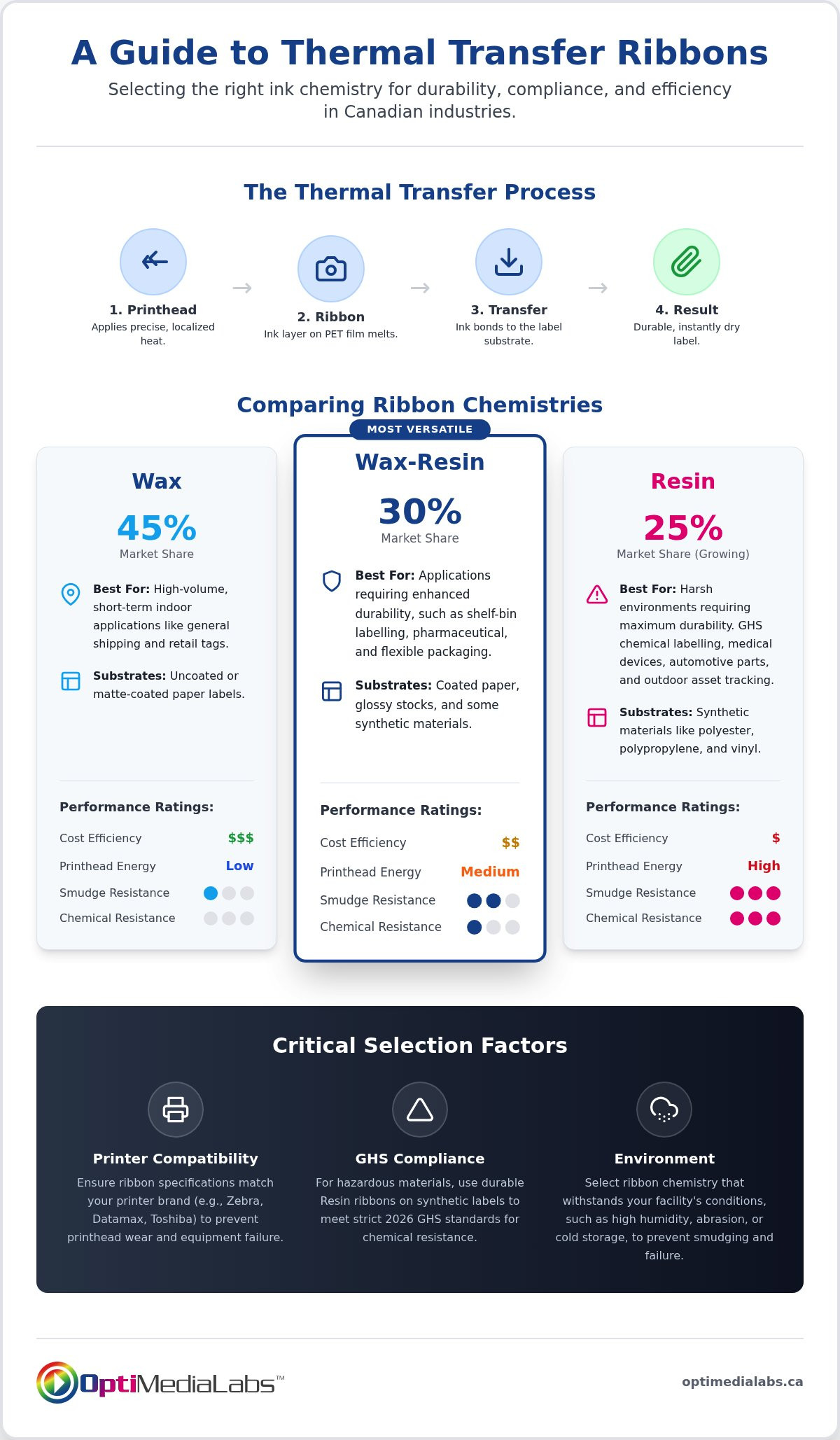
A thermal transfer ribbon Canada is a specialized consumable designed for high-volume industrial environments. It consists of a thin polyester film, known as a carrier, which is coated with heat-sensitive ink. During the printing process, the printer's thermal printhead applies localized heat to the back of the ribbon. This energy transfers the ink onto the label substrate, creating a crisp, high-resolution image that bonds instantly. It's the primary method used across Canadian manufacturing and logistics sectors due to its reliability and scan accuracy.
There's a critical distinction between this technology and direct thermal printing. While direct thermal label printers use heat-sensitive paper that darkens when heated, thermal transfer requires a ribbon to act as the ink source. This allows for a much wider variety of label materials, including synthetics and plastics. Direct thermal is often used for short-term shipping labels, but thermal transfer label printers are the standard for long-term asset tracking and product identification where durability is mandatory.
The Science of Thermal Transfer Printing
High-performance ribbons utilize a three-layer architecture to ensure print quality and hardware longevity. The foundation is a PET base film that provides structural integrity. On one side, the ink layer contains the wax or resin formulations that define the print's durability. On the reverse side, a specialized backcoating protects the printhead from friction and static build-up. This coating is essential because it prevents the ribbon from sticking to the printhead, which reduces maintenance costs and downtime. Thermal-Transfer Printing Technology relies on this precise mechanical balance to function at high speeds. The thermal transfer process is the precise melting of wax or resin onto a substrate.
Why Industrial Facilities Favour Thermal Over Inkjet
Canadian warehouses and factories prioritize thermal transfer over inkjet systems for several practical reasons. First, thermal transfer ribbons produce barcodes that are immediately dry and ready for handling. There's no risk of smudging on high-speed conveyor lines. Second, the durability is unmatched. Labels printed with the correct ribbon can resist UV exposure, moisture, and heavy abrasion. This is vital for outdoor storage or international shipping where environmental conditions are unpredictable. Finally, the total cost of ownership is often lower. Since the technology has fewer moving parts and no liquid ink to clog nozzles, it requires less frequent servicing in dusty industrial settings. It's a stable, transactional solution for facilities that can't afford production delays.
Comparing Ribbon Chemistries: Wax vs. Wax/Resin vs. Resin
Selecting the right thermal transfer ribbon Canada depends entirely on the label substrate and the final application environment. The ink formulation determines the bond strength and the printhead temperature required for a successful transfer. In fact, Thermal Transfer Ribbon Market Trends indicate that while wax remains dominant for logistics, resin formulations are growing rapidly due to stricter industrial safety standards. Matching these chemistries to your specific needs is a core part of our Professional Guide to Label Printer Consumables: Canada. Using the wrong chemistry often leads to illegible barcodes or premature printhead failure.
Standard Wax Ribbons for General Shipping
Wax ribbons are the most economical choice for high-volume logistics and retail tagging. According to current industry data, wax ribbons account for approximately 45% of the market share due to their cost-effectiveness in general logistics. They feature a high percentage of wax-based components that melt at lower temperatures. This reduces printhead wear since less energy is required to release the ink. They perform best on uncoated or matte-coated paper labels. However, they're susceptible to smudging if handled roughly and offer minimal resistance to chemicals. Use these for short-term indoor applications where cost efficiency is the priority.
Wax/Resin Ribbons for Enhanced Durability
These ribbons bridge the gap between economy and performance by blending wax with more durable resin. They account for about 30% of the market and require slightly higher heat settings than pure wax. This chemistry offers superior smudge and scratch resistance, making it the versatile choice for semi-gloss paper and certain synthetic materials. In Canadian warehouses, these are frequently used for shelf labelling and outdoor nursery tags where labels must withstand frequent handling or light exposure. They provide a crisp, dark image that won't degrade during typical transit cycles across the country.
Full Resin Ribbons for Extreme Environments
When labels must survive harsh chemicals, solvents, or extreme temperature fluctuations, full resin is the only viable option. These ribbons require high printhead energy to melt the resin onto synthetic substrates like polypropylene, polyester, and vinyl. They're the mandatory standard for meeting the 2026 GHS 7th and 8th edition labelling requirements for hazardous materials. Resin ribbons ensure that barcodes remain scannable even after exposure to industrial cleaners or deep-freeze storage temperatures. Optimizing your thermal transfer ribbon Canada strategy requires matching these high-performance ribbons to the correct synthetic carrier. If you're unsure which formulation suits your specific substrate, you can consult with our technical team for a tailored recommendation.
Matching Ribbons to Your Printer Brand and Printhead Type
Selecting the correct thermal transfer ribbon Canada for your hardware involves more than just choosing a brand name. You must first ensure mechanical compatibility with your printer's printhead technology and spindle configuration. A critical rule for hardware longevity is matching your ribbon width to the label carrier width. The ribbon should always be slightly wider than the label backing to provide a protective layer between the printhead and the label material. This prevents the abrasive edges of the label from wearing down the delicate heating elements of the printhead.
You also need to identify the ribbon's wind direction. Printers are designed for either Ink Side Out (CSO) or Ink Side In (CSI). Using the wrong wind direction means the ink layer won't face the label, resulting in blank prints and potential adhesive build-up on your equipment. Understanding these technical specifications ensures your facility maintains a frictionless printing operation.
Zebra and Datamax Compatibility (Flat Head)
Zebra printers are the industrial standard in many Canadian facilities and almost exclusively utilize Flat Head technology. These systems typically require CSO (Coated Side Out) ribbons. When sourcing Zebra Ribbons, you must also verify the core size. Industrial Zebra models use a 1-inch core, while smaller desktop units often require a 0.5-inch core. Conversely, many legacy Datamax systems utilize a CSI (Coated Side In) configuration. Always check your printer's spindle rotation before purchasing to avoid compatibility errors.
Toshiba and Near Edge Technology
Toshiba and Avery printers often feature Near Edge printheads, a technology that differs significantly from the Flat Head systems used by Zebra. Near Edge printheads are positioned at an angle, allowing for much faster print speeds, often reaching up to 14 inches per second (ips). Because the contact time between the printhead and the ribbon is extremely short, you must use specialized "Near Edge" ribbons. These ribbons have a unique chemistry designed to release ink instantly upon contact. Standard Flat Head ribbons won't transfer properly at these high speeds. If you're upgrading your fleet, consult our selection of Thermal Transfer Label Printers to ensure your hardware matches your speed requirements.
TSC and Sato Ribbon Specifications
TSC industrial models and Sato CLNX series printers are known for their robust handling of high-capacity consumables. Standardizing your thermal transfer ribbon Canada inventory by length, such as 300m or 450m rolls, reduces changeover frequency and labour costs. When selecting TSC Ribbons, ensure the ribbon's backcoating is high-quality to minimize static. Static build-up is a common cause of barcode "voids" and can eventually damage the printer's logic board. Reliable ribbons for these brands should offer consistent tension control to prevent wrinkling during high-volume print runs.
Application-Specific Selection for Canadian Industry Standards
Industrial operations in Canada face unique environmental and regulatory hurdles. From the high humidity of coastal shipping hubs to the sub-zero temperatures of Prairie warehouses, your thermal transfer ribbon Canada must maintain adhesion and legibility. Successful labelling depends on more than just the printer. It requires a matched set where the ribbon chemistry and label substrate are certified to work together. This technical synergy is explored in detail within our Industrial Labeling Solutions Canada: The 2026 Reference Guide.
GHS Compliance and Chemical Resistant Labelling
As of August 2026, the transition period for Canada's amended Hazardous Products Regulations (HPR) has concluded. All hazardous products must now feature labels compliant with the 7th and 8th revised editions of the Globally Harmonized System (GHS). This mandate requires extreme durability. For chemical drums, you must select BS5609-certified ribbon and label combinations. Only full resin ribbons provide the necessary resistance to oils, alcohols, and aggressive industrial cleaners. These formulations ensure that critical safety information remains scannable even after heavy industrial scrubbing or prolonged exposure to caustic substances.
Cold Storage and Food Safety Requirements
Food processing and pharmaceutical distribution require ribbons that perform in Canadian sub-zero environments. Standard wax ribbons often become brittle and flake off when exposed to extreme cold. In contrast, specialized resin or wax-resin blends maintain their bond in temperatures as low as -40°C. Moisture and condensation are also major factors during refrigerated transport. Your labels must resist smudging when frost melts or during high-humidity cycles. For primary packaging, ensure your ribbon is non-toxic and food-safe. This prevents migration of chemicals into the product. Matching your consumables to these specific stressors is the only way to avoid costly re-labelling or safety recalls.
If your facility needs to verify compliance for a specific industrial application, contact our technical specialists for a durability assessment.
Optimizing Your Thermal Transfer Ribbon Procurement
Reducing the total cost of ownership (TCO) for your labelling operations requires a shift from transactional buying to strategic procurement. Many facilities focus solely on the price per roll. However, the true cost includes printer downtime, wasted media, and premature printhead failure. By selecting the correct thermal transfer ribbon Canada, you protect your capital investment in Zebra printers or Seiko printers. Standardizing your ribbon lengths across your fleet also simplifies inventory management and reduces the time staff spend on roll changeovers.
Sizing and Width Considerations to Reduce Waste
Precision in sizing is the most effective way to prevent hardware damage. You should follow the "1-inch rule" for protecting printheads from label edge abrasion by ensuring your ribbon is always slightly wider than the label carrier. This creates a protective barrier that prevents the abrasive edges of the label from coming into direct contact with the printhead. If your ribbon is too narrow, the label edge will eventually score the heating elements, leading to permanent "voids" in your barcodes.
Matching ribbon width to your specific application also prevents "ribbon wrinkle." Wrinkling occurs when there's uneven tension across the printhead, often caused by using a ribbon that is significantly wider than necessary for the label being printed. Calculate your usage based on the total roll length and your daily label count. For example, a 450m ribbon yields significantly more labels per roll than a 74m desktop roll, which reduces the labour costs associated with frequent loading.
Integrating Ribbons into an In-House Printing Programme
Moving your production in-house gives you total control over your supply chain. You can reduce lead times by maintaining a consistent stock of universal wax-resin ribbons that handle multiple label types. Maintaining a local inventory of thermal transfer ribbon Canada ensures your production line never stops due to supply chain delays. This flexibility is vital when responding to urgent orders or changing regulatory requirements. Utilizing professional software like BarTender or NiceLabel allows you to optimize your layouts, which minimizes the amount of "white space" and reduces ribbon waste.
Efficiency improves when you treat your consumables as a technical component rather than a generic office supply. OptiMediaLabs Canada serves as a national partner for ribbon procurement and technical support. By aligning your ribbon chemistry with your printer fleet, you ensure your Canadian production facility remains both compliant and cost-optimized for years to come.
Future-Proof Your Industrial Labelling Operations
Mastering the technical nuances of thermal transfer ribbon Canada ensures your barcodes remain scannable from the production floor to the final customer. You've learned that matching ribbon chemistry to your specific substrate is the only way to prevent smudging and scan failures. Whether you're navigating the 2026 GHS compliance standards with high-durability resin or protecting your printheads with the 1-inch sizing rule, precision is your best tool for reducing total cost of ownership.
As a national distributor for Zebra, Datamax, and TSC, OptiMediaLabs Canada provides the specialized technical support required to optimize your industrial labelling. We focus on delivering high-performance consumables that withstand the harshest environments, from sub-zero storage to chemical contact. Maintaining a streamlined, in-house printing programme has never been more critical for your production margins. Our team is ready to help you navigate these specifications to ensure zero scan failures in your facility.
Take the next step in optimizing your facility's efficiency. Contact our specialists today to secure the ideal ribbon specifications for your printer fleet. Your facility's reliability starts with a perfect bond.
Frequently Asked Questions
What is the difference between wax and resin thermal transfer ribbons?
Wax ribbons use a lower melting point and are best for paper labels in general shipping. Resin ribbons require higher heat settings but provide maximum resistance to chemicals and abrasion on synthetic materials. While wax is the most economical choice for high-volume logistics, resin is mandatory for labels that must withstand harsh environments. Choosing the right thermal transfer ribbon Canada depends on matching these ink properties to your specific substrate.
How do I know if my thermal printer requires CSI or CSO ribbons?
You can identify your printer's requirement by performing a simple tape test or checking the spindle rotation. Coated Side Out (CSO) ribbons have the ink layer on the outer surface of the roll, which is the standard for Zebra printers. Coated Side In (CSI) ribbons have the ink on the inner side, often required by Datamax or Sato systems. Using the incorrect wind direction will result in the ink not transferring to the label.
Can I use any thermal transfer ribbon in my Zebra printer?
You cannot use just any ribbon in a Zebra printer because of specific mechanical and chemical requirements. Most Zebra models require CSO winding and specific core sizes, such as 1 inch for industrial units or 0.5 inches for desktop models. Additionally, the ribbon chemistry must match your label material to ensure scan accuracy. Using uncertified or poorly matched ribbons can cause voids in barcodes and lead to premature wear on your thermal printhead.
What ribbon type is best for GHS compliant chemical labels?
Full resin ribbons are required for GHS-compliant chemical labels to ensure safety information remains legible under extreme conditions. These ribbons must be paired with BS5609-certified synthetic labels to resist solvents, oils, and industrial scrubbing. In the Canadian market, adhering to these standards is mandatory for hazardous material transport. This combination ensures that the barcode and warning symbols don't degrade even when exposed to harsh sunlight or seawater during international transit across the country.
Why is my thermal transfer ribbon snapping or breaking during printing?
Ribbon snapping usually occurs when the printhead temperature is set too high or if the ribbon tension is incorrect. If the heat is excessive, it can melt the polyester carrier film along with the ink, causing it to break. You should also check for adhesive build-up on the rollers, which can create unnecessary drag. Adjusting your darkness settings in the printer driver often resolves this issue while maintaining high-quality barcode definition and scan accuracy.
Does the ribbon width need to match the label width exactly?
The ribbon width should always be slightly wider than the label carrier to protect the printhead from abrasion. If the ribbon matches the label width exactly, the rough edges of the label backing can score the delicate heating elements. This leads to permanent damage and expensive hardware replacements. We recommend a ribbon that extends at least 2mm to 5mm beyond the edges of your label carrier to ensure a protective layer remains constant.
What is a Near Edge thermal transfer ribbon and do I need one?
Near Edge ribbons are specialized consumables designed for printers where the printhead is positioned at an angle rather than flat against the media. This technology allows for faster print speeds, often exceeding 10 inches per second. You need a Near Edge ribbon if you use Toshiba or Avery systems, as the ink chemistry is formulated to release instantly. Standard flat-head ribbons won't transfer properly at these high speeds and will result in faint prints.
How should I store thermal transfer ribbons to prevent ink degradation?
Proper storage involves keeping your ribbons in a cool, dry, and dark environment to prevent the ink from degrading. You should avoid areas with high humidity or direct sunlight, as heat can cause the ink layers to stick together on the roll. Ideally, store your thermal transfer ribbon Canada at temperatures between 5°C and 35°C. Keeping them in their original packaging until use protects them from dust and static, which can negatively affect print quality.