
Understanding the 3400 Series 1.25" Thermal Transfer Ribbon: A Canadian Industrial Guide

How much does a single unreadable barcode cost your facility when it halts a critical shipment? Most Canadian operations managers recognize that narrow-format labelling often leads to frustrating compromises. You might settle for ribbon widths that don't quite fit or struggle with smudged prints on synthetic stocks that fail at the first sign of friction. Finding a consistent source for the specific 3400*1.25 wax/resin ribbon in the Canadian market shouldn't be a hurdle to your productivity.
We understand that you need a reliable process that protects your hardware while ensuring every scan is successful. This guide explains why the 3400 series 1.25-inch ribbon is the preferred choice for durable, narrow-format prints across warehouses and manufacturing plants. You'll learn how to secure a dependable supply of these consumables to eliminate fading and minimize expensive printhead wear. We'll outline the technical specifications that make this ribbon a strategic asset for your facility, ensuring your labels remain legible from the production line to the final destination.
Key Takeaways
- Understand how the 3400*1.25 wax/resin formulation provides the ideal balance of durability and cost-efficiency for narrow-format industrial labelling.
- Identify compatible printer brands, including Zebra and TSC, to ensure high-contrast barcode prints on both coated paper and synthetic stocks.
- Evaluate the performance of the 3400 series against standard ribbons to see why it remains the top choice for rugged Canadian manufacturing environments.
- Learn the essential "Oversize Rule" for ribbon selection to protect your printer's heater elements and minimize expensive hardware maintenance.
- Streamline your procurement process by sourcing directly from a Canadian distributor specialized in national industrial logistics and bulk supply.
What is the 3400 Series 1.25" Thermal Transfer Ribbon?
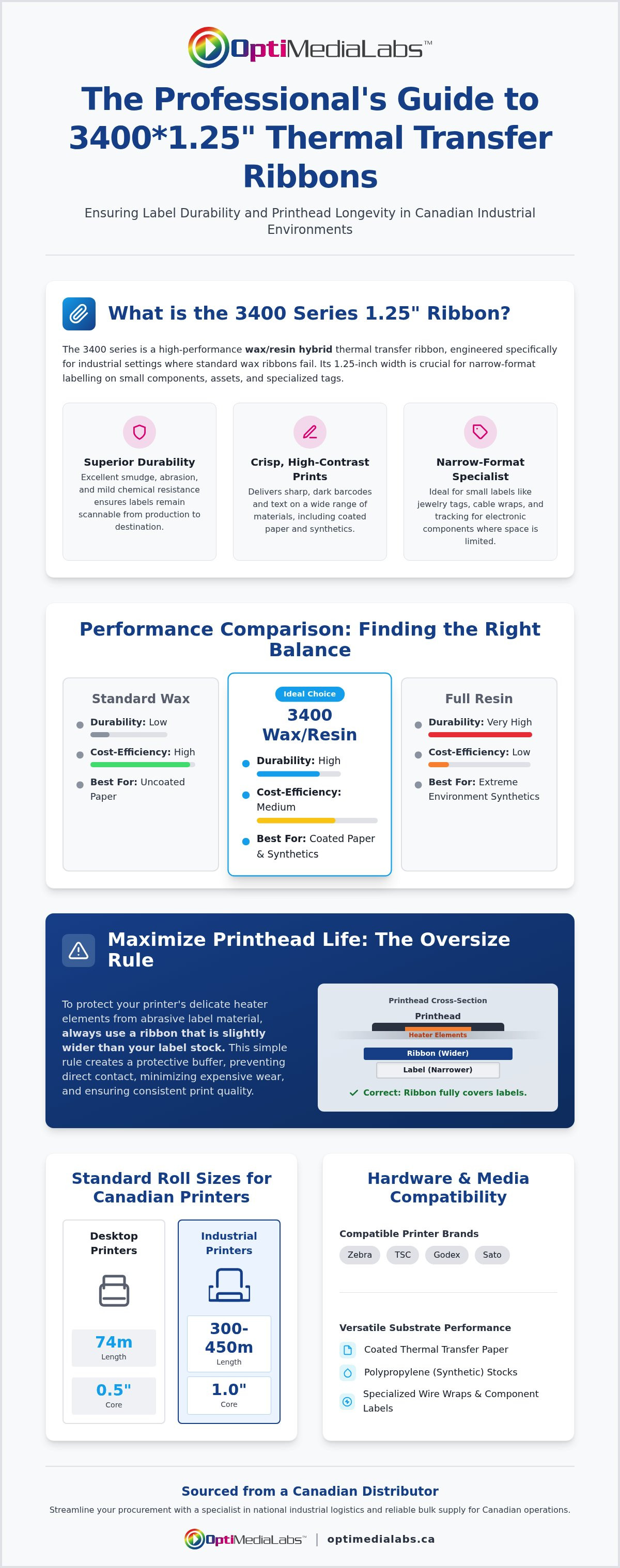
The 3400 series isn't just another consumable. It's a high-performance wax/resin hybrid engineered for industrial environments where standard wax ribbons simply don't hold up. This formulation is specifically designed to provide a durable, crisp image on a wide range of materials. The 3400*1.25 specification fills a vital role in narrow-format applications. This specific width is essential for tracking small components, assets, or inventory in tight spaces where a full-sized label would be impractical.
The 3400 designation serves as an industry benchmark for superior smudge and chemical resistance. It offers a protective layer that resists fading and abrasion, making it a reliable choice for long-term storage in Canadian warehouses. Selecting the correct 1.25-inch width is a technical necessity. It ensures you provide full coverage for specialized labels, such as jewelry tags or cable wraps, without wasting excess ribbon material or risking damage to your equipment.
The Chemistry of Wax/Resin Hybrids
The effectiveness of Thermal-transfer printing depends on how well the ink bonds to the substrate. In a 3400 series ribbon, the ink is a specialized blend of wax and synthetic resin. The wax provides a smooth flow at manageable temperatures, while the resin acts as a hardening agent. This combination creates a print that is significantly more durable than standard wax. It can withstand moisture, frequent handling, and exposure to mild cleaners. To achieve the best results, you'll need to calibrate your printer to a medium-high heat setting to ensure the resin fully melts and fuses with the label material.
Standard Roll Lengths for Canadian Printers
Matching the ribbon length to your hardware is key to reducing production bottlenecks. Most 3400*1.25 ribbons are available in formats that fit both desktop and industrial printer classes. Desktop units typically require 74m lengths on a 0.5-inch core. These are common in office settings or small-scale shipping centres. For high-volume manufacturing, industrial units utilize 300m or 450m rolls on a 1-inch core.
Choosing the correct capacity, such as Zebra ribbons or TSC ribbons, ensures your printer runs longer between supply changes. In a fast-paced logistics environment, minimizing roll swaps directly translates to lower operational costs and consistent output. Always verify your printer's maximum roll diameter before ordering to ensure a proper fit within the media compartment.
Compatibility Guide: Printers and Media for 1.25" Ribbons
Selecting a 3400*1.25 ribbon requires verifying that your thermal printer supports narrow media widths. While many industrial printers are versatile, narrow-format ribbons are most commonly deployed in desktop and mid-range units. Leading brands like Zebra, TSC, Godex, and Sato offer several models capable of handling 1.25-inch rolls. Precision is vital here. If the printer's sensors aren't properly aligned or calibrated for narrow media, you may experience "out of ribbon" errors or skipped labels.
Zebra and TSC Hardware Integration
Desktop models like the Zebra ZD series are frequently paired with Zebra Ribbons for retail or laboratory applications. These compact units excel at short-run printing for jewelry tags or specimen vials. For higher volume, Canadian manufacturing lines often utilize TSC or Godex industrial printers. These machines provide the tension control necessary to prevent ribbon wrinkling on narrow 1.25-inch rolls. Ensuring your hardware settings match the specific ribbon tension is a key step in Maximizing Printhead Life and preventing premature component failure.
Material Versatility: From Paper to Poly
The 3400 series wax/resin formulation is the bridge between economy and extreme durability. It performs exceptionally well on several substrates common in industrial labelling:
- Coated thermal transfer paper for general shipping and inventory.
- Polypropylene (synthetic) stocks for moisture and smudge resistance.
- Specialized wire wraps and small component labels for electronics.
In Canadian industrial sectors, synthetic stocks are the standard for items exposed to temperature fluctuations or light abrasion. The 3400*1.25 ribbon provides the necessary adhesion to ensure barcodes remain sharp and scannable. This high-contrast output is critical for GS1 compliance and internal inventory tracking. If you're unsure which material fits your specific environment, you can consult with a technical specialist to request a media compatibility test.
Testing on various Canadian-sourced label stocks ensures that the ink won't flake or smudge during transit. Whether you're labelling delicate jewelry or industrial wires, the bond created by the 3400 series resin component ensures long-term legibility under moderate stress.
Performance Comparison: 3400 Series vs. Standard Wax and Resin
Choosing the right ribbon involves balancing cost against the specific demands of your environment. Standard wax ribbons are economical for short-term paper labels, but they fail quickly when exposed to friction or moisture. Pure resin ribbons offer the highest durability for chemical exposure; however, they require significantly higher printhead temperatures and a larger budget. The 3400*1.25 wax/resin hybrid is the "sweet spot" for Canadian industrial applications. It utilizes the foundational principles of Thermal-transfer printing to deliver a durable bond that resists smudging without the extreme costs of full resin.
Print speed is another critical factor for national logistics centres. While standard wax ribbons may struggle to maintain edge definition at higher speeds, the 3400 series remains sharp at up to 10 or 12 inches per second (IPS). This allows your production line to move faster while ensuring every barcode meets scannability standards. You'll only need to upgrade to a full resin ribbon if your labels face extreme chemical solvents or constant outdoor exposure in harsh sunlight.
Scratch and Smudge Resistance
In a busy warehouse, labels are subjected to constant contact. Whether it's boxes sliding against one another or manual handling, the 3400 series provides the necessary friction resistance to stay legible. The Canadian climate poses unique challenges; extreme cold can make some inks brittle, while high humidity can soften others. The 3400 series offers significantly higher scratch resistance and environmental tolerance than standard wax ribbons, ensuring your data remains legible throughout the product's lifecycle. It maintains its integrity across these temperature shifts, preventing the "ghosting" or fading that often plagues cheaper alternatives.
Total Cost of Ownership (TCO)
Calculating TCO requires looking beyond the initial price per roll. Label failure leads to reprinting costs, lost labour hours, and potential shipping errors. By using the precise 3400*1.25 width, you eliminate the waste associated with using oversized ribbons for narrow labels. This precision not only saves money on the ribbon itself but also protects your hardware.
Pairing these consumables with professional Thermal Transfer Label Printers ensures a reliable output that lasts. You'll find that the 3400 series reduces the frequency of printhead cleanings compared to wax ribbons, which often leave behind more residue. This reliability keeps your operations moving and ensures your narrow-format labelling remains cost-effective over thousands of print cycles.
Maximizing Printhead Life with 1.25" Ribbons
The printhead is the most costly component of any thermal transfer system. Protecting this sensitive hardware requires more than just careful handling; it demands the correct consumable configuration. One of the most critical standards in the industry is the "Oversize Rule." This rule dictates that your thermal transfer ribbon must always be slightly wider than the label stock you are using. For example, if you are printing on 1-inch wide labels, utilizing a 3400*1.25 ribbon is the optimal choice to ensure longevity.
This extra width ensures that the ribbon acts as a protective lubricant. Without this overlap, the abrasive edges of the label stock can come into direct contact with the printhead's ceramic surface. Over time, this contact causes permanent "path wear" or scratches on the heater elements, leading to dead pixels and unreadable barcodes. By using the 3400 series 1.25-inch ribbon, you ensure the entire print area is shielded from friction and abrasive debris.
The Mechanics of Printhead Protection
Maintaining a 1.25" ribbon width when printing 1" labels prevents the label carrier and face stock from eroding the printhead's protective coating. In narrow-format setups, "ribbon wrinkle" is a common issue that can cause uneven heat distribution and wasted media. Centring the 3400*1.25 roll correctly within the printer helps maintain consistent tension across the head. The specialized back-coating on 3400 series ribbons reduces friction and dissipates static electricity to protect the sensitive heater elements. This anti-static property is vital in dry Canadian warehouses where static discharge can easily damage internal circuitry.
Routine Maintenance for Narrow Media
Narrow media often places concentrated pressure on a small section of the platen roller. This can lead to localized adhesive buildup that interferes with the ribbon's smooth travel. You should clear any residue from the platen roller every time you change a ribbon roll to prevent "slipping" during high-speed jobs. Calibrating the tension for 1.25-inch rolls is equally important to avoid snapping the ribbon during sudden starts or stops.
Consistently using printer cleansing wipes or pens with 99% isopropyl alcohol will dissolve stubborn resins and waxes. This simple step can double the life of your hardware and ensure your labels remain crisp. If you need assistance choosing the right maintenance supplies or ribbons for your specific printer model, contact our technical support team for expert guidance.
Procuring 3400 Series Ribbons for Canadian Operations
Securing a consistent supply of 3400*1.25 ribbons is vital for maintaining the rhythm of your facility. For Canadian operations moving into 2026, the focus has shifted from mere availability to long-term supply chain reliability. Relying on international vendors often introduces hidden costs, such as brokerage fees and unpredictable customs delays. By sourcing from a dedicated Canadian distributor, you gain transparency in pricing and a more responsive support system. It's not just about buying a product; it's about ensuring your production line never stops due to a missing consumable.
National Distribution and Shipping
Sourcing within Canada provides a distinct logistical advantage for high-volume users. National distribution networks allow for faster transit times across provinces, which is essential for just-in-time inventory models. When you manage large-scale labelling projects, the ability to scale your orders quickly is a competitive necessity. You'll find that domestic shipping avoids the complexities of cross-border paperwork and the volatility of international freight costs. To better understand how to manage your inventory effectively, consult our Professional Guide to Label Printer Consumables: Canada. This resource offers deeper insights into optimizing your supply chain for national logistics and manufacturing.
Expert Consultation for Ribbon Selection
Every industrial environment has unique demands that a one-size-fits-all approach can't satisfy. While the 3400 series is highly versatile, matching the 3400*1.25 ribbon to your specific printer model and label substrate requires technical precision. We help you navigate these specifications to ensure the wax/resin blend performs as expected under your specific warehouse conditions. Don't guess which ribbon will work best for your synthetic or coated paper stocks. We encourage requesting samples for compatibility testing to verify ink adhesion and smudge resistance before you finalize a large purchase. This step prevents waste and ensures your barcodes remain GS1 compliant throughout their lifecycle. To get started with a solution tailored to your facility, Contact the OptiMediaLabs Canada team for a custom ribbon quote today. Our specialists are ready to help you organize a procurement strategy that maximizes both efficiency and hardware longevity.
Optimize Your Industrial Labelling Strategy
Choosing the right consumable is a strategic decision that impacts both your print quality and your equipment's lifespan. The 3400 series wax/resin ribbon provides a durable, high-contrast solution that balances industrial-grade performance with cost-efficiency. By adhering to the "Oversize Rule" and selecting the precise 3400*1.25 width, you effectively shield your printer's sensitive heater elements from abrasive wear and premature failure. This technical precision ensures your barcodes remain legible from the production floor to the customer's hands.
OptiMediaLabs Canada serves as an authorized distributor for a wide range of industrial printing solutions. We offer specialized technical support to help you match your ribbons to specific label substrates and various printer models. With national shipping across Canada, we ensure your facility maintains a consistent supply without the frustration of customs delays or international brokerage fees. Our team is ready to assist you in streamlining your procurement and protecting your hardware investment.
Request a Quote for 3400 Series Ribbons today to secure a reliable, high-performance labelling partner. We look forward to helping you achieve superior print results across your entire Canadian operation.
Frequently Asked Questions
What is the difference between a 3400 series ribbon and a standard wax ribbon?
The primary difference is the synthetic resin content in the 3400 series, which provides significantly higher durability than standard wax. While standard wax is ideal for short-term paper labels, the 3400 series hybrid formulation offers superior smudge and scratch resistance. This makes it suitable for synthetic stocks like polypropylene. It withstands moisture and friction better than economy wax, ensuring your barcodes remain scannable in rugged Canadian industrial environments throughout the shipping process.
Can I use a 1.25" ribbon on a printer designed for 4-inch wide media?
You can use a 1.25-inch ribbon on a 4-inch wide printer, provided the hardware allows for narrow media alignment. Most industrial and desktop printers allow you to centre the ribbon on the spindle to ensure even pressure. However, you must always ensure the ribbon is wider than your label stock. Using a narrow ribbon on a wide label will leave the printhead exposed to the abrasive edges of the paper, leading to permanent hardware damage.
Is the 3400 series 1.25" ribbon compatible with Zebra ZD421 printers?
Yes, the 3400 series 1.25" ribbon is compatible with the Zebra ZD421 series, but you must select the correct roll length and core size. Desktop models like the ZD421 typically require a 74m ribbon on a 0.5-inch core or a 300m ribbon on a 1-inch core. Always verify your specific printer's ribbon capacity before ordering. Using the 3400*1.25 ribbon ensures high-quality prints on narrow tags or small component labels used in labs and retail environments.
How do I know if I need a wax/resin or a full resin ribbon?
You need a wax/resin ribbon like the 3400 series for most mid-range industrial applications involving synthetic labels or coated paper. This formulation provides excellent resistance to smudging and light abrasion. You should only upgrade to a full resin ribbon if your labels will face extreme environments. This includes exposure to harsh chemical solvents, automotive fluids, or constant outdoor weathering. For standard Canadian warehouse and logistics needs, the wax/resin hybrid offers the best balance of performance and cost.
Why is it important for the ribbon to be wider than the label?
It's critical for the ribbon to be wider than the label to protect the thermal printhead from abrasive wear. This is known as the "Oversize Rule." The ribbon acts as a lubricant between the printhead and the label stock. If the label is wider than the ribbon, its rough edges will rub directly against the ceramic printhead surface. This causes permanent scratches and dead pixels, which eventually forces an expensive and premature replacement of the printhead.
What is the typical shelf life of a thermal transfer ribbon in a Canadian warehouse?
Thermal transfer ribbons generally have a shelf life of 12 to 24 months when stored in a controlled environment. In a Canadian warehouse, you should keep the ribbons in a cool, dry area away from direct sunlight and high humidity. Extreme temperature fluctuations can cause the ink layers to degrade or stick together. To ensure the best print quality, rotate your stock using a first-in, first-out (FIFO) system and keep the ribbons in their original packaging until use.
Do 3400 series ribbons work with both direct thermal and thermal transfer labels?
No, 3400 series ribbons are designed exclusively for thermal transfer labels and will not work with direct thermal media. Direct thermal labels have a heat-sensitive coating that creates an image without any ribbon. Using a ribbon on direct thermal stock is unnecessary and often results in poor print quality. Always verify that your label stock is "thermal transfer" compatible to ensure the wax/resin ink bonds correctly to the surface during the printing process.
How can I prevent ribbon wrinkling when using narrow 1.25" widths?
You can prevent ribbon wrinkling by ensuring the 3400*1.25 roll is perfectly centred and the printer's tension settings are correctly calibrated. Wrinkling often occurs when there is uneven pressure across the printhead or if the ribbon supply spindle is too loose. Check that the printhead is clean and that the media guides are snug against the label stock. Using high-quality ribbons with a specialized back-coating also reduces friction, which helps the ribbon travel smoothly without bunching.