
Variable Data Label Printing: The 2026 Guide to Dynamic Industrial Labeling

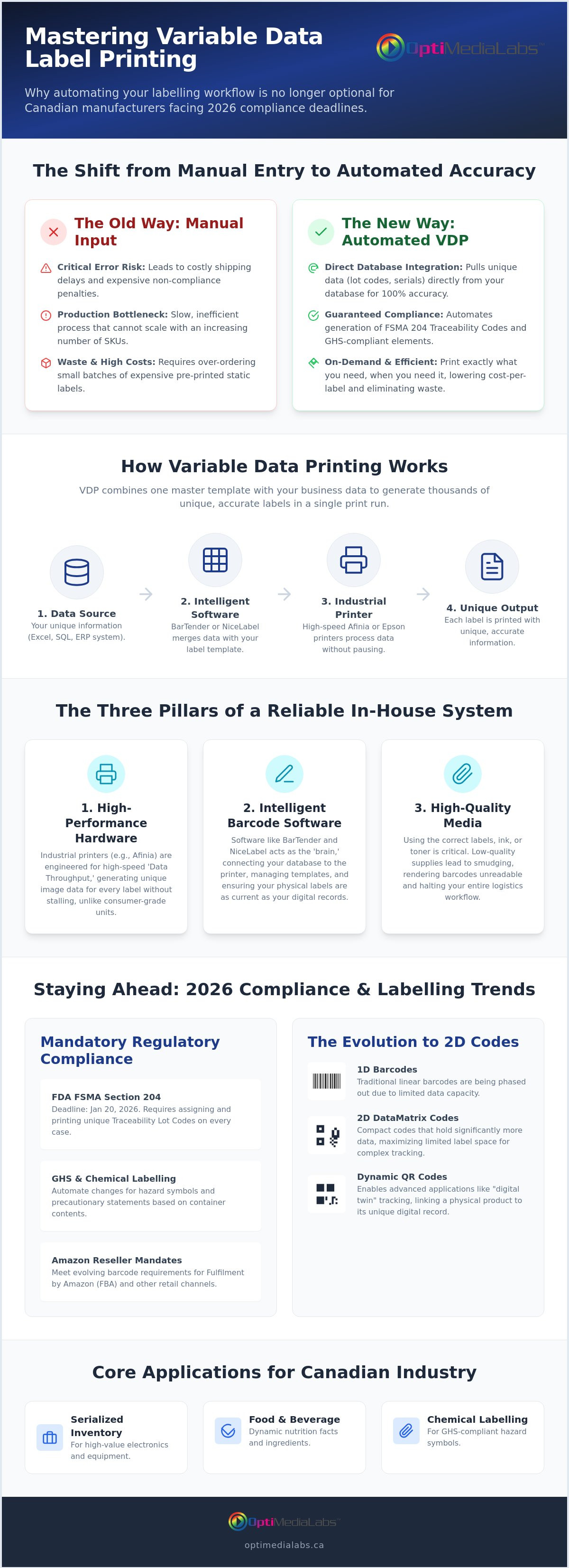
Manual data entry isn't just a bottleneck; in 2026, it's a legal and financial liability for Canadian manufacturers. With the FDA’s FSMA Section 204 compliance date of January 20, 2026, already passed, your ability to assign and print Traceability Lot Codes on every case is no longer optional. Relying on manual input for these critical data elements leads to shipping delays and expensive non-compliance penalties. Adopting variable data label printing allows you to automate this entire workflow, pulling unique information directly from your database to ensure every label is accurate and compliant.
You likely realize that managing an increasing number of SKUs and serialized inventory requires a more efficient approach than ordering expensive small batches of pre-printed labels. We're here to help you modernize your production line. This guide explains how to integrate dynamic labeling to lower your cost-per-label and maintain complete control over GHS and retail standards. We will examine the latest industrial hardware, essential software like BarTender or NiceLabel, and the specific strategies you need to eliminate data entry errors for good.
Key Takeaways
- Automate your production line and eliminate manual data entry errors by integrating variable data label printing directly with your internal database.
- Identify the essential components of a professional in-house setup, including high-speed industrial hardware, intelligent barcode software, and high-quality media.
- Stay compliant with 2026 regulatory updates, including FSMA 204 traceability lot codes and the latest Amazon reseller barcode mandates.
- Explore the shift toward 2D DataMatrix codes and dynamic QR codes to maximize label space and enable digital twin tracking.
- Realize the cost savings of transitioning to an in-house Afinia or Epson system to reduce lead times and lower your overall cost-per-label.
What is Variable Data Label Printing and Why Does It Matter in 2026?
In its simplest form, Variable data printing (VDP) is a digital printing method where elements such as text, graphics, and barcodes change from one printed piece to the next without stopping or slowing down the press. Unlike traditional methods that require a separate file for every variation, variable data label printing uses information from an external database or electronic file. This means you can print a thousand labels in a single run where every single one has unique content. In 2026, this technology is the backbone of compliant industrial labeling. It moves you away from static, "one-design-fits-all" production and toward a dynamic, data-driven workflow.
The primary benefit of this shift is efficiency. You no longer need to manage thousands of individual static label files. Instead, you manage one master template. This setup reduces the risk of using outdated artwork and simplifies your digital asset management. For Canadian logistics, this means faster throughput. When your printer can generate unique tracking data at the moment of production, you eliminate the bottlenecks caused by manual data entry. It ensures that every package contains the exact data required for automated sorting centres and retail scanning systems.
The Evolution of the "Static" Label
Traditional printing workflows often forced Canadian businesses to over-order static labels to reach a viable price point. This created massive waste when regulations changed or product specifications shifted. Static labels meant storing pallets of inventory that could become obsolete overnight. The move toward on-demand printing has changed this dynamic, allowing for smaller, more frequent runs that reduce storage costs and waste. Variable data printing bridges the gap between digital databases and physical product packaging through seamless data integration. By using BarTender software or NiceLabel software, you can ensure your physical labels are as current as your digital records.
Core Applications for Canadian Industry
Canadian manufacturers across various sectors now rely on variable data label printing to maintain operational standards. Common applications include:
- Serialized Inventory: High-value electronics and industrial equipment require unique serial numbers for warranty tracking and theft protection.
- Food and Beverage: Dynamic nutrition facts and ingredient lists are vital for producers with multiple SKU variants or seasonal product changes.
- Chemical Labeling: GHS compliance requires hazard symbols and precautionary statements to change based on the specific contents of the container.
By automating these variations, you remove the human error factor that often leads to shipping delays or regulatory fines. Precision in labeling isn't just about branding; it's about maintaining a secure and traceable supply chain—and for professionals who require peak visual clarity to monitor these systems, you can learn more about Australian Made Vision for premium optical lens solutions.
The Three Pillars of an In-House Variable Data System
Establishing a reliable in-house operation requires a balanced integration of three specific components. This framework, often referred to as the Three Pillars of an In-House Variable Data System, ensures your production line remains efficient and error-free. If one component is substandard, the entire workflow suffers. For example, using low-quality ink on high-speed labels often leads to smudging; this renders barcodes unreadable and halts your logistics. Central to this setup is 'Data Throughput.' This is the speed at which your system processes unique data for every label. While consumer-grade printers often stall when generating unique images, industrial systems are built to maintain full engine speed while pulling data from your 'brain'—be it an Excel sheet, a SQL database, or a complex ERP system.
High-Performance Label Printers
Afinia Color Label Printers are specifically engineered to handle the intense processing requirements of variable data label printing. Unlike standard desktop units, their engines generate unique image data for every millimetre of a roll without pausing. This capability is critical when you're printing serialized barcodes or unique QR codes at high volumes. For businesses that prioritize high-resolution colour accuracy alongside dynamic data, Epson printers provide the precision needed to maintain branding consistency across thousands of unique SKU variations.
Professional Labeling Software
Your software acts as the vital bridge between your raw data and the physical print head. BarTender software allows you to create master templates where specific fields are designated as placeholders for variable elements. For Canadian facilities managing multiple users or sites, NiceLabel offers a centralized platform to control label designs and ensure data integrity. This template-based approach means you design the layout once and print millions of variations with zero manual intervention, pulling data directly from your existing records.
Compatible Consumables and Media
The final pillar is the media itself. You must select blank inkjet labels that are optimized for your specific ink type to ensure crisp, scannable barcodes. In harsh industrial environments, thermal transfer ribbons are essential for creating durable, smudge-free labels that withstand moisture, abrasion, or chemicals. Using mismatched consumables is the fastest way to degrade your print head and cause scanning failures in the field. If you're unsure which media suits your environment, you can discuss your specific production requirements with our technical team to find a compatible solution.
From Barcodes to QR Codes: Trends in Dynamic Identification
Identification standards are shifting from simple linear barcodes to high-density 2D data carriers. As Canadian sorting centres become more automated, the demand for space-efficient labeling has never been higher. 2D barcodes, such as DataMatrix, are quickly replacing traditional 1D barcodes because they store significantly more information in a fraction of the space. This shift is essential for variable data label printing, where each unit requires unique tracking data without cluttering the product packaging. By using these compact codes, you can include batch numbers, expiry dates, and serial numbers while maintaining a clean, professional aesthetic.
The rise of "Smart Labels" is another significant trend for 2026. These labels use dynamic QR codes to link physical products directly to their digital twins. This technology allows for hyper-localized marketing; you can print a single roll of labels where the QR code destination changes based on the region. For example, a single production run can serve both Ontario and Quebec by dynamically switching between English and French digital landing pages. This flexibility ensures your brand remains relevant and accessible to diverse Canadian markets without the need for multiple print setups.
Maintaining scannability is the most critical challenge in a variable environment. Since every label is unique, you cannot rely on testing only the first print of a batch. Every variation must be verified for clarity. Retailers now demand a minimum 0.25-inch (6.4mm) quiet zone on both sides of a barcode for GS1 compliance to ensure scanners can isolate the code. Additionally, a minimum print resolution of 300 DPI is required for GS1-128 barcodes to prevent "picket-fencing" and ensure scanning reliability across the entire supply chain.
1D vs. 2D Barcodes: Which Does Your Business Need?
While traditional UPC codes (1D) are still used for basic retail checkout, they lack the capacity for advanced traceability. QR codes and DataMatrix (2D) offer much higher data density and built-in error correction, making them more resilient to smudges or tears. Sequential numbering is still effective for simple asset management, but 2D barcodes are becoming the standard for Canadian pharmaceutical and aerospace traceability because they accommodate extensive batch and expiry data in a tiny square. Choosing the right format depends on your industry's specific regulatory requirements and the amount of data you need to communicate.
The Integration of RFID
For facilities looking beyond visual identification, RFID label printers provide a way to add an invisible layer of data to every item. These systems combine visual variable data on the label surface with encoded information on an embedded RFID chip. This dual-layer approach is a cornerstone of modern warehouse automation, allowing for bulk scanning of pallets without a direct line of sight. Future-proofing your labeling strategy means moving toward these hybrid solutions, ensuring your business is ready for the hyper-automated logistics landscape of 2026 and beyond.
How to Implement Variable Data Printing in Your Facility
Moving from a static labeling workflow to a dynamic system requires a methodical approach. Successfully deploying variable data label printing isn't just about buying a new printer; it's about creating a seamless pipeline from your digital records to the physical package. You must ensure that your data is clean, your templates are flexible, and your hardware can keep pace with your production schedule. Following a structured rollout reduces the risk of expensive errors and ensures your facility meets the latest 2026 traceability standards.
- Step 1: Audit your data source. Begin by cleaning up your existing Excel sheets or verifying the data structure in your ERP. Inconsistent formatting in your database will lead to misaligned text or unreadable barcodes on the final label.
- Step 2: Design a master template. Use your labeling software to create a single layout with "placeholder" fields. These fields will automatically populate with unique data during the print run, eliminating the need to manage individual files for every SKU.
- Step 3: Select capable hardware. Choose a printer that matches your daily output requirements and offers the resolution needed for small-font compliance data.
- Step 4: Test for scannability and durability. Print a sample batch and subject it to the environmental conditions it will face, such as moisture or abrasion. Use a scanner to verify that every variable barcode is readable.
- Step 5: Roll out and train. Finalize the workflow and train your staff on the software-to-printer connection to ensure smooth operation across all shifts.
Connecting Your Database
Your database is the foundation of the entire system. Most Canadian facilities start with simple CSV or Excel files, but as you scale, connecting directly to a SQL database or a cloud-based ERP becomes essential. Loftware Cloud simplifies this process by providing a centralized hub for data access. This is particularly beneficial for remote teams or businesses managing multiple production centres across Canada. Organizing your data into logical columns and consistent formats prevents the software from misinterpreting fields, which is the most common cause of variable printing failures.
Choosing the Right Hardware for Your Volume
Matching your printer to your daily label count is vital for maintaining engine health and print quality. Small desktop units are suitable for low-volume serialized labels, but industrial environments require heavy-duty machines built for 24/7 operation. For high-volume specs and detailed performance metrics, refer to our guide on the best industrial label printers for Canadian production environments. If your facility uses high-speed assembly lines, consider "Print and Apply" automation. These systems integrate variable data processing with mechanical applicators to place labels on moving products with zero manual intervention. To ensure your hardware choices align with your specific production goals, contact our technical specialists for a system audit.
Optimizing Your ROI with OptiMediaLabs Canada Solutions
OptiMediaLabs Canada serves as a specialized distributor for the Canadian market, providing the technical expertise required to transition from legacy systems to modern, dynamic workflows. While outsourcing unique labels was once a standard practice, the financial benefits of in-house variable data label printing are now undeniable for scaling businesses. By moving production to an Afinia or Epson system, you eliminate the high minimum order quantities and long lead times associated with third-party print shops. This shift gives you the agility to respond to regulatory changes or SKU updates without waiting for a shipment to arrive at your facility.
Professional software plays a vital role in protecting your return on investment. Tools like BarTender software allow you to preview data-driven designs, which significantly reduces label waste during the setup phase. Accuracy is paramount. A single batch of unreadable codes can result in thousands of dollars in retail chargebacks and administrative fines. Beyond software, maintaining your hardware with brand-specific consumables is essential for machine longevity. Using mismatched inks or poor-quality ribbons might seem like a saving, but it often leads to premature print head failure and inconsistent output quality.
Total Cost of Ownership (TCO) Analysis
When comparing the price-per-label of outsourced variable runs against in-house production, you must look beyond the initial invoice. Outsourcing includes hidden costs that often go overlooked in a standard budget. Freight charges, expedited shipping fees for last-minute SKU changes, and the cost of storing pre-printed inventory all add up quickly. Furthermore, the operational downtime caused by delivery delays can stall your entire shipping department.
In-house systems provide a much lower TCO over time. Utilizing high-capacity Afinia ink cartridges or Epson high-yield tanks further reduces your long-term operational expenses. These consumables lower the frequency of replacements and ensure a consistent cost-per-print. This predictable pricing model allows Canadian manufacturers to budget more accurately for high-volume serialized runs without the volatility of third-party service fees.
Expert Support for Canadian Manufacturers
Selecting the right hardware requires a deep understanding of your specific production environment. A dedicated vendor doesn't just sell a box; they provide a secure path to compliance and efficiency. OptiMediaLabs Canada acts as a technical partner, helping you identify whether inkjet or thermal transfer technology fits your specific durability requirements. Our team ensures you have access to the right barcode software to integrate with your existing ERP or database systems.
We provide the specialized hardware and consumables discussed throughout this guide to help you realize your automation goals. Our logistics network ensures reliable delivery of supplies to keep your production lines moving. Ready to modernize your facility and lower your labeling costs? Contact OptiMediaLabs Canada for a professional labeling consultation to find the ideal solution for your unique requirements.
Future-Proof Your Labeling Operations
Implementing variable data label printing is no longer a luxury for Canadian businesses; it's a necessity for maintaining compliance with FSMA 204 and modern retail traceability standards. By transitioning to an in-house system, you eliminate the risks associated with manual data entry while significantly reducing your long-term cost-per-label. High-performance hardware and intelligent software work together to ensure every barcode is scannable and every shipment is accurate. This shift allows you to maintain complete control over your serialized inventory and GHS compliance without the delays of outsourced production.
OptiMediaLabs is your trusted partner for this transition. We are an authorized distributor for Afinia, Epson, and Zebra, offering a comprehensive selection of BarTender and NiceLabel software. With national shipping across Canada, we provide the specialized hardware and consumables you need to streamline your production line. Precision in dynamic identification ensures your logistics remain frictionless as sorting centres become more automated.
Shop Professional Variable Data Printing Solutions at OptiMediaLabs to modernize your facility today. Achieving zero-error production is within reach when you have the right technical framework in place.
Frequently Asked Questions
What is the difference between sequential numbering and variable data printing?
Sequential numbering follows a fixed, predictable pattern like 001, 002, and 003. Variable data label printing is far more complex because it pulls unique, non-linear information directly from a database. This allows you to change every element on the label, including images, graphics, and unique tracking codes, in a single print run.
Do I need special ink to print variable barcodes that are scannable?
You must use high-quality, brand-specific ink or toner to ensure your barcodes meet the 300 DPI resolution required for GS1 compliance. Substandard ink can bleed or smudge, leading to "picket-fencing" that prevents scanners from reading the code. Using original Afinia or Epson ink cartridges ensures your labels remain scannable throughout the entire supply chain.
Can I print variable data labels from a standard Excel spreadsheet?
Yes, you can use a standard Excel or CSV file as your primary data source. Professional labeling software like BarTender or NiceLabel connects directly to these files to populate "placeholder" fields on your master template. This automation ensures that your physical labels are always synchronized with your internal digital product database.
Which Afinia printer is best for high-speed variable data applications?
The Afinia L901 is the optimal choice for high-speed industrial environments. It is specifically designed to process unique image data at full engine speed, which prevents the printer from pausing between labels. This capability is essential for high-volume variable data label printing where serialized barcodes or unique traceability lot codes are required.
Is variable data printing more expensive than traditional label printing?
In-house variable printing is often more affordable for unique or small-batch runs. While traditional printing requires high minimum orders to achieve bulk pricing, in-house systems allow you to print exactly what you need. This eliminates the cost of storing or wasting obsolete pre-printed labels when Canadian regulations change.
Do I need a specific type of label software to handle variable QR codes?
You require professional barcode software like BarTender or NiceLabel to handle dynamic QR codes effectively. These programs allow you to link QR code content to a database, changing the destination URL or data for every label. Standard graphic design tools lack the database integration required for this level of automation.
How does variable data printing help with GHS and WHMIS compliance in Canada?
VDP ensures that every chemical container has a label that perfectly matches its specific Safety Data Sheet (SDS). In Canada, GHS and WHMIS standards require pictograms and precautionary statements to change based on the substance concentration. Variable printing automates these changes, removing the risk of manual errors in hazardous material labeling.