
VIPColor VP700 vs VP750: Selecting the Best Water Resistant Label Printer for Your Business
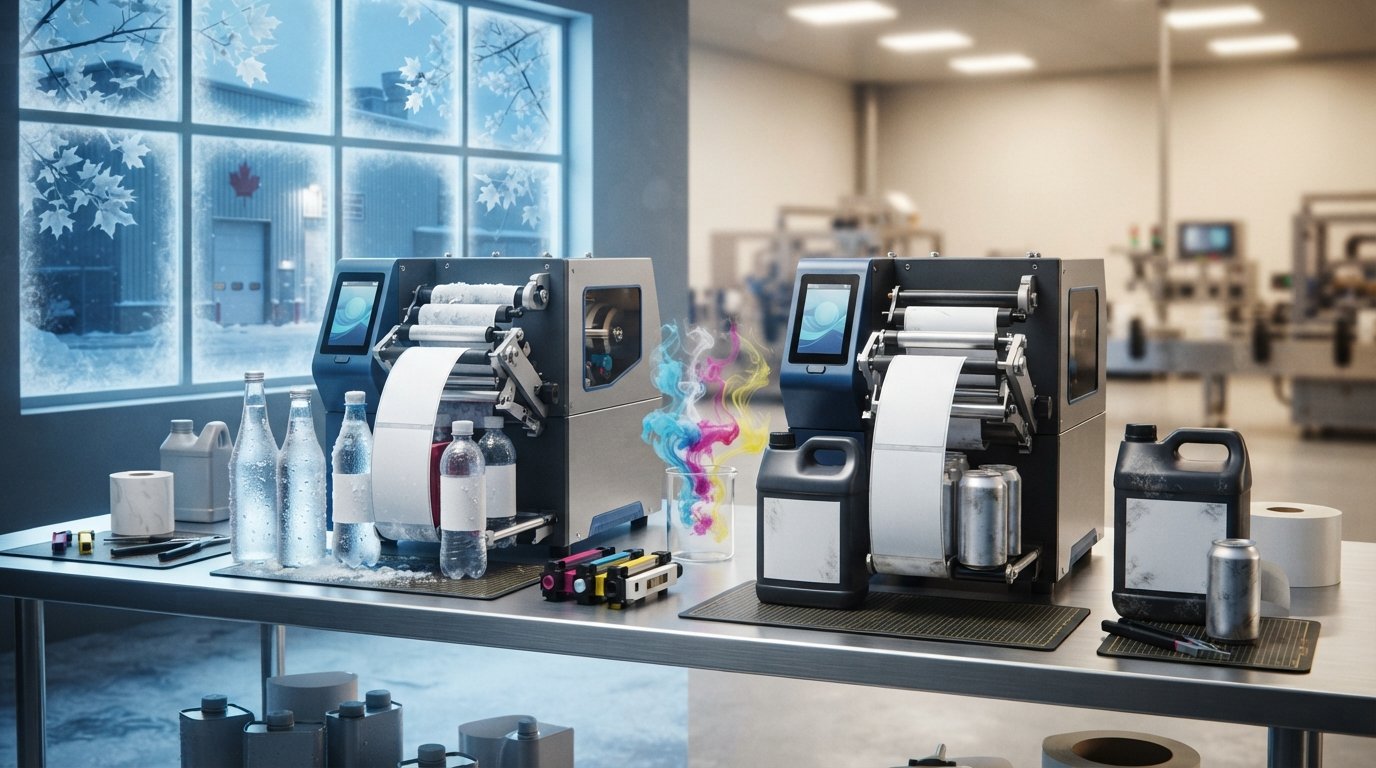
What if the few cents you save on standard dye-based ink actually costs your brand its reputation when a label smudges in a customer's refrigerator? It is a common frustration for Canadian manufacturers in the food, beverage, and chemical sectors. You have likely dealt with the headache of labels that look great in the warehouse but fail the moment they face condensation or shipping friction. We understand that you need a solution that balances professional aesthetics with rugged durability.
Deciding between the VIPColor VP700 vs VP750 water resistant label printing technologies is a critical step in protecting your product's shelf appeal. This guide compares technical specifications, ink durability, and performance in harsh Canadian environmental conditions to help you realize which industrial solution fits your workflow. We will break down the differences in Memjet technology and ink formulations so you can stop overpaying for outsourced labels. By the end, you will know exactly which printer secures your brand integrity and provides a reliable supply chain for your in-house production needs.
Key Takeaways
- Compare the identical 12 inches per second print speed and 1600 dpi resolution to understand the base performance of the shared Memjet engine.
- Identify why the VIPColor VP700 vs VP750 water resistant label printing comparison hinges on the VP750’s specialized ink formulation for high-moisture environments.
- Evaluate the critical role of inkjet-receptive coatings on synthetic media like BOPP to prevent smudging during shipping or refrigeration.
- Determine if your specific product lifecycle requires the "Ice Bucket Test" to justify the investment in enhanced water resistance.
- Learn how sourcing genuine VIPColor ink and media from a national Canadian distributor ensures consistent output quality and operational stability.
Understanding Memjet Technology and the Need for Moisture Resistance
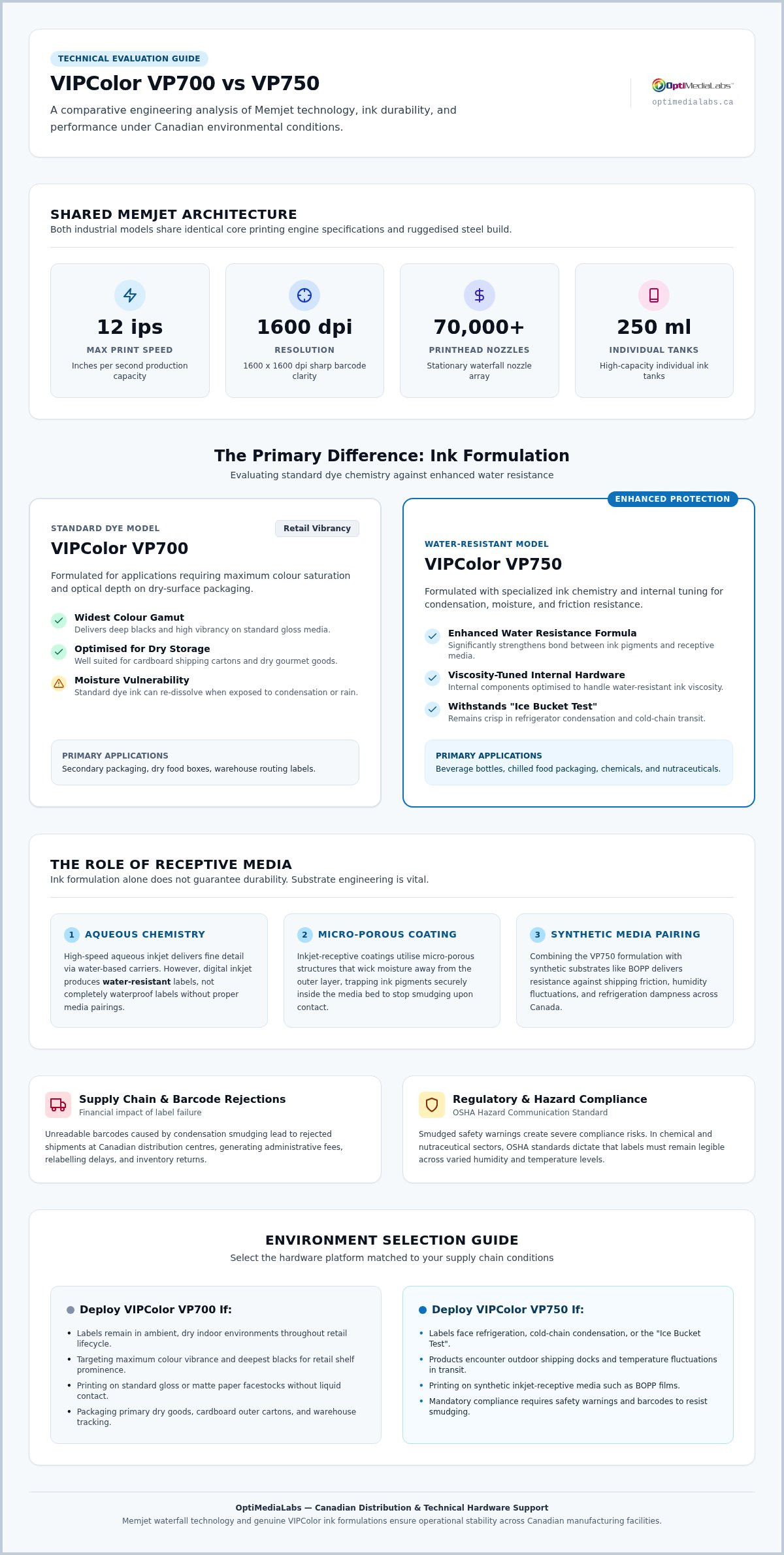
Both the VP700 and VP750 utilize advanced Memjet inkjet technology to achieve industry-leading speeds. This "waterfall" architecture features a stationary printhead with over 70,000 nozzles. It delivers 1600 x 1600 dpi resolution while moving media at up to 12 inches per second. For Canadian businesses, this means professional-grade labels can be produced in-house without the delays of traditional print houses.
High-speed aqueous printing relies on water-based inks. While these provide exceptional colour depth, they face inherent challenges when exposed to moisture. Standard dye-based inks can re-dissolve if they come into contact with condensation or rain. This vulnerability makes the choice between VIPColor VP700 vs VP750 water resistant label printing technologies a pivotal decision for your production line. You must understand that "water-resistant" is not a synonym for "waterproof". Digital inkjet solutions provide resistance to splashes and humidity; however, total immersion usually requires specific media pairings and ink formulations.
The label surface, or media, plays an equally important role. Specialized inkjet-receptive coatings utilize micro-porous structures to wick moisture away from the surface and trap ink pigments securely within the media layer. Without the right coating, even the best ink will smudge during handling.
Standard Dye vs. Enhanced Water Resistant Formulations
The VP700 uses standard dye inks that offer the widest colour gamut and highest vibrance. These are ideal for dry applications like cardboard box labelling or gourmet dry food packaging. In contrast, the VP750 uses an "Enhanced Water Resistance" formula. This version significantly improves the bond strength between the ink and the media. It ensures that labels remain crisp even when subjected to the damp conditions found in refrigerators or outdoor shipping docks.
The Business Impact of Label Failure
Label failure is more than a cosmetic issue. It is a financial risk. Unreadable barcodes can lead to rejected shipments at major Canadian distribution centres, resulting in costly returns and administrative fees. In the chemical and nutraceutical sectors, smudged safety warnings create serious compliance risks. A durable label maintains your premium brand image throughout the entire Canadian shipping cycle, where temperature fluctuations and high humidity are frequent obstacles. Investing in a VIPColor inkjet label printer that matches your environment protects your bottom line.
VP700 vs VP750: Technical Specifications and Performance Comparison
The VIPColor industrial series is designed for high-demand environments where downtime is not an option. Both models utilize a high-performance engine capable of 1600 x 1600 dpi resolution. This ensures that even the smallest fine print and complex barcodes remain sharp. They share a maximum print speed of 12 inches per second. This allows your team to produce thousands of labels in a single shift. When evaluating VIPColor VP700 vs VP750 water resistant label printing capability, the core mechanics appear identical; however, the internal components of the VP750 are optimised to handle the specific viscosity of water-resistant ink formulations.
Efficiency is driven by large 250ml individual ink tanks. This high capacity reduces the frequency of replacements and keeps the cost-per-print low compared to desktop inkjet alternatives. Both printers integrate seamlessly with professional label design software, allowing for easy serialization and data-driven printing. The ruggedised steel construction ensures these machines withstand the vibration and dust of a Canadian warehouse or production floor.
Durability is often a regulatory requirement. The OSHA Hazard Communication Standard labeling requirements emphasize that labels must remain legible under all conditions. This makes the choice of hardware critical for compliance. If you are unsure which model fits your facility, request a technical consultation with our team at OptiMediaLabs Canada.
Print Quality and Colour Consistency
The VP700 delivers a vibrant colour gamut that is perfect for retail shelf appeal. It excels at producing deep blacks and bright primary colours on standard gloss media. The VP750 maintains this professional-grade quality while using a more robust ink set. Both models realise consistent results across long print runs. You must use genuine VIPColor ink to maintain printhead health and ensure your warranty remains valid. Third-party inks often lead to nozzle clogs and inconsistent colour matching.
Media Handling and Versatility
Industrial flexibility is a hallmark of this series. Both printers support roll-to-roll and fanfold feeding, which is essential for high-volume Canadian production lines. They accommodate a maximum label width of 8.5 inches. This is wide enough for large chemical drums or pallet labels. For businesses requiring custom shapes, these printers pair perfectly with label finishers to streamline your workflow. This combination allows you to print and cut any design without the need for expensive dies. The ability to handle varying thicknesses, from thin papers to thick synthetic stocks, makes these machines highly versatile assets.
Choosing the Right Media: How Label Stock Impacts Water Resistance
The effectiveness of VIPColor VP700 vs VP750 water resistant label printing is not solely dependent on the hardware. It is a chemical partnership between the ink and the media surface. Inkjet-receptive coatings are engineered with microscopic pores that instantly capture aqueous ink droplets. This is particularly vital given the precision of Memjet printhead technology, which fires millions of tiny droplets per second. If the coating cannot absorb the volume of ink at high speeds, the result is pooling and smudging. You must ensure your media choice matches the specific ink formulation of your printer.
Synthetic materials like BOPP (Biaxially Oriented Polypropylene) and PET (Polyester) offer the highest durability. BOPP is a cost-effective choice for most food and beverage applications. It resists oils and moisture effectively. PET is more rigid and offers superior resistance to high temperatures and chemicals. Interestingly, matte finishes often provide better moisture absorption than certain gloss stocks. The lack of a heavy gloss top-coat allows the ink to penetrate the receptive layer more quickly. Always test your media in its final environment, as warehouse humidity differs greatly from a retail refrigerator.
Synthetic vs. Paper Labels for Chilled Goods
Paper labels are unsuitable for products facing heavy condensation or ice bucket immersion. They absorb water, causing the fibres to swell and the ink to bleed. In the food sector, BOPP is the industry standard because it remains stable when exposed to fats and liquids. For those transitioning production in-house, sourcing high-quality blank inkjet labels ensures your prints remain crisp regardless of the model you choose. This synthetic barrier is the first line of defence for your branding.
Adhesive Performance in Cold Environments
Adhesion is just as critical as ink durability. Low temperatures can cause standard adhesives to become brittle, losing their "tack" and causing labels to flag or fall off. You must select an adhesive specifically rated for frozen or refrigerated shipping to maintain label integrity. A water-resistant print is useless if the adhesive fails. Ensure your media supplier understands your specific Canadian logistics chain to avoid these common points of failure during winter transport or cold storage.
Assessing Your Production: Upgrading to the VP750
Choosing between the VIPColor VP700 vs VP750 water resistant label printing systems requires a thorough audit of your product's lifecycle. You must consider the journey from your production line to the final consumer. If your product spends time in a Canadian cold-chain logistics network, it faces significant temperature shifts. These shifts cause condensation. A label that looks perfect in a climate-controlled office might peel or smudge during a humid summer transit or inside a commercial refrigerator. Evaluating these environmental stressors before you invest prevents costly production errors.
The "Ice Bucket Test" serves as the ultimate benchmark for durability. Submerge your current labels in ice water for several hours. If the ink runs or the paper backing disintegrates, your brand integrity is at risk. Upgrading to the VP750 provides the necessary security for these high-moisture scenarios. While the initial hardware cost is higher than the VP700, you must balance this against the long-term savings of reducing product returns and maintaining retail compliance. Reliable performance in a damp Canadian warehouse is a strategic advantage that protects your bottom line.
High-Moisture Industry Use Cases
Certain sectors demand the enhanced durability of the VP750. In the craft beer and wine industry, labels must survive total immersion and frequent handling. Cosmetics and personal care products face daily splashes in bathrooms, where standard dye inks often fail. For chemical and industrial manufacturers, maintaining GHS compliance in harsh outdoor settings is a legal necessity. The VP750 ensures that safety warnings remain legible even when exposed to rain or chemical spills, ensuring your facility stays compliant with safety regulations.
When the VP700 is the Better Choice
The VP700 remains a powerhouse for businesses with controlled environments. If you produce dry goods like boxed pasta or secondary packaging that stays in a dry warehouse, the extra cost of water-resistant ink may not be necessary. Indoor retail settings with stable humidity levels are perfect for the VP700. This model is also the preferred choice when maximum colour vibrance on gloss paper is your primary goal. Standard dye inks often provide a slightly wider colour gamut, which is ideal for high-end luxury packaging that stays dry and climate-controlled.
Evaluating your specific environmental stressors is the only way to ensure a successful in-house transition. If you need help determining which model fits your specific workflow, contact our technical team for a media compatibility review.
Sourcing VIPColor Solutions and Professional Support in Canada
Transitioning to in-house production is a strategic move for Canadian businesses seeking to reduce lead times. Outsourcing often involves high minimum order quantities (MOQs) and shipping delays that disrupt your supply chain. By implementing a VIPColor VP700 vs VP750 water resistant label printing workflow, you gain total control over your inventory. You can print exactly what you need when you need it. This agility is essential for seasonal products or rapid market changes. Moving production in-house allows you to organize your workflow around your specific needs rather than a print house's schedule.
Professional design tools like NiceLabel or BarTender software ensure your production remains seamless. These platforms allow you to manage complex variable data and barcodes with precision. When paired with high-speed VIPColor hardware, your team can move from design to finished label in minutes. This integration reduces the risk of data entry errors and ensures every label meets your quality standards.
National Distribution and Reliable Supply
Canadian businesses prefer domestic vendors to avoid the complications of international shipping and customs. OptiMediaLabs provides national distribution across Canada. This ensures you have a steady supply of genuine VIPColor ink and specialized media. Reliability prevents production halts caused by stockouts. Accessing local technical expertise for hardware setup and media selection helps you realize the full potential of your investment. Our specialists understand the technical requirements of industrial labelling. We provide a streamlined path to obtaining necessary resources. A partnership with a dedicated industrial distributor provides the stability needed for long-term growth.
Next Steps for Your Labeling Strategy
Before making a final decision, you should request printed samples to test water resistance within your own facility. Every production environment is unique. Seeing how the ink performs on your specific containers provides the reassurance needed for a large-scale rollout. Analyzing the VIPColor VP700 vs VP750 water resistant label printing results on your specific media is the best way to verify performance. Calculate your potential ROI by comparing the cost of current outsourced labels against the efficiency of in-house production. Factor in the hidden costs of storage and obsolete inventory. Most businesses find that the reduction in waste and lead times quickly offsets the initial hardware investment.
Ready to optimize your production line? Contact OptiMediaLabs today to discuss your VIPColor requirements and secure a reliable Canadian supply chain.
Secure Your Brand Integrity with the Right Industrial Solution
Choosing between these two systems determines how your product survives the diverse Canadian climate. If your labels face refrigeration, condensation, or heavy handling, the VP750’s enhanced chemistry is a strategic necessity. For dry retail goods, the VP700 provides unmatched speed and colour vibrance. Remember that your media selection is just as critical as the hardware. Pairing the right synthetic stock with your printer ensures your branding remains professional from the production line to the customer's hands.
Deciding on VIPColor VP700 vs VP750 water resistant label printing technology is easier with a dedicated partner. OptiMediaLabs Canada is an authorized VIPColor Canadian distributor. We provide expert guidance on GHS and moisture-resistant compliance while offering national shipping on all ink and label media. We help you realize the full potential of in-house production with reliable support and technical expertise.
Request a VIPColor VP700 vs VP750 Print Sample and Expert Consultation
Take control of your production schedule and protect your shelf appeal today. We are here to support your transition to a more efficient labelling workflow.
Frequently Asked Questions
Is the VIPColor VP750 completely waterproof?
The VIPColor VP750 is highly water-resistant but not technically waterproof. In digital printing, waterproof usually implies a label that can survive prolonged submersion without any degradation. The VP750 uses an Enhanced Water Resistance ink formulation that prevents smudging when exposed to condensation or light splashes. For maximum durability, you must pair this ink with synthetic media like BOPP. This combination ensures your branding stays intact during refrigerated transport across Canada.
Can I use standard VIPColor VP700 ink in a VP750 printer?
You cannot use standard VP700 ink in a VP750 printer. While both models share a similar chassis, the VP750 is specifically engineered to handle the different viscosity and chemical properties of water-resistant ink. Using the wrong cartridges will likely lead to printhead clogs and inconsistent colour matching. It also voids your manufacturer warranty. Always source genuine VIPColor consumables from an authorized distributor to protect your hardware investment and maintain professional output quality.
Does the VP750 print as fast as the VP700?
Yes, the VP750 prints at the exact same speed as the VP700. Both industrial machines utilize the high-speed Memjet engine, allowing for print speeds of up to 12 inches per second. This translates to roughly 60 feet of labels per minute. You don't have to sacrifice productivity to achieve better moisture resistance. Whether you choose the VIPColor VP700 vs VP750 water resistant label printing solution, your production throughput remains high and efficient.
What kind of labels do I need for water-resistant printing?
You need synthetic labels with a specialized inkjet-receptive coating. Standard paper labels will absorb moisture and cause the ink to bleed, regardless of which printer you use. Biaxially Oriented Polypropylene (BOPP) and Polyester (PET) are the most reliable choices for moisture-heavy environments. These materials don't tear or swell when wet. The coating is essential because it locks the ink in place, preventing smudges during shipping or handling in humid Canadian warehouses.
How much more expensive is the water-resistant ink for the VP750?
There is a marginal price difference between the standard dye ink and the Enhanced Water Resistance formulation. This cost reflects the specialized chemicals required to ensure the ink bonds securely to synthetic media. While the per-label cost is slightly higher for the VP750, the long-term savings are significant. You avoid the high costs of product returns and unreadable barcodes. Most Canadian businesses realize that the durability of their branding justifies the small increase in consumable investment.
Can these printers handle GHS compliant chemical labels?
Yes, these printers can produce GHS compliant chemical labels when paired with the correct media. The VP750 is particularly effective for this application because its ink resists the harsh conditions often found in industrial settings. To meet full GHS and BS5609 standards, you must use certified synthetic label stocks that are tested for saltwater immersion and abrasion. This ensures your safety warnings and barcodes remain legible throughout the entire lifecycle of the chemical container.
Do I need special software to run a VIPColor label printer?
You don't need proprietary software, but professional tools are highly recommended. These printers use standard Windows drivers, so you can print from most applications. However, to realize the full potential of industrial production, most businesses use BarTender or NiceLabel. These programs allow you to easily manage complex serialization, QR codes, and regulatory data. They provide a more stable and efficient workflow for high-volume printing compared to basic design or office software.
Where can I buy VIPColor ink and labels in Canada?
OptiMediaLabs is your authorized national distributor for VIPColor VP700 vs VP750 water resistant label printing solutions in Canada. We provide a reliable supply of genuine ink cartridges and specialized blank labels for both series. Our national shipping ensures your production line never stops due to a lack of consumables. We offer technical expertise to help you select the right media, ensuring your in-house labelling strategy is both durable and cost-effective.