
Zebra ZT411 vs Toshiba Industrial Barcode Printer Durability: 2026 Comparison
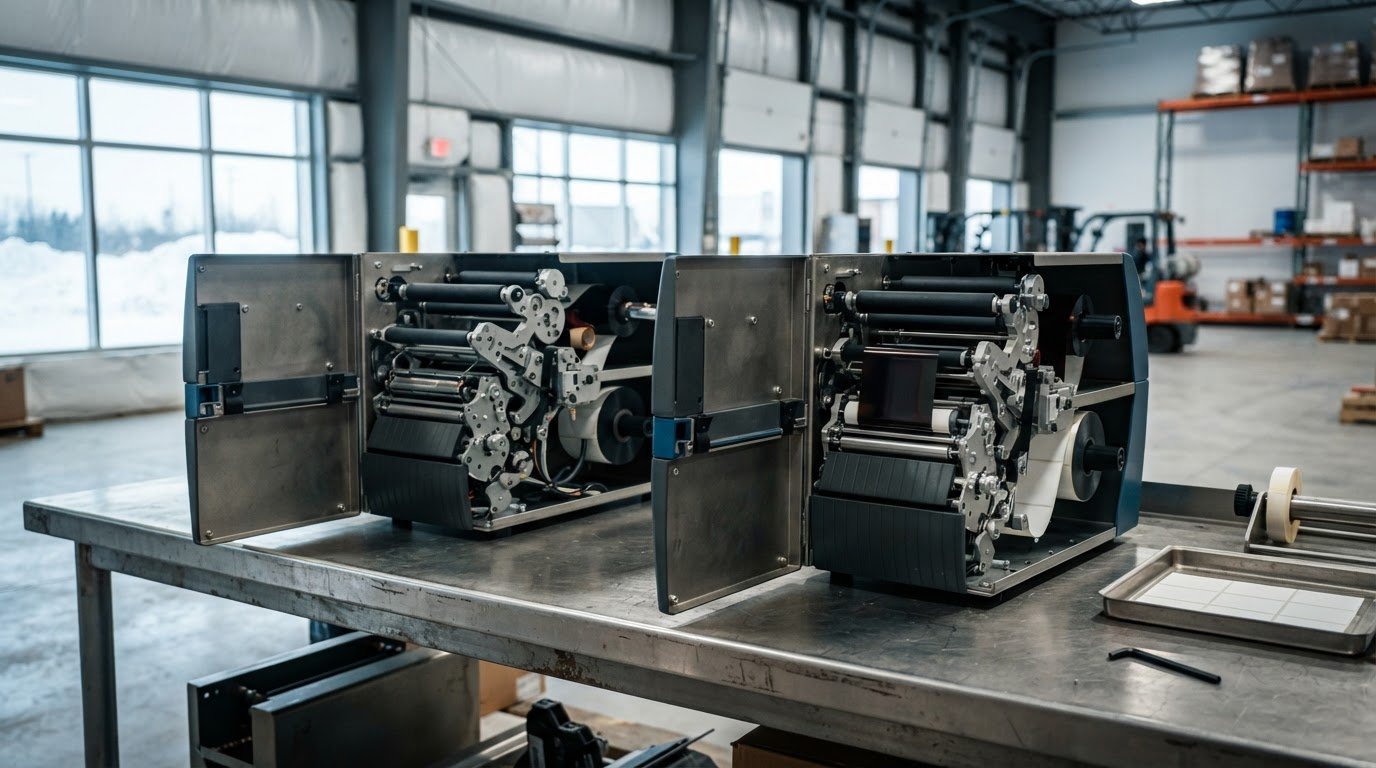
A heavy steel casing won't save your distribution line if your thermal printhead burns out after only a few hundred thousand labels. When evaluating Zebra ZT411 vs Toshiba industrial barcode printer durability, long-term survival depends on internal friction mechanics rather than just exterior metal gauge. While both platforms deliver rugged metal enclosures engineered for punishing multi-shift shifts, their mechanical approaches to heat dissipation, drive tensioning, and media transport differ substantially.
You already know the frustration of unexpected line stoppages caused by fouled mechanisms, continuous plant vibration, and premature component wear. In this operational evaluation, we assess real-world chassis resilience, printhead duty cycles, and routine maintenance demands across both printer lines so you can protect operating margins and minimize total cost of ownership. We compare internal drive assemblies, thermal wear points, and daily reliability to reveal which workhorse genuinely withstands round-the-clock punishment in demanding Canadian facilities.
Key Takeaways
- Understand how heavy-gauge steel frames and bi-fold door designs protect delicate internal assemblies from shop-floor vibration and ambient dust.
- Our evaluation of Zebra ZT411 vs Toshiba industrial barcode printer durability shows how near-edge ribbon mechanics reduce abrasive friction to extend printhead run times.
- Compare tool-less printhead and platen roller replacement workflows that keep multi-shift packaging operations running without third-party service delays.
- Identify operational temperature thresholds and condensation mitigation strategies for unheated Canadian distribution hubs and refrigerated storage depots.
- Apply a practical two-step procurement framework to balance daily linear volume against media abrasiveness for the lowest total cost of ownership.
Chassis Engineering and Frame Construction: Zebra ZT411 vs Toshiba Industrial
Evaluating real-world thermal transfer label printers requires looking past marketing claims to examine physical sheet metal. In high-volume operations, comparing Zebra ZT411 vs Toshiba industrial barcode printer durability starts with structural rigidity. Both platforms use heavy-gauge metal casings to shield core mechanics, but their architectural layouts diverge when handling continuous floor vibration, particulate ingress, and daily warehouse abuse.
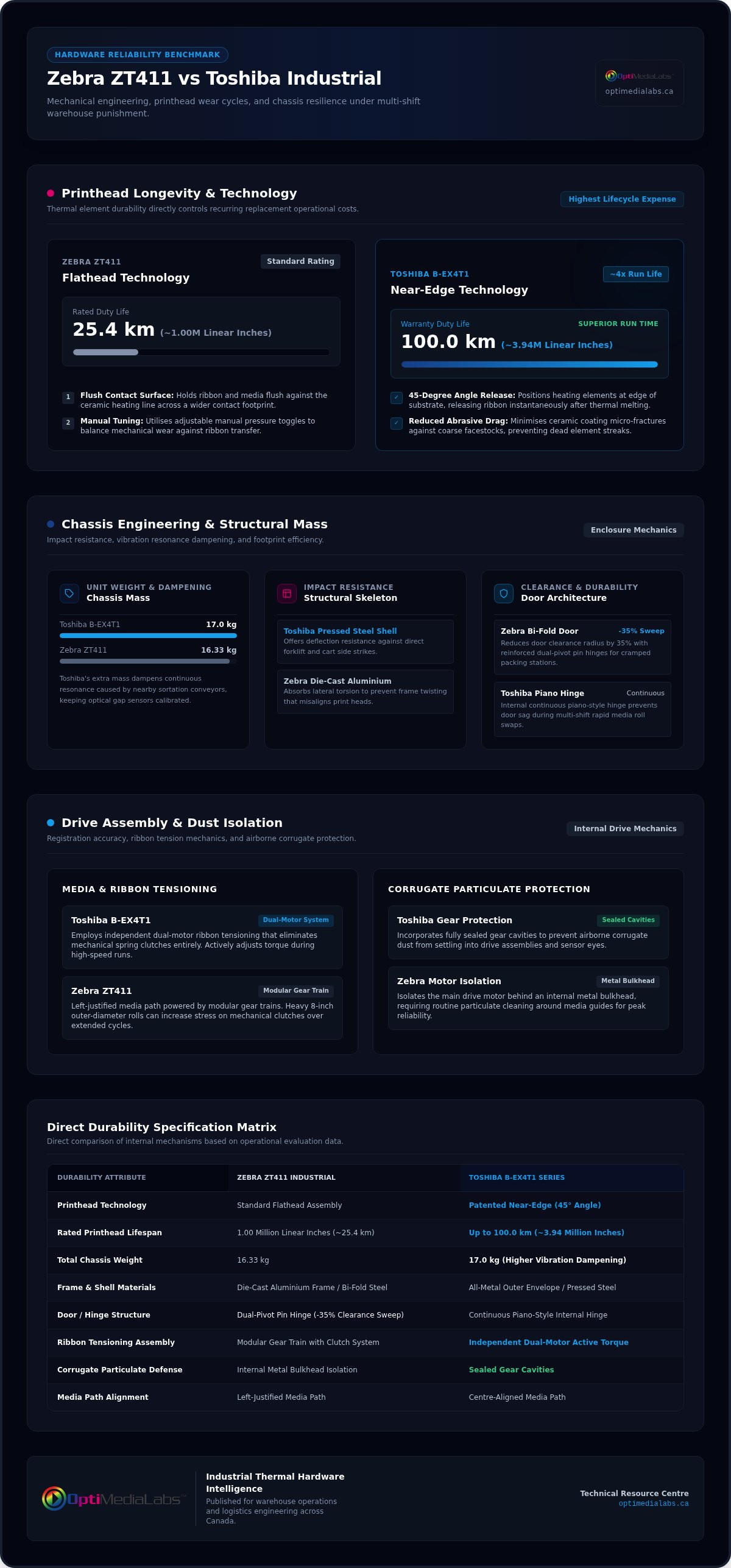
Zebra builds the ZT411 on a die-cast aluminium frame paired with a bi-fold steel media door. This enclosure reduces opening door sweep space by 35%, making it ideal for cramped packing stations. Toshiba counters with the B-EX series chassis, weighing 17.0 kg compared to Zebra's 16.33 kg. Toshiba uses an all-metal outer envelope with a double-fold side cover and center-aligned media paths. This extra mass dampens continuous resonance caused by nearby sortation conveyors, keeping delicate optical gap sensors accurately calibrated over multi-shift cycles.
Structural Integrity in High-Impact Facilities
Accidental impacts from rolling carts and forklift traffic test exterior tolerances daily. Zebra's cast aluminium skeleton absorbs lateral torsion well, preventing frame twisting that misaligns the print mechanism. Toshiba's pressed steel side assembly offers slightly greater deflection resistance against direct side strikes. Furthermore, door hinges on both units endure rigorous use. Zebra uses reinforced dual-pivot pin hinges, while Toshiba relies on a continuous piano-style internal hinge that prevents door sag during rapid roll swaps across three shifts.
Media Compartment and Drive Mechanism Durability
Drive mechanics dictate long-term registration accuracy. The Zebra ZT411 relies on modular gear trains that drive standard left-justified label media smoothly. However, continuous tension from heavy 8-inch outer-diameter rolls can stress mechanical clutches over time. Toshiba employs independent dual-motor ribbon tensioning on the B-EX4T1, eliminating spring clutches entirely. By actively adjusting winding torque, this system reduces strain during high-speed runs.
Industrial dust control is equally vital. During the thermal-transfer printing process, airborne corrugate dust settles onto drive assemblies and sensor eyes. Zebra isolates its main drive motor behind an internal metal bulkhead, whereas Toshiba incorporates sealed gear cavities. For operations deploying Zebra printers alongside Toshiba hardware across Canadian facilities, both platforms maintain reliable drive performance, provided technicians clean particulate build-up around the media guides regularly.
Printhead Longevity and Technology: Flathead vs Near-Edge Wear Rates
Printhead replacement cycles represent the highest recurring operating expense over any barcode hardware lifecycle. When assessing Zebra ZT411 vs Toshiba industrial barcode printer durability, the underlying printhead architecture dictates total wear rates. Zebra relies on traditional flathead heating elements, whereas Toshiba equips its B-EX4T1 line with patented near-edge technology. This architectural distinction fundamentally changes ribbon contact angles, abrasive friction profiles, and thermal duty cycles across high-speed shipping lines.
Flathead assemblies hold ribbon and label media flush against the ceramic heating line across a wider contact footprint. By comparison, Toshiba positions heating elements at a 45-degree angle along the edge of the printhead substrate. This design releases the ribbon almost instantaneously after thermal melting, reducing mechanical drag against coarse facestocks. As a result, Toshiba warranties its B-EX4T1 near-edge printheads up to 100 km (roughly 3.94 million linear inches), compared to Zebra's baseline rating of 1 million linear inches (approx. 25.4 km). For operations producing compliant logistics labels to meet strict GS1 barcode standards, this difference impacts how frequently lines experience scannability drop-offs from dead element streaks.
Thermal Element Friction and Mechanical Wear
Mechanical friction accelerates micro-fractures in ceramic protective coatings. Zebra ZT411 printheads feature adjustable manual pressure toggles. While helpful for dialing in transfers on thick synthetic tags, uneven toggle settings cause uneven abrasive wear across the element array. If left uncalibrated, airborne corrugate dust creates localized hot spots, leading to premature burnout. Facilities must clean printhead elements with 99% isopropyl alcohol at every ribbon change to prevent carbonized wax accumulation.
Ribbon Save Technology and Consumable Heat Dissipation
Toshiba integrates a mechanical ribbon-save module on select B-EX4T1 configurations. The printer physically lifts the printhead away from the platen roller during unprinted label areas, which achieves distinct operating advantages:
- Reduces ribbon material consumption by up to 75% on pre-printed shipping labels.
- Eliminates abrasive contact friction across non-imaged liner gaps.
- Permits rapid cooling of thermal elements between active print cycles.
Maximizing these hardware advantages requires pairing each printhead with certified thermal transfer ribbon formulations. Near-edge heads demand fast-release inks, while flathead systems require standard melting profiles. If your team needs help selecting compatible media or wants to audit your print fleet's replacement frequency, reach out to our technical team for tailored operational guidance across Canadian distribution networks.
Operational Maintenance and Component Replacement: ZT411 vs Toshiba
Line stoppages can quickly wreck fulfillment metrics. When comparing Zebra ZT411 vs Toshiba industrial barcode printer durability, ease of routine servicing proves just as critical as heavy-gauge frame parts. Both manufacturers recognize that keeping production moving means removing external service technician dependencies for routine consumable wear items.
Tool-Less Serviceability on the Production Floor
Replacing high-wear components shouldn't require a maintenance technician's toolbox. Zebra incorporates an intuitive brass latching system on the ZT411. Operators can unclip the printhead and extract the platen roller in under 60 seconds without tools. Toshiba matches this speed on the B-EX series with snap-in printhead brackets and quick-release platen bearings. When severe label wrap-arounds occur from misaligned aggressive adhesive tags, operators on either machine can release the platen roller immediately. This swift access prevents blade gouging and protects operator safety under standard OSHA warehousing guidelines.
Calibration Durability and Sensor Reliability
Transmissivity and reflective sensors encounter heavy dust exposure over multi-shift schedules. Zebra utilizes a laterally sliding media sensor marked with high-visibility yellow indicators. It locks firmly into position, but fine paper debris can settle into the optical channel during direct thermal conversion. Toshiba employs fixed or micro-adjustable sensor assemblies that exhibit exceptional calibration stability against mechanical vibrations. Both printer platforms retain sensor calibration values even after clearing severe media jams, eliminating lengthy recalibration loops.
Physical control interfaces also affect shop-floor durability:
- Zebra ZT411: Features a 4.3-inch full-colour resistive touch interface. It accepts gloved operation readily, though heavy chemical exposure or sharp stylus impacts can abrade the protective display film over several years.
- Toshiba B-EX Series: Utilizes a backlit graphical LCD backed by physical membrane keys. It offers tactile feedback and resists heavy industrial grime, but lacks the step-by-step graphical troubleshooting animations provided on Zebra's screen.
Here is how scheduled maintenance intervals stack up under continuous operation:
| Maintenance Action | Zebra ZT411 Standard | Toshiba B-EX Series Standard |
|---|---|---|
| Printhead Cleaning | Every ribbon or roll change (99% IPA) | Every ribbon or roll change (99% IPA) |
| Platen Roller Inspection | Monthly for adhesive buildup | Monthly for surface grooving |
| Sensor De-Dusting | Every 500,000 linear inches | Every 750,000 linear inches |
| Field Platen Swap Time | Approx. 45 to 60 seconds | Approx. 45 to 60 seconds |
Evaluating Zebra ZT411 vs Toshiba industrial barcode printer durability across daily operations reveals that both platforms excel at rapid modular repairs, ensuring distribution centres stay productive with minimal operational disruption.
Environmental Tolerance: Handling Cold Storage, Humidity, and Particulates
Harsh Canadian plant climates quickly expose mechanical and electrical vulnerabilities. Unheated cross-dock terminals, rapid seasonal humidity swings, and refrigerated packing rooms place heavy stress on internal circuitry. Assessing Zebra ZT411 vs Toshiba industrial barcode printer durability under these conditions requires reviewing thermal operating thresholds, condensation management, and particulate ingress controls.
Sub-Zero Operation and Cold Chain Facilities
Factory operating specifications define where baseline hardware can run safely without specialized protection. Zebra rates the ZT411 for direct thermal printing down to 0°C and thermal transfer printing down to 5°C, with non-condensing relative humidity between 20% and 85%. Toshiba rates the B-EX4T1 for operating environments between 5°C and 40°C, with non-condensing humidity tolerances of 25% to 85%.
Neither unit features a sealed ingress protection rating against liquid spray or condensation. In cold-storage logistics depots, moving mobile print carts between deep-freeze vaults and heated distribution zones creates condensation on platen rollers and circuit boards. This moisture hardens rubber drive rollers, slips drive belts, and creates printhead element thermal shock. When deploying either model in sub-zero freezers, facilities must house units in thermostatically heated industrial enclosures to preserve platen elasticity and print contrast.
Particulate Intrusion and Electrostatic Protection
Dry Canadian winters trigger electrostatic discharge, especially when pulling synthetic label rolls at high speeds through ungrounded chassis paths. Corrugate dust compounds this issue:
- Static Dissipation: Both models integrate internal metal grounding paths that direct static charges away from delicate mainboards. Zebra uses copper grounding brushes along the media pathway, while Toshiba isolates static buildup using grounded media spindles.
- Sealed Gear Assemblies: Airborne cardboard particulate easily clogs exposed drive gears. Zebra shields its stepper motor drive train behind a rigid interior bulkhead. Toshiba isolates its dual-motor ribbon winding gears inside enclosed mechanical cavities, stopping airborne lint from fouling drive tension.
For operations standardizing on enterprise Zebra printers or rugged Toshiba hardware across dusty processing plants, matching physical machine enclosures to ambient contaminants prevents unexpected line failures. If your distribution centre operates in harsh thermal or dusty environments, contact our Canadian hardware specialists to evaluate protective enclosures and optimize your plant floor deployment.
Strategic Procurement Decision: Selecting the Right Workhorse for Your Facility
Choosing between these two heavyweights requires a methodical procurement framework rather than guesswork. Long-term operating margins depend on matching hardware engineering to your daily duty cycles. When concluding your assessment of Zebra ZT411 vs Toshiba industrial barcode printer durability, apply this four-step selection process:
- Calculate Daily Linear Throughput: Determine your weekly volume. Operations running tens of thousands of labels daily across multi-shift schedules benefit heavily from longer printhead life and higher continuous speeds.
- Evaluate Media Abrasiveness: Coarse paper facestocks accelerate ceramic wear. Match your media abrasiveness with the appropriate printhead architecture to prevent premature burnout.
- Audit Software and Network Stacks: Ensure native command compatibility. Evaluate whether your warehouse management system relies strictly on Zebra ZPL / ZPL II or can integrate Toshiba TPCL protocols.
- Project Lifecycle Consumable Costs: Combine routine ribbon spending with anticipated printhead replacements over a three-to-five-year operational window.
Matching Workload Volume to Machine Architecture
The Zebra ZT411 serves as an adaptable workhorse for distributed environments. Its native ZPL environment integrates effortlessly into legacy enterprise resource planning systems without driver adjustments. If your facility uses standard wax ribbons and flathead media, the ZT411 delivers consistent day-to-day dependability. Pair your deployment with enterprise barcode software like NiceLabel or BarTender to manage variable data across your network smoothly.
Conversely, the Toshiba B-EX4T1 excels on high-speed lines running partial-print layouts. Its near-edge printhead and mechanical ribbon-saver drastically lower long-term consumable wear, making it the strategic choice for massive fulfillment runs. For legacy environments, the B-EX series includes native Z-Mode emulation, enabling seamless drop-in replacement into existing Zebra printer fleets without rewriting code.
Securing Industrial Hardware and Consumables Nationwide
Operating a reliable print ecosystem across Canada requires dependable supply chains. Equipment longevity falters if facilities run low-grade ribbons that lack backcoat lubrication, creating static buildup and abrasive wear. For deeper architectural criteria, reference our Industrial Labeling Solutions Canada: The 2026 Reference Guide.
OptiMediaLabs Canada serves Canadian supply chains with authorized inventory fulfilment from coast to coast. We carry authentic flathead and near-edge thermal ribbons engineered specifically for Zebra and Toshiba print mechanisms. To align your specific facility requirements with the right industrial platform and protect your operating margins, connect with our hardware specialists through OptiMediaLabs Canada Contact Us.
Build a Resilient Barcode Printing Infrastructure for Long-Term Uptime
Protecting operating margins against unexpected downtime requires looking past surface sheet metal. In the final assessment of Zebra ZT411 vs Toshiba industrial barcode printer durability, your facility's specific printing mechanics dictate total return on investment. Zebra provides universal software integration and rapid tool-less field maintenance for general warehousing. Meanwhile, Toshiba's near-edge engineering and active ribbon saving significantly reduce ceramic friction and consumable waste across continuous, high-volume production lines.
OptiMediaLabs Canada simplifies hardware deployment as an authorized distributor of genuine Zebra and Toshiba industrial platforms. We maintain extensive national stock of authentic thermal transfer ribbons and specialty media, paired with dedicated Canadian B2B technical product support for manufacturing operations. Speak with our Canadian industrial printing experts to configure your rugged barcode solution today, and build an uninterrupted labelling workflow engineered to withstand multi-shift punishment.
Frequently Asked Questions
How does the Zebra ZT411 compare to Toshiba industrial printers in all-metal durability?
Both models feature rugged all-metal construction, but Toshiba provides slightly more chassis mass to dampen continuous plant vibrations. The Zebra ZT411 uses a die-cast aluminium frame with a compact bi-fold door, weighing 16.33 kg. The Toshiba B-EX series weighs 17.0 kg with an all-metal casing and centre-aligned media feed. When analyzing Zebra ZT411 vs Toshiba industrial barcode printer durability, both withstand heavy industrial impacts, but Toshiba's added weight offers superior vibration absorption.
What is the main difference between Zebra flathead and Toshiba near-edge printhead lifespan?
Near-edge technology delivers longer printhead life because it separates the ribbon from the media immediately after heating. Zebra's flathead elements remain in contact with media longer, producing higher friction wear. Toshiba warranties its near-edge printheads up to 100 km under certified ribbon agreements, compared to Zebra's baseline rating of 1 million linear inches (around 25.4 km). This makes near-edge systems exceptionally durable when running abrasive synthetic substrates continuously.
Can Toshiba industrial barcode printers emulate Zebra ZPL commands without reprogramming?
Yes. Toshiba B-EX industrial printers feature native Z-Mode emulation firmware. This architecture allows them to parse Zebra ZPL and ZPL II data streams right out of the box. Facilities can drop a Toshiba unit directly into an existing Zebra printer fleet without rewriting warehouse management scripts or adjusting backend print drivers, preserving your existing software setup while upgrading your floor hardware.
Which industrial printer is easier to maintain without calling a specialized service technician?
Both machines achieve equal marks for field serviceability. Both the Zebra ZT411 and Toshiba B-EX series utilize tool-less printhead latches and snap-out platen roller assemblies. Plant operators can replace either component in under 60 seconds directly on the production floor. This quick-swap capability prevents expensive line delays and keeps routine maintenance entirely in the hands of internal facility staff.
How does cold Canadian warehouse weather impact thermal barcode printer longevity?
Freezing temperatures harden platen roller rubber, increase electrostatic discharge, and cause thermal printhead shock. Zebra supports direct thermal operation down to 0°C, while Toshiba models generally operate down to 5°C. In unheated Canadian cross-dock facilities or sub-zero freezers, condensation can short internal circuitry. Both platforms require thermostatically controlled heated enclosures to maintain roller pliability and print contrast during deep freeze conditions.
Does Toshiba ribbon-save technology provide noticeable mechanical savings in high-volume plants?
Yes. In facilities printing shipping labels with large unprinted sections, the mechanical ribbon saver physically lifts the printhead away from the platen. This mechanism slashes ribbon consumption by up to 75% and eliminates dry friction against the ceramic elements. For plants assessing Zebra ZT411 vs Toshiba industrial barcode printer durability, this thermal duty-cycle reduction significantly extends the operational lifespan of the printhead.
Where can Canadian manufacturing facilities source genuine replacement ribbons and printheads?
Canadian businesses can source authentic consumables directly through OptiMediaLabs Canada. As a nationwide distributor, OptiMediaLabs Canada supplies genuine Zebra ribbons, Toshiba near-edge ribbons, and certified print media from coast to coast. Sourcing verified OEM ribbons ensures chemical compatibility with your specific printhead architecture, protecting internal ceramic coatings against premature abrasions and sustaining reliable multi-shift operations.